
Kick off your book project in 2 hours, get started with GhostAI in 2 hours, or do both! Free live workshops, on Zoom. You’ll leave with a real book project and a clear plan to keep going. Saturday, June 27, 2026.

Leanpub Header

Skip to main content

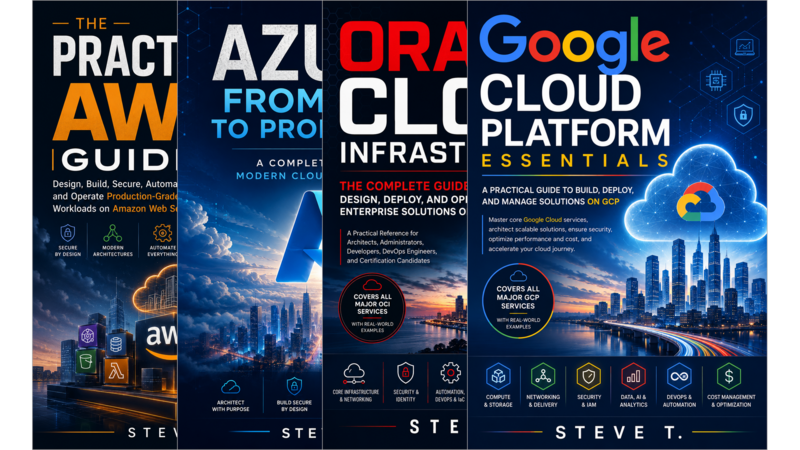
Google Cloud Platform Essentials

Building Resilient, Scalable, and Cost-Efficient Cloud Solutions on GCP

Google Cloud Platform Essentials is a practical, end-to-end guide for anyone looking to build expertise in Google Cloud. From core infrastructure services such as compute, storage, networking, and databases to advanced topics including Kubernetes, serverless architectures, security, AI/ML, monitoring, and cost optimization, this book provides clear explanations, hands-on examples, and proven best practices. Whether you are new to cloud computing, preparing for a GCP certification, or designing production-ready cloud solutions, it equips you with the skills needed to create resilient, scalable, and cost-efficient applications on Google Cloud Platform.

Minimum price

$19.00

$29.00

You pay

Author earns

$

Also available for 1 book credit with a Reader Membership

PDF
EPUB
About

About

About the Book

This is a comprehensive guide to Google Cloud Platform, designed for beginners learning their first cloud platform and IT professionals transitioning to the cloud. It covers every major GCP service category from compute and storage through networking, databases, security, Kubernetes, serverless, AI/ML, monitoring, and cost optimization. Each chapter includes practical examples, best practices, and real-world context drawn from current documentation and industry data. Whether you are preparing for a GCP certification exam or architecting your next cloud deployment, this book gives you the knowledge to build with confidence.

Share this book

Author

About the Author

Steve T. Team Publications

Steve T. is a cybersecurity professional and technology leader with more than 20 years of experience in application security, infrastructure security, vulnerability management, software development, and secure engineering practices. Having started his career during the early growth of the internet and modern web applications, he has worked through multiple generations of technology, security challenges, and software development methodologies.

Today, Steve is part of the advanced research organization at a leading cybersecurity company, where he focuses on emerging threats, security innovation, and the practical application of research to real-world environments. His work includes analyzing new attack techniques, evaluating emerging technologies, conducting deep technical investigations, and helping organizations better understand and manage complex security risks.

In addition to his research work, Steve leads a team of senior engineers and subject matter experts who develop technical books, training materials, and educational content for security professionals. Under his leadership, the team produces in-depth resources that help engineers, developers, architects, and security practitioners build stronger technical skills and improve security outcomes.

Steve's expertise spans software development, reverse engineering, web application security, penetration testing, security architecture reviews, incident response, vulnerability research, operating system internals, and secure software development. He has extensive experience analyzing complex systems at both the source code and binary levels, allowing him to bridge the gap between software engineering, security research, and real-world defensive practices.

Throughout his career, Steve has worked with organizations across a variety of industries, helping them identify, assess, and remediate security weaknesses in critical applications and infrastructure. He is known for combining deep technical expertise with a practical approach to problem solving, focusing on security solutions that are effective, sustainable, and aligned with business objectives.

Through research, engineering, technical leadership, and education, Steve continues to contribute to the advancement of cybersecurity and the development of secure, resilient technology systems.

Contents

Table of Contents

Google Cloud Platform Essentials

  1. Building Resilient, Scalable, and Cost-Efficient Cloud Solutions on GCP
  2. Table of Contents

Introduction: Why Google Cloud?

  1. The Cloud Computing Landscape in 2026
  2. Where GCP Fits: Market Position and Differentiators
  3. How to Use This Book

Chapter 1: Getting Started with Google Cloud

  1. Creating Your First Account and Project
  2. The gcloud CLI: Your Command-Line Workbench
  3. Billing, Free Tier, and Budgets
  4. Deployment Strategy: Regions, Zones, and Machine Types
  5. Hands-On: Your First Compute Engine VM

Chapter 2: Cloud Architecture Principles

  1. The Well-Architected Framework: Six Pillars
  2. Core Architectural Principles
  3. Design for Failure and Resilience
  4. Scalability and Elasticity Patterns
  5. Security by Design
  6. Sustainability as an Architectural Goal
  7. Review Questions

Chapter 3: Networking Fundamentals on GCP

  1. VPC Networks, Subnets, and IP Addressing
  2. Firewall Rules and Network Policies
  3. Cloud NAT and Outbound Connectivity
  4. HA VPN and Cloud Interconnect: Hybrid Connectivity
  5. Cloud Armor: DDoS Protection and Web Application Firewall
  6. Service Perimeters and Load Balancing
  7. Review Questions

Chapter 4: Compute Services

  1. Compute Engine: VMs and Instance Groups
  2. App Engine: Platform-as-a-Service
  3. Cloud Run: Serverless Containers
  4. Choosing the Right Compute Service
  5. Migration Patterns to GCP
  6. Review Questions

Chapter 5: Storage Solutions

  1. Cloud Storage: Buckets, Objects, and Storage Classes
  2. Persistent Disk: Standard, SSD, Balanced, and Extreme
  3. Filestore: Managed NFS for Shared Workloads
  4. Data Transfer and Migration Tools
  5. Review Questions

Chapter 6: Databases on Google Cloud

  1. Cloud SQL: MySQL, PostgreSQL, and SQL Server
  2. Cloud Spanner: Globally Distributed Relational Database
  3. Cloud Bigtable: Wide-Column for Analytics and IoT
  4. Firestore and Memorystore: NoSQL and Caching
  5. AlloyDB for PostgreSQL
  6. Choosing the Right Database
  7. Review Questions

Chapter 7: Security, Identity, and IAM

  1. Google’s Shared Responsibility Model
  2. IAM Roles, Policies, and the Resource Hierarchy
  3. Cloud KMS and Secret Manager
  4. Organization Policies and Access Context Manager
  5. Compliance and Certifications
  6. Review Questions

Chapter 8: DevOps and CI/CD on GCP

  1. Artifact Registry and Container Images
  2. Cloud Build: CI/CD Pipelines and Triggers
  3. Infrastructure as Code with Terraform
  4. Deployment Manager and GitOps Workflows
  5. Secure CI/CD: Attestation and Supply Chain Security
  6. Review Questions

Chapter 9: Kubernetes and Containers with GKE

  1. Google Kubernetes Engine Architecture
  2. Autopilot vs. Standard Clusters
  3. Node Pools, Autoscaling, and Compute Classes
  4. Workload Identity and Cluster Security
  5. Observability, Backups, and Upgrades
  6. Multi-Cluster Management with Fleets
  7. Review Questions

Chapter 10: Serverless Computing on GCP

  1. Cloud Functions 2nd Generation
  2. Eventarc: Event-Driven Architectures
  3. Cloud Run Services and Jobs
  4. Serverless vs. Containers vs. VMs: Making the Call
  5. Real-World Serverless Patterns
  6. Review Questions

Chapter 11: AI, Machine Learning, and Data Analytics

  1. Vertex AI: The Unified ML Platform
  2. AutoML for No-Code Model Building
  3. BigQuery ML and SQL-Based Machine Learning
  4. Pre-Trained APIs
  5. MLOps with Vertex AI Pipelines
  6. Review Questions

Chapter 12: Monitoring, Logging, and Observability

  1. Cloud Monitoring: Metrics, Dashboards, and Alerts
  2. Cloud Logging: Centralized Log Management
  3. Cloud Trace: Distributed Tracing
  4. SLOs, SLIs, and Error Budgets
  5. Managed Service for Prometheus and OpenTelemetry
  6. Review Questions

Chapter 13: Cost Optimization and FinOps

  1. Understanding GCP Pricing Models
  2. Committed Use Discounts and Savings Plans
  3. Spot VMs for Fault-Tolerant Workloads
  4. Rightsizing, Storage Tiering, and Budgets
  5. Real-World Cost Optimization Case Studies
  6. Review Questions

Chapter 14: Real-World Use Cases and Architecture Patterns

  1. E-Commerce Platform: Scalable and Resilient
  2. Healthcare Data Pipeline: HIPAA Compliance
  3. Media Streaming: Global Content Delivery
  4. IoT Data Ingestion: High-Throughput Analytics
  5. Disaster Recovery: Multi-Region Architectures
  6. Case Study Questions for Certification Preparation
  7. Review Questions

Conclusion: The Future of Google Cloud

  1. Where GCP Is Headed
  2. Skills, Certifications, and Career Development
  3. Building Your Cloud Journey
  4. Final Thoughts

References

Get the free sample chapters

Click the buttons to get the free sample in PDF or EPUB, or read the sample online here

The Leanpub 60 Day 100% Happiness Guarantee

Within 60 days of purchase you can get a 100% refund on any Leanpub purchase, in two clicks.

See full terms...

Earn $8 on a $10 Purchase, and $16 on a $20 Purchase

We pay 80% royalties on purchases of $7.99 or more, and 80% royalties minus a 50 cent flat fee on purchases between $0.99 and $7.98. You earn $8 on a $10 sale, and $16 on a $20 sale. So, if we sell 5000 non-refunded copies of your book for $20, you'll earn $80,000.

(Yes, some authors have already earned much more than that on Leanpub.)

In fact, authors have earned over $15 million writing, publishing and selling on Leanpub.

Learn more about writing on Leanpub

Free Updates. DRM Free.

If you buy a Leanpub book, you get free updates for as long as the author updates the book! Many authors use Leanpub to publish their books in-progress, while they are writing them. All readers get free updates, regardless of when they bought the book or how much they paid (including free).

Most Leanpub books are available in PDF (for computers) and EPUB (for phones, tablets and Kindle). The formats that a book includes are shown at the top right corner of this page.

Finally, Leanpub books don't have any DRM copy-protection nonsense, so you can easily read them on any supported device.

Learn more about Leanpub's ebook formats and where to read them

Write and Publish on Leanpub

You can use Leanpub to easily write, publish and sell in-progress and completed ebooks and online courses!

Leanpub is a powerful platform for serious authors, combining a simple, elegant writing and publishing workflow with a store focused on selling in-progress ebooks.

Leanpub is a magical typewriter for authors: just write in plain text, and to publish your ebook, just click a button. (Or, if you are producing your ebook your own way, you can even upload your own PDF and/or EPUB files and then publish with one click!) It really is that easy.

Learn more about writing on Leanpub