

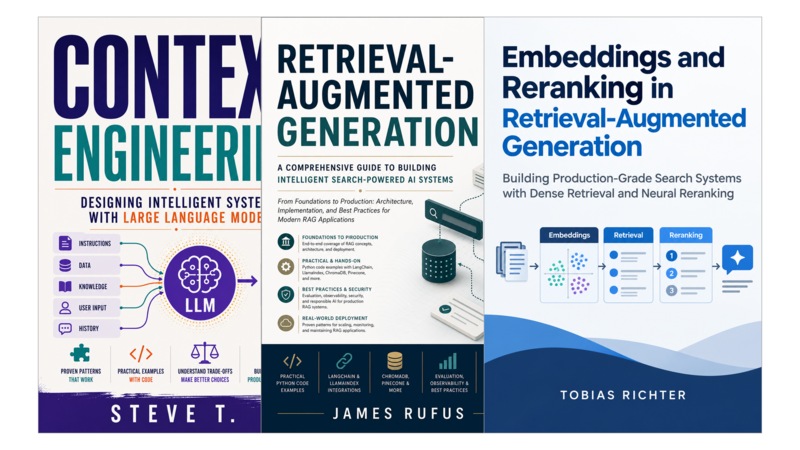

Building Production-Grade Search Systems with Dense Retrieval and Neural Reranking
Introduction: Why RAG Needs Better Retrieval
Chapter 1: The RAG Paradigm
- The Retrieval-Then-Generate Architecture
- Why Retrieval Quality Determines Output Quality
- The Complete RAG Data Flow
- RAG vs Finetuning vs Full Pretraining
- Common Pitfalls and Misconceptions
- What This Book Will Build
Chapter 2: Vector Representations and Similarity
- From Tokens to Vectors: The Basic Idea
- Embedding Spaces and Semantic Geometry
- Cosine Similarity, Dot Product and Euclidean Distance
- Normalization and Its Effects on Similarity
- High-Dimensional Geometry: What Goes Wrong at Large Dimensions
- Choosing a Similarity Metric for Your Use Case
Chapter 3: Embedding Model Architectures
- Transformer Encoders as Embedding Backbones
- Bi-Encoder vs Cross-Encoder Architectures
- Late-Interaction Models and ColBERT
- Training Objectives: Contrastive Learning, Triplets and Hard Negatives
- Mean-Pooling, CLS Tokens and Output Strategies
- Instruction-Aware and Prompt-Based Embeddings
Chapter 4: Dense Retrieval vs Sparse Retrieval
- TF-IDF and BM25: Sparse Retrieval Fundamentals
- How Dense Retrieval Works Under the Hood
- The Lexical vs Semantic Gap
- When Sparse Beats Dense (and Vice Versa)
- Hybrid Search: Combining Dense and Sparse Signals
- Reciprocal Rank Fusion and Other Fusion Strategies
Chapter 5: Document Preprocessing and Text Normalization
- Document Parsing: PDFs, HTML, Office Files and Code
- Text Cleaning and Normalization Strategies
- Handling Special Characters, Numbers and Dates
- Language Detection and Multilingual Preprocessing
- Metadata Extraction and Structuring
- Common Preprocessing Mistakes That Hurt Retrieval
Chapter 6: Context Chunking Strategies - Part I: Foundational Methods
- Why Chunking Is The Most Underappreciated RAG Decision
- Fixed-Size Chunking: The Baseline Everyone Starts With
- Sentence-Based and Paragraph-Based Chunking
- Sliding-Window Chunking and Overlap Strategies
- Recursive Character Text Splitting
- Choosing Chunk Size and Overlap: Evidence-Based Guidance
Chapter 7: Context Chunking Strategies - Part II: Advanced Methods
- Semantic Chunking: Cluster-Based and Boundary Detection Methods
- Hierarchical Chunking and Parent-Document Retrieval
- Structure-Aware Chunking for Markdown, HTML and Code
- Query-Aware and Dynamic Chunking
- Long-Context Chunking for Large Language Models
- Evaluating Chunking Quality: Metrics and Methods
Chapter 8: Vector Indexing and Approximate Nearest Neighbor Search
- Exact Nearest Neighbor vs Approximate Nearest Neighbor
- HNSW: The Workhorse of Modern Vector Search
- IVF, Product Quantization and Other Indexing Strategies
- Index Build Time vs Query Latency Trade-Offs
- Choosing m, ef_construction, ef_search: Practical Tuning
- Vector Database Selection: Pinecone, Weaviate, Qdrant, Milvus and More
Chapter 9: Building the Ingestion Pipeline
- Pipeline Architecture: Batch vs Streaming vs Hybrid
- Document Loading and Format Handling
- Chunking, Embedding and Indexing as Distinct Stages
- Error Handling and Dead Letter Queues
- Incremental Updates and Document Versioning
- Scalable Ingestion Patterns for Large Corpora
Chapter 10: Query Processing and Expansion
- Understanding the Query: Intent, Ambiguity and Reformulation
- Query Embedding with the Same or Different Models
- Query Expansion: HyDE, StepBack and Similar Techniques
- Multi-Query Retrieval and Ensemble Queries
- Query Classification and Routing
- Handling Multi-Turn Conversational Queries
Chapter 11: Candidate Retrieval Strategies
- Single-Stage Dense Retrieval
- Hybrid Retrieval: Dense Plus Sparse Combined
- Multi-Vector Retrieval and ColBERT-Style Approaches
- Metadata Filtering and Faceted Search
- Semantic Search with Numerical and Temporal Filters
- Controlling Recall: How Many Candidates to Retrieve
Chapter 12: Reranking Models: Theory and Architectures
- Why Reranking Improves Retrieval Quality
- Cross-Encoder Reranking: Architecture and Mechanics
- Bi-Encoder vs Cross-Encoder vs Late-Interaction for Reranking
- Training Rerankers: Pairwise, Listwise and Pointwise Methods
- Domain Adaptation and Fine-Tuning Rerankers
- Latency vs Accuracy: When Is Reranking Worth It
Chapter 13: Reranking Model Implementations
- Using Off-the-Shelf Rerankers (BGE, Cohere, Jina, E5)
- Batch vs Streaming Reranking Architectures
- Prompt-Based Reranking and LLM Reranking
- Adaptive and Conditional Reranking
- Cascaded and Multi-Stage Reranking Pipelines
- Cost Optimization for Reranking at Scale
Chapter 14: Context Assembly and Prompt Construction
- Selecting Which Chunks to Include
- Ordering Chunks: Recency, Relevance and Narrative Flow
- Context Window Budgeting and Truncation Strategies
- Adding Source Attribution and Chunk Metadata
- Dynamic Context Selection Based on Query Complexity
- Prompt Templates That Make Retrieved Context Work
Chapter 15: End-to-End RAG System Design
- The Complete RAG Architecture: All Components Together
- Service Boundaries and API Design
- Synchronous vs Asynchronous Request Flow
- Caching Strategies for Embeddings and Retrieval Results
- Rate Limiting and Backpressure Handling
- Multi-Tenant and Multi-Index Architectures
Chapter 16: Evaluating Embedding and Reranking Models
- Retrieval Metrics: Recall@K, Precision@K, MRR, MAP, NDCG
- Building Evaluation Datasets: Queries and Ground Truth
- Model Selection Through Systematic Benchmarking
- Evaluating Without Ground Truth: Heuristics and Proxies
- A/B Testing Retrieval Quality in Production
- Ablation Studies and Controlled Experiments
Chapter 17: Evaluating End-to-End RAG Performance
- Answer Correctness and Factual Accuracy
- Faithfulness and Groundedness: Did the Answer Use the Context?
- Context Utilization and Relevance Scores
- Latency, Throughput and Cost as Quality Metrics
- Automated Evaluation Frameworks (RAGAS, DeepEval, etc.)
- Human Evaluation Design and Execution
Chapter 18: Advanced Optimization Techniques
- Optimizing Embedding Dimensionality and Model Size
- Quantization and Compression for Embeddings
- GPU Acceleration and Batch Inference Patterns
- Distributed Vector Indexing and Shard Management
- Memory-Optimized Retrieval Architectures
- Throughput and Latency Optimization Checklist
Chapter 19: Debugging and Troubleshooting RAG Systems
- The RAG Debugging Playbook: Where to Start
- Diagnosing Bad Retrieval: Query, Index, or Model?
- Identifying Chunking Failures and Context Gaps
- Spotting Reranking Degradation and Cascading Errors
- Hallucination Diagnosis and Mitigation
- Logging, Tracing and Observability Patterns
Chapter 20: Production Deployment and Operations
- Infrastructure and Containerization
- Model Serving: Triton, vLLM and Custom Endpoints
- Monitoring: Metrics, Alerts and Dashboards
- Versioning Models, Embeddings and Chunking Logic
- Rollback Strategies and Canary Releases
- Disaster Recovery and Index Backups
Chapter 21: Security, Privacy and Access Control
- Access Control and Document-Level Permissions
- PII Detection and Redaction in RAG Pipelines
- Prompt Injection and Retrieval Poisoning Attacks
- Data Isolation in Multi-Tenant Systems
- Audit Logging and Compliance Requirements
- Securing Embeddings Against Reconstruction Attacks
Chapter 22: Case Studies and Industry Patterns
- Enterprise Knowledge Base Search
- Code Documentation and Code Search
- Customer Support and Helpdesk Automation
- Legal Document Retrieval and Case Research
- Medical and Scientific Literature Search
- E-Commerce Product Search and Recommendations
Chapter 23: Future Directions and Open Problems
- Long-Context Models and Their Impact on RAG
- Multimodal RAG: Images, Audio and Video in the Pipeline
- Self-Correcting RAG and Agentic Retrieval Patterns
- Learned Chunking and Neural Document Structure
- The Future of Reranking: Are Cross-Encoders Obsolete?
- Open Questions and Research Frontiers
Conclusion: Building RAG Systems That Work
- The Retrieval Stack in One Picture
- Decision Framework for Your RAG Architecture
- Common Anti-Patterns to Avoid
- How to Stay Current in a Fast-Moving Field
- Final Thoughts on Engineering Excellence in RAG
References
- Foundational Papers
- Chunking and Document Processing
- Query Processing and Expansion
- Embedding and Reranking Models
- Benchmarks and Evaluation
- Infrastructure and Optimization
- Security and Access Control
- Technical Articles and Guides