Beyond Context Graphs: Agentic Memory, Cognitive Processes, and Promise Graphs
Enterprise level agent in user pocket


AI engines are booming, and the more we work with agentic systems, the more we see that we need something to make them work at the enterprise level. We're quite active in exploring ideas around context graphs, decision traces, and supporting explainability—giving agents the ability to make more aware and company-aligned decisions.
But this makes sense not only for enterprises, but for users and individuals building personal agents as well. Unfortunately, we have zero-to-none inclination on how to actually build a context graph.
I'll try to explain how to build something like a context graph—but go beyond it. I deeply believe that to make this work, we need specific agentic memory and a set of cognitive processes that truly help agents use this memory and learn from experience and data.
That's why this is the Book: Beyond Context Graphs—with a focus on real-life enterprise tasks and how to make agents make better decisions and, let's say, hallucinate less.
Minimum price
$25.00
$44.88
You pay
Author earns
About
About the Book
If you're following my work, I have a couple of deep research pieces about agentic memory and the application of spacetime concepts. Right now, I'm also working on a book about agentic protocols. This particular book focuses on the question of better context for agents—following the ideas of context graphs and exploring how to actually build something beyond context graphs to manage decision traces.
The goal is to create an architecture for enterprise-level agents that follow rules, make their own decisions, and—most importantly—make explainable decisions. I'll also explore the ability for agents to learn and apply that learning based on past experience.
We'll talk extensively about concepts like agentic memory: why we need memory, how to build memory, and why memory is not just another RAG system. We'll cover how to apply decision traces, how they work, and why cognitive processes—just like memory structures—contribute to learning capabilities.
Beyond this, we'll explore promise theory and promise graphs as an extension of agentic action logs. This creates a rich trace from data signals to promises to actions, making the architecture multi-agent ready. We'll examine this in the scope of agent cooperation, where agents don't just act in isolation but coordinate through explicit promises and commitments.
My core assumption with this book is that we need to build sophisticated agentic memory that goes beyond context graphs, beyond knowledge graphs, and applies advanced topics like causality, temporal causality research, and a deep focus on time itself. This is extremely relevant to my memory book, but here the focus is specifically on agents—and how they work together.
Bundles
Bundles that include this book
- Pricing
$85.00
Minimum priceBought separately$164.88Suggested price$150
Agentic Memory
3 Books
- Pricing
$70.00
Minimum priceBought separately$154.88Suggested price$100
Author
About the Author

Hey I am Volodymyr
Seasoned Developer's Journey from COBOL to Web 3.0, SSI, Privacy First Edge AI, and Beyond
As a seasoned developer with over 20 years of experience, I have worked with various programming languages, including some that are considered "dead," such as COBOL and Smalltalk. However, my passion for innovation and embracing cutting-edge technology has led me to focus on the emerging fields of Web 5.0, Self-Sovereign Identity (SSI),AI Agents, Knowledge Graphs, Agentiic memory systems, and the architecture of a decentralized world that empowers data democratization.
A firm believer in the potential of agent systems and the concept of a "soft" internet, I am dedicated to exploring and promoting these transformative ideas. In addition to writing, I also enjoy sharing my knowledge and insights through videoblogging. Most of my Medium posts serve as supplementary content to the videos on my YouTube channel, which you can explore here: https://www.youtube.com/c/VolodymyrPavlyshyn.
Join me on this exciting journey as we delve into the future of technology and the possibilities it holds.
Contents
Table of Contents
About Book
About Author
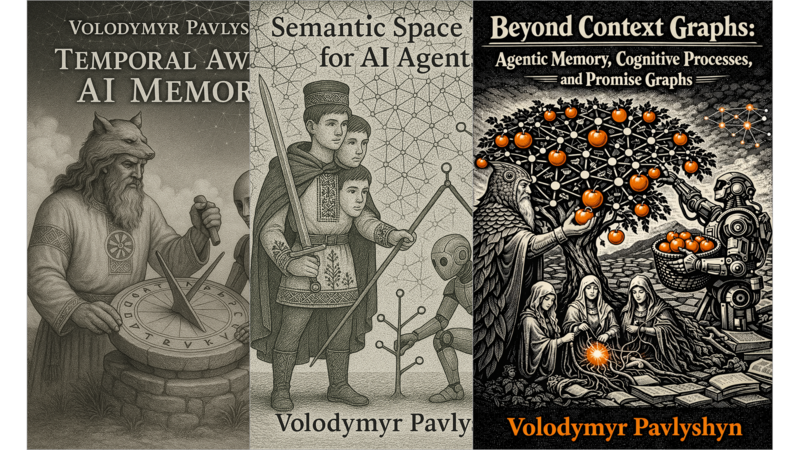
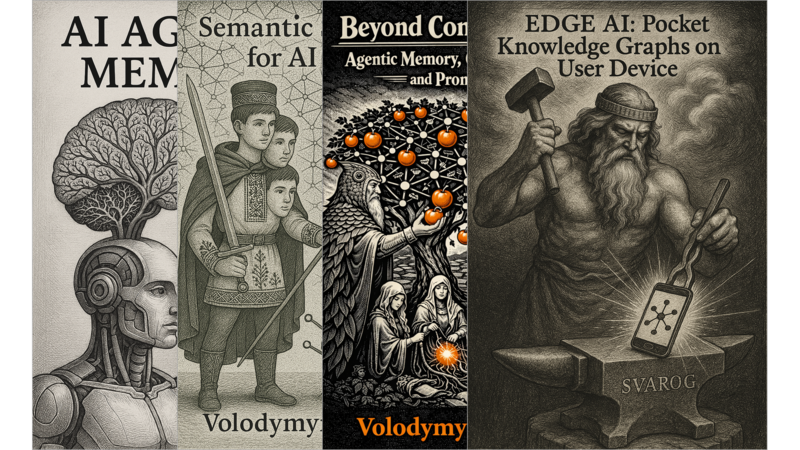
About Cover
Decision Traces and the Context Graph Thesis: The Roots
- The Core Argument: Rules Aren’t Enough
- Two Problems, Not One
- What Context Graphs Actually Are: Bi-Temporal Knowledge Graphs with PROV-O
- The Structural Advantage of Systems-of-Agents Startups
- The Three Startup Paths
- Mapping Context Graphs to Semantic Spacetime
- The Hard Problems Context Graphs Don’t Solve
- Decision Traces Are Not Causality
- Integration Architecture, Not Revolution
- Practical Implications for Builders
- Connecting to the Broader Vision
- Infrastructure Matters, But It’s Not Intelligence
Beyond Context Graphs: Agentic Memory, Causality, and Explainability
- The Missing Foundations
- Why Context Graphs Aren’t Enough
- The Causality Challenge
- The Explainability Imperative
- Memory Architecture: The Foundation
- Trust Through Transparency, Not Anthropomorphization
Context Graphs and Data Traces: Building Epistemology Layers for Agentic Memory
- Data Traces: The Low-Hanging Fruit
- Building an Epistemology Layer
- Revalidation and Learning
- Information Architecture Before Complex Analysis
- A Practical Path Forward
The Epistemology Paradox
- My Favorite Dialogue: The Circular Trap
- The Mathematical Proof: Zero Hallucinations Are Impossible
- Layer 1: The LLM-Knowledge Graph Circular Dependency
- Layer 2: Why Graphs Without Ontology Fail
- Layer 3: The Ontology-Epistemology Gap
- The Epistemology Crisis Since the Internet
- Layer 4: Epistemology Demands Verifiability
- The Verification Technology Stack
- The Limits of Verification
- Layer 5: The Trust Infrastructure Paradox
- The Integration Challenge: A Multi-Layered Approach
- Case Study: Air Canada’s Chatbot Hallucination
- The Brutal Statistics of RAG Failure
- What We Need: The Multi-Layered Solution
- The Honest Technology Stack
- What Genuine Progress Would Look Like
- Conclusion: Beyond the Marketing Mirage
Causal Graphs as the Missing Layer
- The Core Problem — Correlation Masquerading as Causation
- What Traditional Knowledge Graphs Get Wrong
- The Medical Reasoning Benchmark Reveals the Gap
- Why This Matters for Context Graphs
- Decision Traces Are Reified Causal Chains
- Reification: Making Reasoning Visible
- Connecting to W3C PROV Ontology
- The Epistemology Connection
- Semantic Spacetime as the Unifying Framework
- The Four Fundamental Relations Revisited
- Temporal Validity: When Does Causation Hold?
- Bringing It Together: The Four-Layer Architecture
- Implementation Architecture & Technical Patterns
- Causal Edge Scoring in Practice
- CoT-Aligned Retrieval Pattern
- Path Scoring with Semantic Spacetime Awareness
- Bi-Temporal Context Graph Schema
- The Hype vs. Substance Assessment
- What’s Genuinely New
- What’s Repackaged
- What’s Actually Hard
- Synthesis — A Unified Model
- Mapping the Three Frameworks
- The Complete Architecture
- Production Implementation Sketch
- Open Questions & Research Directions
- Automated Causal Weight Estimation
- CoT Stabilization for Deterministic Retrieval
- Ontology Alignment: Semantic Spacetime → Domain KGs
- Provenance Chain Compression
- Multi-Agent Causal Attribution
- Conclusion: The Path Forward
Beyond Context Graphs: Agentic Memory, Cognitive Processes, and Promise Graphs
- The Genesis and Limitations of Single-Graph Thinking
- Episodic Memory and the Foundations of Temporal Causality
- Cognitive Processes: The Missing Layer in Agent Architectures
- The Action Block and Extended Working Memory
- Promise Theory: A More Flexible Framework for Agent Behavior
- The Architecture of Signals, Promises, and Actions
- Multi-Layered Networks: Beyond Pure Graph Structures
- The Primacy of Cognitive Processing Over Storage
- The Question of Human-Like vs. Novel Memory Architectures
- Toward Genuine Agentic Learning
- Implementation Challenges and Future Directions
- Conclusion
AI Memory is Not RAG, RAG is Not Enough for AI Agents
- Introduction
- The Current State of RAG
- Why RAG is Not True Memory
- 1. Lack of Episodic Context
- 2. Limited Association Building
- 3. Retrieval Without Understanding
- 4. No Forgetting Mechanism
- Why RAG is Not Enough for Advanced AI Systems
- 1. Context Window Constraints
- 2. Retrieval Quality Bottlenecks
- 3. Static Knowledge Representation
- 4. Limited Self-Reflection
- What Makes Memory Truly Memory?
- 1. Multi-modal Memory Structures
- 2. Active Reconstruction
- 3. Associative Memory Networks
- 4. Adaptive Forgetting
- 5. Hierarchical Organization
- Promising Directions for AI Memory Systems
Rethinking Time: How Tensor Clocks and Metagraph Models Are Revolutionizing AI Memory
- The Clock That Doesn’t Tick
- The Timestamp Problem: Why Traditional Time Fails AI
- The Evolution of Time-Tracking: From Lamport to Tensors
- Lamport Clocks: The Foundation
- Vector Clocks: Adding Dimensions
- Tensor Clocks: The Multi-Dimensional Leap
- Metagraph Models: Memory as a Living Network
- Beyond Simple Graphs
- The Power of Semantic Time
- Practical Implementation: Building the System
- Event Ingestion and Tensor Coordinate Assignment
- Graph Construction and Edge Formation
- Query and Retrieval
- Real-World Applications and Benefits
- Personal AI Assistants
- Healthcare and Wellness
- Business Intelligence and Team Memory
- Therapeutic and Mental Health Applications
- The Challenges Ahead
- Computational Complexity
- Looking Forward: The Future of AI Memory
Memory Design
- The Time Tree - Modeling Temporal Ambiguity
- The Problem with Precise Timestamps
- The Ontology of Memory — Building a Semantic Foundation
- Layered Visibility: Controlling Complexity
- Relations
Cognitive Processes and Reasoning
- The Foundation: Intent, Promise, Obligation, and Command
- The Distributed Nature of Autonomy
- Self-Assessment: The Core of Autonomous Promise-Making
- Agent-Centric Assessment and Decision Authority
- Voluntary Cooperation as a Foundation
- Individual Responsibility and Behavioral Boundaries
- Super-Agents and Collective Intelligence
- Implications for AI System Design
Promises and Causality
Temporal Causality
From Promises to Action to Decisions
notes on expandability
The Leanpub 60 Day 100% Happiness Guarantee
Within 60 days of purchase you can get a 100% refund on any Leanpub purchase, in two clicks.
See full terms...
Earn $8 on a $10 Purchase, and $16 on a $20 Purchase
We pay 80% royalties on purchases of $7.99 or more, and 80% royalties minus a 50 cent flat fee on purchases between $0.99 and $7.98. You earn $8 on a $10 sale, and $16 on a $20 sale. So, if we sell 5000 non-refunded copies of your book for $20, you'll earn $80,000.
(Yes, some authors have already earned much more than that on Leanpub.)
Learn more about writing on Leanpub
Free Updates. DRM Free.
If you buy a Leanpub book, you get free updates for as long as the author updates the book! Many authors use Leanpub to publish their books in-progress, while they are writing them. All readers get free updates, regardless of when they bought the book or how much they paid (including free).
Most Leanpub books are available in PDF (for computers) and EPUB (for phones, tablets and Kindle). The formats that a book includes are shown at the top right corner of this page.
Finally, Leanpub books don't have any DRM copy-protection nonsense, so you can easily read them on any supported device.
Learn more about Leanpub's ebook formats and where to read them
Write and Publish on Leanpub
You can use Leanpub to easily write, publish and sell in-progress and completed ebooks and online courses!
Leanpub is a powerful platform for serious authors, combining a simple, elegant writing and publishing workflow with a store focused on selling in-progress ebooks.
Leanpub is a magical typewriter for authors: just write in plain text, and to publish your ebook, just click a button. (Or, if you are producing your ebook your own way, you can even upload your own PDF and/or EPUB files and then publish with one click!) It really is that easy.