

The Leanpub 60 Day 100% Happiness Guarantee
Within 60 days of purchase you can get a 100% refund on any Leanpub purchase, in two clicks.
See full terms...
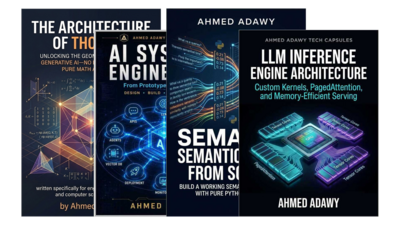
Stop building fragile AI toys. Master the complete engineering stack for production-grade LLMs, vector search, high-performance inference, and autonomous AI agents.
LLM Engineering, AI Architecture, Agentic AI, Semantic Search, Vector Databases, AI Infrastructure, Python Performance, Machine Learning Systems, DevOps for AI, RAG Pipelines
Bought separately
$85.97
With Coupon
$12.15
About the Bundle
LLM Foundations, Semantic Search & AI Systems Engineering Bundle
Moving from AI concepts and prototypes toward production systems requires more than understanding individual models. It calls for a broader view of mathematical foundations, retrieval, and system design.
This bundle brings together four books exploring these connected areas, from the mathematics of large language models and generative AI to semantic search and AI systems engineering.
What’s Included?
- The Architecture of Thought: Applied Mathematics in Large Language Models & GenAI Explore the mathematical foundations behind large language models and generative AI.
- Semantic Search from Scratch Explore the principles and implementation of semantic search through a from-scratch approach.
- AI Systems Engineering Develop a broader understanding of the engineering considerations involved in building AI systems.
- AI Systems Engineering: From Prototype to Production Examine the transition from experimental prototypes to production-oriented AI systems.
Who Is This Bundle For?
- Software and backend developers expanding into AI engineering.
- AI practitioners interested in the connections between mathematical foundations, retrieval, and system design.
- Engineers looking to move beyond isolated prototypes toward a more structured approach to building AI applications.
Bring these complementary perspectives together as you develop your approach to designing and building AI systems.
About the Books

The generative AI boom has created millions of "API consumers"—developers who can plug in a pre-built model but remain completely blind to how these systems actually compute language. If you want to move beyond being a mere consumer and become a true AI innovator, you must dismantle the black box.
"The Architecture of Thought" is your ultimate geometric guide to the underlying linear algebra, matrix calculus, information theory, and training dynamics that power modern Large Language Models (LLMs) like GPT and Claude.
Written specifically for engineers, data scientists, and computer science students, this book completely skips the high-level hand-waving and takes you on a deep mathematical dive. But you won't just read about equations—you will build them. Every single chapter concludes with a practical, robust implementation using pure Python and NumPy from scratch. No PyTorch, no Hugging Face, no hidden libraries.
What You Will Master Inside:The Heart of GenAI: Master the exact calculus behind the Dot-Product Attention mechanism and understand how Query (Q), Key (K), and Value (V) matrices calculate dynamic contextual alignment.
The Transformer Machine: Assemble a full Transformer Encoder Block step-by-step, implementing custom Layer Normalization, Residual Connections, and Softmax functions.
Training Dynamics & Scaling Laws: Demystify Cross-Entropy loss, System Perplexity, Byte-Pair Encoding (BPE), and the empirical Chinchilla Scaling Laws that dictate compute vs. data size budgets.
The Generative Frontier: Discover how Causal Masking mathematically blinds a matrix to the future, allowing the network to perform true autoregressive text generation.
Who This Book Is For:Stop calling APIs. Start building architectures. Grab your copy today and master the geometry of thought!

Master the Transition from AI Prototypes to Production-Grade Systems
Moving artificial intelligence and generative models from experimental Jupyter notebooks to scalable, reliable production environments requires robust systems engineering. This book is a practical, hands-on guide for software engineers, machine learning practitioners, and technical architects building end-to-end AI infrastructure.
What You Will Learn:
• Foundations & Architecture: Deep dive into LLM architectures, Generative AI mechanisms, and core Machine Learning principles.
• Performance Optimization: Eliminate computational bottlenecks, optimize pure Python execution, and leverage high-performance vectorized operations.
• Production Deployment: Build secure, scalable containerized microservices and backend architectures for AI workloads.
• Real-World Implementation: Construct robust AI pipelines using modern Python frameworks and production best practices.
Whether you are an engineer looking to scale your AI prototypes or an architect designing enterprise systems, this book bridges the gap between machine learning concepts and production-grade deployment.

Modern AI systems retrieve information by meaning rather than exact keyword matches. Under the hood, this capability relies on a surprisingly simple foundation: representing text as vectors, measuring similarity, and ranking results.
In Semantic Search from Scratch, you will build this core mechanism yourself from first principles using only Python and NumPy.
We deliberately avoid third-party vector databases, machine-learning frameworks, and high-level retrieval libraries. The goal isn't to build a production platform, but to demystify the mathematical mechanics behind semantic retrieval, vector spaces, and Retrieval-Augmented Generation (RAG).
What You Will Learn & Build:
Who Is This Capsule For?
This guide is designed for intermediate Python developers, AI engineers, and curiosity-driven builders who want to peel back the layers of high-level AI libraries and truly understand how semantic search works under the hood.

Running an LLM is one problem. Understanding its memory footprint, execution phases, and serving behavior is another.
LLM Inference Engine Architecture explores the engineering behind language-model inference—from prefill and decode to KV-cache management, attention kernels, quantization, and request scheduling.
Written for software engineers and ML engineers with a working knowledge of Python and transformer fundamentals, the book connects mathematical explanations with implementation examples and serving-system design considerations.
The book includes numerical examples, reference code, and an educational asynchronous serving simulator. These examples are intended to explain mechanisms and trade-offs—not to replace hardware-specific profiling or production validation.
Read the sample to review the mathematical level, coding style, and scope before purchasing.
Within 60 days of purchase you can get a 100% refund on any Leanpub purchase, in two clicks.
See full terms...
We pay 80% royalties on purchases of $7.99 or more, and 80% royalties minus a 50 cent flat fee on purchases between $0.99 and $7.98. You earn $8 on a $10 sale, and $16 on a $20 sale. So, if we sell 5000 non-refunded copies of your book for $20, you'll earn $80,000.
(Yes, some authors have already earned much more than that on Leanpub.)
Learn more about writing on Leanpub
If you buy a Leanpub book, you get free updates for as long as the author updates the book! Many authors use Leanpub to publish their books in-progress, while they are writing them. All readers get free updates, regardless of when they bought the book or how much they paid (including free).
Most Leanpub books are available in PDF (for computers) and EPUB (for phones, tablets and Kindle). The formats that a book includes are shown at the top right corner of this page.
Finally, Leanpub books don't have any DRM copy-protection nonsense, so you can easily read them on any supported device.
Learn more about Leanpub's ebook formats and where to read them
You can use Leanpub to easily write, publish and sell in-progress and completed ebooks and online courses!
Leanpub is a powerful platform for serious authors, combining a simple, elegant writing and publishing workflow with a store focused on selling in-progress ebooks.
Leanpub is a magical typewriter for authors: just write in plain text, and to publish your ebook, just click a button. (Or, if you are producing your ebook your own way, you can even upload your own PDF and/or EPUB files and then publish with one click!) It really is that easy.