
The Leanpub 60 Day 100% Happiness Guarantee
Within 60 days of purchase you can get a 100% refund on any Leanpub purchase, in two clicks.
See full terms...
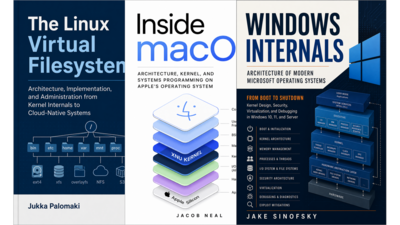
Go beyond the user interface and explore the inner workings of Linux, macOS, and Windows. This three-book collection delivers a deep, cross-platform understanding of modern operating system architecture, kernels, filesystems, security, virtualization, and systems programming.
Bought separately
$87.00
Minimum price
$45.00
$59.00
About the Bundle
Modern computing is built upon three dominant operating system families: Linux, macOS, and Windows. While millions of developers and administrators use these systems every day, only a small fraction truly understand the sophisticated kernel architectures, memory managers, security models, storage subsystems, and I/O frameworks that power them. This comprehensive three-book bundle is designed to bridge that gap.
Together, these volumes provide an in-depth exploration of the internal design and implementation of today's most important operating systems. Rather than focusing solely on user-space programming or administration, the collection examines the operating systems themselves—how they boot, manage resources, enforce security, communicate with hardware, and provide the abstractions upon which modern software is built.
The collection includes:
Although each volume can be studied independently, together they provide a unique cross-platform perspective on operating system design. Readers gain not only a deep understanding of each platform's architecture but also an appreciation of the engineering trade-offs that distinguish Linux, macOS, and Windows. Throughout the collection, architectural comparisons highlight how different operating systems solve similar problems in process management, memory allocation, storage, security, virtualization, and system performance.
Written for software engineers, kernel developers, systems programmers, security researchers, reverse engineers, digital forensics practitioners, DevOps engineers, and advanced computer science students, these books combine theoretical foundations with practical implementation details. Kernel data structures, annotated source code, debugging sessions, architectural diagrams, and real-world case studies provide the level of depth expected from graduate-level textbooks and professional reference works.
Whether your goal is to develop kernel modules, build high-performance systems software, investigate security vulnerabilities, understand modern storage architectures, reverse engineer operating system behavior, or simply master the internals of contemporary operating systems, this collection offers a comprehensive reference that spans the three most influential operating system ecosystems in modern computing.
About the Books

The Linux Virtual Filesystem (VFS) is one of the most elegant abstractions in operating system design: a universal interface that allows dozens of disparate storage technologies to coexist under a single coherent API. This book takes you from foundational concepts through kernel internals to advanced topics like containerization, cloud-native storage, and modern async I/O. Whether you are a system administrator troubleshooting production filesystem issues, a developer building on FUSE or overlayfs, or a kernel engineer contributing to the VFS subsystem, this book provides the deep understanding needed to work with Linux filesystems at every level. The technical baseline assumes familiarity with the Linux 6.x kernel series.

macOS is one of the most widely used operating systems in the world, yet its internals remain opaque to all but a small community of engineers, security researchers, and reverse engineers. This book provides a comprehensive, technically rigorous exploration of modern macOS internals -- from the XNU kernel through Mach IPC, BSD processes, APFS storage, Apple Silicon architecture, and the layered security mechanisms that protect the system. Whether you are a systems programmer writing low-level code, a security researcher investigating vulnerabilities, or an operating systems student seeking to understand how a real-world hybrid kernel works, this book gives you the deep technical knowledge to navigate macOS's complex architecture with confidence.

Modern Windows is the most widely deployed desktop operating system in the world, yet its internals remain opaque to all but a small community of kernel developers, security researchers, and systems programmers. This book bridges that gap. It provides a comprehensive, technically rigorous treatment of the Windows NT kernel architecture from power-on through shutdown, covering the boot process, kernel initialization, memory management, process and thread scheduling, I/O subsystem, file systems, security architecture, virtualization technologies, debugging tools, and modern exploit mitigations. Every chapter includes annotated code snippets, data structure layouts, WinDbg debugging sessions, practical experiments, and comparisons with Linux where illuminating. This book is intended as a graduate-level textbook and professional reference for operating system developers, systems programmers, security researchers, reverse engineers, malware analysts, digital forensics practitioners, and advanced computer science students.
Within 60 days of purchase you can get a 100% refund on any Leanpub purchase, in two clicks.
See full terms...
We pay 80% royalties on purchases of $7.99 or more, and 80% royalties minus a 50 cent flat fee on purchases between $0.99 and $7.98. You earn $8 on a $10 sale, and $16 on a $20 sale. So, if we sell 5000 non-refunded copies of your book for $20, you'll earn $80,000.
(Yes, some authors have already earned much more than that on Leanpub.)
Learn more about writing on Leanpub
If you buy a Leanpub book, you get free updates for as long as the author updates the book! Many authors use Leanpub to publish their books in-progress, while they are writing them. All readers get free updates, regardless of when they bought the book or how much they paid (including free).
Most Leanpub books are available in PDF (for computers) and EPUB (for phones, tablets and Kindle). The formats that a book includes are shown at the top right corner of this page.
Finally, Leanpub books don't have any DRM copy-protection nonsense, so you can easily read them on any supported device.
Learn more about Leanpub's ebook formats and where to read them
You can use Leanpub to easily write, publish and sell in-progress and completed ebooks and online courses!
Leanpub is a powerful platform for serious authors, combining a simple, elegant writing and publishing workflow with a store focused on selling in-progress ebooks.
Leanpub is a magical typewriter for authors: just write in plain text, and to publish your ebook, just click a button. (Or, if you are producing your ebook your own way, you can even upload your own PDF and/or EPUB files and then publish with one click!) It really is that easy.