

The Leanpub 60 Day 100% Happiness Guarantee
Within 60 days of purchase you can get a 100% refund on any Leanpub purchase, in two clicks.
See full terms...
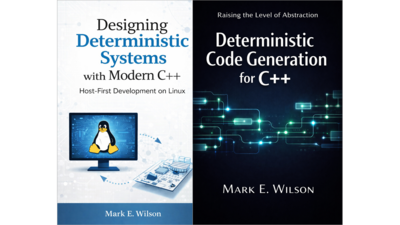
From architecture to implementation, determinism reduces complexity.
Learn how to design predictable systems and preserve architectural intent through abstraction and deterministic code generation.
Bought separately
$59.98
Minimum price
$39.00
$49.00
About the Bundle
Modern embedded and software systems become difficult to maintain when architecture, implementation, and system behavior drift apart. This collection presents a practical approach to building systems that remain predictable, understandable, and resilient to change.
Designing Deterministic Systems with Modern C++ introduces host-first development, deterministic design principles, event-driven architectures, testing strategies, and techniques for building reliable embedded software.
Raising the Level of Abstraction explores how architecture can be preserved through deterministic code generation, allowing systems to evolve while maintaining consistency and reducing accidental complexity.
Together, these books provide a cohesive methodology for designing, implementing, and evolving complex software systems.
About the Books

Designing Deterministic Systems with Modern C++ is about building software systems you can reason about. Rather than treating Linux as something to “port to” late in development, this book uses a standard Linux host as a first-class environment for designing, validating, and stress-testing deterministic behavior before hardware exists. Using modern C++ and disciplined system architecture, it focuses on bounded execution, explicit ownership, analyzable data flow, and long-term maintainability—problems that dominate real embedded systems but are rarely addressed directly.
Instead of treating the host machine as an afterthought, this book embraces it as the most powerful tool you have. You’ll learn how to build a pseudo-realtime development environment using techniques like CPU isolation, memory locking, scheduling policies, and high-resolution timers. These tools allow you to prototype and validate embedded-style systems long before hardware arrives.
Throughout the book, we build a complete working example:
The Weather Reporter Device — a small “IoT-style” embedded system that ingests multiple sensor inputs, processes them through deterministic pipelines, and outputs standardized weather reports in multiple formats (NMEA, JSON, and compact binary).
Along the way, you’ll learn modern, production-strength C++ techniques, including:
This book emphasizes clarity over cleverness, determinism over abstraction, and testability over hacks. Every chapter is structured around real code, real constraints, and real engineering trade-offs.
Whether you're a professional firmware engineer, a modern C++ developer exploring embedded systems, or someone building small devices and simulators on Linux, this book will give you a concrete foundation and a clear path from idea to working system.

This book is about building software systems at the right level of abstraction.
I first wrote about this here.
In many codebases, the structure of the system is buried in implementation details—classes, methods, and glue code that obscure how data actually flows and how components interact.
Over time, this makes systems harder to understand, harder to change, and more fragile than they need to be.
Instead of starting with code, we describe the system using a simple, domain-focused model. That model defines the data, the flow of that data, and the components that transform it. From that description, we generate the implementation using explicit, deterministic rules.
The result is a system where:
This is not about generating code faster. It is about generating code correctly and consistently, in a way that preserves the structure of the system over time.
The techniques in this book use simple tools—YAML, Python, and Jinja2—but the goal is not the tools themselves. The goal is to move from programming at the level of syntax to designing at the level of systems.
This approach is especially relevant for embedded and systems software, where control, predictability, and long-term maintainability matter.
If you have worked on systems that became difficult to reason about as they grew, this book offers a different path.
Within 60 days of purchase you can get a 100% refund on any Leanpub purchase, in two clicks.
See full terms...
We pay 80% royalties on purchases of $7.99 or more, and 80% royalties minus a 50 cent flat fee on purchases between $0.99 and $7.98. You earn $8 on a $10 sale, and $16 on a $20 sale. So, if we sell 5000 non-refunded copies of your book for $20, you'll earn $80,000.
(Yes, some authors have already earned much more than that on Leanpub.)
Learn more about writing on Leanpub
If you buy a Leanpub book, you get free updates for as long as the author updates the book! Many authors use Leanpub to publish their books in-progress, while they are writing them. All readers get free updates, regardless of when they bought the book or how much they paid (including free).
Most Leanpub books are available in PDF (for computers) and EPUB (for phones, tablets and Kindle). The formats that a book includes are shown at the top right corner of this page.
Finally, Leanpub books don't have any DRM copy-protection nonsense, so you can easily read them on any supported device.
Learn more about Leanpub's ebook formats and where to read them
You can use Leanpub to easily write, publish and sell in-progress and completed ebooks and online courses!
Leanpub is a powerful platform for serious authors, combining a simple, elegant writing and publishing workflow with a store focused on selling in-progress ebooks.
Leanpub is a magical typewriter for authors: just write in plain text, and to publish your ebook, just click a button. (Or, if you are producing your ebook your own way, you can even upload your own PDF and/or EPUB files and then publish with one click!) It really is that easy.