


The Leanpub 60 Day 100% Happiness Guarantee
Within 60 days of purchase you can get a 100% refund on any Leanpub purchase, in two clicks.
See full terms...
Minimum price
$4.99
$4.99
About the Book
Before the bomb was a weapon, it was a mathematical certainty. This is the story of the man who saw the cascade coming.
In the early 1930s, the world was a place of predictable, Newtonian certainities. Then came Leo Szilard. A refugee of a collapsing Europe and a visionary of the subatomic realm, Szilard possessed a terrifying gift: the ability to see the invisible architecture of the universe. He saw that the atom was not a static sphere, but a volatile reservoir of energy—and that a single, uncharged particle, the neutron, could act as the trigger for a self-sustaining chain reaction that would change the course of human history forever.
THE LEO SZILARD CHRONICLES: The complete narrative biography is a monumental epic that traces the life of the man who architected the nuclear age. Moving from the feverish "Eureka" moments of the pre-war laboratories to the high-stakes tension of the Manhattan Project, and finally through the paranoid, claustrophobic corridors of the McCarthy era, this biography is as much a study of a mind as it is a sweeping history of the twentieth century.
Through a masterful use of the "micro-macro" parallel, this narrative treats the instability of the atomic nucleus and the instability of the geopolitical world as two sides of the same, terrifyingly unstable coin. As Szilard navigs the transition from the liberation of energy to the weaponization of the atom, the reader is drawn into a world where mathematical proofs carry the weight of existential dread, and where the pursuit of scientific truth becomes a struggle for moral survival.
A masterpiece of narrative non-fiction, this work is essential reading for those who seek to understand the origin story of the modern age. It is a story of brilliance, conscience, and the heavy, indelible legacy of the moment the world changed.
Bundles that include this book
About the Author
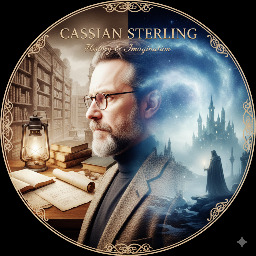
Cassian Sterling writes at the edge of history and imagination. With a career defined by meticulous investigation, he has earned a reputation for deconstructing the lives of the world’s most enigmatic minds, bridging the gap between technical complexity and human tragedy. His fascination with the "unseen"—whether it be the invisible laws of physics or the creeping dread of the classic horror tradition—informs every page of his work. Whether he is decoding declassified government files for a scientific biography or weaving tales of Gothic suspense, Sterling’s writing is marked by a commitment to atmosphere and intellectual rigor.
You can find all my books here.
Within 60 days of purchase you can get a 100% refund on any Leanpub purchase, in two clicks.
See full terms...
We pay 80% royalties on purchases of $7.99 or more, and 80% royalties minus a 50 cent flat fee on purchases between $0.99 and $7.98. You earn $8 on a $10 sale, and $16 on a $20 sale. So, if we sell 5000 non-refunded copies of your book for $20, you'll earn $80,000.
(Yes, some authors have already earned much more than that on Leanpub.)
Learn more about writing on Leanpub
If you buy a Leanpub book, you get free updates for as long as the author updates the book! Many authors use Leanpub to publish their books in-progress, while they are writing them. All readers get free updates, regardless of when they bought the book or how much they paid (including free).
Most Leanpub books are available in PDF (for computers) and EPUB (for phones, tablets and Kindle). The formats that a book includes are shown at the top right corner of this page.
Finally, Leanpub books don't have any DRM copy-protection nonsense, so you can easily read them on any supported device.
Learn more about Leanpub's ebook formats and where to read them
You can use Leanpub to easily write, publish and sell in-progress and completed ebooks and online courses!
Leanpub is a powerful platform for serious authors, combining a simple, elegant writing and publishing workflow with a store focused on selling in-progress ebooks.
Leanpub is a magical typewriter for authors: just write in plain text, and to publish your ebook, just click a button. (Or, if you are producing your ebook your own way, you can even upload your own PDF and/or EPUB files and then publish with one click!) It really is that easy.