Chapter 9 - Research & Leverage in the Technotope
9.1 - Identifying external experiences
9.2 - Open portfolios as external experiences
9.3 - Scope and variables in Programs
9.4 - Scope and variables in Projects
9.5 - Scope and variables in Iterations
9.6 - #CPIM02a in Case 1 - 2030 Agenda
9.7 - #CPIM02a in Case 2 - Library services
9.8 - #CPIM02a in Case 3 - The Petrol Station Case
9.9 - #CPIM02a in Case 4 - The Harbour Case
To Part I (Chapter 1 - 2 - 3 - 4) _ II (5 - 6 - 7) _ III (8 - 9 - 10 - 11 - 12 - (no 13)) _ IV (14 - 15) _ V (Annexes) _ VI (References)
Introduction
The activity black box and assumptions must be expressed. In most cases it is necessary to also list the decision options that will be evaluated (number of models and the techniques used to evaluate them). A decision tree is used to organize all the decision options and their order. If modeling or simulation is required, a modeling or simulation tool must be selected as well.
9.1 - Identifying external experiences for a work system
Given a problem formulation by means of a decision framework, and in reference to a results framework, the next step is to clarify the scope of the work system using a black box notation, and assumptions.
Black Box and Assumptions
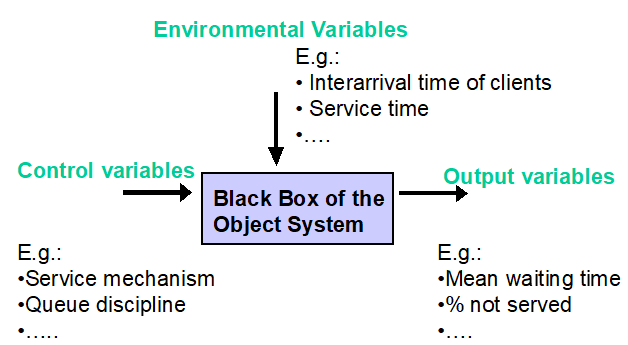
To simulate the system we need input variables. There are two types of input variables:
- Environmental variables: Variables we can’t modify and that are a result of the environment of the system.
- Control variables: Variables we can control or change.
Using these variables, the running simulation and the behaviour of the system can be analyzed considering the output variables.
In this step, the problem and objectives of the decision making engagement are formulated as concretely as possible. The desired reliability and accuracy of the decision making engagement results should also be defined here.
- Reliability is the confidence level at which the results should be displayed. Example: we would like to obtain the average throughput time with a confidence level of 95%.
- Accuracy is the number of decimals at which we would like to display the results. Example: for time measures, we need to know if results will be displayed in hours, minutes, seconds, etc.
These steps must be performed:
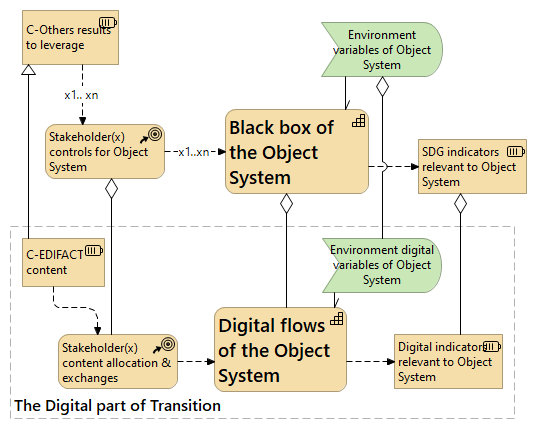
- Determine the environmental, control and output variables of a system in its black box representation (Figure 9.1).
- List and finalize the assumptions. Which components of the real system will be excluded, included as a black box, included in moderate detail, or included in fine details is decided at this step.
It is important to keep a formal list of assumptions throughout the study, starting at the design phase, since the scope of work and the micro level assumptions to be made in model building will depend on them. These assumptions should be kept in mind all through the process and included in the final report. A trap which many modellers may fall into is waiting until the end of the study to record their assumptions; by then, they may have forgotten many of them and wasted a lot of time in inadvertently changing the scope of work throughout the process.
Regulative Cycle extended with Reference Models
The research & leverage is focussed at improving a work system under consideration.
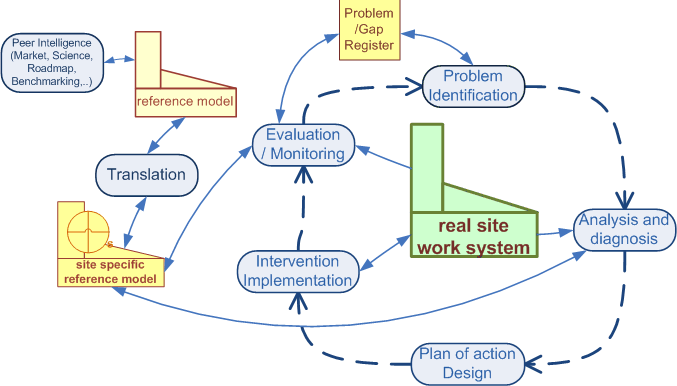
Where research should lead to problem-solving or practical interventions (Goossenaerts et al., 2007), there is often a need for the process of multi-methodology, that is, combining together several methods in an intervention (Mingers, 2003). Originating in psychological practice, the regulative cycle (Van Strien, 1997) has been extensively applied also as a methodology of practice, geared towards the “interested” regulation of the behaviour of groups or organizations in the desired direction. Where principals are engaged with the operations and improvement of a work system such as a plant, a hospital or a service system, the cycle includes the following activities:
- evaluation (of system operations with respect to an instrument or via benchmarking),
- problem identification (selection from a problem mess),
- diagnosis (of the problem situation – analysis),
- plan of action (design), and
- intervention (implementation).
This last step is again followed by evaluation to close the cycle.
In the evaluation activity it is convenient to have an instrument to compare the performance or structure of the work system. The reference fab methodology (Plieninger et al., 2001) uses a reference model for systematic target setting on high level performance indicators.
The model obtained from peer intelligence is translated into a site specific reference model with targets for the actual site work system. The translation considers factor costs, volumes and complexity of technologies.
Where open portfolios, programs and projects involve digital components, some form of concertation of the regulative cycles is recommended. Model-based analysis and development (Berre et al, 2004-2007) and the sharing model repositories can help reduce common project risks (Goossenaerts, 2004). Where a trend to many-to-many relationships is observed (Elgarah et al, 2005), lock-in strategies by software vendors, and free-rider attitudes and prisoner’s dilemma by OEM and their customers may delay achieving solution flexibility, perpetual service-IT alignment, as well as affordable development and implementation costs. A complicating factor in deciding on investments in the digitally enabled constellations is the imitable nature of the standards, architectures, contracts and services that must be deployed. In economic theory, the relevant game is the public good game, a multi-player variant of the prisoner’s dilemma (Fehr and Schmidt, 1999).
In an open portfolio, the purpose of this step is to identify external organizations and service providers that may have already met, or are currently facing needs similar to the ones identified in #CPIM01 - Identify and validate, and then to analyse their experiences and results to determine if they can be applied and leveraged or if a partnership can be formed to address the needs together.
In alignment with “Shared First” principle, it is at this point that the planners consult both internal and external service catalogues for pre-existing services that are relevant to the current needs. In some instances, an entire business model, policy, technology solution, or service may be reusable to address the needs defined in #CPIM01 - Identify and validate – an important benefit in these cost-constrained, quickly evolving times.
Based on this analysis, leadership and stakeholders determine whether or not they will be able to leverage the experiences and results from other organizations in their projects, programs or portfolios.
9.2 - Open Portfolios as external experiences
The 2030 Agenda for Sustainable Development - #SDGs
The 2030 Agenda decision framework and related performances are to serve as catalyst for sharing experiences and results among diverse partners.
In a sense they provide a decision framework.
Consider a current need, expressed as a gap with respect to a sustainable development goal or target for the system’s outcome.
When allocating the goals to sectors of industry and functions of government, and comparing performances of thoses sectors and functions in other countries or constellations with those of the problem owner, options for leveraging those experiences would often exist.
One way of describing the decision variables is via variations in the production and consumption of products and services, as classified in the Central Product Classification (CPC), and as produced and delivered by:
- the economic activities as classified in the International Standard Industrial Classification of All Economic Activities, Rev.4 and
- the functions of government as classified in the Classification of the Functions of Government (COFOG).
A myriad of problem statements can be created using this generic decision frame, and both government agencies and private sector players can launch portfolios, programs, projects and iterations to solve the problems.
Each interested party can activily work at one or a few problems, while ensuring that effort is wisely divided over a feasible range of programs, projects and iterations for a selection of economic activities and functions of government such that “landscape wide” progress can be guaranteed.
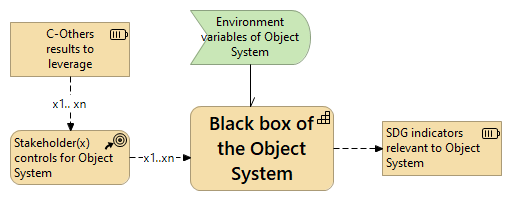
Figure 9.3 shows the black box of the 2030 Agenda.
The 2030 Agenda for sustainable development faces at least these three systemic challenges, for which the OECD has proposed Principles on Effective Public Investment across Levels of Government:
- Co-ordination across governments and policy areas
- 01 - Adopt an integrated, place-specific strategy
- 02 - Co-ordinate across sub-national and national levels
- 03 - Invest at the relevant scale
- The strengthening of capacities for public investment and the promotion of learning
- 04 - Understand impacts and risks
- 05 - Engage stakeholders at every step
- 06 - Include private actors and institutions
- 07 - Build expertise in local partners
- 08 - Focus on results, capture lessons from experience
- Ensure sound framework conditions at all levels of governments
- 09 - Develop a fiscal framework aligned with objectives
- 10 - Insist on sound, transparent financial management
- 11 - Promote strategic use of public procurement
- 12 - Strive for consistent, quality regulation
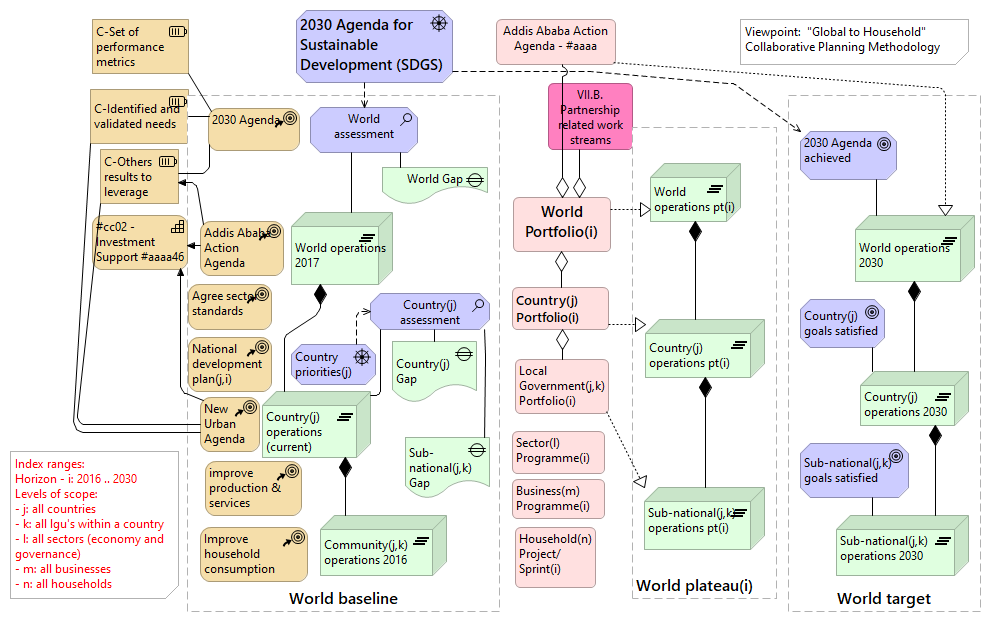
The key open portfolio problem is to convince all the interested parties in investing towards the objectives of the 2030 Agenda.
EDIFACT
To enhance and facilitate international trade UN/CEFACT addresses these topics:
- Code List Recommendations: Codified information is an integral part of data exchange in international business whether this is on paper documents or electronic data exchange. The United Nations Economic Commission for Europe (UNECE), through its UN Centre for Trade Facilitation and Electronic Business (UN/CEFACT) develops, maintains and publishes for free of charge a number of code lists used extensively in business transactions.
-
Standards ranging from general, supply chain management and transport and logistics to environment and covering sectors such as Agriculture, Travel and Tourism and Accounting and Audit. Key standards include:
- UN/LOCODE: The “United Nations Code for Trade and Transport Locations” is commonly more known as “UN/LOCODE”. Currently, UN/LOCODE includes over 103,034 locations in 249 countries and territories. UN/LOCODE is used by most major shipping companies, by freight forwarders and in the manufacturing industry around the world. It is also applied by national governments and in trade related activities, such as statistics where it is used by the European Union, by the UPU for certain postal services, etc.
- UN/EDIFACT: The United Nations rules for Electronic Data Interchange for Administration, Commerce and Transport (UN/EDIFACT) comprise a set of internationally agreed standards, directories, and guidelines for the electronic interchange of structured data, between independent computerized information systems.
- BSP-RDM: The objective of this Buy-Ship-Pay Reference Data Model (BSP-RDM) is to describe the requirements for a generic Reference Data Model (RDM), generalizing the concepts of the Multi-Modal Transport Reference Data Model (MMT-RDM) and the Supply Chain Reference Data Model (SCRDM), leading to the development,publishing and improving the maintenance of a Business Standard, which can be applied by country and regional administrations and industries.
9.3 - Scope and variables in programs
Limit to programs that are aware of open portfolio and intend to maximally re-use the resources provided (ref. Figure 9.3, 9.4 and 9.5):
- by including objectives and indicators in their decision frames;
- by adopting the standards in their analysis and solution design.
- ….
9.4 - Scope and Variables in Projects
9.5 - Scope and Variables in Iterations
9.6 - Scope and Variables in the 2030 Agenda
To the case overview - To the chapter
9.7 - Scope and Variables of Library Services
A library is a large collection of books, and can refer to the place in which the collection is housed. Today, the term can refer to any collection, including digital sources, resources, and services. The collections can be of print, audio, and visual materials in numerous formats, including maps, prints, documents, microform (microfilm/microfiche), CDs, cassettes, videotapes, DVDs, video games, e-books, audiobooks and many other electronic resources.
In the International Standard Industrial Classification of All Economic Activities, Rev.4 the activities of libraries are included in #isic9101 - Library and archives activities, and include:
- documentation and information activities of libraries of all kinds, reading, listening and viewing rooms, public archives providing service to the general public or to a special clientele, such as students, scientists, staff, members as well as operation of government archives:
- organization of a collection, whether specialized or not
- cataloguing collections
- lending and storage of books, maps, periodicals, films, records, tapes, works of art etc.
- retrieval activities in order to comply with information requests etc.
- stock photo libraries and services
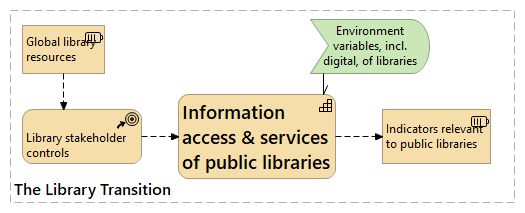
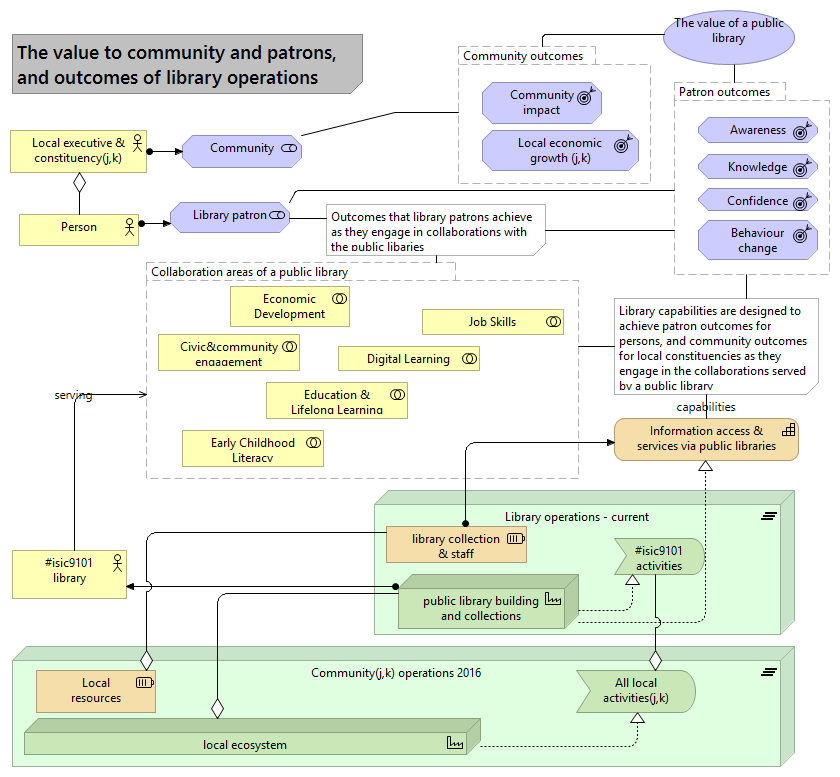
The work system pattern in Figure 9.7 illustrates the wide range of control and environmental variables and indicators that may be considered in the transition of public library services.
To the case overview - To the chapter
9.8 - Scope and Variables in the Petrol Station Case
In this case, we assume no external experiences can be relied upon. We follow the steps explained in chapter 9.1.
The Black Box Representation
The input variables are:
- Environmental variables:
- the interarrival time of cars
- the service time of cars
- Control variables:
- the queue length
- (the number of pumps)
The output variables are:
- the percentage of cars not served
- the mean waiting time

Assumptions and Givens
No data collection is required, as some information is given on the interarrival times and service times.
G1. the interarrival time of cars is expo(4)
G2. the service time of cars is uniform(1,6)
A1. the business operates 24 hours per day; 7 days per week
A2. no defects of the pumps occur
List of assumptions must be maintained as the study (and the Modeling) proceeds, that is why it is convenient to put it in an annex. In real world projects, all assumptions must be approved by the problem owner.
Is Modeling needed?
System:
- Single class system
- No admission control
- One queue (FIFO)
- One server
- in A/B/M/K/N notation: M/G/1/3 system
Are there results available for the M/G/1/3 system? NO!
Can we make any approximation?
Yes: M/M/1/3 system
The Number of Models
There are two models that must be evaluated for the problem owner:
- the current model with queue length 3 (M/G/1/3; by Modeling)
- the situation with longer queue length, e.g. 4, 5 or 6 (M/G/1/4; by Modeling)
In addition, for validating the simulation model, an approximate model will be evaluated by queuing theory, and its results will be compared to a simulation experiment with the same properties.
- the approximate model with queue length 3, and exponentional service times (M/M/1/3; by queuing theory)
- the approximate model with queue length 3, and exponentional service times (M/M/1/3; by Modeling)
To the case overview - To the chapter
9.9 - Scope and Variables in the Harbour Case
In this case, we assume no external experiences can be relied upon. We follow the steps explained in chapter 9.1.
The Black Box Representation
From the objective it is clear that the mean throughput time has to be determined. This is the output variable, which has to be delivered by the observer. In order to deliver this output variable the observer has to record some items within the simulated system.
At the same time attention must be paid to the output variable from the real system: “departing ships”. There are two control variables, namely the dock allocation strategy and the queue discipline. The environmental variables are the interarrival time, service time and the size of the ship.

The input variables are:
- Environmental variables:
- the interarrival time of ships
- the service time of docks for ships
- Control variables:
- the queue discipline
- dock allocation strategy
The output variables are:
- the mean throughput time
Assumptions and Givens
No data collection is required, as some information is given on the interarrival times and service times.
G1 …Gn: …
A1. both docks operate 24 hours per day; 7 days per week A2. no maintenance of the docks is required.
List of assumptions must be maintained as the study (and the Modeling) proceeds, that is why it is convenient to put it in an annex.
Is Modeling needed?
Yes, because changing queues cannot be addressed in analytic models.
For validation purposes, and for determining the number of models, lets simplify as follows:
- dock1 closed to Big ships and dock2 closed to Small ships
- Use simply a FIFO rule instead of the SPT rule?
Then we obtain two separate queuing systems at dock 1 and dock 2 that behave like M/G/1 systems:
- Dock 1, with Intearrival times expo(5.5) and Service time time Uniform(3,7)
- Dock 2, with Intearrival times expo(6.7) and Service time Uniform(2,8)
The Number of Models
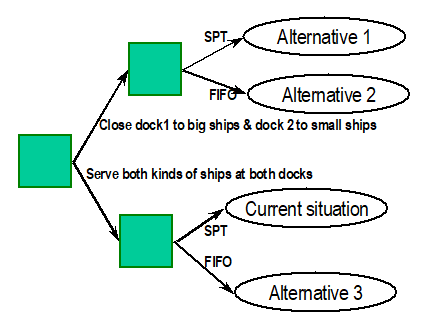
For the problem owner four models must be evaluated:
- the current situation with both kinds of ships served at both docks and SPT;
- Alternative 1: where ships must be served in the specialized dock, with SPT;
- Alternative 2: where ships must be served in the specialized dock, with FIFO;
- Alternative 3: with both kinds of ships served at both docks and FIFO as queue discipline.
For three of these models (current, Alternative 1 and 3) Modeling is required.
In addition, for validating the simulation model, Alternative 3 will be evaluated by queuing theory, and its results can be compared to a simulation experiment with the same properties.
To the case overview - To the chapter