Chapter 5 - An Asset-Aware Collaborative Planning and Investment Methodology
5.1 - A Collaborative Planning and Investment Methodology
5.2 - Re-use of Knowledge Assets in Communication
5.3 - Re-use of Knowledge Assets in a Decision Support Study
5.4 - Capabilities for CPIM
5.5 - Principles that are Realized by the CPIM Capabilities
5.6 - Including Investment Decision Making in CPIM
5.7 - Implications for CPIM of General Requirements and Constraints
To Part I (Chapter 1 - 2 - 3 - 4) _ II (5 - 6 - 7) _ III (8 - 9 - 10 - 11 - 12 - (no 13)) _ IV (14 - 15) _ V (Annexes) _ VI (References)
5.1 - A Collaborative Planning and Investment Methodology
- The phases of CPIM
- Levels of Scope
- Portfolio, Program, Project and Iteration
- Portfolio Management
- Program Management
- Project Management
- Agile Management
The Phases of CPIM
The Collaborative Planning Methodology (CPM) defined in the Common Approach to the US Federal Enterprise Architecture offers a simple, repeatable process that consists of integrated, multi-disciplinary analysis and results in recommendations formed in collaboration with leaders, stakeholders, planners, and implementers.
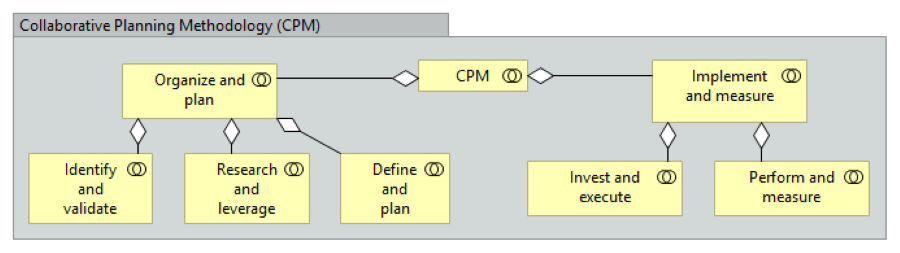
The first release of the CPM includes the master steps and detailed guidance for planners to use throughout the planning process. Enterprise architecture is but one planning discipline included in this methodology. In this e-book some methods and approaches of other planning disciplines are being interwoven into this common methodology.
CPIM01 - Identify and Validate
The purpose of this step is to identify and assess what needs to be achieved in a portfolio, program, project or iteration, understand the major drivers for change, and then define, validate, and prioritize the operational realities of the mission and goals with leadership, stakeholders, and operational staff.
During this step, the leadership, stakeholder, and customer needs and the operational requirements are validated so that ultimately, all interested parties are working towards the same, well understood, validated outcome.
CPIM02 - Research and Leverage
The purpose of this step is to identify external organizations and service providers that may have already met, or are currently facing needs similar to the ones identified in #CPIM01 - Identify and validate, and then to analyse their experiences and results to determine if they can be applied and leveraged or if a partnership can be formed to address the needs together.
In alignment with “Shared First” principle, it is at this point that the planners consult both internal and external service catalogues for pre-existing services that are relevant to the current needs. In some instances, an entire business model, policy, technology solution, or service may be reusable to address the needs defined in #CPIM01 - Identify and validate. This is an important benefit in these cost-constrained, quickly evolving times.
CPIM03 - Define and Plan
The purpose of this step is to develop the integrated plan for the adjustments to the work system that are necessary to meet the needs identified in Identify and validate, while taking into consideration the insights regarding re-use and the solution resulting from the Research and Leverage phase.
Recommended adjustments could be within any or all of the architecture domains: strategy, business, data, applications, infrastructure, and security.
CPIM04 - Invest and Execute
The purpose of this step is to make the investment decision and implement the changes as defined in the integrated plan. Many groups participate in this step, however, it is important to note that these groups will need to work as a coordinated and collaborative team to achieve the primary purpose of this step: to successfully implement the planned changes within the scope set for a project or program.
- CPIM04a: Invest (Financial flows)
- CPIM04b: Execute (Material flows)
CPIM05 - Perform and measure
The mission is performed and measured at a plateau (target) with the new capabilities planned in Define and plan and implemented in CPIM04a - Invest & CPIM04b - Execute. Prior to the implementation, the mission was performed and measured at a “baseline” plateau.
- CPIM05a: Perform - Service delivery (Material flows)
- CPIM05b: Perform - Charge users (Financial flows)
- CPIM05c: Perform - Repay investment (Financial flows)
- CPIM05d: Measure (Semiotic flows)
Asset awareness
This content is not available in the sample book. The book and its extras can be purchased from Leanpub at https://leanpub.com/socarch.
Levels of Scope
Both CPM and CPIM can serve as a full planning and implementation life cycle for use at all levels of scope described in the common approach:
- International ,
- National ,
- Federal ,
- Sector,
- Agency,
- Segment ,
- System, and
- Application.
Therefore we propose it as a pattern from which we derive methods that are customised for actors in
Target outcome: Consistent planning and decision making that leverage experiences and results of other agencies and levels of scope as a means to address priority needs in the most efficient way possible, following recommendations formed in collaboration with local beneficiaries, leaders, interested parties, planners, and implementers.
In its most successful form, enterprise architecture is used by organizations to enable consistent planning and decision making beyond the boundaries of a single initiative, agency or business.
The Societal Architecture needs a community of practice and collaborative method that support efforts to leverage experiences, services and capital provided by others in order to achieve more efficient government service delivery and private sector operations, and synergy.
CPM served as the main source of inspiration for the Collaborative Planning and Investment Methodology (CPIM).
CPIM adds these features to CPM:
- Clarifying re-use of models (and data) in the content stratum, from portfolios, through programs to projects and small scale initiatives;
- Clarifying the link to principles;
- Adding attention for investment;
- Positioning of the steps (phases) with respect to the asset strata: content and knowledge, material, finance;
- Splitting of investment in a substeps involving material and financial resources;
Four of the five steps in Adair’s five point plan can be considered specializations of the value chains that are part of the semiotic flows.
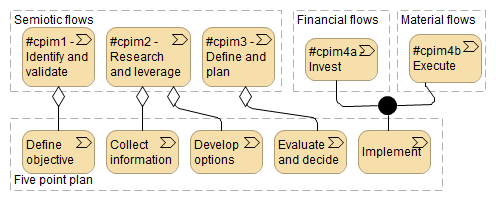
Scaling decision making thus means that generalizations and specializations are performed for those steps, and in these an advanced use is made of Modeling tools.
Portfolio, Program, Project and Iteration
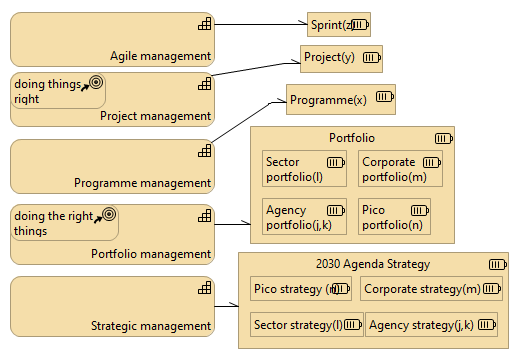
Figure 5.4 positions several management capabilities and resources and gives an impression of the potential dependencies among the planning levels Strategy, Portfolio, Program, Project and iteration.
In this book, we will focus on “model-based” dependencies among the resources that CPIM leverages:
- the 2030 Agenda Strategy must provide resources upon which the various portfolios can build,
- portfolio resources must support program, project and iteration resources,
- program resources must support project and iteration resources, and
- project resources must support iteration resources, and
- that capability/resource pairs may rest upon one another in the collaborative planning methodology.
The nature of the dependencies will be explained in the sections introducing each of the steps:
- #CPIM01 - Identify and Validate
- #CPIM02 - Research and Leverage
- #CPIM03 - Define and Plan
- #CPIM04 - Invest and Execute
- #CPIM05 - Perform and Measure
But first lets take a look at key concepts of each of the “planning” levels as defined in the Open Project Management Methodology (PM²) series by the European Commission Centre of Excellence in Project Management (European Commission, 2021 and 2022), pdf versions of which are free from the website of the Publications Office of the European Union:
- PM² Agile - Guide 3.0.1
- PM² Project Management Methodology - Guide 3.0.1.
- PM² Program Management - Guide 1.0
- PM² Portfolio Management 1.5
Note that these concepts cover only the phases CPIM01 - Identify and Validate to CPIM04 - Invest and Execute and that relatively little attention is given to the quantification of the investment, and its “recuperation” during the CPIM05 - Perform and Measure phase.
Concepts from the area of public-private partnerships may be useful for elaborating the financial aspects of the colaborative planning.
Portfolio Management
This content is not available in the sample book. The book and its extras can be purchased from Leanpub at https://leanpub.com/socarch.
Program Management
This content is not available in the sample book. The book and its extras can be purchased from Leanpub at https://leanpub.com/socarch.
Project Management
This content is not available in the sample book. The book and its extras can be purchased from Leanpub at https://leanpub.com/socarch.
Iterations in Continuous Improvement and Agile Management
This content is not available in the sample book. The book and its extras can be purchased from Leanpub at https://leanpub.com/socarch.
5.2 - Re-use of Knowledge Assets in Communication
At each planning level, communication with stakeholders is important.
In this section we will explore how communication products of initiatives with narrow scope build upon the communication products of those with a wider scope.
To the section - To the chapter
5.3 - Re-use of Knowledge Assets in Decision Support Studies
This content is not available in the sample book. The book and its extras can be purchased from Leanpub at https://leanpub.com/socarch.
5.4 - Capabilities for CPIM
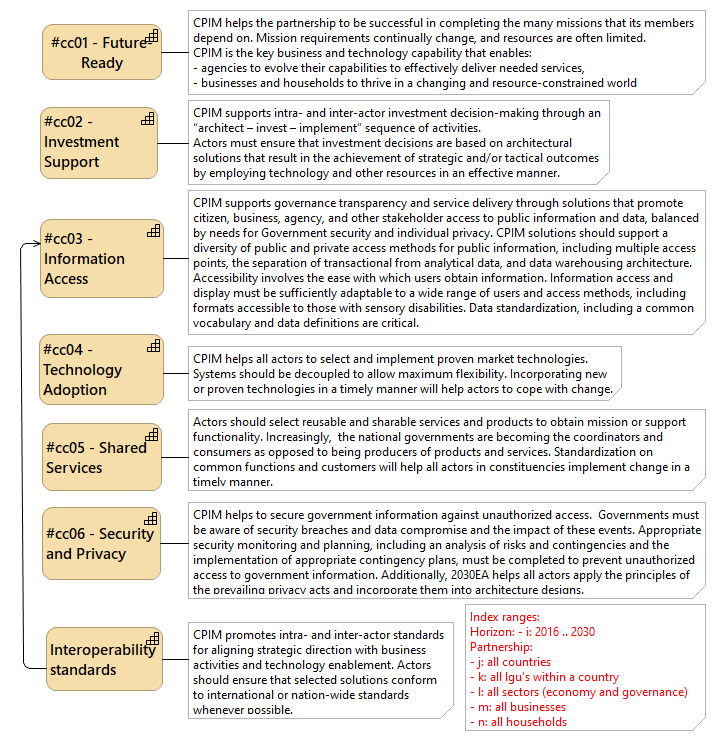
The Societal Architecture General Capabilities matter for all members of the 2030 Agenda Partnership, across the public services they provide and consume, and across the initiatives to achieve the sustainable development goals. These society-wide capabilities have been derived from the General Principles of the Common Approach to the US Federal Enterprise Architecture. Each capability is introduced and where possible a link is added to an Actor Atlas page with related principles that stem from the development research.
In the socio-technical landscape where innovations involve value systems, dashboards, operational processes and supporting information systems of multiple stakeholders, the total number of requirements pertaining to the operations and systems is huge.
Where state-of-the art practices indicate a strong intra-enterprise utility of architectural frameworks, our work indicates important additional gains from the cross-level alignment of requirements captured as models at macro and meso levels and provided to the micro level and to the pico or household levels.
- The Future Ready Capability
- The Investment Support Capability
- The Shared Services Capability
- The Interoperability Standards Capability
- The Information Access Capability
- The Security and Privacy Capability
- The Technology Adoption Capability
The Future Ready Capability
This content is not available in the sample book. The book and its extras can be purchased from Leanpub at https://leanpub.com/socarch.
The Investment Support Capability
This content is not available in the sample book. The book and its extras can be purchased from Leanpub at https://leanpub.com/socarch.
The Shared Services Capability
This content is not available in the sample book. The book and its extras can be purchased from Leanpub at https://leanpub.com/socarch.
The Interoperability Standards Capability
Collaborative Planning and Investment enabled by Societal Architecture promotes intra- and inter-actor standards for aligning strategic direction with business activities and technology enablement.
Actors should ensure that selected solutions conform to international or nation-wide standards whenever possible.
See also: Open Standards Principles and the earlier cited 6th Principle for Digital Development: Create open and transparent practices.
The Information Access Capability
This content is not available in the sample book. The book and its extras can be purchased from Leanpub at https://leanpub.com/socarch.
The Security and Privacy Capability
This content is not available in the sample book. The book and its extras can be purchased from Leanpub at https://leanpub.com/socarch.
The Technology Adoption Capability
Collaborative Planning and Investment enabled by Societal Architecture helps all actors to select and implement proven market technologies. Systems should be decoupled to allow maximum flexibility. Incorporating new or proven technologies in a timely manner will help actors to cope with change.
Principles that are Realized by the CPIM Capabilities
This content is not available in the sample book. The book and its extras can be purchased from Leanpub at https://leanpub.com/socarch.
5.6 - Including Investment Decision Making in CPIM
In the context of the 2030 Agenda for Sustainable Development, also access to finance, and impact on material resources - the environment - are critical issues.
Finance for Development is a topic that is addressed in the Addis Ababa Action Agenda, and the environmental and social impact are addressed via the sustainable development goals and their targets.
Therefor, to CPIM we added collaborations for capital investments and operational expenses and income, to add the investment aspect.
5.7 - Implications for CPIM of General Requirements and Constraints
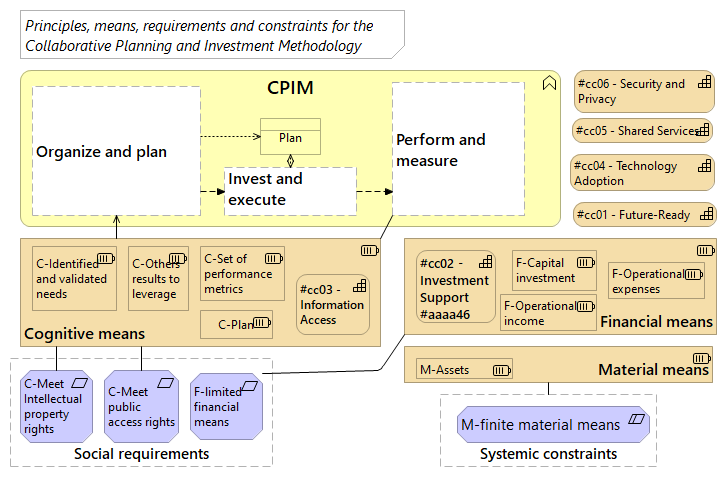
The figure below highlights constraints and requirements on the resources that CPIM depends on.
Cognitive, material and financial means are accessed in the collaborations, and for those means we have included some social requirements - these are negotiable - and systemic constraints.