Chapter 14 - Agents
14.1 - Raising Awareness for Sustainable Development
14.2 - About the Agent Template
14.3 - Citizens and Households
14.4 - Global Partnership
14.5 - National Government
14.6 - Local Authorities
14.7 - Schools
14.8 - UN Country Teams
14.9 - Publishers and Right Holders
14.10 - Libraries
14.11 - Aid Organizations
14.12 - Firms
To Part I (Chapter 1 - 2 - 3 - 4) _ II (5 - 6 - 7) _ III (8 - 9 - 10 - 11 - 12 - (no 13)) _ IV (14 - 15) _ V (Annexes) _ VI (References)
14.1 - Raising Awareness for Sustainable Development
One of the first concerns in the communication plans of open portfolios and the programmes, projects and iterations they enable is the raising of awareness.
Awareness-raising activities aim to increase the engagement of citizens and local communities in order to promote their sense of ownership of the 2030 Agenda and their participation in the achievement of the SDGs at local level.
The raising of awareness is about:
- letting people know about the existence of the SDGs and its targets,
- empowering people to participate in the achievement in their daily lives of localised targets,
- empowering people to hold to account their governments and businesses for their localised development performance.
The raising of awareness is part of a localization process of taking into account subnational and local contexts in the achievement of the 2030 Agenda. Beyond the awareness the localizing will also involve the setting of local goals and targets, determining the local means of implementation and using indicators to measure and monitor local progress.
Supporting Principles
Awareness-raising campaigns should be carried out at international, national and subnational levels, and those campaigns should be mutually enforcing in order to emphasize local spaces “of everyone” (lifeworlds) as the ultimate sites of delivery and development.
National and subnational governments, civil society organizations, the private sector, academia and individual citizens should all be involved in the end-to-end partner journeys for the local implementation of the SDGs.
Supporting principles (#rio or Digital capability Principles - #dp):
- #rio04 - Environmental protection as integral part: In order to achieve sustainable development, environmental protection shall constitute an integral part of the development process and cannot be considered in isolation from it.
- #rio06 - Special priority for the least developed, most vulnerable: The special situation and needs of developing countries, particularly the least developed and those most environmentally vulnerable, shall be given special priority. International actions in the field of environment and development should also address the interests and needs of all countries.
- #rio07 - Common but differentiated responsibilities: States shall cooperate in a spirit of global partnership to conserve, protect and restore the health and integrity of the Earth’s ecosystem. In view of the different contributions to global environmental degradation, States have common but differentiated responsibilities. The developed countries acknowledge the responsibility that they bear in the international pursuit to sustainable development in view of the pressures their societies place on the global environment and of the technologies and financial resources they command.
- #rio09 - Cooperate to strengthen endogenous capacity-building: States should cooperate to strengthen endogenous capacity-building for sustainable development by improving scientific understanding through exchanges of scientific and technological knowledge, and by enhancing the development, adaptation, diffusion and transfer of technologies, including new and innovative technologies.
- #rio10 - Participation of all concerned citizens: Environmental issues are best handled with participation of all concerned citizens, at the relevant level. At the national level, each individual shall have appropriate access to information concerning the environment that is held by public authorities, including information on hazardous materials and activities in their communities, and the opportunity to participate in decision-making processes. States shall facilitate and encourage public awareness and participation by making information widely available. Effective access to judicial and administrative proceedings, including redress and remedy, shall be provided.
- #rio20 - The full participation of women is essential: Women have a vital role in environmental management and development. Their full participation is therefore essential to achieve sustainable development.
- #rio21 - Mobilize the creativity, ideals and courage of the youth: The creativity, ideals and courage of the youth of the world should be mobilized to forge a global partnership in order to achieve sustainable development and ensure a better future for all.
- #rio22 - Indigenous people and local communities have a vital role: Indigenous people and their communities and other local communities have a vital role in environmental management and development because of their knowledge and traditional practices. States should recognize and duly support their identity, culture and interests and enable their effective participation in the achievement of sustainable development.
- #dp9 - Use evidence to improve outcomes.
The agent information is shared in a template that is introduced next.
14.2 - About the agent template
In digital media, the agent template would look as in the figure below in which a number of tab-structures contain a large set of content that is consulted and modified as new initiatives develop and deliver.
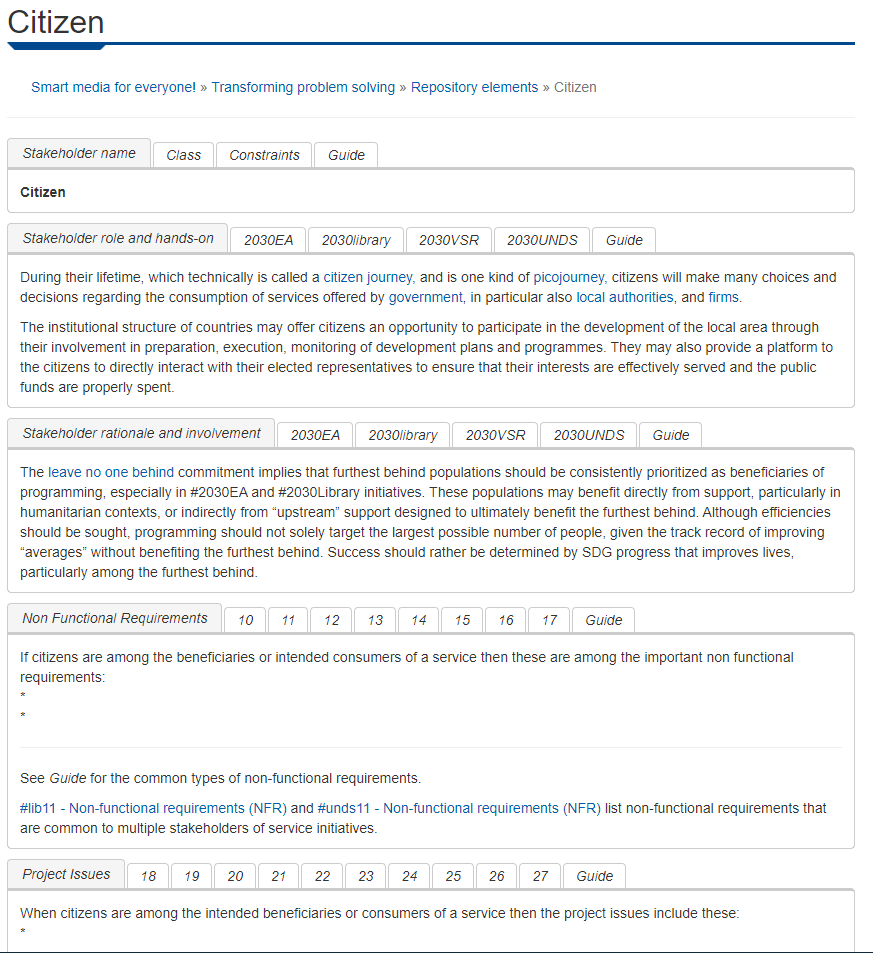
Online open shared agent descriptions support the society-wide re-use of the architecture descriptions. Building upon a formal approach to system modeling, we emphasize specific model-resources at different levels and (will) explain their impact on change projects and the risks involved.
Contextual factors
The availability of a societal architecture - preferably as part of a society repository - will impact the amount of work that must be invested in extending agent descriptions as a portfolio, programme or project is launched.
In a societal architecture described in accordance with the ArchiMate framework:
- agents (for the portfolio that will aim for a service solution) are included in the motivation extension. The rationale for their involvement will often be related to their role in the Business collaboration that must be supported by the service solution;
-
hands-on users (of the products for which requirements are collected and shared) are addressed as part of the active structure aspect:
- the Business actor would include the “agent” descriptive elements and Business role would include the “user role”.
- agents of agent-class “Interfacing technology” are named application components and are described as part of the framework’s Application layer. The rationale for their involvement will often be related to their role in Application collaborations among “services”.
To the chapter - to the introduction on agents
14.3 - Citizens and households
For background and examples, see Household journeys for the #SDGs.
For innovation matters, see citizen (template).
14.4 - Global Partnership
For background, see Global Partnership.
For innovation matters, see Global Partnership (template).
To the chapter - to Joint implementation - to the introduction on agents
14.5 - National Government
For background, see National government.
For innovation matters, see National government.
In a contemporary national government one must distinguish different classes of public legal entities in accordance with their leading of governance, management or analysis & design processes.
14.6 - Local Authorities
For background, see Local Authorities.
For innovation matters, see Local Authorities (template).
To the chapter - to Joint implementation - to the introduction on agents
14.7 - Schools
For background, see School.
For innovation matters, see School (template).
14.8 - UN Country Teams
For background and tasks, see UN Country Team.
For innovation matters, see UN Country Team (template).
14.9 - Publishers and right holders
For background, see Reproduction rights organizations.
For innovation matters, see Publishers and right holders (template).
To the chapter - to Joint implementation - to the introduction on agents
14.10 - Libraries
For background, see Library.
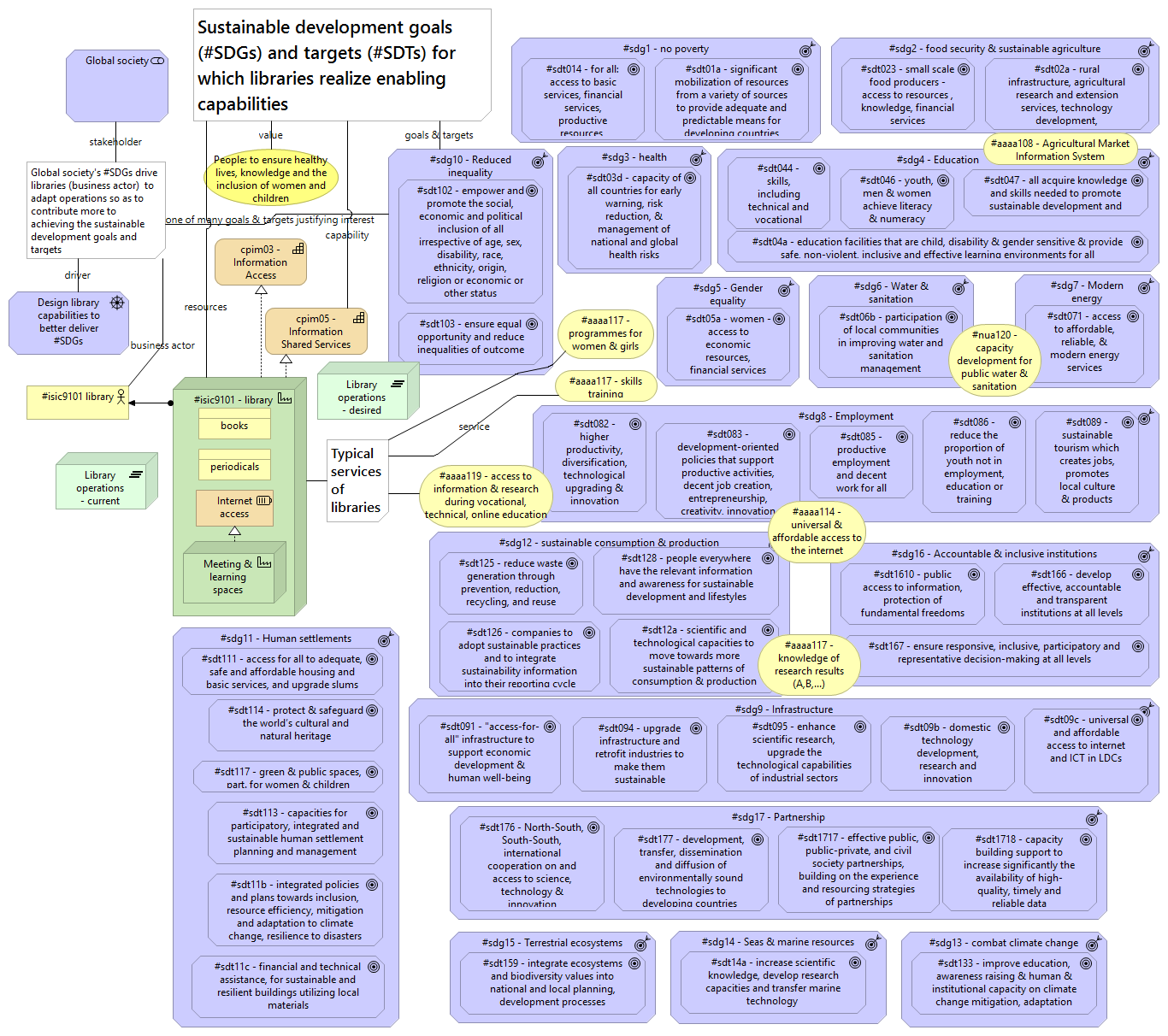
For innovation matters, see Towards a #2030library and the global partnership online agent template where Figure 14.2 can be found.
To the chapter - to Joint implementation - to the introduction on agents
14.11 - Aid and international organizations
For background on International Organizations, see United Nations.
For background on aid Organizations, see aid organizations.
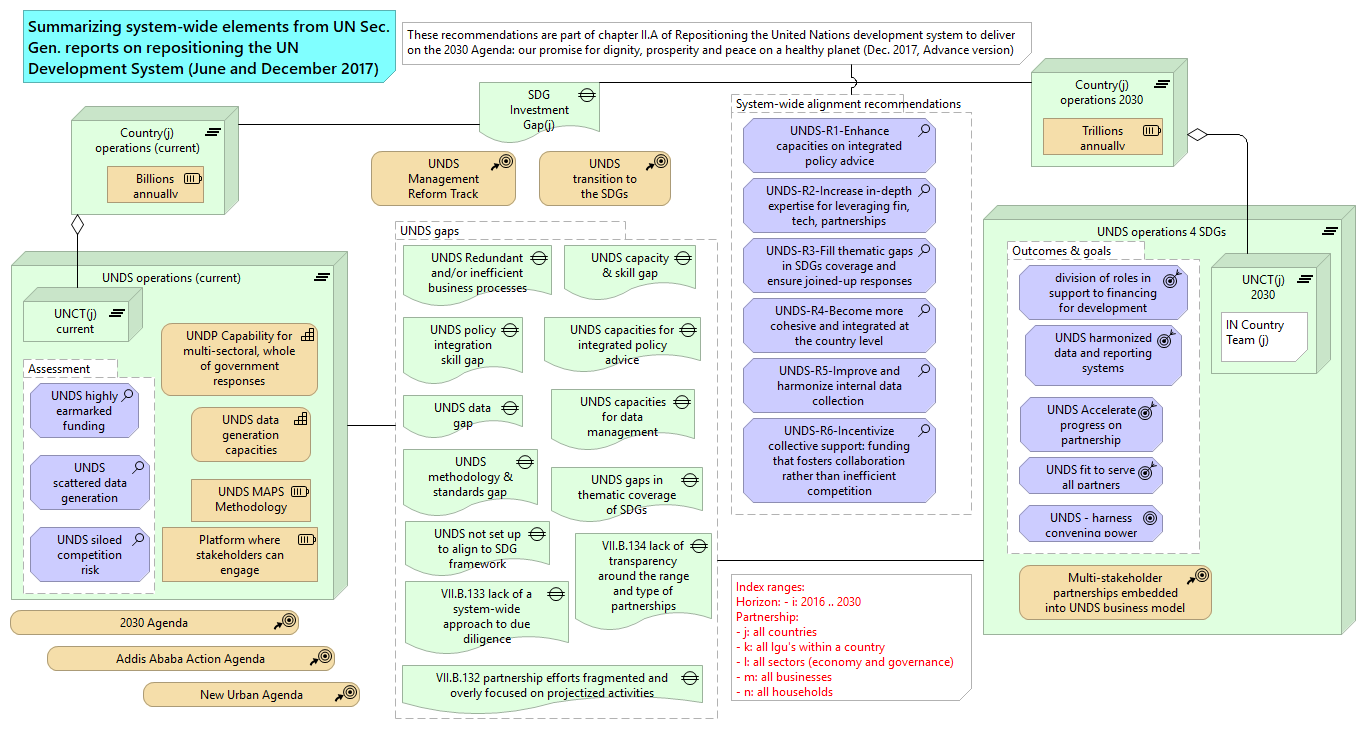
For innovation matters in international organizations, see Towards an Agenda 2030 United Nations Development System and Figure 14.3.
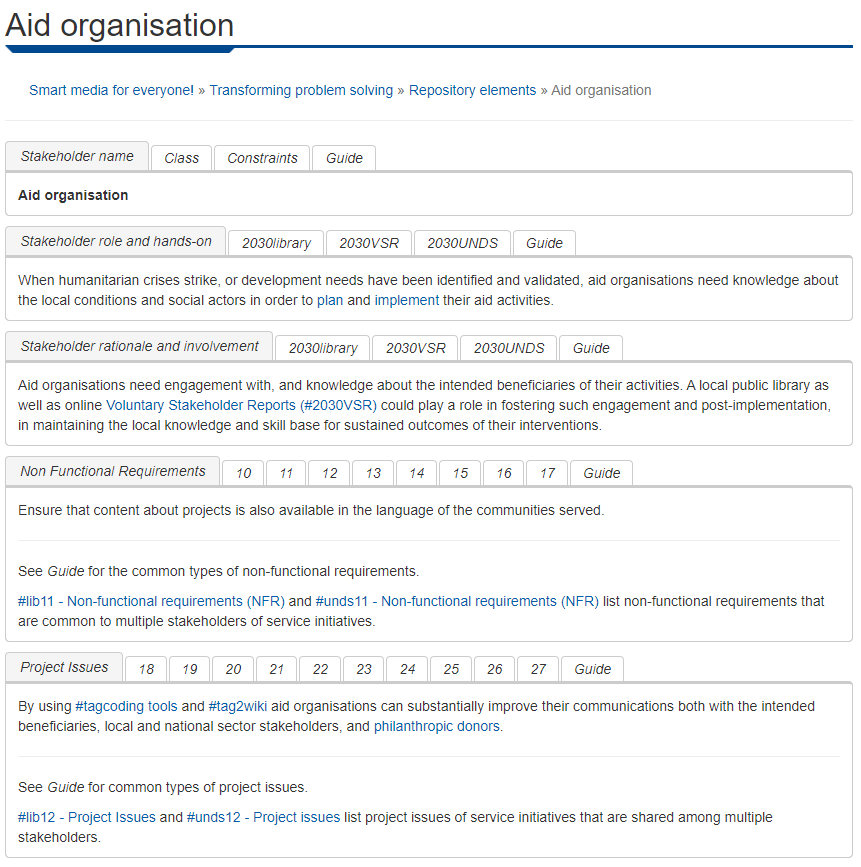
For innovation matters in aid organizations, see the Aid organization template of which a screenshot is included in figure 14.4.
14.12 - Firms
For background, see Firm and other micro-level entities.
For innovation matters, see firm (template).
To the chapter - to Joint implementation - to the introduction on agents