Chapter 11 - Invest and Execute in the Technotope
This chapter is only an early draft.
11.1 - Joint Implementation by Various Actors and Stakeholders
11.2 - Returns of Collaboration in Portfolios and Programs
11.3 - Returns of Collaboration in the Semiotic CPIM Phases
11.4 - Invest and Execute for the 2030 Agenda for Sustainable Development
11.5 - Invest and Execute for Library Services
To Part I (Chapter 1 - 2 - 3 - 4) _ II (5 - 6 - 7) _ III (8 - 9 - 10 - 11 - 12 - (no 13)) _ IV (14 - 15) _ V (Annexes) _ VI (References)
11.1 - Joint implementation by various actors and stakeholders
In this chapter we describe the tools and resources for implementing the 2030 Agenda for Sustainable Development. In this chapter we elaborate the “Societal Architecture customized views” for each stakeholder group with a focus on the reusable input the Societal Architecture provides for their Invest and Execute activities.
An earlier version of the proposed approach was included in A Multi-level Model-driven Project Environment (MMPE) facilitates systematic society-wide re-use of the architecture descriptions models. Building upon a formal approach to system modeling, we emphasize specific model-resources at different levels and explain their impact on change projects and the risks involved (Goossenaerts et al, 2008).
The elaboration of model dependencies that are cross-phase in the regulative cycle, one such cycle could be the TOGAF Architecture Development Method, cross-level in MLP, and cross-layer in the Enterprise Architecture is an original contribution of our work. The allocation of models to the public and proprietary domains is intended to induce fair and concerted growth-focused attitudes (Goossenaerts, 2007).
Stakeholders to consider:
- Citizens and households
- Global Partnership
- Firms
- National Government
- Local Authorities
- Schools
- UN Country Teams
- Publishers and right holders
- Libraries
- Aid and international organizations
11.2 - Returns of Collaboration in Portfolios and Programs
The need for investment from the global to local macro level is clearly expressed in the finance-related Sustainable Development Targets and article 34 on capacities of the Addis Ababa Action Agenda.
Finance related Sustainable Development Targets
- 17.1 Strengthen domestic resource mobilization, including through international support to developing countries, to improve domestic capacity for tax and other revenue collection (#sdt171)
- 17.2 Developed countries to implement fully their official development assistance commitments, including the commitment by many developed countries to achieve the target of 0.7 per cent ODA/GNI to developing countries and 0.15 to 0.20 per cent of ODA/GNI to least developed countries; ODA providers are encouraged to consider setting a target to provide at least 0.20 per cent of ODA/GNI to least developed countries (#sdt172)
- 17.3 Mobilize additional financial resources for developing countries from multiple sources (#sdt173)
- 17.4 Assist developing countries in attaining long-term debt sustainability through coordinated policies aimed at fostering debt financing, debt relief and debt restructuring, as appropriate, and address the external debt of highly indebted poor countries to reduce debt distress (#sdt174)
- 17.5 Adopt and implement investment promotion regimes for least developed countries (#sdt175)
Addis Ababa Action Agenda, Art. 34 “#aaaa34 - Capacities of municipalities and other local authorities”
- We further acknowledge that expenditures and investments in sustainable development are being devolved to the subnational level, which often lacks adequate technical and technological capacity, financing and support (#aaaa34_1)
- We therefore commit to scaling up international cooperation to strengthen capacities of municipalities and other local authorities. We will support cities and local authorities of developing countries, particularly in least developed countries and small island developing States, in implementing resilient and environmentally sound infrastructure, including energy, transport, water and sanitation, and sustainable and resilient buildings using local materials (#aaaa34_2)
- We will strive to support local governments in their efforts to mobilize revenues as appropriate (#aaaa34_3)
- We will enhance inclusive and sustainable urbanization and strengthen economic, social and environmental links between urban, peri-urban and rural areas by strengthening national and regional development planning, within the context of national sustainable development strategies (#aaaa34_4)
- We will work to strengthen debt management, and where appropriate to establish or strengthen municipal bond markets, to help subnational authorities to finance necessary investments (#aaaa34_5)
- We will also promote lending from financial institutions and development banks, along with risk mitigation mechanisms, such as the Multilateral Investment Guarantee Agency, while managing currency risk (#aaaa34_6)
- In these efforts, we will encourage the participation of local communities in decisions affecting their communities, such as in improving drinking water and sanitation management (#aaaa34_7)
- By 2020, we will increase the number of cities and human settlements adopting and implementing integrated policies and plans towards inclusion, resource efficiency, mitigation and adaptation to climate change and resilience to disasters (#aaaa34_8)
- We will develop and implement holistic disaster risk management at all levels in line with the Sendai Framework (#aaaa34_9)
- In this regard, we will support national and local capacity for prevention, adaptation and mitigation of external shocks and risk management (#aaaa34_10)
Shifting Investments
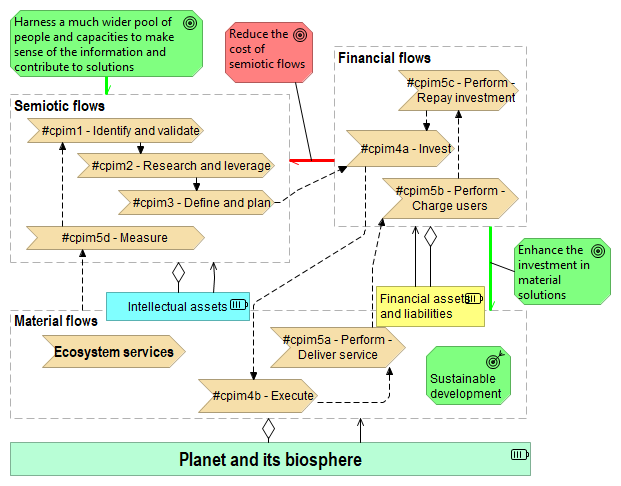
Considering that in the international development landscape a lot of investments are allocated to (expensive) knowledge work that is focused on the semiotic flows the intended impact of the Societal Architecture is threefold as depicted in Figure 11.1:
- To reduce the cost of semiotic flows;
- To enhance the investment in material solutions; and
- Harness a much wider pool of people and capacities to make sense of the information and contribute to (material) solutions.
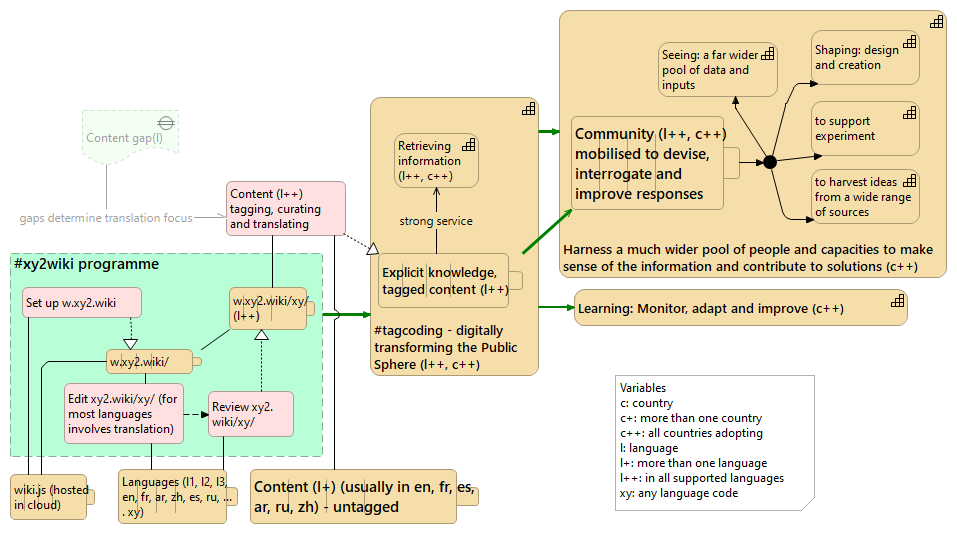
The goal of harnessing a much wider pool of people and capacities to make sense of the information and contribute to (material) solutions is moreover served by #tagcoding and #xy2wiki as depicted in Figure 11.2 that also clarifies the related building up of capabilities.
11.4 - Returns of Collaboration in the Semiotic Phases
For the scope of semiotic phases, see Chapter 4.3 Re-use of Knowledge Assets in Decision Support Studies.
Content in this chapter will be based on Knowledge conversion.
- Landscape models for public-private monitoring, review and validation and sectoral partial models that are aligned with the Sustainable Development Goals and open domain models.
- Reduced risks of stranded resources.
- Identifying commonalities across countries, municipalities and languages as illustrated in Invest and Execute for Library Services.
11.4 - Invest and Execute for the 2030 Agenda
Content in this chapter will be based on Initiative Management - Use evidence to improve outcomes - #dp9
To the case overview - To the chapter
11.5 - Invest and Execute for Library Services
It is important that each town (k) in each country (j) of the world has a local public library (j,k) journey towards providing #cpc8451 - Library services in the languages spoken in the town.
Each language has an ISO-639 code, and this code is used to distinguish the (online) library activities, for instance #cpc8451hi for library services providing content in Hindi.
Depending on the current status of the library services in a language or town, priority initiatives can be selected from below tasks:
- #isic910101 - appoint a librarian for each language or in each town
- #isic910102 - enhance library services in each town
- #isic910103 - integrate the world’s online collection in the local library
- #isic910104 - ensure local content is discoverable in the world’s online collection
Google Translate is an important enabler for the integration of the world’s online collection in local libraries. The languages that are supported in Google Translate are depicted in Figure 11.3. For each language, the linked page contains information such as the number of speakers and the countries where the language is spoken.
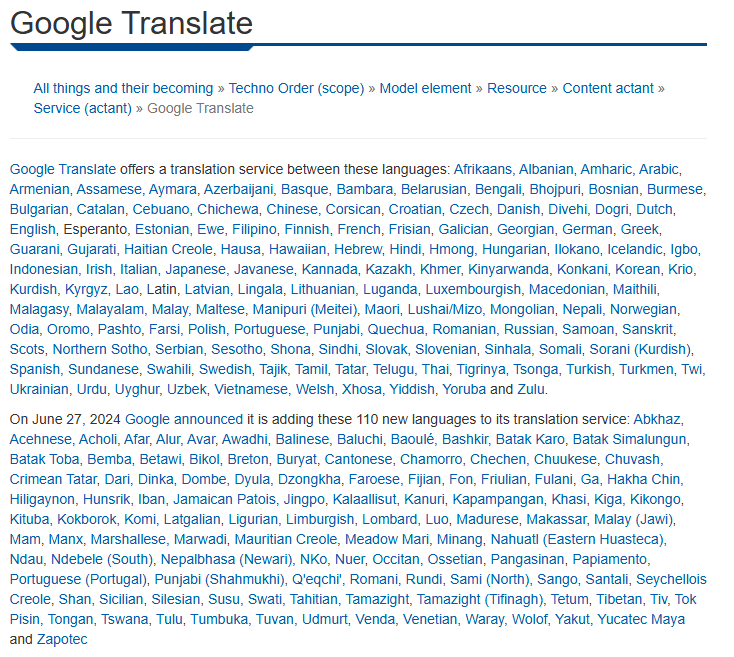
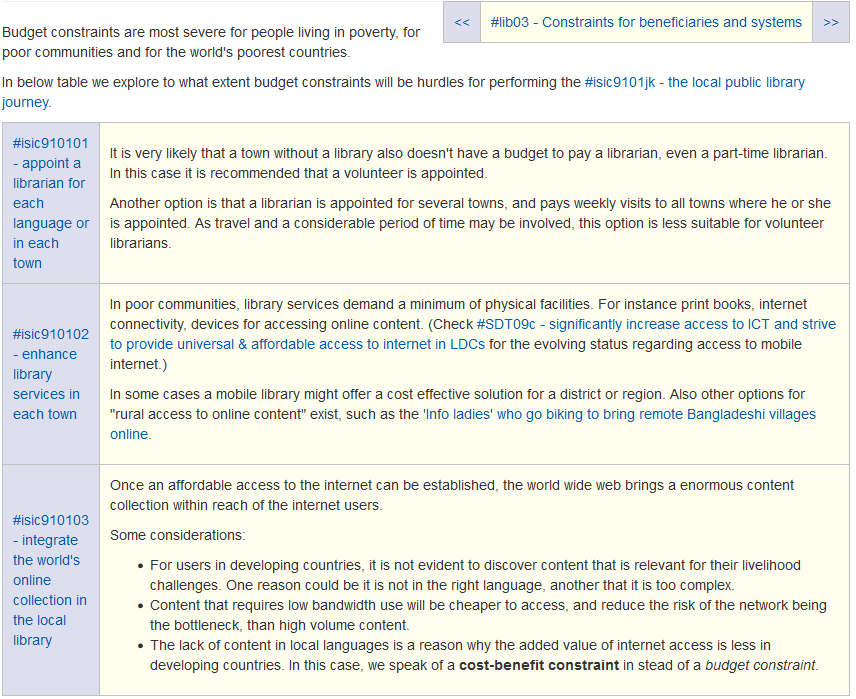
Figure 11.4 shows some constraints for beneficiaries and systems that have to be taken into consideration.
To the case overview - To the chapter