Chapter 1 - Introduction
1.1 - Global Challenges in a Planetary Context
1.2 - Towards Digitally Empowered People
1.3 - Unparalleled capabilities in Partner Journeys, built on the achievements of a generation
1.4 - Awareness of the Assets and Gaps that underpin the Theory of Change
1.5 - Outline of the Book
1.6 - Tools and Resources
To Part I (Chapter 1 - 2 - 3 - 4) _ II (5 - 6 - 7) _ III (8 - 9 - 10 - 11 - 12 - (no 13)) _ IV (14 - 15) _ V (Annexes) _ VI (References)
1.1 - Global Challenges in a Planetary Context
The global 2030 Agenda for Sustainable Development, and the national and local action plans that will be launched in relation to it, will need to influence the decisions, investments and operational choices of many partners: governments, businesses and households. Successful implementation of the agenda will require improved services for decision making, investment, technology adoption and data and information sharing at all levels and in all parts of society.
In order to reduce the perceived complexity of the global problem space, and to compare values that people will refer to when making decisions, it is useful to distinguish three orders:
- The natural order: the natural environment in which humanity lives. It includes aspects such as time, land, climate, biotope and people. It includes material, those material resources that humanity exchanges with the natural environment.
- Social order: the institutional arrangements and socio-cultural networks that humanity has developed to govern relationships and interactions with each other and with the natural order. It is the order in which produced assets and content come into play. Produced assets are non-financial and non-content assets created as outputs of production processes and as inputs of consumption processes and services. Produced assets consist of fixed assets, inventories and valuables. Contents are non-tangible resources such as those that could be protected by intellectual property rights, authored works (in the public domain), data, etc.
- Techno-order: institutional arrangements and actor networks related to constellations and interactions involving complex produced assets, complex content collections and multiple institutional arrangements.
In these orders, entelechy proceeds through interactions in biotope, sociotope and technotope.
Biological and physical systems come together in the biotope, which is an area of uniform environmental conditions that provides a living space for a particular assemblage of plants and animals. Biotope is almost synonymous with habitat, but whereas the subject of a habitat is a species or population, the subject of a biotope is a biological community.
Physical, chemical and biophysical interactions in the natural order. These are studied in dedicated sciences and are not specifically addressed here. However, the findings of these sciences should be taken into account when making decisions.
Climate change, which is a global process of the natural order, threatens humanity’s biosphere.
Humanity’s response to challenges such as climate change involves socio-technical interactions in the social order and the techno-order.
The patterns of these interactions affect how effectively and efficiently we deal with the challenges.
More generally, entelechy or becoming in sociotope and technotope is based on biological and physical systems, but involves additional systems such as legal systems, businesses and agencies and the products and services they provide to society.
A sociotope is a defined space that is uniform in its use values and social meanings. It can be described as the collective life-world of a place, its uses and meanings, in a particular culture or group of people. The sociotope is defined in the real world, where it is shaped by a variety of lifestyles, trades, regulations and services associated with a specific place, which may be local, national, regional or global.
For the group of social actors, the sociotope typically includes a number of regimes and a public sphere.
A technotope is an external space that is uniform in its use values, social meanings and technological uses. It can be described as the collective life-world of a sociotope enhanced by cyberspace, its uses and meanings, in a specific culture or group of people.
The technotope exists simultaneously in the real world and in cyberspace, where it is shaped by a variety of lifestyles, trades, rules and services associated with a specific place, which may be local, national, regional or global, and which involve technical artefacts such as smart phones, computers, digital service platforms, and so on.
Note that the term sociotope, as defined in Wikipedia, also covers the term technotope. This book introduces a distinction to reflect the digital revolution we have been experiencing since the 1960s.
Thus, three interrelated systems are of interest for our decision making:
- the natural system in the biotope,
- actors in the sociotope, and
- digitally empowered actors in the technotope.
Improved use of modelling and modelling tools is proposed as an essential skill for people to participate as decision makers in the technotope, and as a key skill for participation in the social order.
For the social actors, the technotope typically includes regimes that also include elements of the techno-order.
1.2 - Towards Digitally Empowered People
As a wide range of actors learn about the Agenda and commit to making a contribution to improving society’s resilience, they will embark on a partnership journey that will take years, involve diverse teams and include episodes of awareness, advocacy, analysis, design, conflict, implementation and monitoring Global Task Force of Local and Regional Governments.
These journeys will take place in a society with a complexity that no one can comprehend alone, with multiple interdependencies for all, and with multiple initiatives running simultaneously.
Peace, in spirit and in reality, requires a fragile equilibrium that includes both some control over our natural environment, oversight of actions that affect everyone, and trust in others, both near and far. Trust is needed both in people who speak our language and share our culture, and in people who speak different languages and hold different views.
In this book we refer to an open portfolio, program and project management method and use modelling techniques to present key ideas about public and private initiatives, resource use and their interdependencies.
The purpose of these methods and models is to break out of the rigidities that limit our ability to individually and collectively deal with contemporary problems, from climate change, conflict and poverty to failures of democratic governance and justice.
The challenge in presenting this is that both the subject, the methods and the modelling approach are quite complex and multifaceted.
On the one hand, one can present and explain each of a number of content slices with a limited number of different concepts, and on the other hand, one can establish relationships between the slices, from a small number to the public-private chains that are typical of contemporary society.
To bring to life the interactions between concepts in a small number of slices (or dimensions), we will use a number of cases and describe them, first in each of the slices, and then use elements from different slices in the analyses.
Mapping the partner journeys for the partners at different socio-technical levels helps us to develop content sharing services and resources that better manage the interdependencies and complementarities between initiatives worx.wiki/Initiative Management than conventional approaches to communication, decision-making, development and conflict resolution.
We aim to provide partners with model- and data-driven decision making, capacity building, analysis and design, and negotiation techniques, even in the face of frequent environmental change and where many actors are involved.
A first starting point for shared services and shared capabilities for partners is the Common Approach to the US Federal Enterprise Architecture, which emphasises a set of general principles and a collaborative planning methodology to explicitly look outside the agency to address new requirements. In our case, it is partners looking to the partnership for solutions and shared capabilities.
The launch of the 2030 Agenda for Sustainable Development in 2015 provided an important opportunity to promote and explain collaborative approaches to partnership as the basis for effective sustainable development, from global to local scale.
As the requirements for successful initiatives become more challenging in each successive stage of the Partner Journey - from awareness, advocacy, analysis, design, implementation and monitoring – we present the touch points, tools and resources that will strengthen partnership:
- by raising awareness of sustainable development and each other;
- by advocating for local ownership and change;
- by facilitating synergy in the analysis of information ecosystems;
- by designing interoperable digital solutions;
- by enabling joint implementation; and by
- by jointly operating and monitoring systems.
The partnership is enabled by a practical model-based approach to decision-making. We use the decision-making framework described by John Adair (2009) and rely on open source tools Archi and Modelio for sharing models in ArchiMate, BPMN, and UML, the three most popular modeling standards.
1.3 - Unparalleled capabilities in Partner Journeys, built on the achievements of a generation
Today, we have the advantage of unparalleled capabilities that build on the achievements of a generation.
There are a number of open source modeling tools covering various dimensions of public and private decision making. These are available to all.
There are also Open PM² guides on portfolio, program, project and agile management and principles of digital capability. These are also available to all.
We will also look at Administration, Commerce and Transport messages and the UN/CEFACT modeling methodology (UMM) to support Electronic Data Interchange (EDI) between trading partners in administration, commerce and transport.
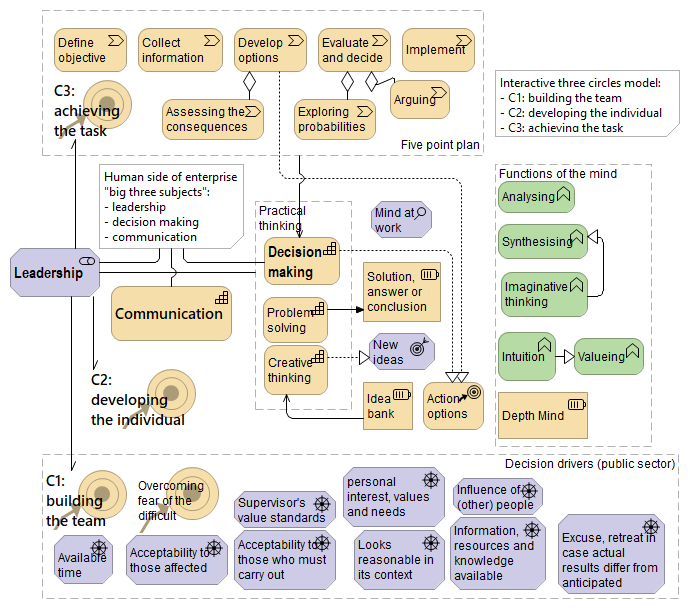
We will also look at John Adair’s presentation of an important yet simple decision-making framework. There are five steps. Define the goal, gather information, develop options, evaluate and decide, and implement. And there are three circles: accomplish the task, build the team, and develop the individual.
We have the methods, tools, and modeling concepts to support each step in the framework and transform work in each of the three circles. We will achieve the SDGs and related United Nations initiatives, despite a wide range of opinions, both informed and uninformed, as shared via Twitter (now X) and other social media.
The Common Approach to US Federal Enterprise Architecture clearly recognizes the relationship between the level of scope and the mission impact and planning detail of enterprise architecture.
The steps of joint planning and investment using the Societal Architecture will vary according to the demands on resources typical of the actors at each of these levels. By clearly defining the principles and constraints that guide these claims, we will achieve balanced reuse practices and services that empower actors to construct sustainable and equitable futures that align with resource endowments and societal values at the individual, community, national, and global levels.
Enterprise architecture as it is practiced in organizations, this is at the micro level, is transferred and elaborated as a multi-level knowledge infrastructure, with the reference levels of pico, micro, meso, and macro. The generic term “technotope” is used to describe the object system at the various levels, from the techno-globe, as coined by Hiroyuki Yoshikawa, to the techno-house that implements domotics.
Within the operational unit’s journey, strategic investment planning utilises practical thinking, the functions of the mind, the five-point plan and decision drivers as described by Adair (2009). These themes and their relationships are modelled in the figure below.
In the figure, note Adair’s three interactive circles (C1 - building the team in the lower part of the figure, C2 - developing the individual in the middle, and C3 - achieving the task in the upper part), the five-point plan for achieving tasks, the functions of the mind and practical thinking that individuals bring to the process, and the (public sector) decision drivers that influence the building of the team.
1.4 - Awareness of the Assets and Gaps that underpin the Theory of Change
Figure 1.2 distinguishes three fundamentally different types of assets in society:
- Intellectual assets that serve semiotic flows,
- Financial assets that enable the financial flows, for instance for investing and “pay for use” of “delivered services”
- The planet and its biosphere that provide a context for material flows, such as ecosystem, infrastructure and commercial services (biotope, sociotope and technotope)
Each kind of flow is home to specific drivers, gaps, barriers, goals and outcomes.
While a comprehensive macro-level problem analysis for “humanity on planet earth” is beyond the scope of this e-book, awareness of the three flows and the positioning of drivers, gaps, barriers, goals and outcomes in specific flows will help to assess the utility of a societal architecture.
In the material flows domain, mankind has to cope with drivers such as pollution, erosion, and climate, and the UN has proposed Sustainable Development Goals. Greed is an important driver affecting financial flows and contributing to financing gaps for many. Semiotic paralysis and mind traps contribute to local know-how gaps.
To implement and deliver materially inclusive capabilities and services in the material flows domain, we must use intellectual and financial assets and will create financial liabilities.
Societal architecture must address flow-specific gaps: the solutions gap in material flows, the financing gap in financial flows, and the local know-how gaps in the semiotic flows.
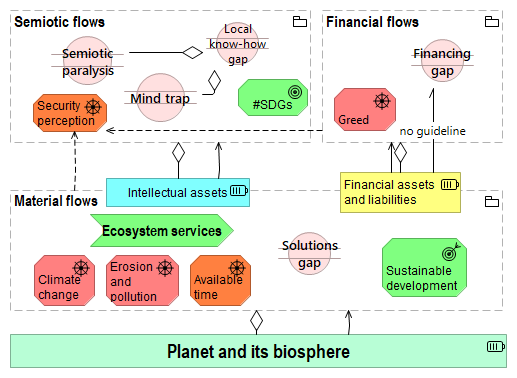
The strategy level narrative of the Theory of Change is that societal architecture will directly address key barriers and gaps in semiotic flows, which will then reduce financing needs and greed. Reduced barriers and gaps in semiotic and financial flows together will enable us to reduce the gap in sustainable development solutions.
1.5 - Outline of the Book
The second chapter explains the role of conceptual modeling in the development of the technotope individual. Here, the focus here is on new languages and tools of human cognition.
The third chapter explains how technotope individuals will build teams. New ways of forming teams, and the expansion of these teams will have implications for funding gaps.
The fourth chapter describes how these teams will collaborate to accomplish tasks at various levels of scale. Humanity will be empowered to address the solution gap.
The fourth chapter lists the building blocks for accomplishing sustainable development tasks in the technotope and also introduces the cases used to illustrate the application of collaborative planning and societal architecture.
Part II, comprising chapters 5 through 7, explains how collaborative planning and societal architecture support the four “semiotic” points in Adair’s five-point plan for practical thinking.
- Chapter 5 on An Asset-Aware Collaborative Planning and Investment Methodology (CPIM)
- Chapter 6 on A Societal Architecture for the Techno Globe
- Chapter 7 on A Societal Architecture Repository enabling CPIM Phases
Part III, comprising chapters 8 through 12 elaborates for each phase in CPIM, how societal architecture will be shaping them in the technotope. In each of these chapters, we link one of Adair’s five points to a step in the Collaborative Planning and Investment Methodology (CPIM) or to a step in conceptual modeling. Using the running cases, the cognitive means that can be reused for each CPIM step are illustrated. The general principles, as well as the characteristics and constraints of the resources being used, have implications for how the various stakeholders can best engage with the resources, including the use of appropriate tools.
- Chapter 8 on Identify and Validate in the Technotope
- Chapter 9 on Research and Leverage in the Technotope
- Chapter 10 on Define and Plan in the Technotope
- Chapter 11 on Invest and Execute in the Technotope
- Chapter 12 on Perform and Measure in the Technotope
Part IV looks at stakeholders and global portfolios in more detail, elaborating on the implications of using a societal architecture for actors, members of the global partnership, at each of the socio-technical levels, for pico, micro, meso and macro journeys:
- Chapter 14 on Agents
- Chapter 15 on The Global Tax Cooperation Portfolio
- Chapter 16 on The Global Content Portfolio will be added in a later version of this e-book.
In this part, the material is presented in an accessible, step-by-step, low-hurdle manner that allows stakeholders to extend the architecture documentation for their own initiatives.
Part V Annexes and Part VI References conclude the book. Annex 13 - Not an ordinary e-Book explains some navigational features that are used extensively in this book and in the #tagcoding manuals and wikis.
Given that the 2030 Societal Architecture is a first attempt (to my knowledge) to translate and extend enterprise architecture practices and lessons to a global partnership, I am aware of numerous shortcomings in this book. I intend to correct these. Feedback from readers is very welcome and will be acknowledged.
1.6 - Tools and Resources
After reading this book, you will be able to apply Societal Architecture and CPIM in the stakeholder role and for the partnership episodes you are familiar with, using the Archi or Modelio models that accompany this e-book. By applying the suggested activities for one episode of the partnership journey, you will build the skills to move to the next episode with the partnership you have recruited. Value creation and the prevention of value erosion will create virtuous and viral cycles in support of high-priority sustainable development goals.
You will be able to apply Societal Architecture and CPIM effectively if you master the tools and have the resources you need, including the extensive systematized online content that accompanies this book.
Before I conclude this introductory chapter, I want to draw your attention to some resources and tools that will be useful throughout the book.
If you familiarize yourself with these tools and resources as you read this e-book, you will learn the skills faster.
Hashtags that digitally support local discourse
Hashtags that support a local development discourse in social media and web use are listed on the country initiative pages as part of the Actor Atlas: Enabling the Sustainable Development Debate in the Digital Public Sphere. The hashtags are also introduced in the #tagcoding handbook.
Open source modeling tools
Repositories
To be completed