Chapter 3 - Building the Technotope Team
Because decisions often involve multiple elements, architecture is a key factor in structuring the shared problem space and organizing the drivers and decision alternatives of multiple stakeholders working as a team.
Architecture is a discipline that is closely related to innovation. Construction, product development, enterprise and information systems development have each seen the emergence of an architecture discipline, and these disciplines have been key to the creation and evolution of increasingly valuable products, services, systems and infrastructures: houses and community buildings, transportation infrastructure, vehicles, aircraft, telecommunication networks, computers and communication devices, software, digital service platforms, and so on.
Following the emergence and consolidation of Enterprise Architecture as a discipline that supports the creation and evolution of business and IT systems “within organizations”, Societal Architecture is proposed as an extended discipline to support collaborative socio-economic development in any territory, from local to global, and by any team in society, including small businesses and households.
Today, the ArchiMate modeling elements and layers are widely used within organizations, and this book illustrates how they can be scaled out. In essence, such scaling out is a collaboration of minds in teams, for which open access to digital content is a key and fair prerequisite (see also Goossenaerts et al, 2007a).
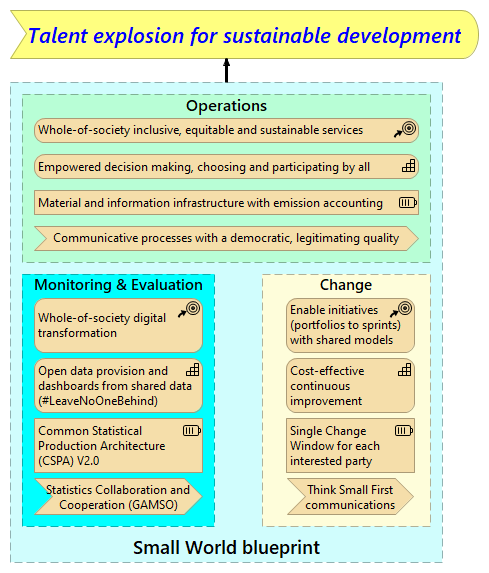
In the societal architecture, we extend the ‘intra-enterprise’ use of elements to ‘society at large’. The 2030 Agenda for Sustainable Development, adopted by the United Nations General Assembly in September 2015, provides an appropriate outcome framework for the articulation of the societal architecture. In support of this global agenda, we propose the 2030 Societal Architecture.
Sustainable development is knowledge-intensive. Applying and expanding a societal architecture as part of a collaborative planning and investment methodology for sustainable development is a way to improve open access to increasingly complex economic and political institutions to promote both political and economic competition and development within the limits of the Earth, our collective resource endowment.
3.1 - Societal Capabilities for Team building
3.2 - Enterprise Capabilities and Team building in the Technotope
3.3 - Partnership Interactions
3.4 - Implications for the decision making
3.5 - Operations
3.6 - Monitoring and evaluation
3.7 - Change
3.8 - Partnership and capability development
3.9 - Towards a Talent Explosion
To Part I (Chapter 1 - 2 - 3 - 4) _ II (5 - 6 - 7) _ III (8 - 9 - 10 - 11 - 12 - (no 13)) _ IV (14 - 15) _ V (Annexes) _ VI (References)
3.1 - Societal Capabilities and Team building
This content is not available in the sample book. The book and its extras can be purchased from Leanpub at https://leanpub.com/socarch.
3.2 - Enterprise Capabilities and Team building in the Technotope
This content is not available in the sample book. The book and its extras can be purchased from Leanpub at https://leanpub.com/socarch.
3.3 - The Potential of the Digital Commons
This content is not available in the sample book. The book and its extras can be purchased from Leanpub at https://leanpub.com/socarch.
3.4 - Partnership Interactions
The partnership interactions in the framework of the Addis Ababa Action Agenda involve actors at the four “socio-technical” levels of the societal architecture:
- pico, individuals who are members of households,
- micro, organizations, including companies,
- meso, associations of organizations in the same sector or with similar interests, and
- macro, institutions with cross-cutting, landscape-wide responsibility;
Each of the three following sections is dedicated to one three interaction areas that are relevant to all actor journeys:
In each section we take a look at these aspects for the interaction area:
- their material and substantive scope, covering many economic activities and government functions,
- the economies of scale, scope, and quality that they imply, and
- the desirability of collective action.
When challenges are complex or involve the communication with many stakeholders these are some of the approaches that could be adopted:
- the use (for instance in the blueprint description or “TO BE”) of wiki-based durable content (as explained in Durable Content Actants (Actant Dictionary);
- the provision of systematized digital commons;
- the use of structured hashtags (Actor Atlas Tag Pivot) when sharing content via social media, in order to achieve a discourse that is both inclusive, convergent and resistant to disinformation;
- low barrier access to open data, such as for instance provided by the World Data Atlas(Knoema).
3.5 - Operations
This content is not available in the sample book. The book and its extras can be purchased from Leanpub at https://leanpub.com/socarch.
3.6 - Monitoring and evaluation
This content is not available in the sample book. The book and its extras can be purchased from Leanpub at https://leanpub.com/socarch.
3.7 - Change
This content is not available in the sample book. The book and its extras can be purchased from Leanpub at https://leanpub.com/socarch.
3.8 - Partnership and Capability Development
This content is not available in the sample book. The book and its extras can be purchased from Leanpub at https://leanpub.com/socarch.
3.9 - Towards a Talent Explosion