Chapter 6 - The Societal Architecture for the Techno Globe
6.1 - Societal Architecture: an Overview
6.2 - Transformation at Multiple Levels
6.3 - Transformation at the Pico level
6.4 - Transformation at the Micro level
6.5 - Transformation at the Meso level
6.6 - Transformation at the Macro level
6.7 - Why Societal Architecture?
To Part I (Chapter 1 - 2 - 3 - 4) _ II (5 - 6 - 7) _ III (8 - 9 - 10 - 11 - 12 - (no 13)) _ IV (14 - 15) _ V (Annexes) _ VI (References)
6.1 - Societal Architecture: an Overview
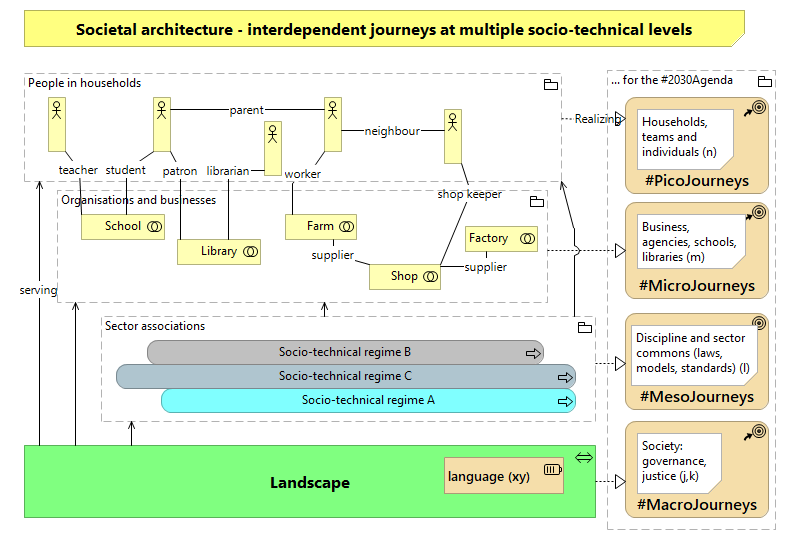
The societal architecture is a reference architecture that recognizes multiple levels of scope and socio-technology in society and its transformation (SlideShare).
Everyone’s path is a composition of journey segments:
- Segments as a curious student, in sports, as a loving mother or father are part of pico-journeys, which are displayed as the highest level in the figure to convey the centrality of the human beings in the social order and as citizen.
- Segments while one is working in a business or organization. Here it is convenient to further distinguish the organizations in accordance with their mission:
- private sector, business for profit, livelihood, non-profit, for sports, etc.: the micro level;
- confederations protecting and representing members with similar interests with respect to the executive and legislative organs in a country, or local government unit: the meso level;
- executive and legislative organs which set and enforce general norms for society as a whole, at levels of (geographic) scope: local over national to international
Given the common use of customer journey maps and in order to support Collaborative Planning (and Investment) at multiple levels in society we introduce terms journey map, macro journey, meso journey, micro journey and pico journey.
6.2 - Transformation at Multiple levels
The following sections generically characterizes actors at different levels in a modern society.
Development agendas such as Addis Ababa Action Agenda involve actors at multiple levels in society. A regulative cycle or collective regulative bundle describes one possible way to deal with (required) change by key actors and in key systems or constellations. The socio-technical level of the actors is depicted in the figure “Socio-technical Transition Pathways”.
The level (macro, meso, micro, or pico) of a principal will determine attributes of its interests (e.g., the resources for survival and growth that it must consume, produce or protect). A Principal is an entity that can own a claim to an object (such as to a piece of land, the right to harvest certain trees in a forest, a liability, the property rights of traditional or new knowledge) and be a party in a contract or agreement.
Also behavioural constraints are determined by the level. For instance:
- within their jurisdictions, macro and meso-level actors should refrain from giving preferential treatment to any of their micro or pico-level “subjects”;
- companies compete at the micro-level in their sector of industry;
- persons or teams compete in sports contests (in sports disciplines (meso-level)) or for job promotion (in the micro-context of an organization);
- the institutional instruments that governments can use to promote or protect domestic industries, or attract foreign investors, are constrained by global trade agreements.
In what follows, for each socio-technical level and for the multi-level, we will address:
Extent and principals
Improved livelihood-centrism in knowledge conversions builds upon attitude changes and decisions by actors responsible at multiple levels of socio-technology and scope: macro, meso, micro and pico.
The interaction in a value-constellation of principals and entities of all four levels: pico, micro, meso and macro.
| Level | what used to be | with societal architecture guidelines |
|---|---|---|
| Pico (person) | little awareness of where the self fits in the whole | be knowledgeable of hashtags for important aspects of life and adopt Household journeys for the #SDGs |
| Micro (organization) | little awareness of how business success builds upon meso-level achievements | distinguish between the cooperative and competitive aspects of business success and give both a balanced attention in Business competing & engaging in partner journeys - #b4sdgs |
| Meso (federation) | in developing countries: little attention for this level | give ‘‘fair’’ federations the attention and resources they deserve for Sector journeys - #isicWW & #cofogWW |
| Macro (society) | little participation by stakeholders due to communicative hurdles | overcome communicative hurdles by using the internet and social media also in a smart and disciplined way for Sustainable landscape, #MacroJourneys and #WWlgu |
Domains & systems
What is the domain and what are typical interactions and systems at the different levels?
The ecosystem, including the natural, social and technical environment and the socio-cultural arrangements.
Improved livelihood-centrism in knowledge conversions builds upon these changes in communications:
| Level | what used to be | with Wikiworx guidelines |
|---|---|---|
| Pico (person) | post the casual, post much, read little, focus on the own reputation ‘‘no matters what’’ | '’research before writing: Before writing and posting to a wide public, check recent contributions in your area of interest; cite your sources; and aim for genuine and reliable contributions, #tag to reach your target readers; engage in discussions with your readers |
| Micro (organization) | marketing, marketing, marketing | reduce the obtrusiveness of your marketing communications, e.g. by ensuring it appears alongside suitably tagged content or pages with closely related content. See the role ‘‘smart online advertiser’’ at Fair Glocal Partnership. |
| Meso (federation) | Federations have been created ad hoc and coexist in a partly competitive mode; very wasteful… | guideline: evolve towards “one federation/space per ISIC or CPC class” |
| Macro (society) | Each agency has its own website and communications channels, without consideration of how the individual in need will find up-to-date information that is relevant to his or her situation now | Explain the use of the ISIC/COFOG/CPC classifications alongside wiki functionality in finding and placing information; and apply it for all government partnership communications, as well as for supporting governmental initiatives. |
Design
What are typical design or development methods? How is change initiated and decided?
Poverty reduction strategies.
See for instance: the Poverty-Wellbeing Shareweb.
Cases
Which cases illustrate change factors? What representative cases are there in the literature?
Several cases are included in Geels & Schot (2007).
Problems
Which approaches are used to identify problem messes?
- (Economic) Growth Diagnostics
- Benchmarking per level in combination with cross-level causal-chain analysis as illustrated in Goossenaerts (2007).
Outcomes / values
What outcomes are valued, consumed and produced? How are they measured?
Sustainable and equitable socio-economic growth by capable people in rural livelihoods. Chambers and Conway (1991) report on their search for ways in which capability, equity and sustainability can be combined so that in practice conflict is low and mutual support is high.
6.3 - Transformation at level Pico
Extent and principals
Humans are self-conscious, anticipatory, imaginative, creative beings. This means that they are not restricted to act in narrowly confined ways according to fixed rules of behaviour. They can invent new solutions—or they may not even see the obvious ones (Bossel, 1999, page 5.) Where people fulfil roles in economic activities, as public servants or as participants in institutions, specific skills, knowledge and attitudes are expected from them.
Persons as members of households and in the role of teachers, workers, engineers, managers, librarians, farmers, parents, public servants, politicians. For more details, see: pico-classification.
The target actors at the Pico level are all persons that might use and produce externalized knowledge during their life, education and work. The community of person-actors is very heterogeneous, with age, gender, resource endowment, education, health, kinship and family-relationships, employment and livelihood as some of the typical determinants. Yet, the Universal Declaration of Human Rights and the UN Convention on the Rights of the Child confirms the same rights for all human beings, young or aged, rich or poor.
The Actor Atlas lists and describes a range of pico-level actors (and roles).
Domains & systems
Typical interactions take place in the livelihood, the learning and/or work context of the person in which various systems are used.
In addition to the resource endowment, attitude, skills and knowledge matter.
Learning
In the Preface of atria.us, four broad competence areas are briefly explained: Communications & Teamwork, Knowledge Translation, Listening Attitude and Skills for Civic Participation.
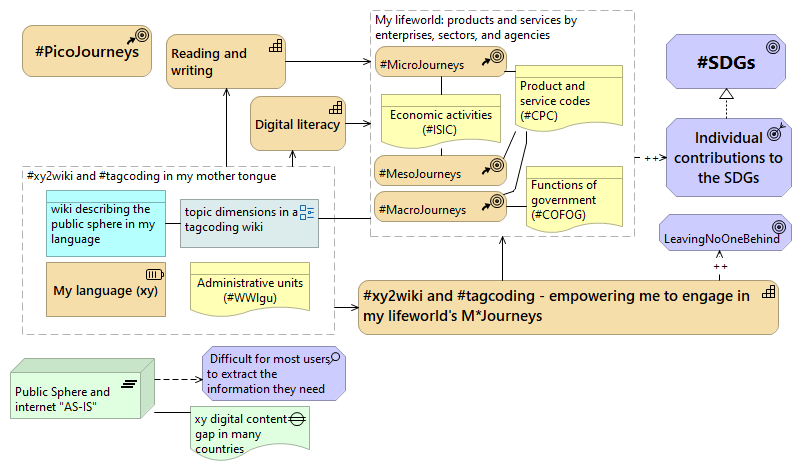
These competences must be combined with specific knowledge, experience and physical capacities of people as they fulfil the roles of pico actors in the classes of economic activity listed in the International Standard Industrial Classification of All Economic Activities (ISIC). Without an ambition to be complete, Figure 6.2 depicts some aspects of the persons lifeworld, related goals, capabilities and gaps. The “xy digital content gap in many countries” refers to the lack of digital content in the native languages of many countries, especially developing countries.
Kolb; learning paths.
The article How companies learn your habits by Charles Duhigg (February 16, 2012, New York Times Magazine) explains and illustrates the importance of cue-routine-reward loops for people, and it explains how life-events, such as giving birth, make customers vulnerable to intervention by marketers.
The Max-Neef Model of Human-Scale Development: for a brief summary, see Max-Neef on Human Needs and Human-Scale Development(Rainforestinfo.org), or the full version as part of Human Scale Development - Conception, Application and Further Reflections (Manfred A. Max-Neef, with contributions from Antonio Elizalde, Martin Hopenhayn).
Maslow’s hierarchy of needs gives a holistic perspective on a person’s needs. These needs must be taken into consideration in change, education and training initiatives (Simons, Irwin and Drinnien, 1987).
- Physiological Needs consist of needs for oxygen, food, water, and a relatively constant body temperature. They are the strongest needs because if a person were deprived of all needs, these would come first in the person’s search for satisfaction.
- Safety Needs. When all physiological needs are satisfied and are no longer controlling thoughts and behaviours, the needs for security can become active. Adults have little awareness of their security needs except in times of emergency or periods of disorganization in the social structure (such as widespread rioting). Children often display the signs of insecurity and the need to be safe.
- Needs of Love, Affection and Belongingness can emerge next. Maslow states that people seek to overcome feelings of loneliness and alienation. This involves both giving and receiving love, affection and the sense of belonging.
- Needs for Esteem can become dominant next. These involve needs for both self-esteem and for the esteem a person gets from others. When these needs are satisfied, the person feels self-confident and valuable as a person in the world. When these needs are frustrated, the person feels inferior, weak, helpless and worthless.
- Needs for Self-Actualization are activated if and only if all of the foregoing needs are satisfied. Maslow describes self-actualization as a person’s need to be and do that which the person was “born to do.” “A musician must make music, an artist must paint, and a poet must write.” These needs make themselves felt in signs of restlessness that cannot be attributed to the non-satisfaction of the foregoing needs
For a person in a high-tech facility, Yamada (2002) explains the issues.
The Person’s Context
The Sustainable Livelihoods Framework (Chambers and Conway, 1991) offers a comprehensive view of the assets and capacities a person needs to escape poverty on a sustainable basis, and of the interactions between the vulnerability context and the poverty of persons and households. Any person needs a critical mass of assets to cope with stresses and shocks, and to maintain and enhance capabilities.
For the person in a high-tech facility, Yamada (2002) explains the issues.
Several proposed education sector initiatives to help overcoming failures in meeting fundamental human rights are listed at (possible) education Initiatives.
Cases and problems
The literature on psychology and pedagogy lists many cases and problem analyses and illustrates change factors and their drivers.
Outcomes / values
What outcomes are valued and produced? How are they measured?
In methods of sustainable development it must be ascertained that even smallholders, poor and disadvantaged persons can interactively influence the joint generation of options, joint decision making and joint actions. This is inclusion.
The use of the mother tongue in education, and the availability of educational content are important enabling conditions for smallholders’ participation in socio-economic development. They are even fundamental human rights, as stated in Article 17 of the UN Convention on the Rights of the Child. Yet in many languages the offering of educational and other content is very limited, as can be seen for a range of languages.
Care of the self and the family. Personal health and wealth.
The backlinks tab of the 2030 Agenda Indicators lists some surveys that include indicators for persons and househoulds:
- Census
- Civil Registration and Vital Statistics System (CRVS)
- Demographic and Health Survey (DHS)
- Global Findex
- Health Facility Data (HFD)
- Household Income and Expenditure Survey (HIES)
- ILO
- Labour Force Survey (LFS)
- Living Standards Measurement Survey (LSMS)
- Programme for International Student Assessment (PISA)
6.4 - Transformation at level Micro
This content is not available in the sample book. The book and its extras can be purchased from Leanpub at https://leanpub.com/socarch.
6.5 - Transformation at level Meso
This content is not available in the sample book. The book and its extras can be purchased from Leanpub at https://leanpub.com/socarch.
6.6 - Transformation at level Macro
This content is not available in the sample book. The book and its extras can be purchased from Leanpub at https://leanpub.com/socarch.
6.7 - Why Societal Architecture?
North, Wallis and Weingast (2009) explain the difference between natural states and modern societies. Modern societies create open access to economic and political organizations, and by doing so they foster political and economic competition, and development.
In the modern society, the balance between open access resources and private property is a subtle one. For knowledge resources, this balance seems to be least understood. Also claims on land, sea and its use are a contentious area.
Vagueness regarding the allocation of resources, be it land, knowledge or material, induces individual risk considerations that hinder development.
By using a multi-level classification of the actors in a “landscape” in which we distinguish biotope, sociotope and technotope we can articulate and vary the rules of interaction and the claims on resources.
By visually representing the claims that exist on contested resources various actors can be allocated better understood and delineated claims on resources, which will be inputs to the construction of sustainable and equitable futures. This construction of a sustainable future must proceed at each of the four socio-technical levels where stakeholders develop or acquire capabilities and interact with resources as mapped or encountered in their journeys.
Both the classification and the visual representations are indispensable instruments in re-architecting the socio-technical fabric of the techno-globe, to enable more inclusive, equitable and sustainable development and clarify what it means to be a member of a global partnership for the #2030Agenda for Sustainable Development - #SDGs. #LeaveNoOneBehind.
In the next chapter, we describe each CPIM phase in detail and propose modalities for performing it, taking into consideration the 2030 Agenda for Sustainable Development, the Addis Ababa Action Agenda and digital public goods.