2 Visual Work Management
Traditionally, management operates behind closed doors. In various meetings, program managers, product managers or line managers get together to discuss key figures — be it the state of completion, cost efficiency or resource allocation. Doing this fosters tunnel vision: little attention is paid to anything beyond the functional organisation. Because of this, management of customer-oriented value streams remains largely non-transparent; not entirely clear in the best case, and completely obscure in the worst case.
How do self-organising companies manage their work flow? How do they deal with the complex and mostly invisible dependencies of knowledge work? And how do they overcome the chronic lack of communication that paradoxically occurs from an overflow of information? From my experience, which I also wrote about with Klaus Leopold in Kanban Change Leadership [1], you get the best answers with the help of visual work management systems.
2.1 Kanban
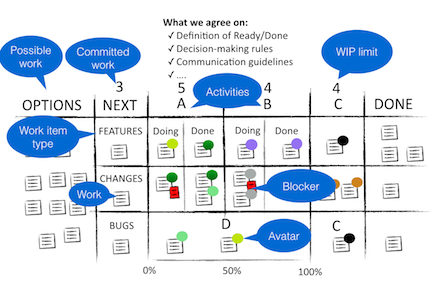
Visual work management helps us visualise what is normally invisible. Complex processes become transparent when we use simple practices to represent our daily work. Figure 2-1 shows a sample of such a representation, which manifests itself as a physical board. Such a board shows us many elements:
- All the work we are currently working on (small squares).
- The types of work there are (for example, features, changes, or bugs).
- The characteristic activities that the work goes through before it's completed (denoted abstractly as A, B and C between the columns of Options and Next on the left hand-side and Done on the right hand-side).
- The maximum number of work items that can be in each activity at one time—regulated by the so-called WIP limit (see the numbers above the columns).
- The quality criteria that are assigned to each activity (definition of "Ready" or "Done").
- Who is busy with what (according to the avatars used, represented by coloured dots here).
- Work that is blocked (shown as little red squares).
- How many activities have already been completed on each work item (according to the work flow).
What does visual work management have to do with flow? With Kanban, it's about having processes that flow as smoothly as possible—and overcoming the inherent risks in these processes. We want to manage our work with our eyes open, channel it correctly, recognize necessary changes early and take care of them as fast as possible. The emphasis is placed on the "We" because Kanban makes everyone working in the system responsible for its management. It isn't just a coincidence that a key principle in Kanban is encouraging leadership at all levels.
Visual work management systems support shared responsibility in many ways:
- It brings work and management together: those that operate the system also manage it.
- For logical reasons, the people managing the work flow are also involved in the design of their management system. The design should be created by those who work in the system rather than dictated by hierarchy.
- External stakeholders only influence this self-organising dynamic by coordinating the input queue. Customers, or customer representatives, determine the what, but the how is defined by those who operate the system. Micromanagement destabilises the system as much as every stakeholder does when attempting to bypass the rules.
- The conscious limitation of all parallel work from arrival (see "Ready" in Figure 5-1) across the entire work flow (see the value-generating activities "A", "B" and "C") up through departure (see "Finished") helps the operators keep their system stable and predictable.
- The system operators are empowered to make all decisions relevant to the workflow, such as handling blockades, dealing with bottlenecks or analysing customer feedback.
- The necessary feedback loops are also created together. How often do we need to synchronise with whom about what? Which metrics make sense? What do we want to communicate to the outside? With whom should we regularly coordinate our efforts?
All work follows some kind of flow. This is why it is so important to keep an eye on the quality of this flow. You can certainly manage a flow-based system without Kanban. As soon as we treat our work process as a series of value-generating activities, we are already on our way. The crucial point is not the method, but the logic behind it; namely, the logic of defining the enterprise in terms of customer-oriented flow instead of internal organisational structures.
2.2 Flight Levels
Experience has shown that we can make our management lives easier with Kanban. This applies to subject matter experts, who can see their work in a new light, the same as it does to line managers, who suddenly have the black box of daily business illuminated. Above all, visual work management systems provide an outstanding service when dealing with enterprise-wide self-organisation. My colleague, Klaus Leopold, shows how we can setup such systems (Figure 2-2) with his Flight Levels model [2].
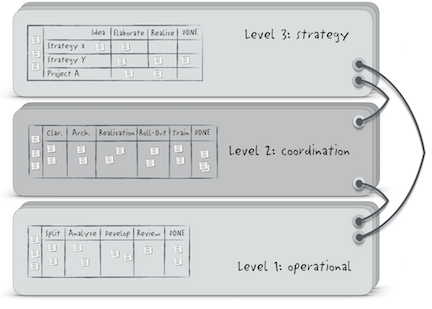
Basically, each level uses the same core practices and principles. Just as you can see in the above figure, it means tailoring the various elements to fit your needs. This applies to the operational board of individual teams (Flight Level 1), the cross-team coordination of the entire value stream (Flight Level 2), and the system that illustrates the portfolio of a business area (Flight Level 3).
Klaus Leopold emphasizes that these Flight Levels are not a capability maturity model: Flight Level 2 is not twice as good as Flight Level 1, and also cannot be refined into Flight Level 3. Although it has to do with transparent management, each level addresses special challenges. For instance, the flow of tasks in daily operations, the creation of value across various units, or the focus on company performance based on a good mixture of projects, services or innovation initiatives.
The various Flight Levels are, however, very much associated with different levels of effectiveness. Kanban can be implemented well at the operational level of teams or departments, but the potential for improvement is much higher at the coordination or strategy level. Flight Level 3 inevitably has an effect on many, if not all, areas. With the help of professional visualisation, we could even gain an overview of the whole enterprise at this level. And this is where the decisions are made that have far-reaching ramifications for our business. How do we handle the gap between the existing business opportunities and our current capabilities? How do we choose the most promising ones from our pool of options? And how many initiatives can we work on at the same time, in light of our limited capabilities? All in all, Flight Level 3 deals with "making prudent choices and combination of projects, developing products and strategic initiatives, recognizing dependencies and optimizing the flow through the value creation chain with the currently available resources" [3].
Of course, the Flight Levels do not force us into an either-or scenario. The various levels can be connected to one another, like the brackets in Figure 2-2 suggest. A strategic portfolio can easily use Kanban for the entire value stream, which in turn supports any number of operational teams. In specific cases, special projects that have no need for coordination can be derived from the strategy board —thus connecting Flight Levels 1 and 3.
Nevertheless, it is not inherently necessary that all initiatives monitored on the strategy board work with Kanban. Scrum, or even the classic Waterfall approach, can be used for running your daily business. Ultimately, substantially larger units flow at the portfolio or value stream level than at the team or department level — strategic options like "less consulting and more service at the customer" and "international expansion of our platform in three countries". While strategic options are chosen at Flight Level 3, Flight Level 2 helps monitor the progress of larger work packages, which are split into individual tasks and executed at Flight Level 1.
The UNO (Unified Network Objects) department at the Swiss Federal Railways is a great example of how a system can operate over two Flight Levels [4]. As pioneer in a now enterprise-wide initiative, the department began in 2012 to apply visual work management. What started off as an overwhelming jumble of Post-its visualising all the tasks for the first time, gradually developed into a management system that connected Flight Levels 1 and 2. Figure 2-3 shows UNO´s workflow, starting with customer input via the Key-Account Management Board, monitored on the main board and processed step-by-step on the team boards. Continuously aligning individual activities (see the red arrows) with their main board ensures superior quality of the deliverable object. Internal dependencies, blockades or bottlenecks are identified early on and dealt with together. The frequency of meetings providing regular feedback is denoted in the red boxes: the individual team standups, the coordination of the team delegates, as well as the monthly retrospectives for working on the change board, where all internal improvements are monitored.
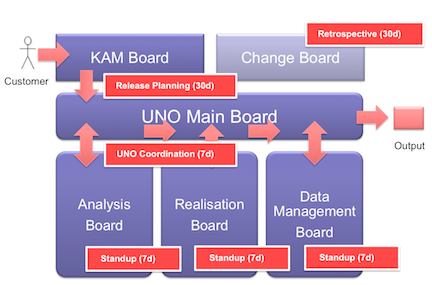
This system-wide networking is a good fit for the content that UNO works with. The Unified Network Objects specialists link a large amount of raw data to an information network that is the basis for timetable planning, train prognosis and train control. Overview is an important issue to ensure completeness, quality and consistency of the output. Kanban has benefited UNO in many ways in the nearly five years it has been in use. According to team leader Michael Beyer, following are the most important benefits:
- Rapid Success. Quick Wins encouraged further improvement activities, which in turn have a positive effect on the daily work and keeps motivation high for everyone involved.
- Improved Management. Transparency facilitates better communication with all internal and external stakeholders from UNO. In addition, the principle of stop starting, start finishing helped to optimise both throughput and quality.
- Active Agility. Continuous inspection and adaption to changing circumstances is now a standard procedure. The amount of improvements that have been implemented over the years has impressed everyone involved.
- Cultural Change. Since the introduction of Kanban, employees have gradually become players instead of observers. The shared responsibility for creating value leads to teamwork that is characterized by mutual respect and understanding the big picture. The employees have become active change agents who not only run, but also regularly improve the system. In the best sense of self-organisation, the subject matter experts take on a large amount of management responsibility. They make the necessary decisions and bring new ideas to make UNO even more efficient.
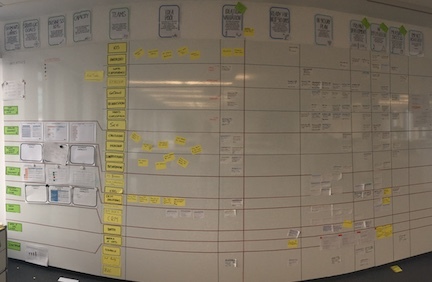
Another practical example shows us how Kanban can be implemented with a focus on strategy. This example is the Kanban board from the German online platform AutoScout24, on which the work for a total of 250 people is represented (Figure 2-4). As a system of the third Flight Level, the board shows us the larger projects, instead of individual tasks, that generate value for the customer as soon as they are completed. In order to assure a good workflow and identify any flow problems early on, the entire value creation process in all relevant customer segments is visualised (see the green cards on the very left). In addition, the individual teams within these segments are represented (see the vertical column of yellow cards). The main activities for the entire workflow across all segments are included on the larger cards running horizontally across the top of the board. In typical Kanban manner, these activities go from an open option pool to an idea generation and assessment phase where the most promising projects are chosen. In addition, these projects are developed using specific success criteria that are checked against the original value proposition. This way, the precise impact of the project is documented.
Since the individual options can vary in size, an overall fixed WIP limit cannot be used. However, too many parallel initiatives will lead to bottlenecks at this Flight Level too, so the WIP limit is always on the agenda at the regular alignment meetings with the representatives of each segment. Along with limiting the initiatives, these meetings deal primarily with four questions:
- What impact did we achieve with our initiative?
- What actual value has been created?
- What is the state of our current initiatives?
- And what can we learn from the overall situation for future use?
2.3 Information and Interaction
All in all, multi-level systems create new design opportunities for any organisation:
- It's suddenly apparent for all people how their own work contributes to the big picture—not everyone may like this transparency, but it allows for more open discussions.
- The personal contribution to overall success is as obvious as the factors that can jeopardize it.
- The systemic effects of individual action become tangible.
- The need for continuous improvement becomes transparent.
- Feedback loops between individual subsystems become faster.
- The entire system can respond more quickly to changes—regardless if these changes are dictated by the market, forced due to strategic initiatives or imposed because of internal problems.
The Flight Levels reiterate the idea — inspired by Russell Ackoff — that an agile enterprise is not the sum of its agile subsystems, just as a team´s success is not the sum of each individual's performance. It isn't enough to just have Scrum or Kanban teams. What's really needed is agile interactions between these teams and the relevant stakeholders of the system. How do we make sure that we are working on the right things at the right time? Who needs to coordinate with whom to optimize the handover? How can we rapidly respond to blockades or bottlenecks? And how do we know if we are really improving? It is important that the entire value stream is considered when answering these questions. Only then can we guarantee our customers also benefit from our self-organisation.
Many companies align themselves along customer groups or product families in order to strengthen their strategic focus. This way, strengths can be pooled, handovers simplified and cycle times reduced. The German load restraint specialist allsafe JUNGFALK had this goal in mind when they eliminated all of their departments—the word department itself means to divide, which prevents flow-based connections. Instead, the company defined customer-oriented processes, which fosters good workflow in all areas.
In many cases, optimising the value stream goes hand-in-hand with its focus. One example is the French automotive parts supplier FAVI, when under the leadership of Jean-Francois Zobrist, that had so-called mini-factories, each focusing exclusively on a specific product or customer. Each mini-factory employed between 20 and 35 workers who had the necessary expertise to be fully responsible for their whole business. And each factory had its own identity, characterised by a colour or customer logo, and was led by a democratically elected manager.
The real estate platform ImmobilienScout24 is a similarly flow-based organisation. Scrum teams that were responsible for development and service were consolidated first into product-type service lines, and later into specific market segments. To ensure mindful management, each of these market segments are led by a cross-functional team from Sales, Product, Marketing and IT. Together, these fantastic four have complete responsibility for the product and business development in their segment.
The online travel agency Traum-Ferienwohnungen is also completely focused on their customers. Each of the five cells of Traum-Ferienwohnungen contains employees from all domains who must work together to provide a high-quality service: customer service agents, software developers, marketing and sales professionals, as well as controllers. The internal coach Achim Hensen states: "In this way, the employees can focus on the requirements of their specific customer group. And they can completely serve the customer from a single source".
Transparent management is inseparable from an open information policy. For instance, the employees of the fire protection experts hhpberlin can access all relevant business data at any time in the CRM system. There they can find information about the progress of current projects, identify new options and connect them by topic. At the same time, the executive management receives a real-time overview of the current situation, has an eye on running costs and can dispatch necessary resources in a timely manner. What IT provides the six locations and approximately 40 competence areas at hhpberlin for a fluid project organisation, is dealt with in a haptic manner and at a single location by allsafe JUNGFALK: partition walls with the relevant key figures, magnet boards with statistical results or blackboards with business information are ever-present. In addition, there is also a strategy wall where all current processes, employees and customers can be found.
Viennese software specialist Compax achieves transparency in a similar fashion: In a monthly newsletter, the executive management communicates all relevant business data, discusses customer projects and introduces new ideas. And Hoppmann Autowelt publishes not only noteworthy business information in their employee newspaper, but also the current profit and loss statements. However, we should not make the mistake of equating pure information with understanding. In many cases understanding is also dependent on expert know-how. Publishing financial figures only makes sense when they can be read and understood in the context of your own work. To achieve this, for example, self-organisation pioneer Semco taught their employees how to read a balance sheet.
Simply imposing self-organisation rarely leads to the desired results. In addition to the basic information of what and why, the how must be designed together. Without open discussion, true commitment will not be achieved. This is also clear to the hotel chain Upstalsboom, which is why culture workshops have become as standard as the breakfasts where ten randomly chosen employees from various departments take part. Workshops and breakfasts help prevent silo thinking and instead encourage exchanges across all areas. The framework supports a deeper learning and understanding of the existing differences: At each workshop, the participants consist of at least 50% new employees across all departments and a maximum of 40% management. This framework provides meaningful exchanges where personal feedback is as important as feedback to the company. And this leads us nicely into the topic of the next chapter.
Key takeaways from this chapter
If companies want to be agile, they need flexible management systems. If they need an eternity to respond to external change impulses, they have already lost. Flexibility is not possible without transparency. Otherwise, it is too difficult to recognize where the company is currently heading and whether or not this course should be modified. Last but not least, companies need to concentrate on workflows that generate value, making customer benefit their top priority.
In this chapter, you learn how a visual work management system (Kanban) can be used to successfully combine transparency, flexibility and flow. Klaus Leopold's Flight Level model allows for such a combination for different purposes: for improved handling of operational tasks in teams or departments, for coordinating value streams across teams or for designing your strategic portfolio.
All Flight Levels exist to utilize the available resources in the best way possible. Because of this, they must align themselves towards maximum customer benefit, limit the amount of parallel work and share the available knowledge. The online platform AutoScout24, the load restraint company allsafe JUNGFALK, the metal processor FAVI or the hotel chain Upstalsboom demonstrate how a company can achieve a high level of self-management without losing control.