4 Customized Decisions
Decisions are the lifeblood of organisations. By making decisions, we process complexity, absorb uncertainty and empower our actions. If you follow systems theory, organisations can only exist if decisions are made and communicated on an ongoing basis. According to systems thinking guru Niklas Luhmann, “communicating decisions, and continuously reproducing the need for decisions, ensures the system has a kind of self-made chaos.”[1]
Thus, organisations are only effective, if they thrive on this chaos by continuously developing their decision making capability. Which leads to the question about how decisions are made. What is the decision-making culture of your company? And how does this culture support self-organisation at all levels? Traditionally, decision making has been a function of hierarchy. Line management os calling the shots. This reduces the effort, but leads to a list of problems:
- Decisions are either made too late or not at all.
- Decisions are not transparent and, as such, difficult to understand.
- The authority to make decisions is not defined. For certain decisions, nobody is responsible, but for other decisions, several people are responsible.
- The scope of decisions is unclear: What even needs to be decided?
- The procedure for making decisions is unclear: How will decisions be made?
- Decision-making authority is clarified, but then is overruled by a higher-ranking person in the hierarchy.
Looking at our daily problems, it should come as no surprise that centralising decision-making authority hinders both agility and self-organisation. Decentralised decision making is even more valuable when you consider risk management. On one hand, it speeds up the company´s response time: Critical points are dealt with more quickly, risks are anticipated earlier and counter-measures are better undertaken—just like the procedures of High Reliability Organisations show. On the other hand, it also addresses general business risks. When decision-making power is monopolized by top management, the economic potential of lower-level decision making remains untapped. As Don Reinertsen argues, decentralised decisions have an enormous effect on the performance of the entire organisation. If we assume an organisation is dependent on its most important strategic decisions, we will become victims of what Reinertsen calls the Pareto-Paradox. We overmanage the 20% of large decisions and undermanage the 80% of small opportunities that, in terms of true agility, should be realised for the customer’s benefit.[3]
4.1 Delegating Authority
The Swedish Handelsbanken is a great example of how delegating decision-making authority can be profitable. This venerable bank, in business since 1871, emphasizes a decentralised structure, making each local branch fully responsible for their entire business. Each of the almost 800 locations in 24 different countries, determine their own strategy, product portfolio, and marketing. Corporate-defined goals, fixed budgets and detailed forecasts do not exist. The efficiency of this approach is validated by an above average profitability for the Handelsbanken over the last 40 years, outstanding cost-efficiency and customer satisfaction. Not to mention, this financial institution was the only one in Sweden that did not receive governmental support during the global financial crisis. Obviously, it pays off to have relevant decisions be made by those closest to the customers. It not only makes economic sense, but also reinforces a relationship of trust and increases the employee’s self-awareness that their work contributes to both the customer’s satisfaction and the success of the company.
A similar story can be seen at Dutch software expert Incentro. At Incentro, there are neither fiscal plans or planning rituals, nor centralized functions that manage marketing or HR. Instead, all relevant business decisions are made by the individual business units. These units are organised according to geographical or technological areas, and concentrate on what company founder and board member Stef Lagomatis calls “the focus of energy”. Each quarter, 30 to 60 employees from all areas of the company realign their energies in order to keep their unit moving in the right direction. Employee satisfaction, customer satisfaction and profitability provide the key signposts for this course.
The Dutch healthcare network Buurtzorg also demonstrates that these principles lead to impressive synergies in a non-profit organisation. This network, which has grown to over 8,000 employees in 2016, is strictly organised into regional teams of 10 to 12 nurses. Beyond that, there are neither management teams nor centralised staff functions. Each team makes their own decisions, whether it is the number of patients cared for, how the care is given or scheduled, how meetings are conducted or how to coordinate with the family members, doctors and administrators. Each individual nurse acts more like a professional health coach than as an efficiency-driven healthcare agent. With ongoing training and coaching, each nurse makes all necessary decisions themselves. Self-management is ground breaking not only in the internal organisation, it is reflected in the autonomy of the patients that benefit from this relationship-based form of care. Instead of being dealt with anonymously, the nurses take time to ask questions, listen to the responses and support social activities. Without a doubt, these investments cost a lot of money. However, a 2010 survey by Ernst & Young calculated that these investments yield an impressive return. Since the patients are more satisfied with their care and require the services only half as long when compared to traditional care facilities, the public saves as much as 40% of the typical healthcare costs. A review by KPMG not only confirmed these figures, it also detected valuable side effects:
“Essentially, the program empowers nurses (rather than nursing assistants or cleaners) to deliver all the care that patients need. And while this has meant higher costs per hour, the result has been fewer hours in total. Indeed, by changing the model of care, Buurtzorg has accomplished a 50 percent reduction in hours of care, improved quality of care and raised work > satisfaction for their employees.” Buurtzorg
Something similarly impressive, but in a completely different area, can be seen at the German load restraint expert allsafe JUNGFALK. Between 1999 and 2016, revenues increased six-fold, EBIT increased twelve-fold and the number of employees increased five-fold. This period of success was accomplished by consistent lean management. Traditional departments and hierarchies were abolished and replaced by self-organising workflow management. Today, production teams themselves prioritise all incoming customer orders in order to guarantee good flow and high quality.
The terms quality, workflow management and success are naturally associated with Toyota. In their newest management agenda, the car manufacturer explicitly focuses on making decisions closer to the customer. Therefore, they will strengthen regional missions, support business activities having a close relationship to the community and allow more local autonomy. In addition, the hierarchy was pared down: Instead of 27 directors, there are now only 11, and globally only 60, rather than 77, top managers.
Delegating decision-making authority is important because business opportunities do not last forever. Just like risks, opportunities change over time, and often quicker than we would like. The longer we need to take advantage of certain options, to free up a bottleneck or to resolve a problem, the larger the economic effect will be. Profit margins disappear into thin air as solution costs rise to astronomical proportions. Usually, most opportunities and risks will be first recognized by the people who work closest to the customer. Zappos is convinced of this:
“Although change can and will come from all directions, it’s important that most of the changes in Zappos are driven from the bottom up: from the people on the front lines that are closest to the customers and/or issues” Zappos.
If the front lines were not given the necessary decision-making authority, the information — positive or negative — remains unused. Often such information doesn’t even show up on the business radar, let alone that it would become relevant for making decisions.
If we want to drive agility by increasing our awareness of opportunities and risks, then delegating decision-making power is necessary. This means giving enough authority to the areas that are closest to the customer. Ultimately, we want to be as “situationally elastic” as possible — as stated by the former Austrian Defence Minister, Gerald Klug, thereby creating the Austrian Word of the Year 2014. This type of situational elasticity has become standard in almost all self-organising enterprises, which grant experts a broad range of freedom. Agile feature teams at eSailors, for instance, determine their product development pool themselves, just as the interdisciplinary groups at Traum-Ferienwohnungen autonomously serve their customers, or the so-called niches at financial consultant Finext determine their specific project management. Even allsafe JUNGFALK has long ceased centralised supply management, repairs or investments. The employees make all the relevant decisions themselves and determine on short notice what they need for each customer assignment. And they also define when, how long and where they work. Instead of the usual control mechanisms, there is now trusted working time.

At the Viennese relay specialist TELE Haase, operational decisions are also made by the respective experts. The flow of core and support processes is determined by a group of 20 employees. An open exchange between the process circles encourages unforeseen capabilities to emerge, whether technical, managerial or linguistic, as was the case with a Portuguese-speaking apprentice who supported the sales team with a Brazilian customer. The transparency of decision-making in the various circles is shown not only on individual computers, but across all distributed iPads within the company. This way, it is possible to have access to all available business information on the in-house Infonet — whether at the employees work space or in the break areas.
Such democratic company cultures demonstrate that self-organisation is not just about operational decisions. At Haufe-umantis, for instance, strategic decisions are also made by involving all employees — such as the portfolio change from custom to standard software, the agreement about the company takeover by the Haufe Group, or the periodic election of executive management. In a similar way, design specialist IDEO always consults the employees before making important strategic decisions. At metal processor FAVI, teams were consulted when financial shortages arose from the economic crisis. When the final solution came from the employees, it reinforced the willingness to take responsibility and ensured these unpopular measures had the necessary support.
In many self-organising enterprises, decisions about new employees are made by those who will be impacted. After all, many of us spend more time with our colleagues than we do with our own families. Peer recruiting should enable all those involved to find a good fit for the group. Instead of classical HR processes, direct talks with potential colleagues, practice tasks or trial work days are used for testing teamwork. The hiring process at German telecommunications company sipgate is a perfect example. It begins with teams deciding if they need someone new for their team. If so, the team drafts a job advertisement and delegates someone to sit in on job interviews alongside personnel experts. The next steps are driven by fast feedback loops: Job applicants receive a response within 24 hours, and in the case of a negative message, the applicant is informed of the reason behind the company’s decision. The initial interview takes place with three or four team members along with HR, who then mutually decide if the candidate makes it to the next round, such as setting up a trial work day. The team is not only responsible for deciding on a candidate, they are also responsible for giving active feedback during the probationary period if someone is hired. The final decision of offering a permanent position is also made by the team—and directly communicated by them. This can be difficult, especially if they choose to not keep the new hire. However, it encourages consistent self-organisation over the long term, and improves personnel decisions as well.[4]
Autonomously managing planned and unplanned absences due to vacations, illness or business travel is standard in many self-organising enterprises. At pioneers like Semco, Gore or Morning Star, even determining the salaries is done on a cooperative basis, where those colleagues that work closest together give each other ratings: How great a role did my colleague play in the overall success? More, or even much more, than myself? Or less? At consulting firm Vollmer & Scheffczyk, a system where the employees determine their salary has been in place for several years. To start, everyone must consult with at least two co-workers using a new format about their respective salary suggestions before setting their own salary. It is based on two simple questions that must be answered by all employees. The first is: At which salary would you consider me overpaid? And the second is: At what salary would I feel underpaid? According to CEO Benno Löffler, this leads to an approximate range of your own and peer estimations, which yields important insights. Where does it fit? Where should we increase it? And what conclusions can we draw from the overall picture—especially in regards to typical salaries for this profession? As Löffler says, this enables transparency and makes individual decisions part of a cooperative network.
If you think such participative management would ruin the company, rest assured it doesn’t. The salary expenses at Vollmer & Scheffczyk have remained the same. Meanwhile, the heated discussions when this approach was first instituted have given way to pragmatic attitudes. Personal responsibility and commitment have risen considerably with this approach. The same goes for TELE Haase. As was the case, when self-determined salaries increased by nearly 90,000 Euros, it was clear to everyone that more revenues were needed to cover these expenses. In that same year, they achieved an increase in efficiency with an estimated value of more than 100,000 Euros, as well as a better gross margin, showing that a fundamental trust in the employee’s willingness and capabilities pays off. Such willingness is also underscored by a profit sharing model at allsafe JUNGFALK. According to executive manager Ulrich Lohmann, there are many forms for showing appreciation: boundaries that support autonomy, processes that ensure good workflow and continuous improvements made possible by the knowledge and good judgement of the employees. However, profit sharing that has been in place for many years is also important. When the company is doing well, everyone should benefit. And this profit sharing has had the positive side effect of employees paying more attention to costs and reducing waste.
4.2 Explicit Decision Management
The title of this section might be a bit irritating: Why must we again, or still, manage things? Isn’t it enough to just delegate decision-making authority? We should not overlook the fact that the path towards self-organisation brings more than just new freedom. The dissolution of traditional structures can bring unforeseen power struggles. All of a sudden, negotiation processes that were once dealt with through hierarchical structures are now part of daily business. To prevent possible confusion, I recommend once again to define explicit parameters: Which decisions need to be made? In what form will this occur? And who is responsible for it? If there is no active management of these new options, it can quickly lead to false assumptions. Each person has something different in mind and often relies just on their gut feeling. This leads to recurring debates á la Bill Murray in Groundhog’s Day.
So how can making decisions be regulated across the entire company? How can an organisation make sure their entire business know-how is available when dealing with critical decisions? How can you find out which decision-making format makes the most sense? From my experience, two methods are especially useful for answering these questions: the RACI Matrix, which originates from the Six Sigma approach, and the Delegation Board, which comes from the field of systemic consulting. How do these methods work? And how do they support entrepreneurial self-organisation? Generally speaking, the goal of the RACI Matrix is to clarify specific roles and responsibilities. It is filled out in three main steps.
- Defining Roles: Who is involved? Who needs to be included and in what form, if we want to make good decisions?
- Identifying Work Packages: What needs to be decided? Where do we need clear responsibilities?
- Clarifying Responsibilities: Who does which work (R stands for responsible)? Who carries the overall responsibility (A is for accountable)? Who should be actively involved and possibly even asked for input (C like consulting)? Who needs to stay informed (I for informed)?
| Work | Role 1 | Role 2 | Role 3 | Role 4 |
|---|---|---|---|---|
| Package 1 | R | A | C | |
| Package 2 | A | R | I | |
| Package 3 | A | R | C | |
| Package 4 | C | I | A | R |
| Package 5 | R | I | A |
Table 4-1 Sample RACI Matrix
Co-creating a RACI Matrix has several advantages: * It helps us to capture the typical range of work in our system. * It assigns those responsible and those involved to these tasks. * It improves communication. * The probability of overlooking important stakeholders is reduced. * Misunderstandings can be eliminated with open dialogue: At the end, everyone knows what their tasks are and with whom they need to coordinate. * In this sense, the decision management can be seen as a twin of visual work management—while the latter provides visibility, the former explicitly defines what is often only implicitly understood.
In comparison to the RACI Matrix, the Delegation Board concentrates more on how the decisions are made. As soon as the “What” is clarified, the next step is determining the “How”: How should we make decisions? Who should take responsibility for them? Who will be involved and in what form? And how can respective forms of decision making be setup? The board is worked out in the following steps: 1. Defining your decision-making areas 2. Defining how to make decisions 3. Clarifying your current state 4. Agreeing on your future state
Defining your decision-making areas
This point deals with collecting all relevant information for making decisions: Brainwriting (each aspect written on an individual Post-It) and clustering (bundling the Post-Its according to topic) are effective facilitation techniques that ensure a strict course of action. Table 4-2 shows an example of what this definition could look like from lottery specialist eSailors.
| Area | Decisions |
|---|---|
| Technology | Technological decisions affecting the Team |
| Technological decisions affecting various Teams | |
| Decisions about the infrastructure | |
| Organisation | Internal work management |
| Methods | |
| Meetings | |
| Metrics | |
| Homeoffice | |
| Holidays | |
| Continued Education | |
| New Hires | |
| Feedback on behaviour & performance | |
| Budget | Investments in infrastructure & equipment |
| Investments in hardware & licenses | |
| Investments in travel, training & conferences | |
| Investments in coaching or team building |
Table 4-2 Sample Decision-Making Areas
Defining how to make decisions
In this step, you are clarifying how a decision should be made. My experience has shown that distinguishing four ways is enough: * Hierarchical decisions, made from the top down, are part of the systemic framework. * Consultative decisions are also made within the hierarchy, but where those affected by the decision are asked for their input. * Collaborative decisions are worked through in an open discussion forum. * Autonomous decisions are firmly placed within individual groups or with subject matter experts.
Clarifying your current state
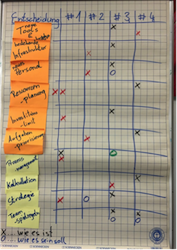
What decisions are currently made? When is someone asked for their opinion? Where is there a case for peer coaching? And who is allowed to make decisions alone? True to the motto, “Start with what you are doing now”, ascertaining the current situation offers an effective foundation for delegating authority—and often uncovers different points of view (see the various coloured X in Figure 4-2).
Agreeing on your future state
Analogous to the Agile Planning Poker Game, this process can be done in a gaming fashion. Each person involved gets a set of cards covering all relevant forms of decision making, numbered 1 to 4. For each decision area, all participants play their cards at the same time. The cards are initially placed on the table without comment, then a discussion follows about the differences between the numbers chosen. However, it isn’t going about justifying the decisions or persuading others to change their minds. Instead, the goal is understanding: Why did my colleague play a 2, when the other colleagues and myself put down a 3? How does the manager explain his 1, when all the others played a 4? And so on. This type of poker has nothing to do with bluffing, rather it deals with open communication and sustainable agreements.
In order to clarify decision making effectively, it must be combined with professional change management from the beginning. Such change usually starts with the “Why?” This applies equally to the need for and the urgency of explicit decision management: Why do we need it? How does it support self-organisation? Why do we believe this will make us more agile? And what impact does it have on our value creation process? In this preliminary phase, information should not be confused with communication, and feedback should be taken seriously. Perhaps it is not clear to the stakeholders what the benefits will be. Perhaps the decision-making policies are not seen as a critical point. Perhaps the fear is that such policies will degenerate into political wrangling — or that they will make power struggles more difficult in the future.
Implementing a RACI Matrix or a Delegation Board requires thorough preparation in terms of facilitation and focus. While facilitation deals with the well-known issues of time, execution and intermediate goals, the focus should remind us that self-organisation does not mean grassroots democracy. Effective decision management is dependent on a clearly defined framework. This requires line management doing their homework: Which decisions must be restricted? What will not be put up for discussion—at least not now? And where is management truly ready to accept team or professional decisions? Part of this homework includes determining how to evaluate the set-up. How can the manager evaluate whether the quality of decisions has improved? And how exactly will it be validated? It’s understood that both methods described here are not intended to be used just once, but must be applied in a consistent manner. It is also important to check whether the delegation of decision-making authority supports self-organisation. Otherwise, there is a risk that the Delegation Board will become just another piece of paper.
4.3 Simple Techniques for Deciding
Along with the RACI matrix and Delegation Board, self-organising enterprises also use specific methods to simplify decision-making.
The Point Query has proven itself useful for finding a democratic majority in any group. Depending on what is to be decided, options are visualised on cards or on a flip chart. Then, all group members receive a set number of dot stickers and mark their respective favourites (depending on the number of ideas, typically 2–4). To prevent peer-group pressure, the individual favourites can be written on the dot stickers before the actual query starts. In groups that already have experience with this method, marking your preferences directly will also work. In this case, a simple X or I marking can be used instead of dot stickers. At the end, the points are simply counted and the options are ranked by priority.
The Law of Two Feet turns the more cognitive Point Query into a decision that you have to stand behind, so to speak. In contrast to the Point-Based Query, the options are not listed on a board, rather they are visualised individually on different sheets of paper. Afterwards, these sheets are distributed across the room and the participants are asked to go to the option that attract them the most. If there are not too many options in the room, the distribution of people determines the respective majority.

The Five Finger Demo also needs a bit of physical interaction. Some groups can discuss things forever, going over the same problems again and again and always asking new questions. In such situations, it can be helpful to interrupt the discussion to capture interim results and check consent. A method we call the Five Finger Demo can be used here. Everyone involved in the decision gathers in a circle and extends one of their arms. After a 3-2-1 countdown, everyone demonstrates their support for a specific idea with a showing of fingers. The number of fingers mean: - Five Fingers: I support the option 100%. - Four Fingers: I support the option by and large. - Three Fingers: I am going along with the majority. - Two Fingers: I would like to know more about certain aspects before I make a decision, namely …. - One Finger: I object to making a decision until we have dealt with the following question, namely ….
The so-called Thumb Barometer follows the decision-making system of the Roman Emperors. In our case, it is going about the fate of a discussion: Thumbs up mean “continue discussion”, thumbs down mean “stop discussion”. The same method can also be used for finding solutions. Thumbs down signalise a veto, thus showing that further communication is needed.
A Consultative Decision-Making Process allows employees to basically make every decision themselves, as long as they stick to a few fundamental rules. These rules include aligning with the most important stakeholders affected by the decision, as well as consulting with experts for the respective topics being decided. With this type of proactive help, the exchange of information and the quality and acceptance of decisions improves. Each decision is treated as a small change initiative, where those who are affected by the decision are also involved to a certain degree. At Gore, high risk decisions are called waterline decisions. Decisions that endanger the well-being of the company, such that the proverbial boat everyone is on is in danger of sinking, must be well coordinated: with those people who have expertise in the affected area and with the managers who are ultimately accountable. Based on these consultation principles, Morning Star employees are even entitled to make larger investment decisions. The waterline there requires creating a business plan that must then be presented and debated with colleagues.
Key take aways from this chapter
Decisions are the lifeblood of an organisation. When decisions are made, complexity is processed and uncertainties are absorbed. In this chapter, two strategies for making good decisions were presented. The first strategy looked at practical examples from very different, but equally successful, organisations such as the Swedish Handelsbanken, the Dutch health care network Buurtzorg or the Swiss software developer Haufe-umantis. The second strategy presented methods for how you could setup and implement you own decision management system. Whether you can take something from the examples given, can implement methods like the RACI Matrix or Delegation Board, or apply pragmatic approaches such as the Point-Based Query, Rule of Two Feet or a consultative decision-making process, one thing is for certain: you must distribute decision-making authority to encourage responsibility at all levels. The agility of your company rises and falls with the awareness of those who are based at the customer frontline. However, this awareness is about more than just simple observations. A crucial part of it is to embrace decisions that are relevant for the customer, as well as the company.