1 Customer First
"The only thing that bothers us is the customer", as the saying goes. Anyone who thinks this is just a cliché should take a look around. Customer trouble is still very much alive, especially in large enterprises. The day-to-day business is overloaded with tasks, work is broken apart by constant changes and line management adds additional uncertainty due to micro-managing. The fact that many companies willingly outsource their customer support speaks volumes. Instead of seeing their customer service as a valuable feedback loop, it is delegated to a call centre where the primary goal is efficient processing. The call centre agents do not concern themselves with the relationship between company and customer, nor do they provide feedback on this relationship to the company. Rather, they are used by the companies to keep the customers off their back.
Everyone is talking about agility, especially those who complain about market volatility. They want to reduce complexity, and dream of shorter response times. The brave ones apply Scrum and Kanban in more and more areas to achieve these goals. Some even see themselves as an agile enterprise because they have agile teams. At the same time, very few of these enterprises place the customer first. Instead, their organisational agendas remain focused inward. Local optimization (i.e. so-called high performing teams) and tactical action (i.e. performance management) are the order of business.
It's easy to forget, in light of such a mindset, that even the largest companies once started small. Today, we refer to them as startups. Despite many constantly changing factors, one law remains the same: companies can only survive if they have customers — and can only grow if the number of customers, along with their willingness to spend money, increases. When founding a company, it is completely normal to focus the company's actions around the customer. You know the customer, understand their needs and how to generate revenue from it. Otherwise, the company's development is over before it starts.

But how can a company keep its customer focus when it is no longer in its startup phase? How, when it's no longer a so-called garage-based business, but rather an enterprise with a growing number of employees? How, if it gradually starts becoming more concerned about process guidelines or standards of conduct rather than on activities that have value for the customer?
I am going to give you three answers that define the state of each enterprise: the mission, the vision and the strategy.
1.1 Mission and Vision
Why does our company exist? This is the fundamental question that a so-called mission statement answers.
Before you start writing your statement, there are two things that you should consider. First, how can you make sure that your mission statement drives the company, versus just being a piece of paper? Second, how would you like to develop this statement? Are you just going to dictate it from the top? Will you consult with certain colleagues? Maybe you will even have customers validate your value proposition?
The way in which you answer these questions could also reveal something about your understanding of management and your corporate culture. Regardless how large the organisational unit where the mission statement is intended, it should be a concise summary regarding the "what" and "why" of your work. Perhaps some practical examples would help? The mythical motorcycle manufacturer Harley-Davidson states, "We fulfil dreams through the experiences of motorcycling, by providing to motorcyclists and to the general public an expanding line of motorcycles and branded products and services in selected market segments". The supermarket chain Whole Foods writes, "Whole Foods Market is a dynamic leader in the quality food business. We are a mission-driven company that aims to set the standards of excellence for food retailers. We are building a business in which high standards permeate all aspects of our company. Quality is a state of mind at Whole Foods Market. The Swiss software developer Liip created a manifesto around their core values of agility, innovation, sustainability and fun. Besides the adaption of the manifesto for agile software development, you will also find some basic beliefs regarding web and development: the view that our current culture is determined by the internet, that it is imperative to invest in the company and in people equally, using Open Source technology, or the commitment towards innovative projects which foster the unique capabilities of the customers. And at outdoor specialist Patagonia, all of their activities consistently revolve around their mission statement to "Build the best product, cause no unnecessary harm, use business to inspire and implement solutions to the environmental crisis".
The Dutch nursing network Buurtzorg also started an ambitious undertaking:
"Improve the service and quality of home care through guidance and cooperation with local nurses, allowing every person to receive the type of care they need the most at the place they prefer to be—avoiding expensive institutional nursing care for as long as possible."
The Californian tomato company Morning Star even has four different mission statements: at the company level, between the autonomous divisions, in each operational unit and for every individual employee.
- The personal mission statements form the backbone of the company. They describe how each person contributes to the company's success.
- In a so-called CLOU (Certified Letter of Understanding), agreements between colleagues who work closely with one another are summarized. The majority of employees have approximately ten such CLOUs in which results, goals and metrics are stipulated.
- Every two months, the achieved results are used to compare the actual performance to the planned performance in the CLOU and, if necessary, take corrective action. The CLOU is transformed into a type of guidance system for the activities, instead of simply becoming a bureaucratic task.
- The same coordination principle is also used between the various departments and divisions, weaving each employee and each subsystem into a dense network of commitments. However, the network is not dictated by hierarchy, but instead is negotiated between colleagues. This is the main point of personal responsibility at Morning Star. "Make the mission your boss" is the motto [1].
Making a mission statement into something operational is important, because they often suffer the same fate as corporate values or principles. The mission statement lists a number of buzzwords, and leads a miserable existence plastered on the office walls. If carefully implemented, however, it can provide a high degree of clarity: It outlines what is expected from every individual, what they are supposed to do and how they contribute to the overall enterprise. According to Jean-Francois Zobrist, well-formulated mission statements help us go from being a "how" company to a "why" company. For the former CEO of the self-organising pioneer FAVI, it is not necessary to constantly tell someone how to do their job. By concentrating on plans, regulations and standards, you are occupying your time with everything other than what really counts, which is whether or not the work is completed properly and if the customer is satisfied. In comparison, "why" companies replace the proliferation of standards by one single question: "Why do you do what you do?" As long as the answer is, "To make the customer happy", according to Zobrist, there is no need to give any thought about how exactly that is accomplished [2].

If the mission explains the existence of your company, and gives each individual clarity about how they contribute to its success, then full speed ahead. But what is a vision then? Is it not the same thing? Although mission and vision are often interchanged in practice, there is a one main difference. While the former drives your business operation, the latter defines your higher aspirations. A vision should not be confused, however, with operational targets. Instead, it frames an idealized picture of your company's future.
- What do you want to accomplish in 5/10/x years?
- How will your business area look then?
- Who are your customers? What value will you deliver to them?
- What distinguishes your organisation? What separates you from your competition?
A well-formulated vision communicated to everyone can serve as a kind of guiding star, turning the focus towards the big picture when making decisions. Perhaps the most famous example of such a guiding star is Toyota's True North: zero failures, 100% value added, one-piece-flow, overall work security (mental, as well as physical) and professional challenges (meaning continuous improvement). At first glance, it is obvious that this vision can never be achieved. It is too strongly based on the superlative. Relentlessly striving for perfection, though, always spurns new improvements and ensures sustainable economic success, as Toyota has impressively proven despite various crises.
Companies in completely different sectors also understand how to set the bar high. The Finnish cleaning specialist SOL, for instance, formulates the vision of an outstanding service provider. "We want to be the best operator in the field of environmental issues, both for our customers and our personnel." Although this objective seems inconspicuous, it is quite ambitious since they are using chemicals on a daily basis. On the other hand, Zappos predicts., "One day, 30% of all retail transactions in the United States will be online. Consumers will buy from the company with the best service and the best selection. Zappos.com will be that online store."
Harley-Davidson has a vision which places an emphasis on two areas: "to continuously improve our mutually beneficial relationships with stakeholders (customers, suppliers, employees, shareholders, government and society)" and on the "empowerment of all employees to focus on value-added activities".
1.2 Strategy and Culture
Both mission and vision are ineffective without a coherent strategy. If you offer unattractive products and services, it makes little difference if you are self-organising or not. The same goes if you chase after a guiding star that doesn't shine. The customers will be as indifferent as your value creation. How can specific strategies be created that will pool existing strengths? How can you prevent these strategies from becoming costly ceremonies, like those celebrated all over the country by the large consulting firms? How can you set powerful objectives instead? At their peak, the Hamburg-based website specialist Jimdo was a perfect example of how strategy development can be done in a way that systematically uses the potential of self-organisation. The main idea was based on consistent focus. Goal #1 became whatever was currently promising the greatest value. This goal was not, however, simply given out and then monitored behind closed doors. Instead, delegates from all areas met at regular intervals in order to exchange information and to ensure effective coordination of everyone involved [3].
For strategy-oriented coordination in a self-organising enterprise, the swarming method has proven itself useful. These swarms are used anywhere the company has a complex business problem to solve. Similar to a swarm of fish, those persons having the necessary expertise for a solution self-organise themselves into a group. With adequate training, the swarming needs neither special facilitation nor a dedicated management to allocate resources. At personnel software expert Haufe-umantis, swarming can even be found at the strategic level. In the research and development area, there are around 60 self-organising employees that get together to pursue, from their point of view, the best value proposition. How does it help the customer to work even more successfully? What brings the greatest benefit? And how can we manage it? Every three months, these questions are worked on together so the available resources can be pooled in the best way possible. Fixed departments are as rare as classical managers in the research and development area. Harley-Davidson builds on something similar. Their "natural working groups" are organized into three segments and are geared towards bringing the right people together to implement projects with great potential. The employees find themselves within certain product, support or marketing circles to find appropriate solutions for the customer.
The Dutch nursing network Buurtzorg impressively demonstrates how an ambitious mission can be combined with a clear strategy. This strategy is comprised of six components [4]:
- Assessing the patient's needs. This is done holistically, and includes medical, social and personal concerns. Based on this assessment, an individual care plan is drafted.
- Gathering all the informal networks and their contribution to the care.
- Identifying the official caregiver and their involvement.
- Implementing the care.
- Supporting the patient, thus allowing them to exercise their social roles.
- Promoting independent care and personal independence.
These strongly bound components set the framework in which the private and professional nurses provide their services.
The question remains, though, about how you can assure the customer remains at the centre of your strategy. The answer to this question can vary, because self-organising enterprises themselves are quite diverse. The one thing they have in common is the consistent inclusion of the employees. Instead of making strategy exclusively a management responsibility, it is instead based on the experiences and ideas of those who are usually much closer to the customer. This can occur, as it does at sipgate, in a group composed of people from a range of departments and hierarchy, who regularly meet for strategy workshops. Or it can include all employees, like at eSailors, who meet quarterly for an overall review and planning meeting. Or, in the case of Computest, through a group delivering company-wide services, managed with a so-called discovery board.
Figure 1-2 shows my comparison in picture form. Furthermore, the picture solves the puzzle of what the spaceship should be named.
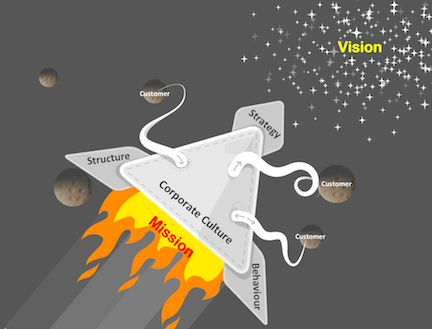
The importance of culture hardly needs to be emphasized in agile environments. "Culture is the true North Star," notes Arne Roock, which is obvious in many self-organising enterprises [5]. For business success employee satisfaction plays as equally a vital role as customer satisfaction does. And culture is often used as an argument for employee satisfaction. So far, so good. Figure 1-2 underscores, though, that this culture cannot be reduced to atmosphere, climate, spirit or something similarly vague. It emerges more as a result of the dynamic interaction of strategic, procedural and behavioural factors. The easiest way to translate the cumbersome concept of corporate culture, underlining this interaction, is "this is how we do it here”: this is how we see the market, this is how we perceive the challenges, this is how we work together, this is how we serve our customers, etc.
Corporate culture is not a single factor. It is not the product of the interplay of strategy, structure and behaviour. Thus, it is a broad and deep phenomenon that governs our thinking, feelings, actions. That is why changing the corporate culture is a costly and time-consuming undertaking. As dm´s CEO Erich Harsch points out, we cannot simply "flip a switch. Changing culture takes years." This change will be driven, according to Harsch, by two inseparable principles: through a customer-oriented stance and through the appreciation of individuals. The principle is, "customer first, and success will follow". This only works, though, if the individual isn't simply seen as a way to maximize profits. "If I treat my employees poorly, I shouldn't be surprised when they treat the customers poorly."
The power of corporate culture does not come as a surprise for Peter Stämpfli, president of the board of directors at communication service provider Stämpfli. On the contrary, the step-by-step transformation of the long-standing company towards more autonomy is hard to imagine without the existing foundation of equality and commitment. According to Stämpfli, this foundation is extremely important for answering the pressing questions of today: What challenges will the company face? What will be the effects of the ubiquitous digitalisation in various areas? And, as Stämpfli states, can "a different synergy between awareness and interaction" be achieved? More decision-making autonomy within clearly defined boundaries is one of the answers they are currently working on. Stämpfli is convinced that additional answers will lead towards a more agile leadership philosophy. Regardless how many more change experiments will be needed, the motto remains the same: Communication – person to person. And this motto, built on respect and trust, will continue to apply to employees as well as customers.
Harsch´s and Stämpfli´s ideas underscore an additional risk that accompanies every change of corporate culture, namely the risk that employee satisfaction and customer satisfaction will be separated from or even pitted against one another. Does the customer or the employee come first? Do we want to do a better job or create a good working environment? Do we want to embrace more business opportunities or cultivate new ways of working? It goes without saying that employees are the most valuable asset of an organisation. Without their experience and capabilities, without their commitment and business intelligence, we cannot achieve a single benefit of agility. This requires us to foster every type of corporate culture, whether it be treating each other with respect, exciting challenges, attractive conditions or a powerful employer brand. At the same time, it is important to retain the best employees over the long-term and win the war for talents.
On the other hand, we should not ignore that neither human nor technical resources can be used effectively if there is too little demand. If we want our business to develop, the unavoidable question is how we retain our regular customers while gaining new customers. How do we consistently align our corporate culture to the customer? Which structures and processes are needed for this? How does this affect the behaviour of the employees? How do we strategically align these behaviours? And, in turn, what effect does this strategy have on our structures and processes?
1.3 Design Thinking
I know these questions will be like opening up a can of worms. Almost 15 years ago, Henry Mintzberg already warned us about the adventures awaiting us in the jungle of the strategy industry [6]. But, with all due respect, I would like to wrap up this chapter by briefly taking a look into this jungle. Self-organising enterprises are not spared from the strategy safari, so how can you avoid getting lost in this concept jungle?
Based on what has already been stated, the answer is straightforward: Every strategy safari that has real discoveries in sight must inevitably lead us to the customer. However, it begs the question how to best make this journey, and at the same time learn something from it that benefits from our corporate culture. To navigate this journey successfully, I recommend using Design Thinking, which has significantly influenced how to develop an organisational strategy since the beginning of the 2000s [7].
Design Thinking was initially meant for the early phases of generating ideas, but has since been used in many business areas: the entire product development cycle, the introduction of various services, strategy development, as well as organisational design. Moreover, Design Thinking pioneer IDEO has been using this method in developing countries for several years.
Since its start, Design Thinking has left its mark on many companies. It can be seen in new products or services. It can also be seen, though, in the change initiatives, innovation forums or strategy discussions. Invariably, the same issues always have to be addressed. Issues such as how to raise the awareness of each employee, how to use their knowledge and experience, or how to transform these forces into promising initiatives.
The interdisciplinary and iterative nature of Design Thinking makes it a close relative of agile methods. On the other hand, the focus on customers, the experimental nature and the prototype-focused approach are in the tradition of lean thinking. And without self-organisation, without the willingness to intensively communicate across many areas and test new methods, every innovative endeavour is already on the wrong path.
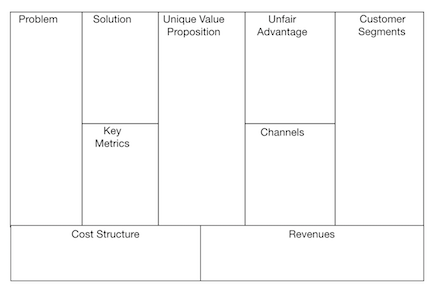
At the same time, Design Thinking inspires new practices in all of these areas. Ash Maurya's Running Lean concept appears most promising in this regard [8]. Maurya starts with the classical innovation questions: Are the customers interested in our product or services? Are they also willing to pay for them? And how difficult is it to actually develop and deliver? The answers to these questions are driven by a Unique Value Proposition. In the area between problem and solution, this proposition outlines how the customer benefits from our idea. Before we do our best to get this idea to market, however, we should also do some homework. Which channels do we want to use to distribute our product? What does it cost to provide a specific service? What type of revenues are we expecting? And how do we know if we heading in the right direction? To prevent us from going crazy with so many questions, Maurya offers us a simple template to keep an overview of our most important answers. Figure 1-4 shows his so-called Lean Canvas, which can be used as a template for the entire innovation process.
The canvas alone does not eliminate all of the questions we are confronted with at the beginning of any innovation cycle. However, it helps to keep an overview of all the relevant factors when dealing with three business-critical risks:
- Product Risk: Which problem are we solving? What needs are being met with it? What would a minimally viable product (MVP) look like, which allows us to test our idea with minimal cost?
- Customer Risk: For whom exactly is the problem we have identified a concern? For whom is it so important that they would be willing to pay for a solution? How do we find those who are ready for it right now?
- Market Risk: How is the problem being dealt with currently? What other solutions are already available? What price can we charge for our solution?
For effective risk management, Maurya recommends that we don't rely on typical data gathering. The number of clicks, the usage time or simple sales figures tell us little about the actual customer experience. Instead of vaguely interpreting these figures, we would be better off having direct contact with the customer. He recommends three specific formats for this: the problem interview, the solution interview and the interview regarding our MVP.
Regardless of your specific business hypotheses, prototypes or interviewee partner — the direct interaction will help you gain crucial insights with minimal effort. Interviews are a simple means to continuously collect data in an iterative way. Instead of pondering too long over ideas, sitting forever in internal innovation workshops and keeping yourself busy with your own product versions, you should follow the basic principle of business agility: customer first!
The next chapter will give you information on how you can successfully implement your business ideas. If your company is not a startup, the innovators are forced to compete with existing offers. Which begs the question as to how you can make sure your innovation initiative doesn't just get started, but can be finished within a reasonable amount of time without negatively affecting your current cash cows. How can you manage such a balancing act? How can you secure enough resources for new initiatives when the existing work itself requires so much? How do you continue to improve? And how do you monitor all these things?

Key takeaways from this chapter
The title of the first chapter on scaling self-organisation points out the course of action: customer first. This course of action is reflected in the mission of a company, as well as in their vision or the strategy they use to follow this vision. If it doesn't add value to our customers, it doesn't count.
In the introduction to this chapter, you get an overview of the companies that were examined. Following that, specific examples are given of how companies focused on their customers. It's interesting to see how customer focus is done in companies of various sizes, histories or sectors and how it leads to a unique corporate culture.
State-of-the-art methods, such as Design Thinking or Lean Canvas, reiterate the idea that a customer-oriented corporate culture is not just important for the current business. Such a culture also leads to new products and services that, now more than ever, depend on agile interactions with the market.