5 Bold Experiments
The legendary Bill Gore asked his associates time and again, “Have you made any mistakes lately?”. When they would answer with no, he would state his mantra, “You haven’t been taking enough risks” [1]. The risks that Gore had in mind pertained to the topics of improvement and innovation. How should something improve if you are not willing to do something differently and accept any possible failures? And how would you replace something if you are not willing to leave the well-trodden path, instead being confronted with possible detours and dead ends?
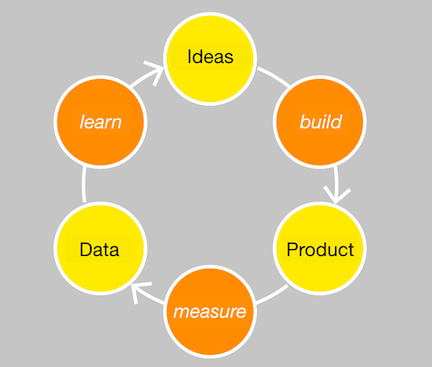
Eric Ries has given us a useful model to better manage the risks of innovation: build – measure – learn. His feedback loop is supported by two main elements. The first element is the Minimal Viable Product, a lean version of a product, developed with minimal effort, that can go through the entire loop. The second element is validated learning, which puts our subjective confidence “to the acid test of real numbers”[2]. According to Ries, too often the amount of uncertainty is underestimated. The explanations that are gladly given for why something didn’t succeed and all of the stories that are created to justify our actions and to rationalise disappointing results have nothing to do with valid feedback. The only thing that gives us certainty is empirical data on real customer behaviour. There is a reason why we talk about the value of experience. As different as these values might be, four fundamental questions remain the same:
- Do customers know they have the problem we are trying to solve?
- If there were a solution, would they buy it?
- Would they buy it from us?
- Can we build a solution for the identified problem?
Whoever tries something out also risks something, and whoever risks something doesn’t always have everything under control. So why should we take such risk upon ourselves? Former Formula One driver Mario Andretti had an answer for this: “If you have everything under control, you are simply not going fast enough.” Although very few companies deal with car racing, we can learn something from Andretti & Co. If we want our company to be as agile and powerful as a race car, we must accept certain risks. We cannot avoid uncertainty when we want to try something new.
5.1 Growth and Agility
According to Diego Rodriguez and Ryan Jacoby, two experts of the design thinking pioneer IDEO, there are four distinguishable paths for development. Their matrix, seen in Figure 5-2, shows that product or service innovation is coupled with different risks and, therefore, require different strategies.[3]
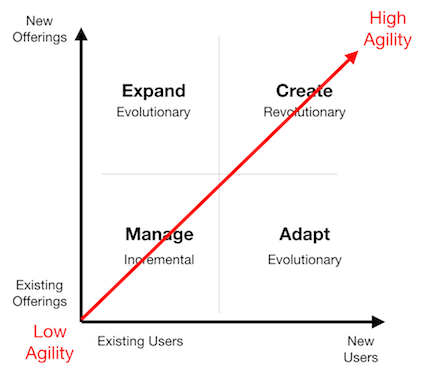
Basically, the strategies described by Rodriguez and Jacoby proceed along the dimensions offerings and users.
- If you are dealing with established products for regular customers, incremental management is required. Practical examples of this are additional products of a successful brand, the next generation of a best-selling product or introducing packaging or delivery services, such as those offered by dm or Whole Foods.
- If you want to stretch your market position, you can follow two evolutionary strategies. The first one is to adapt existing offerings to meet the needs of new customers or markets. Toyota is a perfect example of this when they introduced their hybrid Prius, appealing to customers interested in ecology and energy efficiency.
- The second evolutionary strategy extends existing offerings to solve the unmet needs of current customers. A great example of this is the Nano from Tata Motors, which conquered the Indian market as a cheap small car.
- The final quadrant is the one, without question, that carries the most risk: creating something new. Ground-breaking innovations are associated with revolutionary strategy. After all, they create new needs and new markets. Sony was able to do this with the Walkman, for example, and years later Apple did the same thing with the iPod. In both cases, the interesting point is that the innovation wasn’t the technology, but rather that it completely redefined the experience of listening to music.
Which leads to another question, which seems interesting to me in the context of this book: How much agility is really needed in order to implement the various strategies? I see a different amount of urgency for agility, as indicated by the red arrow in the diagram. For ground-breaking innovations, we have a high amount of product, customer and market risk to overcome, and need at least an equal amount of internal and external awareness. Even for continuous improvement, a good radar is necessary: Which existing products can be expanded? What could run better? Which markets can we still serve?
However, if we are talking about commodity, agile processes make little sense for me. The product and service risks are negligible, moderate measures are adequate and careful management is indicated. Where our cash cows graze, our desire for changes should be kept within limits. Operational efficiency is required here. This also applies to all areas of the organisation that are set up for stability. Or would you rather have your financial experts get creative all of a sudden, your back office constantly question themselves or the infrastructure guys have new surprises ready for you all the time? I wouldn’t go as far as John Kotter, however, who recommends having two different operations systems to accelerate the entire enterprise.[4] Splitting organisations into innovation and business as usual reeks of a bipolar disorder for me. Although it begs the very valid question of whether or not we really need one agile enterprise.
I think we need to avoid pushing agility, just as we must avoid a complete separation of the various departments. Asking the good old “why” questions — if necessary, several times— seems to be a constructive way to uncover the real motivation towards agile: Why must we be more agile? Why do we have a problem with our current management system? Why does it need different solutions than the ones we have? And why in this area? It seems to me that dynamic interactions would be appropriate, allowing for a high degree of autonomy and at the same time keeping the need for alignment in mind. It affects core processes, which we want to set up as value-adding as possible, as well as services that should help us with this. For instance, what should a financial system that supports agility look like? What methods can human resource experts use to foster self-organisation? And how does the back office provide stability when so much is in motion?
It is not a coincidence that we have landed at organisational questions while discussing about an experimental-friendly culture. This culture does not live just from innovative products and services, it inevitably includes the question about the design of the entire organisation. How can we create a system that gives employees the necessary freedom to address customer needs? Which boundaries are needed to contain this kind of freedom? And how can we make sure that these boundaries are regularly inspected and adapted?
5.2 Organisation Design
You might have noticed that we are back at the initial questions from this book. It shouldn´t surprise you that I connect a flow-based organisational design with innovation. In other words, with the ongoing improvement our workflow, allowing us to optimize our value stream. Both of these areas are important. Without new and attractive offers for the customer, our process improvements are nothing more than ingenious development ideas drowning in a dysfunctional workflow.

Every change initiative succeeds and fails within the boundaries you have set up. The focus on flow, the autonomy of the individual business units and a well-defined distribution of decision-making authority are key drivers for this. Not to mention, such a culture simply needs time — not time fixed to a ready-made agenda, but to openly discuss about observations, to discover areas of optimisation and to run improvement experiments. At allsafe JUNGFALK, such experiments led to more than just the next round of the usual continuous improvement process (KVP). “The KVPs infiltrated the entire company”, manager Ulrich Lohmann states, “they were an important catalyst for the overall change of our corporate culture”. Every company can ask itself how much they care about experiments. Are we aware of the meaning of such experiments? Is it up to each of us to determine them ourselves? Do we have enough resources? Or are we completely consumed by our daily business?
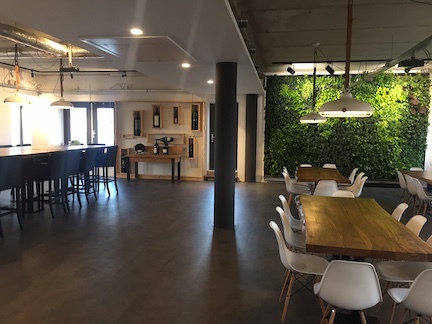
Last but not least, autonomy requires not only time, but adequate space as well. The corporate culture manifests itself within the office or shop-floor architecture. The desired improvement and innovation culture must be, in the truest sense of the word, furnished. Elements of a beneficial architecture includes:
- Open areas for communication, such as the ones at Spotify, where many sitting areas, pleasant meeting rooms or open meeting spaces are available.
- Play areas with foosball or ping pong tables, like those found at allsafe JUNGFALK and many other companies.
- A smart office architecture, such as the one at InVision, where large team tables without fixed working spaces or classical office equipment are used. In addition, there are also small rooms for working undisturbed, sound-proofed areas for customer calls and an upper level open to everyone, as long as the applicable library rules are followed.
- A library with interesting books, together with a comfortable reading space, should provide immersion and inspiration, just like it does at sipgate.
- Day-care for children, which is a cornerstone of Patagonia´s corporate culture.
- Kitchen areas, such as the impressive row of refrigerators at Spotify, or the daily lunches prepared at Computest or even the restaurants at InVision or sipgate, where their own kitchen teams create culinary highlights.
In order to support improvement and innovation, self-organising enterprises make sure there is adequate time and space, but also use some special formats.
Pairing can be used in all areas where the point is to learn with and from one another, as well as improve quality. Depending on the goal, two or more people put their heads together to complete a piece of work. To generate as many improvement impulses as possible, the leadership roles are often changed. One time this person leads while the others look over their shoulder, then the roles are swapped. This improves the awareness for various approaches, refines the questions asked and supports open feedback. Pairing, which originated in eXtreme Programming (XP) software development, is now used in the most diverse corporate areas. At sipgate, it is not only used in software development, but also by personnel or finance experts getting together to work on an issue. And at Menlo Innovation, nobody works alone. All activities are carried out together to prevent knowledge silos, to support each other and to quickly correct errors. In this way, sharing expertise is as routine as personal feedback. The weekly rotation of employees ensures ongoing challenges and fresh impulses.
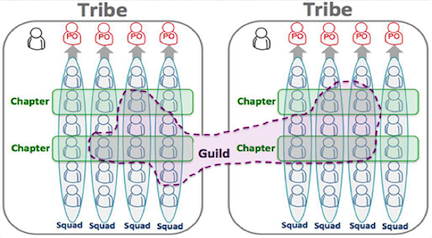
Communities of Practice (CoP) work in a similar fashion. Such communities normally consist of people with the same expert background who meet for an open exchange beyond organisational borders. Compared to regular meetings, these exchanges have neither a fixed agenda nor standardised procedure. A CoP can deal with subject-matter discussions on various topics, consulting about challenging situations, as well as filling up a shared tool box. What makes CoPs valuable is directly linked to forming and strengthening the professional identity of the community members. At Spotify, these CoPs are even a part of the organisational structure. Their so-called Chapters connect experts from the same field and their interest groups (Guilds), ensuring a lively exchange across the individual core teams (Squads) and product areas (Tribes).[6]
Along with the more team-oriented Communities of Practice, many self-organising enterprises use various Large-Group Formats to foster system-wide communication. For example, the Viennese software developer Compax holds quarterly conferences on selected topics. They also combine their yearly Christmas party with an open space to work on strategic questions like “What moves us forward as a company?”. Likewise, large group events are standard procedure at Liip. Each week, so-called Tech Talks are held across all five locations to exchange ideas about ongoing initiatives and skill building. At sipgate, employees from various departments meet every two weeks for an Open Friday. This Open Space-format allows them to exchange experiences across all organisational units, work on difficult questions and develop new ideas—an opportunity that, on average, two-thirds of all colleagues take advantage of. Community events are another form that go beyond the usual team meetings. For instance, eSailors facilitates regular meetups on various topics, sipgate holds a series of lectures, Lean Dus, with renowned guest speakers and InVision has its hafentalks on technical topics. sipgate even hosts concerts and cultural events in their office space, which have absolutely nothing to do with the daily business.
Peer Coaching is another form of professional exchange that plays an important role in self-organising enterprises. As will be discussed in more detail in Part III of this book, this format can include simple questions, case studies or mentoring between senior and junior employees. As the Dutch health-care network Buurtzorg demonstrates, it makes a big difference if the peer coach is from our own turf or if s/he comes from a different business area. Often, an external viewpoint of the familiar can provoke a change in perspective, which is the prerequisite for any improvement, let alone innovation.
Peer Feedback is related to peer coaching, but is focused on individual improvement. In Chapter 3, I already mentioned that personal feedback is an essential part of any self-organising culture. In Part III of this book (to be published in Summer 2018), I discuss eight specific formats for this type of feedback. The IT group Synaxon uses a special form of peer feedback, Liquid Feedback (LQFB), where all types of improvement ideas are evaluated by the employees themselves. Based on a short description, an idea must be supported by at least 10 % of the colleagues before being put up for a democratic vote. All ideas with a simple majority vote result will be implemented, and it receives appropriate support from top management, even if they are not completely convinced about the initiative themselves.
Even in the most mature enterprises, there are situations where neither daily communication nor explicit feedback can help. The tension between individuals, or even entire teams, threatens to spread beyond those involved. For such cases, Peer Mediation has proven itself useful—nobody says that good solutions require hierarchical authority. Although such mediation is inevitably experimental, the phases of professional mediation provide reliable guidelines. The first step is about agreeing on certain mediation rules. The second phase is about clarifying the current situation, whereas the third phase involves collecting information about the disputed issues and each party’s perspective. The fourth phase brings the parties together to find solutions and work out specific agreements. The final phase is a follow up, where the agreements are evaluated and further steps are negotiated if necessary.
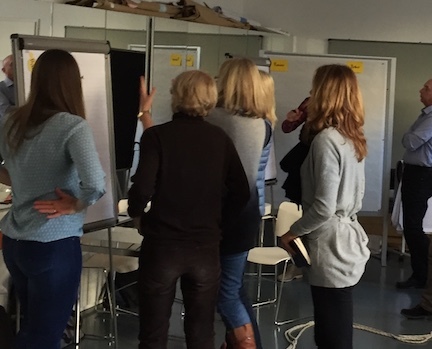
Retrospectives are regular meetings to inspect and adapt the quality of agile work processes. Some colleagues even suggest that retrospectives are drivers of agility in any environment. When compared to the traditional project reviews or post mortems that are typically conducted after all work is completed, the retrospective nurtures continuous improvement right from the beginning. It builds a bridge between looking back, the current insights and the outlook on specific improvement measures. Occasionally, retrospectives focus only on selected topics, such as blockades, performance data or customer feedback. At higher Flight Levels, such as strategic portfolios or value streams (see Chapter 2), delegates are used to check the whole system.
Self-organising enterprises also encourage a rotation principle of the delegates, which leads to changing responsibilities, different perspectives and positive information flow. In order to build on as much insights as possible, it makes sense to run the team retrospectives before the large-scale retrospectives. In other words, only after reviewing the various parts of the workflow does it pay off to look at the overall value stream.
Hackathons concentrate all available resources for a certain period of time to develop new solutions. The term, which is a combination of hack and marathon, guarantees intense collaboration outside your daily business, and requires stamina since hackathons typically run 24 hours. A hackathon is already self-organising because the participants decide where they want to run to, i.e. which projects they find most interesting. Depending on who participates, various mixed groups emerge to collaboratively drive their ideas forward. Hackathons can regularly be found in agile software companies such as eSailors and Spotify uses entire hack weeks.
Do Food Meetings can be in the form of a joint breakfast, an American-style brown-bag lunch or a catered meetup in the evening. Many self-organising companies support such informal gatherings by offering the necessary infrastructure (space, facilities or equipment), as well as providing food and drinks. This includes anything from the obligatory coffee machine or completely stocked refrigerators like at Spotify, as well as personal chefs like at Computest or sipgate that prepare fresh meals for the employees everyday. It does not always need to have a factory canteen atmosphere!
5.3 Developing Self-Organisation
The question of when and how you use which format to support organisational learning inevitably leads us to a much bigger question: How do you make way for self-organisation in your company? What must happen so that the entire system is set in motion? And which decisions are needed for this? “It needs a kick-off”, the long-time executive manager of Hoppmann Autowelt, Bruno Kemper, explains in an interview. “There has to be some form of initial spark”, he states, “along the lines of a Big Bang” [8]. This Hoppmann-ish Big Bang happened in the 1960s when Klaus Hoppmann took over the company after his father’s unexpected passing. Since then, participation and profit-sharing are important attributes of the company. Strategic decisions are made by their own economic committee consisting of five employee delegates and five employer delegates. Whoever thinks these are political games, however, will be disappointed. The focus of this committee is strategic decisions meant to benefit the entire company—and the employees also benefit, since they share in the profits. Hoppmann´s sustained success shows that this fair model pays off. Despite automotive and economic crises, healthy revenues were generated and steady growth was achieved with the company now having 460 employees. An evolution of the corporate culture has accompanied this, without using command-and-control management or individual patronization.[9]
All power to nobody, is how Andreas Zeuch summarises various examples of corporate democracy.[10] It sounds good, but has little to do with reality. Paradoxically, a certain amount of power is needed to get such a democracy started—and usually this power is in the hand of only a few people. If we compare the histories of self-organising companies, we see that it always started on top. “Owners, board of directors and executive committees must allow the employees to take part”, as Peter Stämpfli points out, himself President of the Board of Directors at the long-standing Stämpfli Gruppe. “Openness is the key factor in this context. Openness, paired with respect for the people we work with.” Stämpfli’s statement is quite representative: across various branches, market situations and corporate cultures, it is the owners or chief executives that initiate the journey towards self-organisation. It can be a response to the patriarchal culture of leadership from their father’s generation, such as at Semco, Hoppmann Autowelt or TELE Haase. It can be driven by a leadership crisis, as was the case for Uppstalsboom or Harley-Davidson. Some companies simply refuse traditional subordinate/superior structures, just like Liip, Computest or sipgate did. And sometimes, management has a strong vision of how the company should operate, as we saw with Zappos, Morning Star or Handelsbanken.
All these self-organising experiments are much more than just small tests. It requires courage and a willingness to take on difficult work, as protagonists of self-organising enterprises will attest. “Many would like an extra safe solution”, Markus Stelzmann, CEO of TELE Haase, states. “You would like change, but please without risk and make sure everyone is happy.” However, the shift towards self-organisation requires something from everyone, where some may feel they have something to lose, others may feel overwhelmed and a few will drop out. “You need the right employees who are willing to contribute, create and take responsibility rather than just wanting to do their work.” Stefan Truthän, managing director at hhpberlin, summarizes this in a similar way: “The company is like a Jacuzzi: It’s always bubbling. Nevertheless, some have a desire for quiet, they just want to swim along and hide themselves behind the hierarchy rather than spend their whole life in a Jacuzzi.” Therefore, as Ulrich Lohmann from allsafe JUNGFALK explains, it is crucial to win over employees for the new organisational design. “You must encourage them to do what they think is right. They should use their technical and social knowledge with a healthy dose of common sense.” The transformation of the traditional structures into a flow-based enterprise can only be successful through joint learning. And Lohmann is convinced that this learning never ends. “We must continue to learn from our customers, use the diversity of our teams, exchange experiences and relieve ourselves of dysfunctional dependencies in order to become better.”
The question is, how can companies best accomplish this? How can employees and managers be empowered? How do you encourage the willingness to take on responsibility? And how do you attract people for those everlasting changes, which are the boon and bane of the agile world? It goes without saying, that there is no one-size-fits-all answer that will work for every situation. Self-organisation does not follow a standard formula. “Freedom is the enemy of the formulaic”, as Brian Carney and Isaac Getz point out [11]. For companies that want to be freed from dysfunctional principles, there are four reference points they can use:
- Listen more, talk less and eliminate all symbols and practices that stand in the way of equality.
- Communicate the company vision in such a way that others can make it their own and understand that this can only happen when people feel respected
- Stop motivating people and instead setup an environment where people can grow and motivate themselves. If they understand the vision, they will take care of the rest when they are allowed to.
- Remain mindful and become a guardian of the new culture of freedom.
Frederic Laloux also provides a few tipps on how to cultivate self-organisation. To begin with, you can implement consultative decision management, which is an effective system for conflict resolution, peer feedback, and architecture encouraging communication. For existing companies, he recommends concentrating on one area at the beginning: the fundamental understanding of self-management, creating trust and psychological safety or mutually designing a meaningful future. [12].
Along with the individual practices, Laloux emphasizes the crucial role context plays for successfully developing self-organisation. Whether you allow a higher amount of autonomy for various business units, design for a higher degree of alignment or institute flexible forms of loose and tight coupling will essentially depend on two factors: the size of the company and the nature of the value chain. The first factor is easy to understand. The smaller the business unit, the easier it is for the employees to self-organise. This would suggest simply segmenting larger enterprises, just as Buurtzorg, FAVI, dm or AVIS have successfully done for years. Although these companies are from completely different industries, they have more in common than what initially meets the eye. They focus on service, build upon individual expertise, require relatively little division of labour and have a rather short value chain. The customer is near to the mission driving the company forward. In comparison, companies like Incentro, Compax or Handelsbanken need a completely different form of self-organisation. Admittedly, they also allow many tasks to be completed in small units; the complex nature of these tasks inevitably leads, though, to longer value chains requiring a much higher degree of alignment. On one side, this is accomplished by using interdisciplinary teams, or in the case of Incentro, cross-functional cells of 30 to 60 employees—and on the other side, this requires a good system for ongoing alignment between various experts and teams. If you want to proceed as agile as possible, strategic flexibility also comes into play, like at Gore or IDEO with their floating teams or like Harley-Davidson or Haufe-umantis show with their project-related swarming. On the other hand, consulting organisations like hhpberlin, Finext or Vollmer & Scheffczyk work very close to the customer. This requires intense networking, ongoing re-orientation, as well as a good amount of trust. Sometimes this trust leads to disappointment, but that lies in the nature of such things. However, there is no alternative, as Benno Löffler believes: “The price of more trust is lower than the price of less trust.” To wrap up this chapter, I would like to—fitting to the topic—present a minimal viable model that could help you in developing your own self-organising enterprise. Building on my ideas about developing self-organising teams, this model is also based on a simplified matrix.
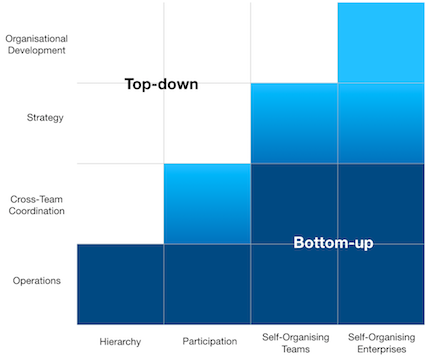
On the vertical axis you find four areas of responsibility that can be assumed either top-down or bottom-up: operational responsibility, responsibility for cross-team coordination, responsibility for strategic decision-making and responsibility for organisational development. Combining these areas with the distribution of responsibilities, four characteristic organisation types emerge.
- The hierarchical organisation in which the core teams are only responsible for the daily business while management deals with all coordination aspects. Depending on the hierarchy, management answers strategic questions and questions about company development. Agile procedures are very limited in this type of organisation and there is little room for self-organisation.
- The participative organisation has teams that, for the most part, coordinate themselves and are sometimes even asked for input on strategy development (see the light blue squares in figure 5-6). In participative organisations, though, a higher degree of autonomy is the exception rather than the rule. Key decisions are still made from the top down.
- Self-organisation on the team level can be found in all companies that build upon local autonomy. For example, Scrum teams in software development, the alignment of several product development teams or entire business units focussed on specific customer segments. Often, the individual units are even involved in strategic issues or at least asked their opinion. In many cases, there are explicit decision policies built upon bottom-up responsibilities.
- Enterprise-wide self-organisation encourages agile interactions between all units. It is built upon a smart system of distributed management responsibilities, where the boundaries for this system are defined from the top down. Functional divisions (keyword: departments), as well as hierarchical management logic (keyword: above and below) are avoided. Agility is driven by decisions based on technical and field expertise close to the customer.
The chequered areas reiterate that the world is not black and white. In a number of companies, line managers and subject-matter experts share responsibilities. Depending on the topic and goals, this can lead to very dynamic forms of collaboration, keeping both the company and its employees on their toes. For Stefan Truthän, one of the executive managers at hhpberlin, this mobility is essential: “The organisation must remain open to change, otherwise it will become as hard as concrete—and once that happens, it is not possible to make it flow again.”
It’s quite possible that the matrix presented here will not help prevent any confusion, which may lead you to declare my experiment a failure. Without a doubt, the model is in many cases questionable, especially when identifying areas of responsibility, classifying the organisational form or defining conflicting priorities of top-down and bottom-up. Perhaps, though, it helps you better identify your current situation and, above all, ask helpful questions. What currently occupies us the most in regard to self-organisation? How is the interaction between management and technical experts set up? What can be done to realise more of our potential? These questions lead us to the next design area: the organisational structure needed to encourage self-organisation.
Key takeaways from this chapter
As always, mindfulness is called for when dealing with culture. This is true for companies in general, but especially true for self-organising enterprises — particularly if a process for continuous improvement and innovation should be established. This chapter shows how you can embrace such a process and what you can do to ensure the expected results. Once more, a few characteristic patterns can be identified. Design pioneer IDEO distinguishes between evolutionary expansion or adaption and the type of revolutionary creation found at Toyota. The Hamburg-based eSailors uses more or less the same innovation format like the California-based Menlo Innovation or Dutch Buurtzorg. And companies like InVision or Spotify not only supply their employees with the necessary technical resources, they also provide meeting rooms, quiet areas of retreat and good food. The ambition to experiment is also required if entrepreneurial self-organisation is to be strengthened. This can be seen in companies like Autowelt Hoppmann, the motorcycle producer Harley-Davidson, as well as the engineering experts Vollmer & Scheffczyk. At the end of this chapter, a simple matrix was shown that could help a self-organising enterprise determine their current state and define next steps of organisational development.