Part III Coaching
15 Coaching Managers
Père Joseph was an extraordinary man. Born in 1577 as François Leclerc du Tremblay, he set new standards not only in France. As a Kapuziner monk at the beginning of the 17th century, he ensured a constant exchange of information with his fellow monks in all parts of the world—and with it created one of the first global networks. A close confidant of Cardinal Richelieu, he acted as what is commonly called a grey eminence. He was a trusted man, confessional priest and advisor in personal union—and as such, one of the forefathers of the coaching profession. Naturally, this profession has changed fundamentally since then. These days coaches share neither the same religion nor have they taken monastic vows. Instead of being obligated to an institution, today they are often successful freelancers rather than monks living with vows of poverty. And last but not least, the web of power, politics and leadership in the 21st century is certainly different than it was in the 17th century. Nonetheless, Père Joseph seems to have left behind a rich legacy. Modern management coaching also deals with the following:
- Mastering the challenges that arise from leadership positions.
- Building an exclusive relationship based on trust and confidentiality.
- Developing a common language for assessing the current situation, and defining appropriate measures for a better future.
- Securing a protected area in which the coach and coachee are able to operate as sparring partners.
- Gathering professional feedback, developing other perspectives and adjusting your self-perception with a professional outsider’s view.
- Exploiting new opportunities to improve and implementing specific experiments.
Exclusiveness, trust and protection — these are the essential parameters when coaching managers. It wasn’t without good reason that the business consultant Wolfgang Looss titled his book on management consulting Unter Vier Augen (Just Between Us). According to Looss’s definition, management coaching is going about the question of how the person will master his or her role [1]. This definition brings up many other questions with it. Why should a manager even take on such work — don’t they have enough other tasks to work on? Why should they trust a coach for this? If they decide for personal coaching, what does a manager need in order to be able to open up? And which parameters need to be considered if this coaching takes place in an agile environment?
15.1 Motivation
Let me first deal with the first two questions. According to a survey in the Harvard Business Review, management coaches are hired for three reasons mainly: for developing potential, for getting professional feedback and for changing dysfunctional behaviour [2].
The magazine’s survey conducted on coaching in the USA and Great Britain align well with the research in the German-speaking region. In this part of the world, managers profit from personal coaching in the following areas [3].
- Sharper Focus - What do the managers concentrate on in order to counteract the chronic distractions in their daily work? What do they primarily pay attention to? What do they encourage?
- Better Decision Making - What are the key decision-making areas? How should things be decided? What does the company need to encourage good decision making?
- Improved Self-Organization - How do managers pay attention to their core tasks? And how do they support this focus across the entire company?
- Professional Conflict Resolution - How can managers deal with conflicts? Which points should they stick to? And which strategies are worth following?
- Mindful Change Management - What exactly should be changed? Who needs to be involved? What does the approach look like?
- Balanced Self-Perception - What is seen the same way? In which aspects are there noticeable differences? And what does the coach see that the manager doesn’t?
In an agile world, nobody can eliminate uncertainty — not even managers. Neither are they able to hold on to the ideal image of the super-expert, nor are they well-equipped for a volatile business world. Last but not least, managers are under pressure in many different ways, which makes the topic of burnout into a true long-burning issue. In my view, it is exactly these three drivers of change from which the need for management coaching grows: the organisation, the roles and the person. These drivers cannot be completely separated from one another. They are dependent on and influence each other. What will be initiated by the organisation can have a huge impact on how you design your leadership role, role-related ambiguities could cause very personal issues, personal concerns lead in turn to organisational issues and so on.
For a deep understanding of management coaching, it pays off to take a closer look at the three change drivers mentioned above. Organisational reasons for management coaching mainly arise from the turbulence of today’s business world. Most companies cannot effectively address this turbulence without questioning both their structures and processes. This brings along new challenges for the senior management — and more often leads to the idea of getting professional help. Experienced coaches concentrate on the organisational questions that inevitably arise when fostering business agility: Which boundaries are needed if we want to support self-organisation? What impact does it have on the existing processes? What changes for the customer if we follow agile principles? What changes for the employees? And what is needed to achieve an overall culture of continuous improvement?

In the face of such questions, it’s no wonder that the topic of change stands at the top of many management coaching agendas. Along with the basics of change management, it is mostly about design topics such as:
- Designing work systems that help realise everyone’s potential.
- Ensuring a common focus in all areas of your organisation.
- Facilitating system-wide agreement and decision-making processes.
- Dealing with resistance that arises as a natural part of any change.
- Defining metrics that allow us to recognize if we are on the right track.
The first part of this book hopefully made it clear that these are everything but trivial tasks. Less clear is how managers should deal with the uncomfortable feelings triggered by these new tasks. What is needed to overcome the paradigm of business administration? How can the new design challenges be mastered as effectively as possible? Which new concepts and tools might help? When faced with these problem-focused questions, it is easy to understand why management consulting gladly utilizes standardized solutions. Accordingly, scaling models like SAFe, LeSS or Disciplined Agile Framework are at the top of the list. With detailed models, they suggest organisational feasibility and promise certainty at places where there is none. This kind of consulting focuses once again on instruction: An expert explains how it is done correctly and oversees the proper implementation of the prepared plan. Whether or not this plan actually improves your daily business is a different story. Anyone who is not satisfied with ready-made solutions needs a different approach. As described in Chapter 12 (not published yet), many coaches use agile and systemic know-how. They keep the balance between expert and process coaching, are able to connect their expertise with their ignorance and make sure that enough time is spent on analysing organisational dependencies. In order to effectively address the challenges identified, they combine various techniques and do not allow themselves to be held to methodical dogmas.
15.2 Preconditions
Non-dogmatic management coaches are hired to support managers who are dealing with agile challenges. The question remains about the requirements for such support. What is necessary to make mutual learning possible when uncertainty cannot be ignored? If certain risks are unavoidable when trying to solve the problem? If feeling threatened, as Wolfgang Looss suggests, is even a necessary prerequisite for any successful consulting? “Whoever asks not only for recommendations from experts, but truly allows themselves to be counselled, i.e. goes on a search for solutions that are not immediately apparent (…) voluntarily endangers themselves in their familiar role and evolved identity” [4]. So, when do executives commit themselves to such a seemingly dangerous experiment? The rational answer to this is: It happens when the risks created by not dealing with the current problems become bigger than the effort to work on them.
However, the decision for or against coaching isn’t just an intellectual matter. Just like most other decisions, the gut also has a say, that’s why managers also need an emotional answer when asking the question “coaching, yes or no?”. “It is a sign of strength and confidence to know when you’ve reached the limits of your knowledge and know enough to enlist outside help”, as Kathleen Sutcliffe and Karl Weick argue [5]. This argument is easy to understand from an intellectual standpoint and explains why coaching should actually be a given for all knowledge workers. Nevertheless, it is emotionally difficult for managers to recognize their need for help—and even more difficult to see this need as something benefiting their professional self-confidence. Without a doubt, this has something to do with the persistence of traditional management ideals. Such beliefs are more than simple role models that we can quickly discard. They act as mental models that filter our perceptions and guide our thinking. A manager’s reluctance also has a lot to do with the uncertainty that coaching itself represents. To a large degree, this is caused by a market situation that offers neither direction nor compelling value propositions. They first must make their way through the consulting jungle. Moreover, the nature of professional coaching forces managers into an unfamiliar situation. All of a sudden, they are the ones with the knowledge deficits they typically attribute to their subordinates. And then the coach seems to be in control of everything. In short: managers must allow themselves to be in a auxiliary position, intentionally increasing their uncertainty. This is demanding a lot from them.
The coaches, and not just the coachees, must also get involved—and they must create the conditions so the coaching can succeed. In my experience, four interventions can be used to ensure that the risks remain manageable:
- By mindfully checking the essential cornerstones of coaching in the first conversation.
- By defining an explicit contract** in which the necessary framework is outlined.
- By combining a clear mindset with coaching methods that ensure psychological safety.
- By having the courage to shake-up your collaboration, to prevent landing back in your comfort zone.
The next sections go into depth on these four interventions and show how they can contribute to successful collaboration.
15.3 First Contact
Each coaching is different—and yet always starts the same: with the first conversation. This conversation can be inspiring or pragmatic, it can literally crackle with tension or quickly lose steam, a coaching mandate can grow out of it or both parties go their separate ways afterwards. In any case, there needs to be a certain understanding. Often, the first contact occurs by telephone and the coach is not really prepared for it. Coaches don’t typically sit next to the telephone anxiously waiting for the next customer, and are able to focus when a potential customer calls. The telephone ringing pulls you away from a specific situation and you are required to open up to a very different situation. Postponing the conversation and offering a callback gets you out of a stressful situation but doesn’t always leave the best impression. Even if you believe that the power of a first impression is a myth, as a coach you do not want to start off stuttering. After all, your initial contact deals with groundbreaking decisions—or at the very least the decision about whether there will be a second conversation. In my view, the responsibility lies with the coaches to at least touch upon the most relevant factors. The following list of questions can serve as a checklist so nothing is forgotten if you are caught off guard.
Six basic questions you should have answered by the end of your first conversation
- Who is contacting you?
- Organisation, business unit, team, context and the like
- Role of your contact person – also in terms of being the potential coachee, an assistant of the potential coachee, an expert from HR, …
- What is your contact person actually looking for?
- Help for a specific situation – If this is the case then do your best to learn more about this situation, e.g. by asking your contact person about the two biggest challenges and strengths they can build on
- General information about coaching, your approach, your business model
- An opportunity for a face to face meeting (for her/himself or someone else)
- A tentative offer
- Why are they contacting you right now?
- There is a clear sense of urgency established
- There is a big problem to be solved and its unclear how to do that
- There is some curiosity to learn more about coaaching, agile management, lean and the like.
- There is an event in the calendar that has to be managed
- What does their experience with coaching look like?
- Something they see as valuable support
- Something they have mixed feelings about
- Something they would like to encourage
- Something they like to have because everybody else does
- What do you need for providing professional help?
- Clear decision to encourage professional coaching
- Commitment by a potential sponsor
- Willingness to co-create a culture of continuous improvement
- Clarity about your fee and additional expenses
- How do you proceed?
- Sending a memo about the most important answers you got
- Scheduling a face-to-face meeting with the coachee
- Waiting for them to clarify a few things (e.g. about the prerequisites for your help)
- Saying just thanks for calling and moving on
Depending on how the coachee answers, the coach will have additional questions — and will try to give all the essential information on what coaching can look like. A mutual understanding about the actual objectives, the entrepreneurial context and the essential framework conditions for the coaching should be established as quickly as possible. Even if it is just an assistant making contact, rather than the coachee herself, the coach should still give his best to clarify as many basics as possible.

During the first conversation, hypotheses can also be tested along with these questions. This becomes easier as the coach gains more experience in a particular area. “This sounds to me like…”, “I have the impression that…?”, “It seems like problem X is due to Y?!”, “Is it possible that…”, are typical formulations for this. If you want to go a step further, you can even test possible interventions: “If it is about X more than about anything else, have you already tried Y?”, “In a nutshell, your situation reminds me of a company that completely concentrated on Z — would that be something you might also consider?”, “Your initial situation suggests to me that we should quickly arrange for…!”
Whether the coach provides feedback, tests assumptions or explores further interventions, it is always going about building a mutual understanding of what is expected. Even in the initial discussion, though, exploring many relevant aspects of work, relationships, and business is impossible. If the one calling is a manager interested in coaching, it’s likely that they are under pressure. It’s equally likely that they will invest only a limited amount of time in general clarification. The telephone is also a medium that limits the bandwith of communication and therefore makes it difficult to establish a good relationship from the outset. Last but not least there is also the hurdle of basic conditions to be dealt with, let alone the coachee´s fee, such that some conversations suddenly dissolve into a discussion of costs. The value of professional help comes in at a poor second place…
If you manage to overcome this hurdle, nothing should stand in the way of a second conversation.
15.4 From Contact to Contract
“Customer collaboration over contract negotiation”, the Agile Manifesto proclaims [6]. How does this resonate with the need of an explicit contract for coaching? Well, the solution to the puzzle lies in the fact that a coaching-specific contract is not about formal negotiation. The focus instead is on clarifying all essential aspects of collaboration. Along with the content (focus, goals, methods, expertise and the like), the specific culture of the helping relationship is established (patterns of interaction, mutual expectations, trust, etc.). For me as a coach, it is always interesting to see how this culture develops from the very beginning. Is the coachee ready to put their cards on the table? Do they also bring up their considerations and concerns? Does not only the coach, but also the coachee, ask clarifying questions? And does not only the coachee, but also the coach, show areas of uncertainty? Especially in the context of agile companies, I believe it is important to understand cultural aspects right from the start. Balance is a main guiding principle for me: whether it be the balance between subject matter expertise and ignorance, personal or organisational focus or balancing the amount of talking and listening. For me, the balance between asking questions and delivering information is essential. Ultimately, we do not want to overwhelm the coachee with questions, but at the same time also not forget that they expect the coach to maintain a certain amount of control. The way I understand coaching, process expertise is needed just as much as professional know-how in business agility. Here are some guidelines for effective contracting in self-organising environments.
What?
Questions on
- Motive for coaching: What brings you to me? Which issues do you want to work on?
- Goals for improvement: What do you specifically want to achieve?
- Expectations: What are you expecting from agility/lean/self-organisation? What can the organisation do after the coaching that it can’t do at the moment?
- Environment: Which context factors are to be noted? Who are the relevant stakeholders of the planned changes?
Information about
- Topic: What agility/lean/self-organisation is from the coach’s viewpoint—and what it isn’t.
- Good practices: What has proven helpful (see “Who?“ & “How?“)
- Role of the coach: What are they responsible for? How do they contribute to your overall success?
- Benchmarks: What the coach learned in similar initiatives
Why?
Questions on
- Drivers of change: What are the most important challenges that you need to deal with right now? What are the three most important strenghts you can build on?
- Case for action: Why do you think it is the right time for a change?
- Approach: Why agile coaching? Why self-organisation?
- Support: Why coaching? What do you expect? What would helpful coaching look like?
Information about
- Experience with agile/lean/self-organisation: Why other companies have moved in this direction, what their experiences were and what they were able to achieve.
- Laws of change: What should be paid attention to in coaching.
- Mindful approach: Why stakeholder management is critical to success.
- Management and coaching: Why managers play a central role — and why coaching can be helpful in many ways.
Who?
Questions on
- Internal stakeholders: Who is part of the system that is about to change? Who is a key player? Whose expectations should not be ignored?
- External stakeholders: Who else is affected by your change initiative? Who should be involved? Whose OK is vital?
- Sponsors: Who sets the boundaries for successful change? Who is providing the resources needed??
- Change agents: Who takes care of the whole initiative? Who is driving things forward? Who is informing and involving other people?
Information about
- Systems thinking: Why we should design our enterprise from the outside-in
- Network of stakeholders: Who has to be involved in order to build and keep momentum
- Guiding coalition: Who should be in the driver´s seat? Who has to be informed regularly? Who is asked to provide feedback?
How?
Questions on
- Decisions: How to define change sponsorship and agency? When to kick-off? How to keep overview? Make sure that we finish?
- Collaboration: How do you want to interact with the coach?
- Lessons learned: What would you like to do better than before?
- Agreements: How do you want to move on? Who should be doing what until when?
Information about
- Coaching lessons: Good practices from the trenches
- Big picture: How to create a culture of continuous improvement rather than just managing change
- Next steps: Written summary by coach, joint review with coachee, clear decision
Of course, no conversation follows these guidelines exactly. It would be a strange understanding of agility if we would just go through these questions one after the other. Contracting is more similar to an interactive dance than it is to a one-sided clarification. The reality of coaching is that we jump directly from a What question to a Why question, we allow ourselves to be led by the coachee´s storytelling, use an aside to a past coaching experience to clarify the How of the current collaboration, wander towards a special aspect of the topic, go back to the goals, and so on. These guidelines have often proven to be useful because of the dynamic nature of your interaction. I can maintain an overview, am able to reorient myself during the discussion and don’t forget any important points unintentionally.

15.5 Creating Safety
On the journey from first contact to an explicit work contract, there is more than just the correct mixture of questions and information. We must also work on the typical psychological aspects of the starting phase. Because those who need help can easily feel that they are in a weaker, more or less subordinate position. This positioning is an issue, especially in management coaching, because many managers take their superior position for granted. All of a sudden, the manager-coachee must grapple with their knowledge gaps and tunnel vision, while the coach is associated with overview and expertise. This can awaken negative memories of strict parents or unfair teachers, which can then transfer to the coaching, making it uncomfortable. Even if the discussion quickly shifts to focus on the subject matter, the start of the coaching relationship remains dominated by various concerns.
- What will the coach expect from me?
- Where will the coach lead me to? How far must I follow them?
- What happens if I don’t do this? What if the whole thing turns out to be a waste of time?
- And I still have to pay a lot of money for it?
Such questions can mobilise defensive behaviour. Then, the coachee acts cautiously, does not openly address his hottest topics, avoids answering trickier points or just uses buzzwords. This ambivalence might seem confusing at first. Isn’t it the manager who is deliberately seeking help and turns to a professional coach to provide it? Perhaps it is true that you finally recognize your own limits and that you won’t be able to advance. At the same time, it is rarely the case that emotional strength is gained from this. Seeking professional help magnifies your own uncertainty.

What does this initial situation mean for the coach? How do they deal with the uncertainty that is the elephant in the room? And what can they do, right from the start, to encourage an equal partnership? According to my experience, acknowledging this precarious situation is already a good starting point. In addition, a mindset of respect is needed. And it requires techniques that overcome the negative feelings.
Ed Schein has given us a clever concept for combining respect and intense interaction [7]. Schein calls this concept humble inquiry, which fosters a special form of mindfulness. It deals with questions, active listening, but also with observing, the non-verbal communication level and personal feedback. You could say that coaches use all their senses to find their way forward. Humble inquiry can be accomplished by applying the Socratic principle: “I know that I know nothing!” Just like everything in life, this principle should not be overused, otherwise the coachee could easily lose trust in the professional expertise of the coach. In a balanced way, humble inquiry can help gain a lot of information. Beyond that, it puts the coachee in a position of an expertise and let her quickly gain safety during the initial phase.
However, psychological safety is not conveyed through humble techniques alone. Safety is created, above all, by dealing constructively with the typical coaching topics. Here is an overview of these topcis.
Defining Goals
Agile professionals know that they shouldn’t waste too much time defining the desired results. We also know, though, that a vision is needed so we can move forward with goals in mind. What would an organisation that fulfils the current requirements look like? What is such an organisation capable of? What are the core capabilities of its members? What do they deliver? And what do the customers get out of it? It is the nature of the agile approach, that the vision cannot be completely defined at the beginning. Without any vision, though, it is difficult to define and prioritize sub-goals for tackling the first stages of change.
Clarifying the Current Situation
Meaningful goals can only be determined if they are in the context of the current situation. Only then is creative tension created to drive change. From the coach’s viewpoint, the current situation, as well as the future situation, is unknown territory. As a consequence, the coachee is invited to tell their story. By actively listening, making humble inquiries and sharing certain asssumptions, the coachee and the coach are able to expand their mutual understanding.
Defining the Boundaries
It should be common sense that successful self-organisation requires clear boundaries. In order to create a trustful container, there needs to be some basic agreements. Personally, I deliberately define a few rules at the beginning—after all, I am responsible for setting up the coaching system. Since this is a multi-layered working-relationship-business, it includes rules for action (e.g. iterative approach), confidentiality (e.g. Las Vegas Rule), procedures (e.g. duration and frequency) and last but not least, economics (e.g. professional fee). Even for the annoying topic of liability, especially in regards to cancellation on short notice, there should be a clear agreement (keyword: conditions of cancellation). It goes without saying that these parameters, as well as the goals, must be regularly reviewed and, if necessary, expanded upon (e.g. agile contracting).
Creating Opportunities for Relief
Often the topics of burden and relief are immediately present: Managers are under pressure, teams aren’t delivering what they’re supposed to, the whole company must improve, and so on. Becoming more agile is seen as a magical solution. In such situations, the coach can easily feel like she should act as a solution hero. It’s likely that they immediately act like Merlin and brew up a magical potion for the organisation. I know how tempting such a situation can be and how easily you can fall into this trap. Humble inquiry is a tried and tested method to prevent such power illusions. By stepping back, the coach makes space for the coachee to be able to air their frustrations. It almost always pays off to start with open ears first, making emotional relief possible before starting on the professional solution.
Helping to Sort
The emotional roller coaster between feeling helpless and feeling like the big boss is often reflected in intellectual confusion. This can be seen in a wild mixture of myths and clichés, that are translated into weird concepts of change. It is the coach’s job to respect these concepts, and at the same time make it clear that there needs to be a more sustainable approach. Coaches do this by helping the coachee sort out the myths from the realities of self-organisation. What is necessary to continuously make the system more agile and what are just cosmetic changes? Where do we begin if we want to create smooth workflows, which ideas lead us to a dead end? In a sense, we separate the wheat from the chaff, pick up useful ideas and try making them part of an even better approach. Fortunately, in many cases we are able to rely on a good foundation. The coachee is knowledgeable in many areas, and maybe even builds upon relevant experiences. However, some of it is and remains garbage and coaches are doing a service by taking it out as early as possible. This is easier written than done because this means hurting someone’s feelings, disappointing them and fuelling their mistrust. Nevertheless, coaches who serve up half-baked management ideas are already setting themselves up for failure.
Instructing, Practicing, Learning
Professional coaches are aware that they must deal with a lot of unknowns at the beginning of a coaching situation. They are also aware that they have profound knowledge about success factors, which you can profit from during the coaching. They proceed methodically and use helpful tools: checklists, guidelines or simple models that offer some orientation to the coachee. Practical examples and benchmarks from other companies are always welcome.
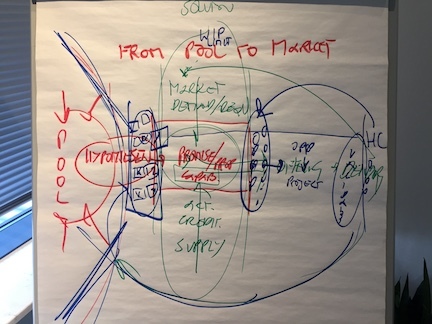
Feedback can be enhanced when the knowledge transfer is combined with practical exercises. I have good experience with different variations of visual talk, which is an essential part of design thinking. Even better is when I apply visual talking with the coachee while standing together in front of a flipchart or whiteboard. This combines perfectly with subject matter expertise such as value stream mapping or Kanban. I invite the coachee to a special ping pong game by handing over the marker: How would their picture look? What can they add to it? What do they want to correct? And which impulses can the coach give them? This way, coaching suddenly becomes a kind of training camp where the manager is able to think through, test and improve things in a practical manner. I think it is important to stimulate a manager’s willingness to learn as early as possible. It continues on with the agreement on specific transfer steps: Improvement actions for the daily business, clarifying discussions with others or reading certain articles. It is also helpful to set up regular calls between the meetings to provide a minimum level of joint monitoring.
15.6 Creating Uncertainty
You might have already noticed: If there is a common thread that is pulled through this coaching concept, then it is the idea of balance. Whether it is the balance between knowledge and ignorance, between trust in the process and controlling the context, or between leading and being led—it’s going about preventing excessive bias. For this reason, we do not want to get too comfortable in coaching. To ensure an appropriate counterbalance, we can contrast the gentle art of questioning with what I like to call the respectful art of provocation. What is meant by this? Provoking literally means to challenge. For coaching this means not being satisfied with the status quo, It means stepping across the current line to create something better. To accomplish this, we can use various forms Ed Schein’s confrontational interventions from his process consulting principles [9]. I see confrontation as any intervention that is focused on making a difference. A Latin scholar knows the original term is confrontatio. And the coach, in turn, knows how to confront by posing a challenging question, bringing in an alternative way of thinking, using an irritating comparison or expressing a different opinion. For sure, we still need a minimum level of certainty to progress with the coaching. However, experience shows that this only brings us to a certain point. This point can only be moved along when we push the boundaries. If we, in other words, leave humility behind and focus on those aspects that seem questionable or even controversial. Thus, when we risk conflict—apropos confligere, “to engage, to confront” — we antagonize ourselves.
It is a truism that relationships are strengthened by jointly resolving conflicts. We are unable to understand our real differences unless such conflicts are brought to light. As mentioned, I feel that conflict-friendly exchanges are a constitutive element of any self-organisation. Challenging the manager’s point of view is absolutely critical for successful management coaching. It is laid down in the basic constitution of people who see themselves as experts in both personal as well as organisation development. If coaches are not willing to address these situations, they may not be respected as equal partners by their coachees. In my view, management coaches must regularly question their relationship. In soccer terms, we would say it is the ability to approach the opponent with unexpected moves, powerful tackling and a certain amount of resilience, so as not to fall apart at the first counterattack.
There are many ways to cultivate this kind of agility. Let’s take a closer look at four variations:
- Constructive Mistrust
- Systemic Questions
- Open Disagreement
- Personal Feedback
The first strategy to challenge the current state of coaching is what I call constructive mistrust. “Mistrust?” I hear you asking and can easily imagine you wondering about my mental health. After all, I am saying all the time that coaching is based on trust — and I am hardly the only one. A closer look at the genesis of trust shows where I am going with this. How do we build trust in coaching? First, both sides must be willing to grant some trust because without this, they can not confide in one another. This basic trust must be worthwhile, otherwise coachees will question further investments. Consequently, coaches should not stay in question mode for too long. Rather they must provide guidance and professional help so their coachees get a tangible return in the short-term and have a good reason for further investments.
True trust is acquired step by step, you must earn it as is commonly said. This applies to both parties, by the way: The coachee must learn to trust the coach, and vice versa. In order for trust to grow, positive experience with each other is required. Furthermore, a good balance of questions and information is needed. But can coaches really take everything that is told to them at face value?
Don´t get me wrong. I am not advocating general scepticism. We do not need to weigh every single word. As someone who had to learn it the hard way, though, I would like to advise against being too gullible — and to encourage coaches to do some reality checks. Do the stories that we are being told make sense? Are there essential parts missing? Does the story correspond to similar experiences? Do we get the impression that something is being concealed? Do we really see the entire problem, or are we still sorting it out piece by piece?

Instead of lulling ourselves into a false sense of security, we should regularly question the quality of our collaboration. The so-called systemic questions are a good means for that. Systemic questioning offers a broad variety of techniques to move from humble inquiry towards respectful provocation. We can differentiate various categories of questions. The so-called triadic questions concentrate on the perspective of an absent third party. Employees, management colleagues, friends or even the coach themselves offer a good anchoring point to expand the individual point of view. All systemic questions tend to challenge your worldview. Is my way of looking at things really the only possibility? Do all the others see it the same way? Or are there other perspectives that should also be considered?
Hypothetical questions make up another category. Simply stated, they deal with imaginary situations. “What would happen, if…?”, “What would the situation look like, without…?”, “What would be different tomorrow if a miracle occurred overnight and your biggest problem was solved?”, or “What would you compare your current situation to? What film would it be? What would the newspaper headline read?” Just like all systemic questions, the hypothetical questions seek to broaden your perspective. For this, coachees need a sense of creativity. Managers should be able to imagine a different situation and visualise certain changes as if they had actually already occurred.
The third category that I would like to recommend to you are the classifying questions. As the name suggests, it’s dealing with a special type of measuring: How heavy would the problem be if you put in on an imaginary scale? What t-shirt size would your current issues wear? And where on a certain continuum would your situation be positioned?
Systemic questions often provoke resistance. “How should I know what my employees think about this?”, stated an irritated Robert Kappacher in his company, as I turned our conversation to triadic questioning. “Am I supposed to be a fortune teller?” Don’t shy away from such defensive reflexes. Give yourself and your coachee time to consider the question. Allow yourself to paraphrase the question or explain why you are asking. There is one thing you shouldn’t do, however: Take your question back. Instead, you should see it as an essential part of your sparring partnership — as a mutual test of strength and fitness.
A spirit of sparring is also needed for a different type of intervention, which always provides a good portion of uncertainty: open disagreement. This type of dissent is present when you firmly have a different opinion. There can be many reasons for this.
First of all, coach and coachee can have different views. One of my favourite examples of this comes from a session I had with Dagmar Reininghaus, in which the managing director of a service company compared agile methods the following way: Scrum is for innovation projects, Kanban for incremental improvements, Scrum for complex challenges, Kanban for efficient operations, Scrum encourages creative lateral thinking, Kanban a good workflow, and so on. In Dagmar´s case, I couldn’t resist bringing up another abstruse comparison: “Did you know that home trainers were developed for ambitious athletes and fitness studios for lazy sportsmen?” As with many other polarisations, the key point lies in the randomness of our associations. Maybe there are certain tendencies, as I explained myself to Dagmar Reininghaus. In my view, though, what is more crucial is what you make out of your ideas in your specific environment. And to me, this seems to apply to fitness equipment the same as it does to methods.
Second, coach and coachee can contradict each other because they have different values. In such cases, this can quickly turn personal. I remember an intense dispute with Peter Larsen, the CEO of a medium-sized automotive supplier, as I explained my understanding of trust. True trust, according to the CEO, meant that his people should follow him blindly. If you didn’t just start reading this book, then you can probably guess my response. The interesting thing was that we quickly found ourselves, after our rhetorical head-on collision, in a constructive discussion about one-way and two-way streets in communication. And other contradictions followed this initial one because the CEO was well aware that there was room for improvement in his meetings (quote: “It´s death by powerpoint.”).
Third, agile principles are also useful for questioning the basis of coaching. In software development, the comparison of individuals and interactions versus processes and tools is an absolute classic. Nobody using agile principles suggests that the latter would be more important than the former. However, often enough decisions are made according to process guidelines, and tools are debated more intensely than their effect on collaboration. Coaching offers a good opportunity to detect such contradictions and to work out a more ambiguity-friendly understanding of agility.
Disagreement is also likely if the coach has completely different experiences than the coachee. In this regard, I have often felt like Don Quixote in my battle against traditional change windmills. These windmills may be called the masterplan, change-in-progress unlimited or missing monitoring.
It also shows that there are different expectations on how the coach and coachee should collaborate. Following their professional reflexes, managers in the agile environment tend to treat coaches like their employees. Personally, I have an allergic reaction to direct orders such as “Mr. Kaltenecker, go ahead and do …!” Consciously or not, manager-coachees try to make the coach responsible for things they are themselves responsible for. “Mr. Kaltenecker, speak to…!”, “Make sure that team X gets back in line!”, and the like. I highly recommend to resist such delegation strategies — and to see their occurrence as an indicator that your work agreement should be reviewed.
When we want to create more uncertainty and risk conflict, sometimes direct confrontation is a useful strategy. “Do you really believe that …?”, “You seem to be convinced that …?”, “I have never experienced that …!” Of course, if we want to encourage the ideas of agility and self-organisation, we cannot use blueprint models. We must resist oversimplifying concepts, and in some cases, we must go so far as to reconsider the coaching mandate. Can business agility be fostered if we only concentrate on teams? Is a management coach supposed to simply accept that decisions are still being made by superiors alone? Or that feedback loops wither away to just information rituals?
Last but not least, I would like to point out personal feedback as a tried and tested strategy to increase uncertainty. “Why is this unsettling?”, you might ask. Isn’t feedback a catalyst for improvement? Well, I admit that the uncertainty proposition requires some explanation. In the agile world, there is a surprisingly uniform opinion on feedback. Feedback is seen as essential, even necessary for survival and it should occur in short loops. It seems to be welcomed at every level, both in terms of our system´s performance and in terms of individual behaviour. So much for the theory. The practice of feedback offers some stumbling blocks, however. If it is going about critical responses, you have an entire pile of blocks to deal with from time to time. And if this criticism is concentrated on the manager’s behaviour, it can seem like a mountain of blocks. Feedback can turn out to be truly hard work.
What makes critical feedback difficult can be better understood by looking at the uncertainty that goes along it. It is anything but simple to have a positive discussion about negative aspects. Usually our own emotions get in the way, not to mention the emotions that our feedback triggers in the coachee. On top of this, most managers are not used to being confronted with critical feedback. At the same time, the higher up we go in the hierarchy, the more we see a true need for this. CEOs of large enterprises seem to be as many light years away from their customers as they are from an honest feedback on their real behaviour. Nobody dares to openly mention any weaknesses or blind spots. Naturally, it is quite possible that everyone share the same blind spots because CEOs like to surround themselves with people just like them (aka the mini-me syndrome). However, given the plenitude of power associated with top management, companies with this particular type of tunnel vision accept incalculable risks.
In my view, management coaches have a duty to work against this tunnel vision. They are required to use all their senses to provide accurate feedback on their coachee’s behaviour. The gap between saying and doing, knowledge and ability, willingness and capability offer a worthwhile starting point.
Like all other interventions to raise uncertainty, critical feedback has a challenging nature. It is driven by provocation. And it should also, as Figure 15-8 shows, not only cover conscious wants, but also unconscious needs. Unlike the additional wants revealed by expanding the public area, these needs are at first obscure for the coachee (aka a blind spot). Only the coach will have some insight, or at least some hypotheses.
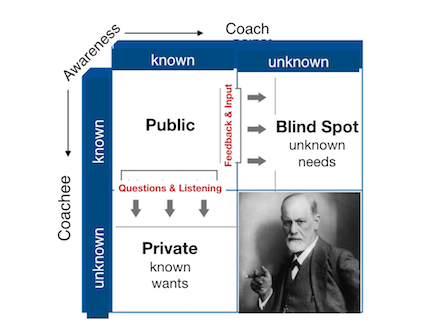
The coach’s critical feedback emphasise that there is more than just the manager’s worldview. However, critical feedback has nothing to do with rebellious acts. It’s much more about aligning different perspectives that the concept of criticism literally stands for. Management coaching should support every exchange about differences, which is one of the basic ingredients of self-organisation. However, critical feedback needs to be given in the right doses. If coachees are confronted with too much feedback too quickly — as was the case in the previously mentioned case with the production manager — it can become overwhelming very quickly. In such cases you don’t need to be surprised when defensive behaviour takes place. That’s why the coach must make sure enough trust is built up before they confront the manager with other points of view. In other words, there must be some certainty established before uncertainty can be risked. To close out this section, I would like to recall a simple tool that I have used to prepare for and provide critical feedback [10].
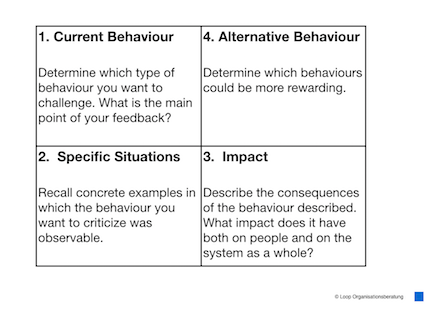
As always, when we use certain techniques, we should not apply it too technically. Instead of just working through the boxes, we should use it as a starting point for an open discussion. In my opinion, a good balance of questions and explanations goes along with this, too. How does the manager see their behaviour? How did they experience certain situations? Which consequences are they aware of? And how can they ensure improvements? Personally, I shy away from recommendations for alternative behaviour. In many cases, I have certainly thought of some, but what is key is what the coachee themselves can imagine. Again, it is important to be patient, give enough time and not disrupt the coachee’s considerations early on with your own ideas.
Key takeaways from this chapter
These days, management coaching is a given in many companies. This chapter shows what motivates managers, how coaching works and what it means in an agile environment. On the one hand, I show how coach and coachee actually find each other. From the first contact, to an explicit contract, in which all essential goals, expectations and conditions are outlined. On the other hand, the chapter describes the exceptional interplay of professional management coaching – creating certainty and targeting uncertainty. In addition, you see the benefits of such an interplay and which techniques can be used to facilitate it.
References
Introduction
[1] Semler, R., Maverick. The Success Story Behind the World’s Most Unusual Workplace. Warner Books 1993, p. 3.
[2] ibid., p. 253.
[3] Kaltenecker, S., Leading Self-Organising Teams. Workbook for Lean and Agile Professionals. InfoQ 2015.
https://www.infoq.com/minibooks/leading-self-organising-teams
1 Customer First
[1] Hamel, G., First, Let´s Fire All the Managers. Harvard Business Review, December 2011,
https://hbr.org/2011/12/first-lets-fire-all-the-managers.
[2] Carney, B.M., Getz, I., Freedom, Inc. Free Your Employess and Let Them Lead Your Business to Higher Productivity, Profits, and Growth. Crown Business, 2010, p. 15.
[3] Roock, A.: Culture is the True North.
https://www.infoq.com/articles/scaling-at-jimdo
[4] Huijbers, P., Care in the Neighbourhood: Better Home Care at Reduced cost.
http://interlinks.euro.centre.org/model/example/ NeighbourhoodCareBetterHomeCareAtReducedCost
[5] Roock, A.: Culture is the True North.
https://www.infoq.com/articles/scaling-at-jimdo
[6] Mintzberg, H., Ahlstrand, B., Lampel, J., Strategy Safari. A Guided Tour Through The Wilds of Strategic Management. Free Press, 1998.
[7] Brown, T., Change by Design. HarperCollins, 2009.
[8] Maurya, A., Running Lean. Iterate from Plan A to a Plan That Works. O´Reilly, 2012.
2 Visual Work Management
[1] Leopold, K., Kaltenecker, S., Kanban Change Leadership. Creating a Culture of Continuous Improvement. Wiley, 2015.
[2] Leopold, K., Practical Kanban. From Team Focus to Creating Value. LeanPub 2017.
[3] ibid., p. 48.
[4] Kaltenecker, S.; Beyer, M., Kanban on track – Evolutionary Change Management at the Swiss railways.
http://www.infoq.com/articles/kanban-on-track.
3 Fast Feedback Loops
[1] Vacanti, D., Actionable Agile Metrics for Predictability. An Introduction. Leanpub, 2015.
[2] ibid., pp.123.
[3] Magennis, T., Top Ten Date and Forecasting Tips.
http://focusedobjective.com/top-ten-data-forecasting-tips/
[4] Reinertsen, D. G., The Principles of Product Development Flow. Celeritas Publishing, 2009, p. 222.
4 Customized Decisions
[1] Luhmann, N., Organisation und Entscheidung. Verlag für Sozialwissenschaften, 2000, p. 71.
[2] Weick, K. E.; Sutcliffe, K. M., Das Unerwartete managen. Was Unternehmen aus Extremsituaitonen lernen können. Klett-Cotta Verlag, 2003.
[3] Reinertsen, D. G., The Principles of Product Development Flow. Celeritas Publishing, 2009, p. 169.
[4] Mois, T., Baldauf, C., 24 Work Hacks…auf die wir gerne früher gekommen wären. Sipgate, 2016.
5 Bold Experiments
[1] Carney, B.M., Getz, I., Freedom, Inc. Free Your Employees and Let Them Lead Your Business to Higher Productivity, Profits, and Growth. Crown Business, 2010, p. 11.
[2] Ries, E., The Lean Startup. How Constant Innovation Creates Radically Different Businesses. Portfolio Penguin, 2011, p. 122.
[3] Brown, T., Change by Design. HarperCollins, 2009, p. 163.
[4] Kotter, J., Accelerate. Building Strategic Agility for a Faster-Moving World. Harvard Business Review Press, 2014, p. 163.
[5] Brown, T., Change by Design. HarperCollins, 2009, pp. 73.
[6] Kniberg, H., Ivarsson, A., Scaling Agile @ Spotify with Tribes, Squads, Chapters and Guilds.
http://blog.crisp.se/2012/11/14/henrikkniberg/scaling-agile-at-spotify
[7] Derby, E., Larsen, D., Agile Retrospectives. Wesley-Addison, 2006.
[8] Zeuch, A.: Alle Macht für Niemand. Aufbruch der Unternehmensdemokraten. Murmann Publishers, 2015, p. 105.
[9] Hoppmann K., Stötzel, B., Demokratie am Arbeitsplatz. Ein Modellversuch zur Mitwirkung von Arbeitnehmern an betrieblichen Entscheidungsprozessen. Campus Verlag 1997.
[10] Zeuch, A.: Alle Macht für Niemand. Aufbruch der Unternehmensdemokraten. Murmann Publishers, 2015.
[11] Carney & Getz, 2009, p. xvii.
[12] Laloux, F., Reinventing Organizations. Nelson Parker, 2014., pp. 259.
6 Lean Organisational Structure
[1] Olesen, A., Handelsbanken: Consistency at its Best. Case Report.
https://gallery.mailchimp.com/33069b15098259cee2f42cf2b/files/Handelsbanken_Consistency_at_its_Best_02.pdf?utm_source=Autoresponder+kampagne+juli+2015&utm_campaign=b04b30d4bd-&utm_medium=email&utm_term=0_c851225309-b04b30d4bd-199903217
[2] Laloux, F., Reinventing Organizations. Nelson Parker, 2014, p. 141.
[3] Hamel, G., First, Let´s Fire All the Managers. Harvard Business Review, December 2011
https://hbr.org/2011/12/first-lets-fire-all-the-managers
[4] Bennett, P., A Loosely-Designed Organisation.
https://lboi.ideo.com/oops.html
[5] Andrey, G. & Jung, P. E., Selbst organisiertes Unternehmen. Fallstudie zur Einführung von Holocracy. In: zfo – Zeitschrift Führung + Organisation, 06/2016, p. 386.
[6] Robertson, B.,
[7] Arnold, H., Wir sind Chef. Wie eine unsichtbare Revolution Unternehmen verändert, Haufe, 2016.
[8] Vacanti, D., Actionable Agile Metrics for Predictability. An Introduction. Leanpub, 2015, p. 141.
[9] Reinertsen, D. G., The Principles of Product Development Flow. Celeritas Publishing, 2009, p. 27.
[10] Conway, M.E., How Do Committees Invent?, 1968
https://www.youtube.com/watch?v=OHcFd5KaYRI
[11] Bollenbeck, P., Org Hacking for Fun and Profit
https://www.youtube.com/watch?v=OHcFd5KaYRI
[12] Gruczel, M., Kaltenecker S., Gruber, H., Agile Sailors. A Journey from a Monolothic Approach to Microservices. 2016
https://www.infoq.com/articles/agile-sailors-microservices? utm_source=infoq&utm_medium=popular_widget&utm_campaign= popular_content_list&utm_content=homepage
7 Distributed Management
[1] Hope, J.; Fraser, R., Beyond Budgeting. Harvard Business Review Press, 2003.
[2] Arnold, H., Wir sind Chef. Wie eine unsichtbare Revolution Unternehmen verändert, Haufe, 2016.
[3] Janssen, B., Die stille Revolution. Führen mit Sinn und Menschlichkeit. Ariston Verlag, 2016.
[4] Stoffel, M., Mitarbeiter führen Unternehmen –Demokratie und Agiität bei der Haufe-umantis AG. In: Settelberger, T., Welpe I., Boes, A. (eds.), Das demokratische Unternehmen. Neue Arbeits- und Führungskulturen im Zeitalter digitaler Wirtschaft. Haufe Gruppe, 2015, p. 269.
[5] Gloger, S., Demokratisch, praktisch, gut. New Work bei Traum-Ferienwohnungen. In: ManagerSeminare, Heft 227, Februar 2017, S. p. 32.
[6] Russell, B., The Conquest of Happiness. Routledge 2006., p. 48
[7] Teerlink, R., Ozley, L., More Than a Motorcycle. The Leadership Journey at Harley-Davidson. Harvard Business Press, 2000.
[8] Werner, G. W., Womit ich nie gerechnet habe. Die Autobiographie. Bastei Lübbe Verlag, 2008.
[9] Senge, P., Lehrmeister für Organisationen. In: Havard Business Manager, 6/2011, p. 78.
[10] Seddon, J., Systems Thinking in the Public Sector. Triarchy Press Ltd, 2008.
8 Continuous Training
[1] Hope, J.; Fraser, R., Beyond Budgeting. Harvard Business Review Press, 2003, p. 143.
[2] Rother, M., Toyota Kata. McGraw-Hill, 2009.
[3] Gysinn, A., Capriuoli, T., Die hierarchiefreie Bank – Umsetzungsschritte und Erfahrungen. In: Seidel, M., Liebtrau, A. (eds.), Banking & Innovation 2015. Ideen und Erfolgskonzepte von Experten für die Praxis. Springer Gabler, p. 85-91.
[4] Ruijs, H., Towards a Self-Managing Organisation, 2016.
https://corporate-rebels.com/guest-blog-hartger-ruijs/
[5] Doppler, K., Lauterburg, C., Change Management. Den Unternehmenswandel gestalten. Campus Verlag, 2002.
15 Coaching Managers
[1] Looss, W., Unter vier Augen. Coaching für Manager. EHP Verlag, 2006, p. 15.
[2] Coutou, D. & Kauffmann, C., What Can Coaches Do For You? Harvard Business Review, January 2009.
[3] Martens, A., Was kann Coaching? ManagerSeminare, Mai 2016.
[4] Looss, W., Unter vier Augen, p.40.
[5] Weick, K. E.; Sutcliffe, K. M.: Das Unerwartete managen. Was Unternehmen aus Extremsituaitonen lernen können. Klett-Cotta Verlag, 2003, p. 173.
[6] Beck, K. et al.: Manifesto for Agile Software Development. 2001, http://agilemanifesto.org/.
[7] Schein, E. H.: Humble Inquiry. Berrett-Koehler Publishers, 2013.
[8] ibid.
[9] Schein, E. H.: Process Consultation Revisited. Building the Helping Relationship. Addison Wesley, 1999.
[10] Jerome, P. J.: Coaching Through Effective Feedback. Jossey-Bass Pfeiffer, 1994.
[11] Looss, W., Unter vier Augen, 2006.