7 Distributed Management
It is often snidely remarked that experts do the work while managers sit in meetings. Skeptics equate management meetings with a black hole: Many go in, but nothing comes out. The cynical ones assure us that something does get spit out from this black hole, namely, decisions that make their work life more difficult.

However you want to interpret such statements, the fact is many managers in large organisations have very little to do with the core business. The higher they are in the hierarchy, the weaker their connection to the people who are actually responsible for creating value. The micromanagement attacks, especially in allegedly critical situations, reinforce rather than contradict this disconnection. The distance from the core business underscores how little some of the strategic decisions have to do with reality. Setting goals is known to be much easier than actually realising them.
The question is how do self-organising enterprises navigate — and who is sitting at the helm. What does it mean for our understanding of leadership if many responsibilities of traditional line management are taken over by teams? If experts themselves perform many of the tasks that have been the privilege of superiors? If everyone is a manager, as Morning Star CEO Chris Rufer asserts, or even a boss, as Hermann Arnold points out?[2]
Lean thinkers suggest managing the work, not the worker. As argued in Chapter 1, we should primarily focus on value streams. Transparent management systems and quick feedback loops, the subjects of Chapter 2, facilitate this focus. When we pay attention to how we coordinate various organisational units, we can make ground-breaking decisions together. As was shown in Chapter 3, everyone should be responsible for successfully designing and operating their own work system. And as explained in the last two chapters, this system is designed for maximum autonomy and minimum overhead.
7.1 Leadership through Networking
Self-organising enterprises stand out because their flow-based system drives both daily business and continuous improvement by relying on peer relationships instead of hierarchical relationships. At InVision, for example, joint sprint reviews are held every two weeks. By making work results transparent, all employees not only gain an overview, but also the opportunity to better coordinate their work with one another. Similarly, this encourages communication, looking outside of one’s own box and taking more responsibility for the big picture. Planning works without a manager the same way coordinating workflows does. Feedback is received directly from those who are involved, decisions are made based on this feedback and continuous improvement is driven forward autonomously. The captains of the organisation no longer find themselves on an aloof command bridge, rather they are found at the forefront where the customers are. Instead of heroic managers, there are a great number of small heroic acts in self-organising enterprises.
The distribution of management tasks does more than just encourage more employee participation. It is also about the competitive advantage an Agile company can gain from it. Market turbulence does not eliminate traditional management tasks, regardless the amount of volatility, uncertainty, complexity and ambiguity (VUCA) it brings. However, the market dynamic does profoundly change these tasks. The main issue is how a company responds to these turbulences that are constantly confronting them. How do you deal with complex challenges? What advantage does it bring to master the inevitable ambiguity of many topics? And how can you cope with the uncertainty that accompanies it?
The principle of self-organisation offers a simple calculation. The better a company designs itself to master change, the more business opportunities it will create. Distributing management responsibilities pays off in many ways – as the following list of classic tasks and benefits through self-organisation suggests:
Setting Goals
Input: Many sensors help to identify the most important challenges
Customer Focus: Respectful relationships make it more likely that we pursue the right things
Autonomy: We set our goals based on local opportunities
Ownership: Strategies for achieving goals are co-created by those who will implement them
Planning
Suitability: We create budgets from the bottom-up instead of top-down.
Manageable Risk: We proceed iteratively, regularly inspecting and adapting our course of action
Value-Orientation: We coordinate our input to pursuit the most promising business options.
Flow Principle: Small batch sizes enable shorter cycle times and higher predictability.
Decision-Making
Clarity: We jointly define the what, how and who of decision-making.
Delegation: We shift the decision-making authority away from the hierarchy and towards subject matter expertise
Response Time: We encourage decisions that help us use business opportunities quicker and resolve problems earlier
Minimize Risk: Decision-making responsibility is spread across several shoulders
Organising
Simplicity: Short feedback loops instead of bureaucratic reporting.
Autonomy: Acting based on actual need rather than conforming to general guidelines
Responsiveness: We use processes that allow us to quickly respond to changes
Creative Space: We need time and the necessary resources in order to come up with new ideas
Controlling
Self-Control: We take on responsibility for ourselves and for each other
Lean Thinking: We reduce costly overhead wherever possible
Overview: We use transparent management systems
Learning Loops: We implement useful metrics in order to learn together.
“Leadership is a service, not a privilege”, as owner and chief executive of Upstalsboom, Bodo Janssen, states.[3] Everyone involved benefits from distributing this service. Professionals are respected for their expertise, teams are given the right to design themselves, value-driven coordination is supported, market-oriented business areas are given full responsibility for their profit-loss results and customers get what they need as quickly as possible. Using optimist jargon, we can talk about a win-win-win situation for the customer, employee and company.
Although it looks like everyone should be happy with this, there is at least one piece that remains unsolved. If management duties are distributed, systemic responsibilities embraced by various people and leadership agendas become a team effort, why would we still need line management? Strictly speaking, line management is a good example of what lean thinkers call wastefulness. This type of thinking borders on hierarchical sacrilege. But when examining it more closely, it’s not difficult to question the business value of superiors. Typically, customers place value on good business relationships, interesting products, professional services and the willingness of the company to go that famous extra mile. I have yet to see a customer that finds the hierarchical relationships within the company important. Why must highly-qualified professionals always obey the orders of a hierarchical superior? How does this fit to the requirements of the 21st century if we still connect our system performance with personal dependencies?
Nobody would deny that a certain amount of management is needed in any organisation. However, if the employees manage themselves to a high degree, the position of the former supervisor is inevitably in peril. What value is added by a manager in a self-organising environment? What can they do that the experts themselves, with a certain amount of practice, cannot do? Are hierarchical positions really superfluous, as agile evangelists have prophesied for years?
7.2 Line Management
Despite the risk of being misunderstood as the lifesaver of hierarchy, I would like to argue at least three good reasons for a powerful line management:
- There has to be someone to work on the boundaries and contexts of self-organising systems. It requires to some extent a designer who marks out the playing field and does everything necessary so the people in the system can do their jobs as well as possible. In the words of Marc Stoffel, CEO of Haufe-umantis: “The challenge for top management lies in implementing an organisational design that not only meets the needs of the market and the customers, but also offers the employees and ideal working environment.”[4] A similar point in an anecdote by Paul Bennett starts with his job interview at IDEO. When he asked how he would know his work was successful, CEO Tim Brown gave him a nearly Yoda-like response: “The system will embrace you and you will see your impact.” As mysterious as Bennett found this prediction, after he started working he quickly understood what it was going about: “IDEO gives me a place where I can squint and feel my impact with just enough boundary conditions to allow me to feel safe” (https://lboi.ideo.com/oops.html). In addition to the infrastructural setup, a clearly defined decision-making authority are part of these conditions. Moreover, regularly inspecting and adapting these setups and authorities is essential.
- In order to prevent global sub-optimisation, we cannot just concentrate on parts of the system alone (agile teams, etc.). That’s why along with designers, there also need to be something like architects, or perhaps choreographers, who work on the big picture. This is even more challenging in an agile environment, where we can expect little stability. Strategic swarms like the ones at Haufe-umantis or fluid teams like those at InVision are good examples of sub-systems that must be regularly re-coordinated. To accomplish this, there needs to be an overall system facilitator and choreographer. Top managers operate “not as a boss, but as a broker”, as Nicolaj Armbrust states, founder and one of the executive managers at Traum-Ferienwohnungen.[5]
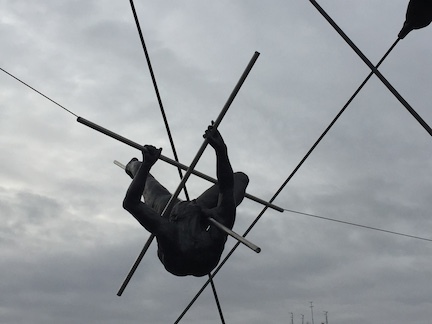
- Last but not least, we should be able to provide help to people too. The term coaching has established itself in recent years for the professional support associated with this. In the third part of this book, I will explain in-depth why managers should see themselves as coaches, and how they can implement this role.
“One of the symptoms of an approaching nervous breakdown is the belief that one´s work is terribly important”, the philosopher Bertrand Russel once said.[6] Many line managers in traditional organisations seem to be candidates for such a breakdown. They see themselves as doers, but fail to notice how they, in many cases, create bottlenecks by omitting information, making unclear decisions or delaying feedback. They interfere in operational work processes and fail to see how they patronise professionals when they do this. They set overly ambitious goals, but pay little attention to how these should be implemented. “They live in their own world”, is how a UX-Designer made the point. “When I look at some of the decisions being made, I don’t know if management is still on planet Earth, or if they exist in their own universe.” No wonder that many self-organising enterprises focus on making leadership a service. At Gore, line managers are explicitly there to serve the employees and support their work as best as possible. The same goes for Harley-Davidson. As the former CEO Rich Teerlink and his coach Lee Ozley wrote in More Than a Motorcycle, the ideas of shared leadership responsibility and cross-functional collaboration quickly bears fruit: decisions are made as close as possible to the source of the problem, leadership turned into a process where everyone took part; consequently, each person that had hierarchical authority turned step-by-step into facilitators and coaches.[7]
The German allsafe JUNGFALK can tell a similar change story. After all departments had been abolished and a customer-oriented process organisation was established, the job description of the former department managers was also forced to change. Flow thinking was called for rather than business administration. Today, management focuses on two areas: Optimizing processes and developing employee potential. Supporting autonomy is as important as the open discussion about failures and learning together. And along with continued training and coaching, the process leader accompanies the field service to the customer site in order to listen, watch and ask questions there. A similar story is told by Markus Stelzmann, CEO of TELE Haase. According to Stelzmann, he does not see himself as the big boss who wants to keep everything under control. Such an approach would be absurd in regard with TELE Haase´s self-managing business circles. He takes on two roles to influence the daily business: as a lobbyist for topics that are especially important to him and as a personal mentor helping individual employees. This is anything but child’s play: “How do you convey that it isn’t enough to just do your work? How do you nurture the mental readiness to try new things? And how do you support the bold actions needed for innovation?” The Dutch software specialist Incentro pushes the envelope of this idea. The executive management no longer acts as a control-oriented supervisory board, but rather as a board of inspiration hosting special guests several times a year, such as football managers, philosophers or artists like Dutch rapper Typhoon. A plethora of new ideas emerge from these workshop-like events, which then are disseminated within the company. The core values of ambition and happiness, along with inspiration, are the focus at Incentro. As senior manager Mathijs Kreugel explains, it is about giving “talented people…the opportunity to excel. We achieve this in a variety of ways, including by giving each other the freedom we need to grow, so that everyone gets a chance to develop their full potential.” (https://www.incentro.com/en/culture/happiness).
At Toyota, line management’s mission is enabling the team to win, meaning creating value for the customer. Management is not directly involved in creating value, rather they coach and support the team members. Which is quite similar to Zappos: “The role of a manager is to remove obstacles and pave the way for the employees to be successful” Zappos.
The only legitimate goal of line management is to support self-management, as proclaimed by Götz Werner, founder and member of the board of directors for dm. According to him, a manager is not someone who knows everything and can do everything better. A manager is able to ask the right questions. Asking questions increases the awareness of the person being asked, and makes it possible for them to find their own answers.[8]
Of course, this requires a special form of attention, as organisational guru Peter Senge claims: “The managers of today must be researchers who acutely study their own company. They need to be designers who initiate any learning process that enables self-organising and leads to profitable performances in an ever-changing world.”[9]
These examples reinforce a crucial point: distributing management is not a lifeline to save dysfunctional leadership. Instead, it’s about defining the services we need to encourage business agility on all levels. Designer, choreographer and coach are not supposed to undermine leadership as a team sport. Designing a successful organisation is still the responsibility of everyone. Line managers do their part by focusing on those things that go beyond the control of the experts working in a specific environment. They work on the system and not in the system, as John Seddon points out.[10]
Of course, that is easier said than done. The collaboration between line managers and subject matter experts remains challenging and requires trust and a special form of fitness. The last design area described in the next chapter — continuous training and coaching — emphasizes why this fitness is so important and how we can achieve it.
Key takeaways from this chapter
Self-organising enterprises break away from many traditions: the tradition of connecting management and hierarchy, the tradition of disconnecting planning, controlling and implementing, the tradition of telling highly-qualified professionals how to do their job or the tradition of treating adults like children.
This chapter tries to clarify what you are getting into when you break with these traditions. You can profit from it, but there are also risks and side-effects when you distribute management responsibilities across your organisation. The concept of shared responsibility also changes what line managers can and should do. Designer, choreographer and coach are three aspects of a new management that fits the challenges of the Agile world. Leadership is no longer a privilege, rather it is a service we provide our customers and each other for the benefit of the company.