6 Lean Organisational Structure
Speedboat instead of steamboat is one of the slogans for business agility. Ultimately, we want to be fast and responsive instead of just clumsily chugging along. As I already explained in Chapter 2, these metaphors are chosen wisely: They emphasize the flow principle that drives our product and service “boat” to our targeted customer “port”. Although experience shows that value needs to be the centre of our attention, we cannot avoid questions about organisational structure. How should companies design themselves if they want to ensure agility? Which roles are needed to utilise self-organisation? And what procedures are necessary to coordinate various units?
Lean, de-centralised, loosely coupled, interdisciplinary, flat — these would be the structural requirements for self-organising enterprises. What do these requirements mean in detail?
Lean means, first of all, to focus on small business units. You are more flexible when responding to change as a result. Agility is unlikely if a large apparatus has to be put in motion. Across diverse industries, self-organising enterprises use core teams with a limited number of members. At Buurtzorg, there is a maximum of 12 people on a team, at sipgate it’s 10 and at Harley Davidson it’s 20. At their high point, FAVI had self-managed mini-factories, each with a maximum of 30 workers. Incentro is built on customer-oriented units having 30 to 60 specialists and Traum-Ferienwohnungen limits their autonomous cells to a maximum of 20 people each. If the work in these cells increases, along with the number of assigned experts, the cells are simply split apart. InVision, on the other hand, has shrunk their core unit in some cases to 3 or 4 people in order to make communication as easy as possible.
Working across teams is also limited. It can just be the organisational structure like at Spotify, where product-oriented tribes have a maximum of 150 employees. Or they focus on certain market segments, like it is done at ImmobilienScout24 and AutoScout24. Small business units also make it easier to have alternative management models, like Handelsbanken demonstrate: relative goals, continuous planning, resources as needed, dynamic coordination across various company areas and a high degree of autonomous decision-making [1]. The Finnish cleaning company SOL also manages without fixed goals and budgets. The 11,000 employees are organised into regional studios that independently manage their daily business—which is done during the day, in contrast to the industry trend of cleaning at night—and new business opportunities.
Decentralisation also has a considerable trimming-down effect. Static bureaucracies give way to dynamic networks. Whether it is Toyota’s manufacturing teams, Morning Star’s divisions, hhpberlin’s project teams or Liip’s autonomous locations: The traditional headquarters, as well as the hierarchy and staff functions that go along with it, are replaced by self-directed business units. Naturally, this is not a new model. The car rental company AVIS already used decentralised business units, each with their own profit-loss responsibilities, in the 1960s—and at the same time removed many status symbols such as reserved parking, prestigious offices or sophisticated job titles for managers. Decentralisation helps overcome many policies preventing people from giving their best. Less bureaucracy, no unnecessary management rituals and eliminating a culture of personal dependency are good prerequisites for this. Already in the 1990s at dm, the classical business pyramid was turned upside down. On top is the customer, or better said the stores, where they enjoy a high amount of freedom to design for their local customers. Management still plays an important role, but instead of the typical hierarchical structure, leadership is cultivated as a service. Instead of dictating budgets, revenue goals or conduct guidelines, they set general boundaries. The focus is on supporting the stores that serve the customers.
Loose couplings are often used to build self-organising structures. This thins out of all the lines, levels and boxes typically found in traditional command-and-control cultures — and can go as far as companies like Compax, Liip or Gore, where there are no formal org charts at all. This leads to employees not being fixated on an explicit job description. Just like positions, descriptions by definition tend to be static: We do only this job, we insist on this position and so on. Frederic Laloux compared job descriptions to a “honey pot for the ego”: They attract you and make you addicted, but ultimately are unhealthy [2].
“Don’t put people into boxes” Gary Hamel also warns us, because a narrowly defined role is as detrimental to learning as is exclusively focusing on just one area of expertise or over-identifying with a certain team [3]. Business agility should be nurtured by personal flexibility, where you work with various people on different things in order to go beyond your own core competencies. Great examples of this are the so-called fluid teams at Düsseldorf software developer InVision, the demand-driven transfer of production teams at FAVI or the strategic swarms at Haufe-umantis. Depending on customer requirements and the projects arising from them, experts find themselves in different constellations. Paul Bennet from IDEO even talks about loosely structured organisations requiring a special balance: “Enough design, but not too much. Sufficient structure, without feeling over-structured. Only enough planning as necessary, without controlling too much.”[4]
- A constitution where the rules of the organisation are set.
- A structure of circles, special roles and their dynamic interaction.
- A decision-making process for regularly inspecting and, if necessary, adapting all roles and authorities.
- Regular Meetings to coordinate individual circles and roles.
Decentralisation, just like coupling, goes beyond silo thinking. It is replaced with interdisciplinary collaboration at various levels. If individual business units want to operate autonomously, they must have all the necessary power for generating value. This applies to teams as it does for large groups that are together responsible for a product or service or for business units that work on an entire portfolio. At Computest, the whole organisation was converted from expert silos to interdisciplinary teams. The various service units include all competencies necessary for the respective customer segments. At the same time, strategic development is now driven by an interdisciplinary group of technical and process coaches, which have replaced middle management. A similar story happened at Traum-Ferienwohnungen. Before, customer-oriented changes were tied up with time-consuming alignment across various departments, but today are accomplished over a shortened route. Specialists from various areas work together within self-managing units and deliver the customer solutions from a single source. ImmobilienScout24 has the same goal. There, individual development teams are clustered according to market segment, focusing on cross-team coordination to generate value. The line management is interdisciplinary, too. The top people from sales, product, marketing and IT share overall responsibility.
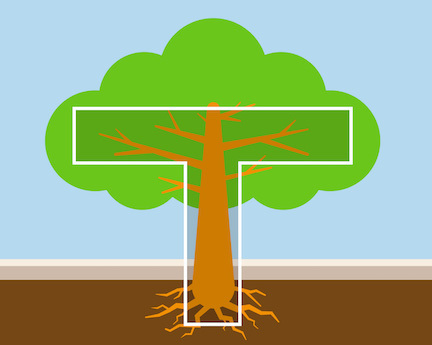
Interdisciplinary structures should not only provide cross-functional expertise, but also promote learning. Mutual understanding is as important as building so-called T-shaped skills. As can be seen in Figure 6-2, the T-shaped skills result from connecting special expertise and general know-how. While the core competencies are like a deeply rooted tree, this tree can expand by learning from other experts. The growing branches of capability can be pictured at the top part of the T. In interdisciplinary teams, developers learn from testers, sales people from product managers, or designers from marketers. In this manner, they will never achieve the same level of knowledge. However, they increase their understanding of each other, are more aware of dependencies and better align themselves towards the big picture.
Last but not least, self-organising enterprises favour flat hierarchies. Many teams don´t have designated managers anymore. Basically, everyone is responsible for decision making (see Chapter 4). The same applies for planning, organising and controlling all work that has to be done to delight the customer. Naturally, this also holds for feedback, learning and improvement. Delegates, acting as speakers for the group, are chosen to coordinate with other business units. This ensures transparency and a common focus on both sides. Rotating group speakers prevents anyone from mutating into a chief delegate. dm is a great example of how a large corporation with an extensive store network can operate with a flat hierarchy. With 38,000 employees, there are only two management levels: a total of nine executive managers, who are also responsible for specific business areas, and regional managers that support 20-30 stores each. The broad areas of management responsibility strengthen the principle of subsidiarity and make micromanagement nearly impossible.
The story of InVision shows how you can go from a first iteration of agile change, to increasing bureaucratisation, back to a more or less mature level of business agility. Although the growth phase led to traditional structures with more and more line management, a radical form of self-management is nurtured these days. Instead of a hierarchy, there is autonomous teamwork. Instead of fixed roles and job titles, the exchange between various professionals is fostered. And instead of silo logic, there is an emphasis on value-oriented creativity (https://www.youtube.com/watch?v=OHcFd5KaYRI).
Just like at InVision, self-organisation is one of the reasons that middle management is shrinking—or even completely disappearing. What is middle management good for in a company where everyone is responsible for work, as well as people management? For Hermann Arnold, middle managers seem to have a similar fate as travel agents. In their current form, they are more and more unnecessary and need to reinvent themselves.[7] In some companies, managers go back to expert roles while others provide coaching functions, which I will discuss in more detail in Part III.
6.1 Minimum Guidelines
Lean, decentralised, loosely-coupled organisational units set the stage for a high amount of autonomy. Hierarchical interventions rarely help serve the customers better. This obviously does not apply only to the world of small software companies. Industry giants, such as American organic supermarket Whole Foods and the German drugstore dm, also succeed with minimum guidelines. Rather than bothering employees with superfluous standards, they are expected to bring their own ideas. At Whole Foods, experiments to better serve the customers are encouraged throughout the company. This can be in the form of regional product selection, an appealing presentation of goods or any type of help that simplifies shopping, packaging or transporting goods. At dm, each store determines their assortment of goods to a large degree, as well as any special services they want to offer the customers. They are also free to hire and coordinate employees as needed. Salaries are as transparent as the projects you can apply for. Personnel costs are understood to be employee income and further training is seen as an investment into the future.
Such design autonomy is not possible without a certain amount of decision-making authority. This applies to both the systemic and individual level, including the possibility of company internal job changes like at American finance expert USAA. The excellent customer service, for which USAA has received many awards, is reflected in a corporate culture where individuals have a variety of opportunities available. If someone is convinced they can serve the company better in a different area, the move is not only granted, but also supported with specific training.
However, self-organisation does not live from structural independence alone. It needs a willingness to responsibly utilise this independence at all levels, along with the commitment to develop your own capabilities.
A clear understanding of commitment is all the more important because self-organisation is not self-serving. The ultimate goal always remains the same: be profitable while ensuring employee and customer satisfaction. As Don Reinertsen so convincingly argues, proxy goals are too often pursued: more innovation, better product quality, democratic corporate culture or self-management and agility. None of these proxy goals are objectionable, as long as it is clear that they are a means to an end, namely making the organisation profitable.[9]
As crucial as profit is, the spirit of self-organising enterprises is not solely based on this. Sure, they need money, just like people need to breathe. But at the same time, people do not simply live to breathe. Companies like Patagonia, Gore, Haufe-umantis or dm don’t just exist to maximize profit. Instead, they are practical examples of why the particular balance between profitability, customer satisfaction and employee satisfaction is so important these days. Although customer satisfaction contributes to the obvious profits, employee satisfaction should not be underestimated. I believe it is a fundamental prerequisite for any sustainable value creation.
“Value creation through appreciation”, as Bodo Janssen points out for the German hotel business Upstalsboom. Anyone who thinks this is just another pathetic management cliché can take a look at a few impressive numbers. Since implementing democratic processes, employee satisfaction has increased 80% within a few years, while the sick leave quota sank from 8% to 3%. At the same time, guest satisfaction increased 98%, which led to a doubling of company revenues within three years, along with a significant increase in productivity.

9.2 Mirror Phenomenon
Thought leaders of self-organising enterprises have often alluded to the dynamic interaction between organisational and professional openness. The conduct within the organisation always affects the conduct of the organisation with its customers and vice versa. Corporate culture and customer relationship culture are two sides of the same coin. That’s why the way an organisation treats their employees affects the way customers are treated. If the employee’s need for respect, growth and autonomy is fulfilled, this not only has an effect on their own satisfaction, but also on that of the customer — in a sense, the spark is carried over.
Similar mirror phenomenon can also be found within the enterprise. Conway showed how company and software architectures influence each other in the IT business.[10] Simply stated, the structures and processes of one area are found in the structures and processes of the other area. This mirror phenomenon can be found in the history of each company. InVision is a perfect example of how growth and success can increase complexity in an unexpected way. What began as an agile experiment led to IT systems that were dull and prone to errors, which they tried to “fix” with an increasingly bureaucratic control mechanism. It’s no wonder, as CEO Peter Bollenbeck stated, that customer-focus, as well as the fun factor, had been lost over time.[11]
From Bollenbeck’s perspective, InVision found their way back when they began applying IT hacking principles within their organisation. This kind of organisational hacking not only required a profound understanding of what was going on, but also a certain amount of disrespect along with a trial-and-error mentality. In this spirit, the control mechanisms that made life difficult for everybody were attacked in at least two ways. First, the rigid IT standards from Microsoft, Oracle or SAP were gradually replaced with open source solutions. Second, command-and-control management was replaced with autonomous teams and flexible alignment. Both strategies encouraged entrepreneurial spirit along with business agility.
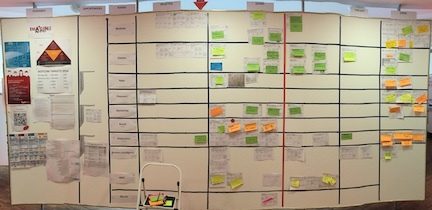
As we saw with lottery specialists eSailors, organisational development rarely occurs with a harmonious balance.[12] Similar to InVision, the software development at eSailors was also shaped by a monolithic IT architecture, which was migrated piece-by-piece to one that favoured autonomy of the cross-functional product teams. The independence of these teams forced, in turn, the transformation towards microservices. And changes turning the former assembly-line into customer-oriented processes eventually left their mark on the leadership culture. Figure 6-4 shows this new culture also led to a transparent workflow.
What can we learn from these examples? Maybe this: If we want a lean organisation we also need to make cross-team coordination as easy as possible. Or even this: If value creation and appreciation are like Siamese twins, we should pay attention to customer satisfaction and employee satisfaction in equal amounts. Both areas are valuable. Without question, an open-minded environment where experts manage their work themselves results in less employee turnover, as well as fewer costs for recruiting or onboarding. The outstanding commitment that distinguishes self-organising enterprises, such as identifying with the employer, a sense of responsibility towards colleagues and the willingness to serve your customers are themselves important values, too.
The emphasis is placed on balance. If the focus is on optimising workflow without giving people decision-making authority, such a balance cannot be achieved. The same goes for a work management system that allows transparency, but doesn’t support self-management. Self-organising enterprises have, above all, two benefits. First, they increase what is called the psychological revenue through an open working environment that nourishes the so-called happiness factor. Second, the marketing effects of a self-organising culture should not be underestimated. In a time where the war for talent seems to be ubiquitous, a company’s good reputation is a valuable commodity. That’s why the Dutch software expert Incentro has both employee and customer satisfaction on its agenda. They are convinced that satisfied employees will not only be happier in their jobs, but will also deliver better results. For Incentro self-organisation is not an end in itself, according to founder and managing partner Stef Lagomatis. It is a means to ensure satisfaction in all relevant areas. The company was recently voted a Great Place to Work confirming his conviction, as do the results of the Net Promoter Score (NPS), which collects customer feedback on a quarterly basis. Both of these interim results underscore the ambitious goal of making customers the ambassadors of Incentro.
**However, profitability can never be ensured through company structure, regardless how lean it is. The potential for improvement is minimal if we focus on the levels of our organigram. What benefit does it bring to the customer if we move boxes around? Reduce the number of levels? Pile up teams on top of one another like Legos? Reshape the silos? Or replace them with circles? Hardly any, I think. If the customer is unlucky, the product and service quality decrease because the organisation is too busy working on its internal structure. If, though, we can channel our value streams to improve cycle times, manage our workflow with less effort and deliver better quality, our customers will quickly notice.
In other words, flow is and will always be the determining factor of business agility. It’s a bit like soccer. The deciding factor is not the line-up, but rather how the game is played. Even a team of superstars will lose if they are not able to play well together. It is the interactions, not the sum of the individual elements, that determine the degree of agility. At the same time, the line-up cannot be completely ignored. A limping soccer forward would make as few goals as a blind goalkeeper could prevent. The same applies to the strategy we follow in our organisation. The more cumbersome our line-up is, the longer it takes to get things flowing. The clumsier our teamwork is, the slower our value creation becomes. And the more we centralise management tasks, the more artificial bottlenecks we create. Which brings us to the next design area of self-organising enterprises—distributed management tasks.
Key takeaways from this chapter
Business agility is not possible — and I consciuosly repeat myself here — without system thinking, lean principles and self-organisation. Although we focus on the interplay of work flow and value stream, we cannot avoid the questions of organisational structure. How should we set-up our enterprise in order to maximize value and minimize waste? With the keywords lean, decentralised, loosely-coupled, interdisciplinary and flat, we have some essential answers. A further hodgepodge of real-life examples shows how this can be done. For example, the Finnish cleaning services company SOL with its 11,000 autonomously organised employees, the loose coupling at the California tomato producer Morning Star, the interdisciplinary cells at Traum-Ferienwohnungen or the flat hierarchies at outdoor clothing experts Patagonia.
All of these companies show how to apply and gradually expand autonomy: whether it is the autonomy of work processes, decision making or networking. If this can be achieved, you will neither have to worry about customer and employee satisfaction, nor about the profitability of your company.