Patrons of the Digital Renaissance
Mindy Burton

|
We have a potential renaissance in art today, but we need a catalyst for creativity to guide and sponsor budding artists: the digital-age patron. |
The digital age may seem like a tornado sweeping through the arts, disrupting the traditional relationship between artist and patrons, and even changing the definition of an artist. What fueled the arts from the past is quite different from today. All the artistic activity in today’s age is wonderful, but it’s very chaotic. It is important we understand the changes in order for art to continue to be fueled, giving it the opportunity for an even greater, modern Renaissance.
Art in the digital age
The potential Renaissance for art today is happening due to some key factors in the digital age: the availability of creative tools and easy methods of distributing art.
In today’s age the resources and tools available to artists seem unlimited. A resurgence of interest for artists has exploded. Everything has gone digital, whether its the tools to create the art, or the tools to distribute the art. It has opened up the doors, for what used to be expensive hobbies, to the everyday person.
Take photography as an example. Before digital cameras, it took a true expert to be able to produce images that would look good. Photographers didn’t have the luxury of reviewing shots, so they would only take a photo if they knew it would look good. If they had a roll that held 24 frames, each frame cost money and none would be wasted. With the digital camera, however, a photographer has the luxury of taking 100 photos and not having to worry about “wasting film”.
The experiencing of creating art is no longer limited to professionals.
The internet has opened up the doors to artists everywhere. Whether they are pushing their photography, music, or art on their own through social media, or using a service such as iTunes, Teespring, or iStock. They have the control and ability to reach those who are interested in their art. Artists don’t have to move to a big city to try and make it, they can create and distribute their art from their Mom’s basement.
The net effect of all this artistic activity is a great multiplication of the kinds of art being made and the types of people making it, and this ties in with the digital age phenomena known as the “long tail” and the “rise of the amateur”.
Theory of the Long Tail
The theory of the long tail in the marketplace first came about in 2004. The main idea is that our culture and economy is moving away from the head of a demand curve, most popular products or more generic, towards the more specific or niches (Anderson). An example of the this is in music sales. A popular musician such as Taylor Swift will sell her album (head of the curve) to the masses, but thousands of individual songs (niche or long tail) will be sold by lesser known artists.
The digital tools, internet, and long tail are the pieces that give rise to today’s amateur.
A positive impact of the digital age for artist is that there are more out there! Artists are not limited by physical boundaries or institutions. Anyone with a camera can be a photographer. Anyone with Garage Band can create music. Artist can look up “how-to” tutorials on almost anything: photography, drawing, painting, writing music, and so on. Artists do not have to be trained in the classical or traditional sense to rise to fame.
The music industry is one of many industries that has seen a rise in amateurs. The Internet and its many music related platforms has allowed musicians to get their music out to the masses faster and easier. Some artists, like Lindsey Stirling, have even been able to make it to the head of the long tail without using a record label.
All of this is great for the arts! But with all this is an overabundance of art, and the digital age is wild and untamed. The Internet is flooded with young, auto-tuned people like Rebecca Black, who go viral simply because everyone can’t stand her. With all these budding artists, how can those with true potential be discovered and supported so that we can have a true Renaissance of today? Perhaps what is needed in the digital age is to have patrons.
Artists and patrons during the renaissance
If we look back in history, the Renaissance can teach us how it was patrons in the Renaissance who managed to bring along the great artists of that period. Nothing illustrates this better than the great artist, Michelangelo.
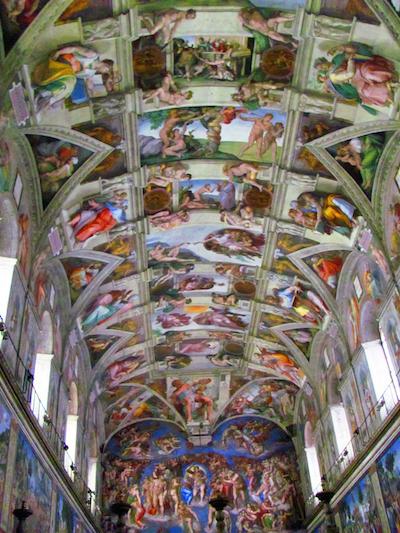
The ceiling of the Sistine Chapel houses one of the most famous works of art, painted by Michelangelo. He spent the better part of four years lying on his back to complete this master piece, totaling, roughly, 5,000 square feet. He would not have been able to complete this work without the patron who commissioned it, Pope Julius the II.
The relationship between a patron and an artist during the renaissance was quite involved. They provided structure for the creative artists. The patrons wanted to find the best of the best to produce art for them. These patrons took on an active role in the creativity of art they commissioned, giving direction on not only subjects or themes, but also what materials to use (“Artists and Patrons”). They also were the ones who could ensure the art was completed, because they commissioned and paid for it.
Another key way in which patrons made art happen in the Renaissance can be seen in the example of the Medici family. This family was extremely wealthy, had a lot of political power and some even served as popes. The first family member to become a patron of the arts was Giovanni di Bicci de’ Medici, a banker.
The Medici family provided means of living for artists, which enabled artists to focus on their work. Artists were supported financially, and sometimes even given a place to live, like Leonardo da Vinci, who received patronage for seven years (New World Encyclopedia). The family commissioned pieces with Donatello, Fra Angelico, Sandro Botticelli, and Michelangelo.
Why was patronage so important during the Renaissance? They brought the best artist to their city, fueling the accomplishments of the Renaissance (Drogin). But, there were limitations to this structure. Patronage was proprietary to the wealthy, and since artists relied on patronage there were limited artists.
Digital patronage today
We can see similarities in patronage, like the Medici family, today. Celebrities have discovered artists and taken them under their wings.
Justin Bieber was only 12-years old when he became a sensation on YouTube. He flew to Atlanta in hopes of landing a record deal. He was able to meet Usher, who not only signed him but took him in as a protege.
David Foster is another music producer who saw talent in a 17-year old boy, Josh Groban. Within just a few weeks of Foster discovering Groban a situation arose. Andrea Bocelli, a well known Italian singer, was unable to attend a rehearsal for the 1999 Grammy Awards. He was singing a duet with Celine Dion. Foster convinced Groban to fill in, and that moment changed his life.
These artists were backed by a patron who took care of their needs or put things in place for their career, allowing them to focus on their art, much like the Medici family.
Another form of patronage is seen through crowdfunding. Patronage is distributed through many people. This is most commonly done in the form of Kickstarter.com, where an artists ask their fans for money so they can produce their work.
Both single patronage and distributed patronage are great, but they each have limitations. There aren’t that many big-wig sponsors discovering new talent, it takes someone to know someone. In the case of Groban, it was his vocal teacher who knew Foster directly that connected the two.
Crowdfunding is a great kick start for many artists, but it can only take them so far. How many times can you ask your friends and family and small pool of fans to fund ongoing work? It is true that if an artist is able to get traction outside of friends, family and fans that they can see more success from their crowdfunding. It can open the doors to more opportunities. But crowdfunding doesn’t allow for those who want to be patrons beyond what crowdfunding platforms allow.
And so, though there are some good examples of patronage happening today, we need to perfect digital patronage in a couple of ways.
Nicholas Zakas decided he wanted to publish an ebook. He chose Leanpub.com as the platform partly because of the digital tools it provided, but also for the structure and order it provides. He said the customized landing pages and URLs automated the publishing process and simplified things for him. In addtion, “The fact that Leanpub handles all orders and returns is fantastic. I never wanted to deal with that stuff” (Zakas).
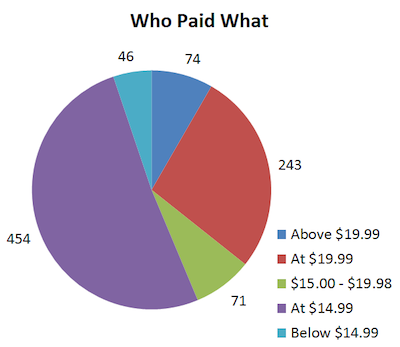
Zakas was also able to set two different prices for his book, the “suggested price” for $19.99 and the “lowest price” for $14.99. The results from his sales is where we truly see evidence of the digital-age patron. Out of the 888 sales, 243 paid the higher suggested price of $19.99, 74 above the $19.99 price, with the highest payment being $78.62. These are amazing results that illustrate the point that people were willing to pay more than what was requested in order to thank and encourage more of this person’s work.
Patron’s provide validation and structure
Validation and encouragement can come from money, or it can simply come from “likes”. Many artists create things and put them online for people to view for free. Instagram, for example, has been a way that visual artists can share their work with fans. They are then validated and encouraged by patrons through engagement and “likes”. These likes don’t equate to money, but what is important about the validation is that artists feel as though people are invested in them.
Patronage of the best sort is not just about providing money, but about providing validation and structure.
Without patrons from the Renaissance there wouldn’t have been such great flourishing of arts. Isabella d’Este was another famous patron during the Renaissance. She was one of the many patrons for Leonardo DaVinci, but also a lesser known instrument maker Lorenzo Da Pavia. But she was also an amateur. She herself liked to learn how to play new instruments. She also liked hosting parties, writing, fashion and collecting art.
She provided structure for an instrument maker Lorenzo Da Pavia. She commissioned him to make different types of instruments, whether they were for herself or as a gift. The first instrument she had made by Lorenzo was the clavichord. She first wrote him in March of 1496, and he promised to deliver it by July. But the timeline kept getting pushed back. She persistently contacted him to deliver her piece, and the persistence paid off. She got him to put her work in front of other patrons because she held him to his contract (Prizer, 86).
Their relationship lasted 19 years. Her investment and encouragement in Lorenzo was surely a key in what was said about him and his reputation. “It is true that the harpsichords, clavichords and other diverse keyboard instruments would have been altogether equal, except for the fact that he also was the one who brought back [into prominence] the orders of pipes and strings into certain harmony and perfect consort (Prizer).”
The best patrons provide structure and creative limits that bring along the artists’ talent. Isabella wasn’t just invested in Lorenzo, she gave him deadlines.
Daivd Whitacre is an example of a patron of the digital-age who successfully who provided structure and order to create a virtual choir. He first started by putting up his musical scores on his blog for anyone to download. He then put up the background music so volunteers could learn it on their own. From there, people could record their “audition” and submit it to him for possible selection. He was then able to put the tracks of his choosing together, to produce a beautiful piece of music (Burton).
If we can capture the structure and support from patrons of the Renaissance, we can see an even better modern day Renaissance. We can see the flourishing of arts like never before.
Works Cited
Anderson, Chris. “The Long Tail, in a Nutshell.” Longtail. Web. 10 June 2015. [http://www.longtail.com/about.html](http://www.longtail.com/about.html..
“Artists and Patrons.” Italian Renaissance Learning Resources. Web. 27 May 2015. http://italianrenaissanceresources.com/ units/unit-8/essays/introduction/
Burton, Gideon. “Brave New World.” 9 Sept. 2012. Web. 10 June 2015. http://bravenewdigital.blogspot.com/2012/09/ creativity-and-big-picture-for-new-media.html.
Prizer, William F. “Isabella D’Este and Lorenozo Da Pavia, ‘master Instrument-maker’.” EMH Early Music History 2 (1982): 87-118 120=1127. Cambridge University Press. Web. 29 May 2015.
“The Making of An Artist.” Italian Renaissance Learning Resources. Web. 27 May 2015. http://italianrenaissanceresources.com/units/unit-3/.
“Medici Family.” New World Encyclopedia. Web. 27 May 2015. http://www.newworldencyclopedia.org/entry/Medici_family
Isabella d’Este and Lucrezia Borgia as Patrons of Music: The Frottola at Mantua and Ferrara Author(s): William F. Prizer Source: Journal of the American Musicological Society, Vol. 38, No. 1 (Spring, 1985), pp. 1-33 Published by: University of California Press on behalf of the American Musicological Society Stable URL: http://www.jstor.org/stable/831548 Accessed: 29-05-2015 19:53 UTC
Zakas, Nicholas. “NCZOnline.” Leanpub: One Year Later. 18 Mar. 2014. Web. 10 June 2015. http://www.nczonline.net/blog/2014/03/18/leanpub-one-year-later/.
Image Credits
- “The Sistine Chapel” by Flickr user Glen Scarborough. Used under the Creative Commons Attribution 2.0 license.
- Copyright Nicholas Zakas, 2014. Used by permission. “Leanpub: One year later” http://www.nczonline.net/blog/ 2014/03/18/leanpub-one-year-later/.
About the Author

Mindy Burton
Mindy Burton was raised in Mapleton, Utah. She is currently studying Public Relations at Brigham Young University and is very passionate about the rise of social media. Follow her on twitter @mrsMindizzle.