Digital Identity Subjected to Social Darwinism
Denise Tuairau
|
In the 20th century, colonization was justified by Social Darwinism. Identity was affected because one superior race and culture was imposed while the others’ were progressively suppressed. Similarly, today, our digital identity is subjected to social standards set by the online crowd. Those who can adapt to them will prevail while the others will progressively be suppressed. |
Identity: The colonizers and the colonized
In the 20th century, groups of people were mainly distinguished between “white” and “other colors”. People were superior and acceptable if they had a white race, white culture, white civilization, and so forth. This mindset started with the theory of Social Darwinism. Darwin’s “laws of evolution” were applied in Society: The fittest or best-adapted traits, races, and cultures would prevail. Social Darwinism lead to the spirit of Colonization. Colonial authority was set upon the notion that “Europeans in the colonies made up an easily identifiable and discrete biological and social entity: A “natural” community of common class interests, racial attributes, political affinities, and superior culture” (McClintock). In regards to colonial politics, McClintock explained that there were written “legal and social classifications designating who was “white”, who was native, who could become a citizen, rather than a subject”. “White” people were the Colonizers while people of “other colors” were the Colonized.
At the time, the Colonizers were identified as pure, powerful, and civilized, while the Colonized were identified as weak, ignorant, and inferior. The mix of races was seen as a danger against racial purity and cultural identity. Social Darwinism justified the Colonial idea that “civilized white races [had] a duty to the “heathens”, to educate, and to protect [the Colonized]” (Drogin). For instance, France set a mission they called, “La Mission Civilisatrice” (The Civilization Mission): Colonizing to them was indeed a duty to civilize others and their culture was a gift they were generously giving. If one’s identity is defined through race and culture, then the identity of the Colonized, seen as the least socially fitted, was being suppressed, even replaced by the identity of Colonizers. Social Darwinism was reflected in Colonization and by that, it affected people’s identity in the 20th century.
In the early 1900’s, Victor Segalen, a French author, lived in Tahiti, which is where I am from, and he was one of the few who disagreed with what the French people were doing to the Tahitian culture. Victor Segalen expressed his disagreement through a book he wrote called, “Les immemoraux”. It’s the story of a Polynesian who failed to recite a certain legend for a traditional ceremony, and out of shame, he left his island and only returned 20 years later. At his return, he was shocked by the drastic change caused by the European culture: His culture seemed to be lost.
Personally, I saw this happening from my grandparents’ generation to mine. For instance, language at the time was a strong part of culture. My grandparents’ generation, and that is in the early 1900’s, mainly spoke Tahitian. When my parents attended school, they were not allowed to speak Tahitian although that was the language they used at home. So my parents’ generation is known for speaking both languages fluently. Then, with more and more public facilities having to be French speaking, my generation ended up being only fluent in French. However, today, we can see with the generation after me, the return of the Tahitian language and even the Tahitian culture in general. That is because of the Digital influence. As Castells said, “the more the world becomes global, the more people feel local” (p.6).
A globalized and diversified identity
In the Digital Age, identity is no longer imposed onto another the way it used to be during the time of Colonization. Since the internet, we find an interchange of cultures leading to a process of international integration: “[Internet] users are able to develop their own identities largely on their own terms” (Brabham). Today, in the Digital world, people are open to different races and cultures, while in the 20th century, “adaptation to local food, language, and dress… were [seen as] sources of contagion and loss of the white self” (McClintock). At the time, there was a great fear of becoming inferiors like the Colonized by mixing up cultures. Today, there is a new form of collective identity.
In regards to a new form of collective identity, ideologues today suggest that the rise of the global network of society is the coming of a flat world, a world with common rules and values. That is similar to the mindset related to Social Darwinism and Colonization: An attempt to form a high and unified culture. However, the reality is that globalization enables people to keep their “cultural specificity, hanging onto their god, their family, their locality, their ethnicity, and their nation” (Castells). The production and distribution of cultural products like movies, music, clothes, food, arts, and so forth, make the network global but the products stay local and diverse. As Castells said, “We are not sharing a global culture. Rather, we are learning the culture of sharing our global diversity”.
Interestingly, that “culture of sharing our global diversity” leads to the idea of being free to identify ourselves however we want to. Thomas said, “The internet allows wide audience opportunities for exploration of identity… [It is] no longer bound by the confines of the embodied identity… The old can feel young, the ugly can feel beautiful, the shy can be extrovert, the loner can be popular and vice versa” (p. 17). The exploration of identity in the Digital world offers liberation to many. However, there is a disruptive identity today with limits set by the Social Darwinist influence.
Identity: the “adaptable people” and the “masses”
Today, there are more interracial unions than there has ever been throughout history. But we find a similar effect of Social Darwinism on identity today than there was in the 20th century. In the online environment, identity is defined by posted aspects of the body (e.g, gender, race), emotions, relationships, cultures, and the way storylines are adopted (e.g, social context or imaginative role-playing). Thomas clearly explained that online identity is, “the authoring of self…it’s me but minus the things I don’t like about me. Those aspects of self-chosen to be shared with the public”. In a way, the concept of digitally sharing only the fittest or best-adapted aspects of an individual correlates with the theory of Social Darwinism. The digital identity is therefore disruptive: People today are so confident that the progression of technology can only lead to more free and diversified ways to identify ourselves but reality shows it differently.
Interestingly, there are online social standards, which, like Social Darwinism, are based on common feelings, tastes, and opinions. The online crowd sets a common judgment on what seems to fit in best in the Digital world. I found this interesting comment from Will Kriski on Google+: “Keeping up with FB [Facebook] changes is like Social Darwinism. Only adaptable people will keep up, leaving the masses to languish in obscurity”. Online social standards separate those “adaptable people”, fitting best in the Digital world, to “the masses”, being progressively suppressed.
Let’s take the example of the MTV show called “Catfish”. The show is about checking if the person someone is having an online relationship with is real. Most of them are not who they claim to be in the Digital world: Either they stole others’ digital identities or they idealized their appearance. The reason is always the same: Wanting to fit in. Creating such fake online identities allows them to meet the online social standards. As a result they can build relationships with those “adaptable people”, which would not have been the case in the real world. In fact, in the show, most of the partners end the relationship with their fake online lovers once they discover their real identity. The host of the show, Ned Burns said on Google+, “Sometimes you want to fall in love, but not with a real person, because real people are imperfect and their imperfection is a terror”. It is clear that there is another aspect of Social Darwinism today. We find a subjectivity of identity in the Digital platforms, limiting that exploration of identity mentioned earlier.
A globalized but disruptive identity
In general, identity has been defined by one’s race, traits, culture, interests, and so forth: What distinguishes a group of people or a person from another one. In the 20th century, Social Darwinism, the theory that only the most socially fitted people prevail, lead to the selectivity of identity: It was either suppressed or imposed. Colonization, reflecting Social Darwinism, has been a great evidence of that: Colonizers attempted to impose the white “superior” identity on the Colonized in order to establish one high and unified civilization.
Today, because the internet has allowed a wide international exchange, we can now enjoy globalized and diversified identities. People are more open to differences: They can be part of a nation, yet have their own culture and identity. In addition, creativity in the online environment allows a greater diversity as people can freely make their own digital identity. With that happening, it is commonly believed that our continuous technological advancements can only make the issue of identity better. But the truth is, there is a disruptive identity today: Like Social Darwinism had an impact on the identity of the Colonized, it has a similar impact on today’s Digital identity.
Online social standards keep changing based on the crowd’s common judgments and opinions. When creating Digital identities, people tend to identify themselves based on what would be most appealing to the online crowd. As Lexi Hanshaw said in her chapter, Changing Frames of Reference; then and now: “We live in a time where the only constant is change; where those who are able to adapt to change the quickest are most successful”. There is clearly an aspect of Social Darwinism in the Digital world: People are digitally distinguished between “the adaptable people”, those who keep adapting their digital identity to the online social standards, and “the masses”, those whose non-appealing identity are progressively being suppressed from the Digital world.
Works Cited
Brabham D. “Crowdsourcing”. The Mit Press Essential Knowledge Series, 2013.
Castells M. “The power of identity”. John Wiley and Sons, 2011. Social Science. P. 1-17.
Drogin S. Spare me the details! iUniverse, Inc, New York Bloomington Shanghai.
McClintock A., Mufti A., Shohat E., “Dangerous liaisons: Gender, Nation, and Postcolonial perspective.’’ Minneapolis, Univ. of Minnesota Press, 1997. Cultural politics. p. 345-360.
Segalen V. “Les immemoriaux.” Terres Humaines, 1956.
Thomas A., “Youth online: Identity and literacy in the Digital Age.” Lang Publishing, Inc, New York, 2007.
Image Credits
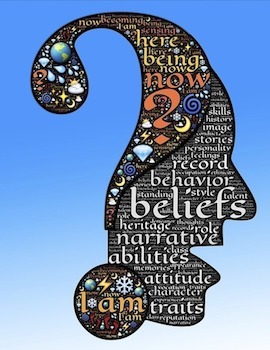
Hain J. Image of identity (Visual). Licence CCO public domain.
Special Thanks
Krisk W., Google+
About the Author

Denise Tuairau
Denise Verdugo was born and raised in Tahiti, French Polynesia. At 18 years old, she moved to Provo, Utah, to be a Chemical Engineering major at Brigham Young University. Denise speaks French and English, she’s passionate about cultures, science, and cooking. She married and became a mother in 2012.