Fashioning Your Identity
Hayley Wigginton

|
The rise of the digital age and the subsequent long tail of clothing disrupt traditional views of identity by equalizing society. We are no longer socially ranked based on our adherence to popular fashion trends but can manipulate them to convey our personal identity. |
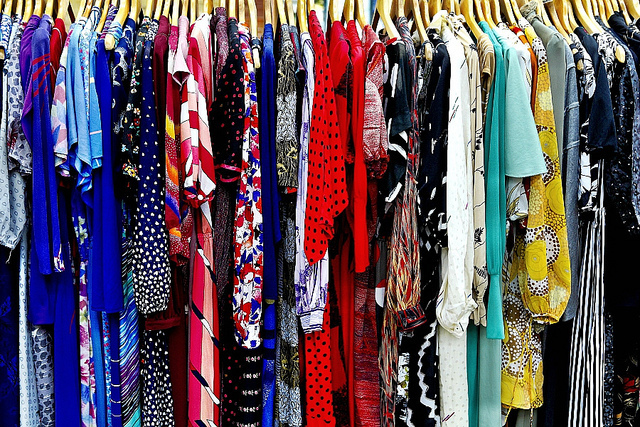
Fashion reflects the identity of society. It exemplifies their standards of beauty, indicates the state of the economy and represents societal ideals. Until recently the fashion industry has been dominated by an elite group of clothing makers and sellers. Consequently, in the early 20th century, it ranked people based on their ability to adopt popular trends dictated by these designers. In the digital age fashion has become a mode for expressing identity due to the rise of the digital age and the long tail phenomena. The long tail theory describes “a shift from mass markets to millions of niche markets” (Anderson) which ensures a diversification of products. In the 21st century we are able to showcase our individuality by utilizing these diverse products found at a variety of prices. By giving a historical reference in the 1920’s and comparing it with our current ideals of fashion we witness the disruption of fashions rigid guidelines in defining and expressing identity.
Enslavement to an Icon in the 1920s
The 1920’s marked a period of change for the entire western world. Gone were the days of WWI and the Spanish Influenza. Strides were being made in women’s suffrage and American woman had gained the right to vote on August 26, 1920. “A new feeling of freedom mixed with disillusionment combined to create a new kind of culture - a live for today, devil-may-care society that led into the Roaring 20’s and the distinctive look, sound, and fashion of the Jazz Age” (Monet). The dresses women wore became shorter to accommodate dancing. Their dress waistlines dropped and they wore their hair in a bob—the closest women’s fashion had ever come to resembling a man’s appearance. It is a look that remains idolized as “the flapper”. Although it resulted from women’s desire to celebrate their new identity, they enslaved themselves to the flapper icon. They formed a rigid social system based on the type of clothing one wore.
The look was easily recognizable and quickly categorized which lent to easily defined classes of those who were flappers and those who couldn’t maintain the look. An article published in “Outlook Magazine” in 1922 described the popular trend. “If one judge by appearances, I suppose I am a flapper. I wear bobbed hair, the badge of flapperhood. I powder my nose. I wear fringed skirts and bright-colored sweaters, and scarfs, and waists with Peter Pan collars, and low-heeled “finale hopper” shoes” (Page). The style left little room for innovation or idiosyncrasies. You could be categorized as “in style” or “out.”
Made popular by famous icons such as Zelda Fitzgerald, the flapper trend swept the nation. She describes the trends hierarchal movement. “Her (the flappers) outer accouterments have been bequeathed to several hundred girls’ schools throughout the country, to several thousand big-town shop-girls, always imitative of the several hundred girls’ schools and to several million small-town belles always imitative of the big-town shop-girls via the “novelty stores” of their respective small towns.” Big city girls ruled over those of suburban and rural towns. The wealthy stood apart from the middle and lower classes since price paid a huge role in the adoption of the flapper look.
It is estimated that to maintain the look of a flapper would have cost $115, about $1,200 in today’s currency (Zeitz, 81). The average American could not afford to maintain the look! Lines were drawn and assumptions made based on the speed and entirety that one adopted the look. You were judged by your appearance and your worth was deigned from the clothing you wore. If you were unable to attain the look, you became an outcast in your group of peers. The importance of keeping up with the status quo to achieve social recognition is demonstrated in this story about Mrs. Mesime and her daughter Ida.
Mrs. Mesime was arrested for standing watch while her daughter stole $150 worth of clothes from a market street clothing store. When asked why she aided her daughter in theft, she told the judge “I had no money to buy the clothes my daughter wanted, Ida got the craze to be a flapper, and to get her the necessary clothing we decided to steal. I was afraid she would adopt a worse method of getting her finery, so intent was she upon being able to dress as well as other girls in the neighborhood” (Zeitz, 81). Although extreme, Ida’s story portrays the social strain that affected the women of this era. These strains have lifted with the onset of the digital age and instead of scrambling to keep up with the national ‘identity’ of woman in the flapper age, we create our own ways of expression.
The Digital Age: a changing frame of reference
The democratization of fashion refers to the abundance of relatively cheap ready to wear styles and the decrease of overarching fashion authorities (Ward). Fashion’s democratization changes the role it plays in society; it is a tool useful in defining identity rather than in categorizing wealth and position. This is due to our technological advancements in the textile industry, but also through the near limitless resources of digital platforms. Online shopping, fashion blogs, Pinterest and fashion apps provide immeasurable variations and ideas for creating personal identity through dress.
Diana Crane expresses the degradation of fashions role in defining social status. She describes the transformations that modern technology and digital availability have lent to the industry. “Clothes have gradually lost their economic but not their symbolic importance, with the enormous expansion of ready-made clothing at all price levels. The availability of inexpensive clothing means that those with limited resources can find or create personal styles that express their perceptions of their identities rather than imitate styles originally sold to be more affluent” (5). Fashion in the digital age has changed our frame of reference.
A new market is born
The digital age has also furthered the diversification of fashion. Zappos.com CEO Tony Hsieh agreed to sell shoes online when he found out that footwear in America was a $40 billion market with almost no sales occurring through the Internet. Zappos makes over $1 billion a year and boasts thousands of shoes on its site- from name brands to lesser-known designers. “The Internet imposes no barriers to entry, no economies of scale, no limits on supply” (Shirky) encouraging a whole new market for fashion that has changed the industry forever. As Tony Hsieh illustrated, there are benefits to online shopping such as competitive prices and nearly limitless designs. Due to the ever expanding and developing online clothing market you can find styles to suit the individual- regardless of taste.
My niece is a self-proclaimed 13-year-old “fan-girl.” Hers is a selective group idolizing popular fiction. Although her interest is by no means a dominating culture, she has outlets for purchasing clothing to reflect her personal style. A quick search for “fan girl fashion” brings up hundreds of results; one of the best known is heruniverse.com “Ashley and Araca created Her Universe with the mission to create stylish, fashion-forward merchandise for female sci-fi fans” (heruniverse.com). This illustrates the phenomena of the long tail of fashion. Our hits driven society has taken a blow as niche groups are better represented with the onslaught of digital platforms. Designer brands and big city fashions don’t affect my niece and she isn’t judged based on her lack of adopting a singular dominating fashion, because the long tail degrades the idea of being “in style” or “out.”
The long tail includes the rising population of people interested in creating fashion and sharing their ideas. Where once we would be forced to turn towards pricy labels to achieve our desired look, platforms such as pinterest.com, fashion blogs and tumbler have led to a rise in “DIY” or “Do it yourself” projects. With access to simple instructions and common materials, clothing can be made for a fraction of the price. Buzzfeed.com, a site full of relevant, popular articles wrote about the designer knock-off phenomena. People can mimic what they believe to be popular fashion at a fraction of the price by implementing creativity and DIY tactics. The article’s headline reads “It’s so frustrating when you see something you love that costs 1,000x what it actually should” (Wang). It goes on to show 20 popular styles and techniques to reproduce the featured looks inexpensively. The DIY movement contributes to the long tail and the developing of personal identity through fashion.
With the accessibility of the Internet the voice of the crowd can be heard and average people that shop at the same stores and make the same money as mainstream America are quickly rising in influence. The ability to create your own personal style is quickly becoming a trait more admirable than owning designer ware. Previously the Media was the main medium for bolstering the Fashion industry. Fashion week in Paris influenced famous designers from all over the world. Magazines, such as Vogue, were a staple for fashionable individuals.
Although the media continues to influence fashion, Business Insider remarks on the magazine industries decline and the rise of ordinary individuals fashion blogs. “While magazines aren’t exactly the ostriches they once were when it comes to building an online presence, the fact that Tavi, a single teen blogger from the Chicago suburbs, is influencing nearly as many people as the entire online staff of Teen Vogue can’t be ignored” (buisnessweek).
The democratization of fashion: cultural implications
This emphasis on identity is a relatively new concept in the digital age. As Lexi Hanshaw mentions in her chapter on changing frames of reference, online profiles change the way people view themselves and others. We are constantly aware of our appearance and strive to put our best foot forward on social media. Having a unique identity has become more important than ever in standing out from a crowd of millions of online users. We strive to take the best instagram photo or write the cleverest tweet in order to persuade others to view us as we wish to be seen. Fashion is a tool in conveying identity. It is the outward layer donned to further cement our image. It is the first look we give others into our personalities. We fashion our identities through the clothing we choose to wear. This is a huge shift from past ways of thinking, which used clothing as a method for enforcing social structure.
The rise of the digital age and the long tail of clothing have equalized society. No longer do magazine and popular designer trends dictate, “This way is the only way.” This phenomenon ensures that we have freedom from the social hierarchy characterized by the fashion as seen in the age of the flappers.
I am grateful I’ve never felt like Ida in the story about Mrs. Mesime. Living in the digital age, I have so many options for attire. I do not feel pressure from the high fashion magazines to adopt their fashion. There are countless options! For example, Amazon and EBay allow buyers to contact sellers as far away as China in order to buy garments at reduced costs in unique fashions.
I love learning about fashion through the ages and am especially interested in the radical changes during the 20th century from Edwardian fashion to the 90’s grunge style. As we moved towards the digital age, fashion lost some of its ability to make rigid class distinctions. My favorite places to shop are thrift stores. You can find one-of-a-kind pieces for well under $5. I am grateful for the long tail and the changes it has made to the industry in order to ensure that my life is not dictated by trends in contemporary society.
The turning point
One may argue that we still fall into social classes and can be judged based on our economic situation, education attainment and other factors. However, it is easier to blend class barriers because of the decline of the designer’s monopoly in fashion. Those with considerable wealth may dress in sweats and a t-shirt because it’s in style or what makes them comfortable. They won’t be condemned or dropped from their social class. Social classes have lost fashion as a weapon in labeling the “elite” from the rest of society.
Unfortunately, although we have avoided one trap we have fallen into another. People will judge your personality based on your clothing. I did a science experiment for a biology class my freshman year of college to prove that a male’s shoes correlated directly with his major. I hypothesized that individuals who wore athletic shoes daily were most likely pursuing math/science related majors. Boys who wore “specialty shoes” like Sperry Top Siders, snooks, or toms tended to study public relations, business or finance- careers heavy in human interaction. Those with alternative footwear such as Birkenstocks, moccasins or wing-tip dress shoes studied Art, History and English. I made my guesses based off of my own observations. Although the study appeared narrow-minded and judgmental, I found that I was able to prove my hypothesis correct after surveying a group of boy’s dorms. Fashion still has a hand in labeling in an equally invasive way but in my opinion with a less detrimental effect.
A dramatic shift in our culture has occurred as the role of fashion transformed from defining social status to expressing identity. Clothing is a huge focus in our society and it has become a tool for liberation instead of confinement. The digital age has made a positive impact in the fashion realm, dislodging dangerous social habits. The democratization of fashion is a positive disruption to previously held views of fashion as a means of identifying status. Today we are free to choose how we represent ourselves. We are spared the grief of past generations whose significance was based on their ability to dress up to par with the rest of the nation.
Works Cited
Anderson, Chris. “About Me.” About Me. Wired Magazine, n.d. Web. 11 June 2015. <http/::www.longtail.com:about.html>.
Crane, Diana. “Fashion, Identity and Social Change.” Fashion and Its Social Agendas: Class, Gender, and Identity in Clothing. Chicago: U of Chicago, 2000. N. pag. Print.
“The Fashion Blogs Are Beating Vogue At Online Influence.” Business Insider. Business Insider, Inc, 18 July 2011. Web. 28 May 2015. http://www.businessinsider.com/the-fashion-blogs-who-are-beating-vogue-at-online-influence-2011-7
Fitzgerald, Zelda Sayre. “Eulogy on the Flapper.” Metropolitan Magazine June 1922: n. pag. Print. Lamare, Amy. “How To Make $450 Million Selling Shoes – The Story Of Tony Hsieh And Zappos.” RSS. N.p., 01 Nov. 2013. Web. 25 May 2015. http://www.celebritynetworth.com/articles/entertainment-articles/make-450-million-selling-shoes-story-tony-hsieh-zappos/
Monet, Dolores. “Women and Fashions of the Early 20th Century - World War I Era - Clothing of 1914 -1920.” HubPages. HubPages, n.d. Web. 25 May 2015. http://hubpages.com/hub/Women-and-Fashions-of-the-World-War-I-Era-Clothing-of-1914-1920
Page, Ellen Welles. “A Flapper’s Appeal to Parents.” Outlook Magazine 6 Dec. 1922: n. pag. Web. Saltar, Nicola. “The Fashion Industry and The Long Tail Effect.” Media Musings. N.p., 14 Sept. 2013. Web. 25 May 2015. https://nicolasalter.wordpress.com/2013/09/14/the-fashion-industry-and-the-long-tail-effect/
Wang, Peggy. “26 Designer Knock-Off DIYs That Cost Way Less Than The Real Thing.” Buzzfeed Buzzfeed.com, 1 Feb. 2013. Web. 29 May 2015. http://www.buzzfeed.com/peggy/26-designer-knock-off-diys-that-cost-way-less-than#.ms8M2PEQm
Ward, Rachel K. “Democratization of Fashion.” Fashion & Power. Blogspot.com, 4 May 2011. Web. 29 May 2015. http://fashionandpower.blogspot.com/2011/04/democratization-of-fashion.html Zeitz, Joshua. “New York Sophistication.” Flapper: A Madcap Story of Sex, Style, Celebrity, and the Women Who Made America Modern. New York: Crown, 2006. N. page. Print.
Image Credit
“Dress” by Roberto Trombetta CC by 2.0
About the Author

Hayley Wigginton
Hayley Wigginton is from Sacramento, California. She studies Geography and International Development at Brigham Young University. She likes traveling, reading and being outdoors.