Democracy 2.0
Mason Parkes

|
The Age of Enlightenment tapped crowd resources like never before. Now, due to new digital developments, we can reach entirely new heights of popular participation that can provide Enlightenment-like changes in our political system. |
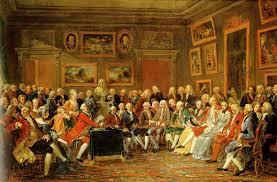
The Age of Enlightenment was a period of disruption for western civilization. At the beginning of this period, Europe was plagued with difficult questions, and nobody knew just who had the answers. The faults of the governments and even the churches of previous eras were becoming more and more apparent, and the people needed someone to whom they could turn. The answers that have shaped the Western world for so long after this crucial era didn’t come from professional politicians or clergymen. A group of Enlightenment thinkers collaborated through a loose organization known as the Republic of Letters (due to its reliance on the mail for correspondence) to solve major problems. This small group or crowd started a shift that led the larger crowds to be included in the democratic processes in many nations.
Today we have more powerful tools available to help us more efficiently harness the power of the crowd. We no longer have to hope for random collaboration from interested sources; we can use things like broadcast search crowdsourcing to call the masses to action and disrupt our stagnating political system.
What is broadcast search crowdsourcing?
Broadcast search crowdsourcing is a way of looking for new solutions that may come in unexpected ways from unexpected sources. This type of crowdsourcing, a term used to describe the practice of distributing labor or creative tasks to a large group of unassociated people, consists of an organizer asking a question, stating a problem, or otherwise introducing a challenge and inviting society as a whole to come up with ideas. Most ideas won’t work, some will, the best may receive financial compensation. That is the way that websites such as Innocentive.com operate. Innocentive.com describes itself as a “global innovation marketplace where creative minds solve some of the world’s most important problems for cash awards up to $1 million.” (InnoCentive) And a quick look through the available challenges is impressive. Government agencies like NASA look for ways to create a space colony independent of Earth. Large corporations like Ford advertise their need for “Accessories to Enhance the Driving Experience.” To get a better taste of this, let’s look a little more at this particular challenge.
The challenge offers $15,000 to the person or people who can create an accessory that can be beneficial for a person driving through sparsely populated areas or rugged terrain. It states several of the challenges involved in these situations and specifically lists Australia as the environment to be considered. The problem solvers then have until the posted deadline, in this case, a month and a half after the challenge was posted, to be able to respond with some sort of innovation that they think the Ford Motor Company will deem worthy of up to $15,000. And just like that, anybody registered at the website (registering required no more than basic information like home and email address) can participate in this challenge, throw their hat into the ring of innovation and attempt to take home a nice sum of money.
This is an amazing concept. There really isn’t anything that qualifies one person to have a better idea about a car accessory than another. There are people who study engineering for years on end and know the ins and outs of the business and have come up with countless innovations, but there are other people who don’t know nearly as much about the technical side of this industry. Maybe they’ve just noticed something that their car is missing, that all cars are missing, and through this process they can not only be compensated for their insights, but contribute to the auto industry and maybe even to society as a whole. While the applications for businesses can be readily seen, I think that this approach can benefit society in more ways than just fancier cup holders. There are more important problems facing society than the accessories in our cars or even the future of space exploration. There are problems here and now that we need to solve. Who better to answer the questions of the masses then the masses themselves?
Crowd collaboration in the Enlightenment
What kind of questions can a crowd answer? How reliable can a group of at best loosely associated people work together and communicate and postulate new ideas that could lead society in a new direction? I think that to answer these questions, we ought to look to history, particularly at the crowd collaboration at the time we now know as the Age of Enlightenment. Consider the year generally thought of as the beginning of the Age of Enlightenment, 1650. Europe has just emerged from the devastating 30 years’ war between the Catholics and Protestants. England fares no better, as it still has two years before it struggles out of a decade of civil war. The Catholic Church, the force that unified Europe for more than a millennium, now faces the scientific revolution, and the new facts of a heliocentric universes that goes directly against its teachings. In short, the world is in turmoil. The answers are disappearing; the things that people thought they knew, the things that they never challenged, may be entirely fictional. It was a world turned on its head, a world of chaos.
Thomas Hobbes wrote much of chaos in his Leviathan. In the following paragraph, he describes the environment in which we would live without an organized political society.
In such condition, there is no place for industry; because the fruit thereof is uncertain: and consequently no culture of the earth; no navigation, nor use of the commodities that may be imported by sea; no commodious building; no instruments of moving, and removing, such things as require much force; no knowledge of the face of the earth; no account of time; no arts; no letters; no society; and which is worst of all, continual fear, and danger of violent death; and the life of man, solitary, poor, nasty, brutish, and short. (Hobbes)
Surely Hobbes saw the dangerous possibility of this type of society as England strove to achieve some sort of balance through its civil war. And I venture to think that all of Europe could have similar thoughts during this time period. Surely, the remarkable Age of Enlightenment stands out as a crowning achievement in human thought, because, as a pearl looks so brilliant against a black velvet background, it stands so starkly in contrast to the conditions existing before it. While there was no centralized call for collaborations, like there is in crowdsourcing, there were major problems that needed solving in society, and people didn’t know where to turn for answers. In the past they could have asked the Catholic Church or the government or other authority figures, but at this time these organizations were looking weak and answerless. A new and undiscovered source was needed to help stabilize society.
We can look at the group of philosophers now called the Enlightenment Thinkers as the source of many of these answers. Men like John Locke, Voltaire, Benjamin Franklin, and Jean Jacques Rousseau began to think up new ways to look at the world, new ideas for government, new ideas for ideas themselves!
Something that sticks out about these men is the diverse cloth from which they are cut. They came from many nations, some were formally educated in the finest institutions, others had little formal schooling. Some were doctors, others lawyers, others inventors, but the thing that they all had in common was the desire and ability to help society.
They communicated through what is now known as the Republic of Letters. The Republic of Letters is the term used to describe the network created by these enlightenment thinkers, so called because they communicated via letter. It wasn’t an actual republic or nation, it was just a loose association of people who communicated their ideas in order to respond to the issues of the day.
Stanford University has recently started a project called, “Mapping the Republic of Letters.” In this project they analyzed 55,000 letters between 6,400 correspondents to give us some picture of the scale of the Republic of Letters (Chang). The accompanying map shows to a small degree the extent of this communication across Europe.
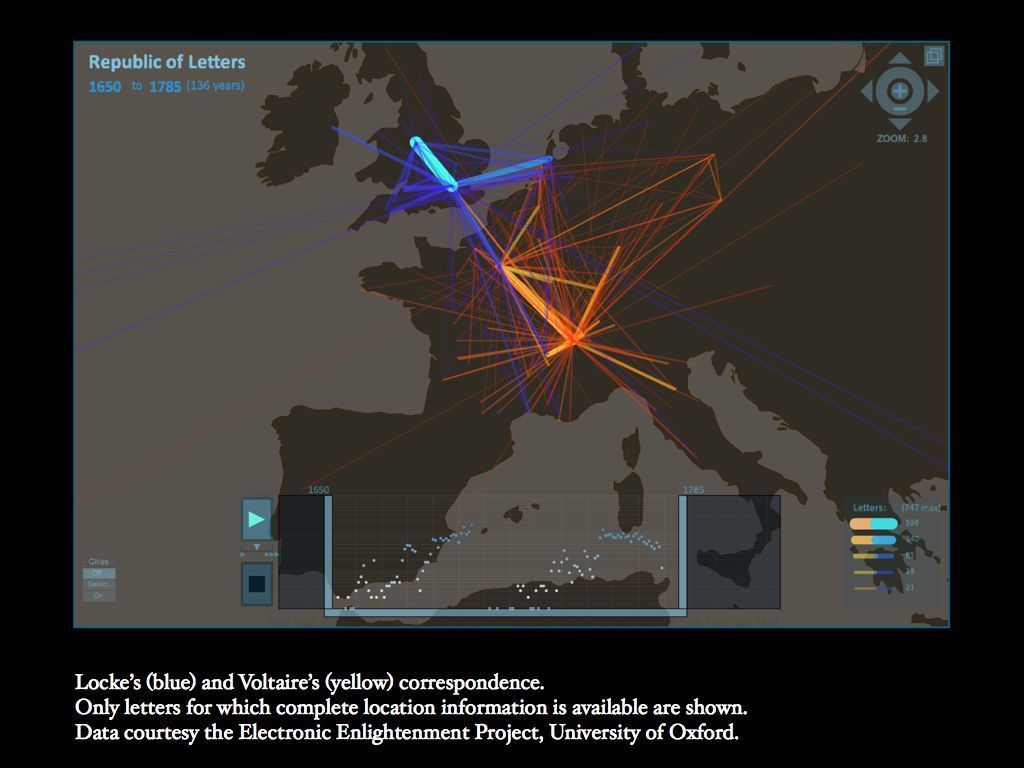
Map of Locke’s (originating in England) and Voltaire’s (originating in France) correspondence
This map shows the correspondence initiated by just two members, John Locke and Voltaire, of this international society, but illustrates just how extensive this network really was. Through their letters, these otherwise completely unassociated people could collaborate and form the ideas that continue to influence western society as we know it. They formed a “crowd” through which they were able to propose solutions to the problems at large in society.
Today, a wider range of people can participate in this creative collaboration process. Digital literacy has replaced basic literacy as the requirement for collaboration. Now, look at this map that shows the participation in the aforementioned Ford challenge.
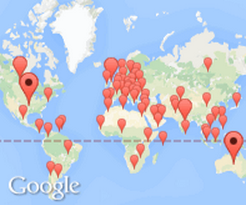
Map of participation in the Ford “Accessories to Enhance the Driving Experience” challenge on Innocentive.com
People from all over the world, joined together in a type or “republic of car part ideas” are actively trying to create what could be the next great innovation in the auto industry. But I think that all of this innovation could be used for more. As noble as new car parts are, what if we were to put these people to work in solving the problems that plague nations, or even the world as a whole? When Enlightenment thinkers collaborated, they innovated many facets of today’s society, particularly the democratic ideals that have governed western nations since this time.
The Age of Enlightenment allowed the crowd to participate more. People began to see that the masses were good for more than mass labor. People could collaborate through a democratic process to form new policies that benefit all involved. These men changed our society to be more democratic in a very democratic way. For centuries democracy has met the needs of the people, but we are now faced by increasingly complicated issues. Due to these complications and other problems, like the increased influence of money in political campaigns, the democratic system is stagnating. Participation is declining, and fewer and fewer people believe that they can truly affect change through the current system.
Crowdsourcing and Enlightenment-level disruption
The crowd collaboration that took place through the Republic of Letters revolutionized the political processes of many nations by taking democratic ideals to new heights. Crowd collaboration in the digital age can once again advance this progress.
It is concerning to see the torpidity of our political system. I see people who identify more with a party than a nation and are more concerned with whether the background behind a speaker is blue or red or what letter is beside the name of the person talking than what they are actually saying. And, as stated in a recent poll, “More than four in five Americans say money plays too great a role in political campaigns,… while two-thirds say that the wealthy have more of a chance to influence the elections process than other Americans.” (Confessore) I think that the way to boost the interest and the sense of efficacy that people have in the political process is making them a more vital part of it.
Lawrence Lessig, a Harvard Law professor and outspoken proponent of political change, wrote about these financial problems in a recent blog post, “Our democracy will not heal itself. Reform will not come from the inside alone. We must end our Christian Science-like approach to this disease, and take the steps that a cure will need.” (Lessig) He explains in the same article that the broken political system serves the status quo, so the insiders don’t really want to change it, no matter which party they represent. And if change and outside influence is so necessary to the political system, to “restart” the heart of democracy, as Lessig might put it, then the people ought to supply it through the process of crowdsourcing. It has revolutionized the world of business, allowing products to meet the desires of consumers, shouldn’t the same advances be made in the world of government?
That’s the idea behind things like Popvox, a website where people can see all the bills currently being discussed in Congress and weigh in on them. Quick options are supporting or opposing the bill, and then you may offer comments, which can be sent on to the congressmen and women involved. This is a step up in the political involvement that an ordinary citizen can have, but really it’s just a new way of writing a letter to the people that represent you. A step up from this is the website entitled, “We The People,” where the White House allows people to make and support petitions that the President will consider.
We, as a nation, however, are still behind other countries like Iceland, who “took crowdsourcing to its logical conclusion in 2011 when it drafted its new Constitution using input from Twitter and Facebook users,” as journalist Caitlin McGarry said. And then there is Finland, where, as McGarry said, “politicians last year began using a crowdsourcing platform called Open Ministry to draft new legislation.” She states in the same article, “Political crowdsourcing in America is largely used for recreational purposes (see: Death Star, federal debt reduction calculators).”(McGarry) (She mentions the Death Star in reference to a bill proposed on the aforementioned website “We The People” which was proposed and received enough support to merit the president’s consideration.)
Many people look around today and see a plutocracy instead of a democracy, where those who fund campaigns are the only ones with any real influence. In this atmosphere the act of voting seems to be meaningless. Its almost as if the real decisions have already been made. Almost everybody is in agreement that we need a change, and crowdsourcing can provide that change. Tanja Aitamurto, in a book she wrote for the parliament of Finland, concludes,
Crowdsourcing, among other new participatory methods, creates new possibilities for citizen activism in established political processes. They give citizens new means to govern themselves. This can lead into citizen empowerment and more informed political decisions. They also offer new possibilities to take the citizens’ voice into account in traditional policy-making.” (Aitamurto, 42)
This level of citizen participation, possible now like never before due to the digital world in which we live, is what experts like Lessig are arguing for. Lessig, the Harvard Law professor I mentioned earlier, in a senate subcommittee meeting in 2012, said,
I think to the surprise of many people, you would see that ordinary people deliberating about what the Constitution needs and how the reforms should go forward, would far surpass ninety eight percent of what is commonly discussed in this particular context. And that’s because, frankly, politics is the one sport where the amateur is better for the nation than the professional. (Taking Back Democracy Hearing)
The amatuer he refers to is the ordinary citizen, the person who cares. Worth noting is that the word “amatuer” comes form the latin “amator” meaning “lover,” and here the amatuer truly is someone passionate about society. He advocates the creation of citizen conventions that work together as juries who can deliberate in a way that will allow them to reach new ideas. I think that crowdsourcing can be used as a way to allow these people who care to give real constructive input. There are of course many variables involved here, and more variables get added in each time a new person joins the political process, but Enlightenment ideals gave more power than ever before to the masses, trusting them to make the responsible decisions that will meet society’s needs. We can now use these digital tools to create more situations in which people can participate, and in these situations, there are people that can emerge, the currently “undiscovered experts,” as Aitamurto puts it, with the ideas that can help millions. And who knows? Maybe one of them could be the next John Locke.
Works Cited
Aitamurto, Tanja. Crowdsourcing for Democracy: A New Era in Policy-making. N.p.: n.p., n.d. Print.
Chang, Daniel, Yuankai Ge, Shiwei Song, Nicole Coleman, Jon Christensen, and Jeffrey Heer. Visualizing the Republic of Letters. Stanford University, 2009. Web. 28 May 2015.
Confessore, Nicholas, and Megan Thee-Brenan. “Poll Shows Americans Favor an Overhaul of Campaign Financing.” The New York Times, 2 June 2015. Web. 03 June 2015.
Hobbes, Thomas. Leviathan. Cambridge: Cambridge UP, 1991. Print.
“InnoCentive.” Create Accessories to Enhance the Driving Experience. Ford, 1 May 2015. Web. 25 May 2015.
Lessig, Lawrence. “Frodo Baggins for President.” Medium. N.p., 06 June 2015. Web. 08 June 2015. McGarry, Caitlin. “Power to the People: Crowdsourcing in Politics.” TechHive. N.p., 21 Jan. 2013. Web. 28 May 2015.
Taking Back Democracy Hearing, 112th Cong. (2012) (testimony of Lawrence Lessig). Print. “We the People: Your Voice in Our Government.” We the People: Your Voice in Our Government The White House, n.d. Web. 28 May 2015.
Image Credits
Edelstein, Dan. “Mapping the Republic of Letters.” Stanford University, n.d. Web. 25 May 2015.
About the Author

Mason Parkes
Mason Parkes was born in Las Vegas, Nevada in the year 1993. He is currently studying physics at Brigham Young University. Follow him on Google+ at https://plus.google.com/+MasonParkes