Blood In Our Eyes: How Violence Unites and Divides Our Identities
Taylor Quass

|
The topic of violence has become a catalyst for identity both socially and personally. It has become a greater part of our identity than what many would like to believe, especially in this the digital age |
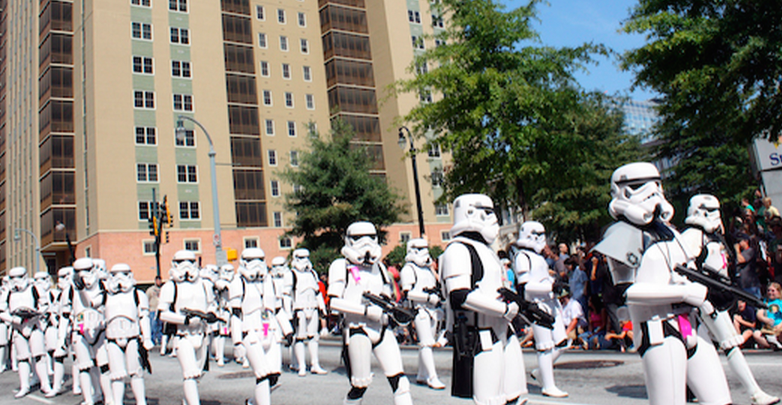
501st Legion at the DragonCon in Atlanta, Georgia
We seem to view the world with ‘blood in our eyes:’ People unite, divide, and judge by violence. Obvious links to violence include recruitment campaigns of terrorist groups like ISIS, bullying, assault, and murder. However, that’s not my focus. No, I’m talking about how the most pervasive forms of violence in our society today are not seen in hurting each other, but how the topic of violence builds up, distinguishes, and disrupts of communities.
Some may think they are free of violence and its influence, but the that’s simply not the case. Violence has in part become a sanitized reagent in this the Digital Age. Violence is a catalyst, or thing that facilitates a reaction or change without itself needing to change. It’s a catalyst for identity both socially and personally, for unifying and dividing, even if the evidence is subtle.
This article will discuss how violence unites and divides us, as well as how exactly it has become a sanitized catalyst and reagent for identity today. By recognizing that violence can be part of identity can we use violence as a tool and control its presence in our lives instead of being controlled by it.
Violence unites us
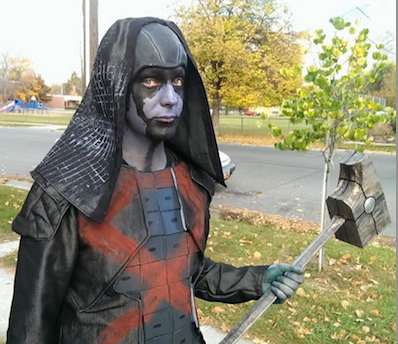
My friend John dressed as Ronan the Accuser. He worked together with his wife Corina to create this outfit. He won an award for best costume at his work
The digital age has given us the internet and thereby access to a virtual world. This virtual world is not limited by physical boundaries or distances. Rather, it transcends them, connecting people across vast distances instantaneously that otherwise would never meet. People with very specific interests can interact one with another and form niche communities. Hayley in her article discusses the long tail and specific interests there. People unite by mutual interests, and the digital aspects of our world facilitates that. Many of these are based on something violent in nature, thus making violence a facilitator as well for collective identity.
An example of this is cosplay. Cosplay is by definition dressing up as a character from a book, game, or movie. How many of you or your (adult) friends and family enjoy dressing up and wearing costumes, even on days besides Halloween? How many of those friends make those costumes themselves? For most people, I doubt the number is high. The word ‘Cosplay’ may not even be in your vocabulary. Yet there are those who enjoy it. A lot of characters these people dress up as use swords, guns, and other such weapons. The storm troopers shown in the opening picture carry guns, for example, and the character my friend is dressed up as - Ronan the Accuser from the Guardians of the Galaxy franchise - kills lots of people. It’s used as a pretext.
The 501st Legion is an entire group of such people who enjoy the Star Wars franchise and identify themselves by it. You can request them to come to an event, or they may just decide to go themselves. They go to things like store openings and conventions worldwide. The 501st Legion was literally “…founded to simply provide a collective identity.(“Our Mission”, Par. 4, italics added) Below is an excerpt from their charter:
…The Legion is an all-volunteer organization formed for the express purpose of bringing together costume enthusiasts under a collective identity within which to operate. The Legion seeks to promote interest in Star Wars through the building and wearing of quality costumes, and to facilitate the use of these costumes for Star Wars-related events as well as contributions to the local community through costumed charity and volunteer work… (501st Legion Charter)
This is a hobby to them. It’s fun. They and others like them collaborate, share, and identify and form their self image by such things online. Though their interest as well as the interest of other such groups is based on something violent, the fans themselves are not. They are regular people like you and me. If you go to a comicon, you won’t find people killing each other. Instead, you’ll find a lot of happy people having fun and feeling like they are a part of something bigger than themselves.
Violence unites us personally
A kind of violence that unites is martial arts. Most if not all martial art styles teach about balance, peace, control, and responsibility, bringing together a lot of ideals under one roof. A lot of people go to studios to learn martial arts, some from a very young age like myself. I took Karate when I was 10 or so for self-defense training and to get some exercise at a nearby dojo, a martial arts studio. The more I trained, the more accomplished and confident I felt. Part of who I was - my identity - came from how I knew martial arts.
Dojos aren’t the only place to learn, however. Many hundreds of online sources like the YouTube channel FightTIPS exist to teach it. For some, it’s a matter of self-defense. Others, a hobby. Either way, it helps form their self-image and identity, both social and personal.
When I was in Middle School, I used violence to help unify my strengths and ideals in order to form my identity. One time, a kid slammed a locker on my head. I was a nerdy kid who didn’t have many friends and spent his days reading books and playing games. I didn’t know who did it - they snuck up on me when my back was turned, and left as soon as the deed was done. I was angry and hurt, and vowed to change my situation. I was done being bullied. I decided that day to become like the heroes I had read about, and to be the hero to myself I had played as in my games.
The next few times bullies teased me and said I was so fat I could “sit on people and kill them,” I said “yep. Wanna find out?” I told them I would fight them to the ground and ‘sit to kill’ if I needed to. They stopped soon after.
Though I didn’t hurt a single person, the violence I had associated with my identity helped unify my strengths, desires, and ideals enough that I could stand up for myself. I used the ideals and examples often represented through violence in games, books, and movies to change my self-image into a more confident one.
Other ways people unify their personal identities through violence today is through books, news, movies, and games, all of which are widely available digitally. In books, we can identify, connect with, and feel for the heroes and their struggles. In the news, we can read about happenings, learn from them, and decide how we’d react. In movies, we can watch heroes conquer villains and overcome challenges. In games, we can experience and decide for ourselves how to act in situations both real and fantastical. In all these cases, the struggles at times mirror our own. The fantastical situations can be allegories of something real, or relate to something we know or face ourselves. From these experiences we define ourselves. Thus, our self image is formed and united in part by violence.
How violence divides us
Double standards on violence in society
Violence is often viewed with a double standard. We as a society can deem the same act or result of violence acceptable in some situations and completely unacceptable in others. A hero in one country can be a villain in another, for example, the Red Baron of WWI. Other examples include sports, the riots of baltimore, and violence between men and women. By these things people form opinions and determine who’s on ‘their side’ or team.
An easy example is sports. Think about it - could you tackle a complete stranger in front of a cop, and get away with it? No. If anything, you’ll get arrested for disruptive disorderly conduct and assault, and the other person would have the chance to file charges and possibly sue you for all your worth. In this instance, the act of violence is frowned upon.
But at American Football games, players tackle other players all the time and fans cheer them on. Some fans even go as far as to travel thousands of miles to see their team play, dressed (and at times painted) in their team’s colors. Some people view these games as form of tribal warfare (Ethan Gilsorf) , pitting community against community and city against city.
Rioting is a not-so-socially-acceptable example of violence dividing us. To the rioters and their supporters, the destruction of property and fighting against police is an acceptable demonstration of discontent, and violence their means of delivery. But to others it is not. On such issues, people go online to voice their opinion and pick sides long after the thing is said and done, sometimes causing sometimes nationwide or global debates. Baltimore riot is a prime example; it was sparked by a racial issue involving a white cop shooting a black man.
Another, very stark example of double standards is violence between men and women, both on- and offline. The domestic violence charity ManKind Initiative staged an event where they had a man and a women take turns being the abuser in public (Raychelle Lohmann, Par. 6). When the man was abusing the woman, people rushed to her aid. When the woman hit and otherwise abused the man as much as he had been previously abusing her, people laughed and did nothing. Again, people are divided on our opinion of violence based on who does what when.
Violence disrupting identity online
Ever notice how people online can be very mean? In comments sections and forums, people at times tell others how they’re idiots and should just die, or how much they’d like to stab, maim, kill or otherwise hurt them? Such violent and derogatory comments are seemingly given freely, diving online communities based more on feelings rather than knowledge or capability. Ever wonder why they do that?
It used to be that anything published took money and time to be printed and distributed. Nowadays, anyone can publish online, and do so anonymously. See Adam’s article for further discussion regarding internet publication. Some people argue that it’s because of the anonymity of the internet that people post mean comments, or how little they need to care. Others, like me, argue that it also has to do with how little thought and interaction is required. According a study conducted at University of Haifa in Israel, it has to do with eye contact.
When their eyes were hidden, participants were twice as likely to be hostile. Even if the subjects were both unrecognizable (with only their eyes on screen) and anonymous, they rarely made threats if they maintained eye contact…. [Eye contact] fosters empathy and communication.” (Moyer Par. 3).
The internet allows people to not see each other’s eyes when they discuss or debate online. With no eye contact to “fosters empathy and communication” (Moyer Par. 3), people sometimes act and speak more violently and with more hostility to one another than they would otherwise. This disrupts people identifying as a community or society as they pick sides online without ever knowing or even caring about who the commenters are. Furthermore, for the commenters, the threats can be sanitized in nature (discussed later) because they aren’t making eye contact with those they are threatening.
Double standards for our digital and non-digital identities
In the real world, most people don’t go around killing other people for fun. They’re usually quite peaceable. In the virtual world, that’s a different story. There are things people can and sometimes will do in a game which they would never do in real life. Violence being a major one, as it is culturally unacceptable.
In fantastical online games like World of Warcraft or Runescape, players can be anyone. They can be smiths, merchants, mercenaries, or even bandits. If they need money or experience, they can go kill things. In others games like Grand Theft Auto (a franchise that has sold over 185 million copies), players are criminals. They can steal cars, rob, deal drugs, and murder if they so choose. Normal people can be someone virtually that they themselves would never aspire to be or even want to associate with in real life. Why?
Because there they are free. There is no bureau in charge of online content, no government that determines what is and what isn’t allowed so long as it doesn’t infringe upon the rights and property of others (unless you’re in countries like China or Korea, where the internet is censored by the government). No Secret Service agents will come looking for someone if they kill the digital president, nor angry digital relatives if they accidentally run over grandma. They can do whatever they want virtually without fear of real-world consequence. Some people as far as to become someone else online, thus dividing themselves from themselves, morally-speaking.
Violence: a sanitized catalyst for identity
The digital age has allowed a sanitation of violence on a scale the human race has never before seen. Why? Because the digital world allows us to cherry-pick the things seen in our entertainment and media. In many games, you have a chance to die, sometimes violently. But even if you die in a game, you won’t die in real life. The threat of permanent, personal death is cleansed from digital violence. Some other games let you fight without any blood or gore. In the Mario franchise, you are a lowly plumber forever rescuing a princess. You ‘kill’ enemy creatures by jumping on their heads, throwing or shooting things at them. Any way you kill them, enemies simply disappear, leaving a game clean of some of the horrors of violence while still leaving the act of violence.
In TV shows like Merlin, people are dying left and right. I really wonder why people like living in Camelot the capitol. Yet very rarely is the blood and gore that would actually occur in real life ever seen on screen.
Violence is not something completely horrible anymore. It’s something that can now be used as a tool, a catalyst, a reagent, a basis for a plot in a book, game, movie, or TV series. Anyone can experience it safely. It’s something you can incorporate into your identity without repercussions because it can be experienced in a safe and controlled way. Because it’s on a screen or on paper, anyone can see and experience it without blood on their hands, instead keeping it to stay in their eyes. Real people don’t have to die for our amusement like they did in the Coliseums of ancient Rome. Virtual ones can take their place, and people can go as far as to experience it as a participant themselves.
People can be united by a sanitized, violent disruption
A long time ago, Persia wanted to invade Greece, a region then divided into a bunch of independent city-states. Sparta tried to unite these city states, but they only managed to get about 3 dozen or so to join forces at Thermopylae, a narrow pass in the mountains (David Frye Par. 16). The others either sat idly by or joined forces with the Persians. People in the coalition didn’t have much faith either, evacuating women and children even as they sent 7,000 troops to their supposed death.
Yet according to the account written by Herodotus, this small force held off the Persians for 7 days, slaughtering thousands in the process. They only fell when a Greek named Ephialtes betrayed a secret path around Grecian defenses to the Persian King, and the coalition had to order a retreat. A small force of 1,400 troops - 300 of which were the Spartans and their king - stayed behind to cover the retreat, fighting on that 7th and last day. Though they lost the battle, tales of this conflict spread throughout Greece like wildfire and inspired the Greeks enough to unite them and repel the Persian invasion. This is a prime example of a violent event that united us in the past.
We still have such uniting but violent events today. On 9/11/2001, the World Trade Center towers and the pentagon were hit one after another by 3 hijacked planes. News broadcasts dominated the airwaves and as the events unfolded, allowing people to watch in real time as the towers burned then fell in a voluptuous cloud of smoke and debris. Numbers of the dead later poured in, showing that nearly 3,000 people died in the space of 2 hours.
Though hotly debated as to why the towers fell, the eyes of America were abruptly turned both towards the victims of that catastrophe and the terrorists who instigated it. By a single disruptive event, millions of Americans and others worldwide united in cause and identity to help. Children drew pictures and wrote thank-you cards to the firefighters, police, and those who lost loved ones during the attack. Some like actor Steven Buscemi helped sift through debris and search for survivors. Others who couldn’t directly help provided money, food, shelter, and emergency supplies. Many all over the world even held prayer services and offered words of comfort where they could. Militarily-speaking, countries around the world helped fight against terrorism.
However they helped, they did it because they identified somehow with the event and felt like doing something. Many people can tell you exactly where they were on 9/ll, how they felt, and what they did about it. They were united by this identity, and comforted those in need. Today, Americans identify their strength and personality as a country as well as their stance on terrorism based at least in part on the events of that day.
In both of the cases and others, a violent event became a social catalyst and helped unite a people and their identity. Both events were also sanitized of certain ‘unnecessary’ details. For the battle of Thermopylae, records don’t often include a list of the dead, or much detail about how people died. Instead, they focus on the tactics, how bravely people fought, who did what and why.
For the 9/11 attacks, plenty of people had enough cameras that anyone can watch everything without needing to actually be there. People can learn about who did what, who died, and then debate at our leisure. People can choose what pictures, videos, and reports of carnage and destruction they both see and share, and can thus sanitize it.
Why this matters
I wish to stress this next point; I am neither encouraging violence, nor am I saying it’s good or evil. What I am saying is that violence is a far more common and pervasive part of identities than what some people would think. Violence being so sanitized allows it to be so.
Part of knowing and owning identities psychologically-speaking is recognizing all the parts that make it up. A functional, basic, or sometimes defining part of an individual, group, or community’s identity can be as much violence as colors or nationality would be. Failure to recognize and/or admit violence as a functional part of identity, when present, can result in violence controlling and disrupting our identities and, through them, our actions.
If we can recognize that aspects of personal and social identity can be affected by violence, then we can use it as a tool and catalyst for identity, unity, and diversity. By knowing, recognizing, and owning the violence as a part of identity development can we truly use violence as a tool or catalyst in moderation instead of being controlled or governed by it.
As you can see, violence is the basis of many things people like. People form parts of their personal and social identities by means of violence, unite and divide by it, and see the world with ‘blood in their eyes.’ Today especially, violence is sanitized in its use allowing people to unite and divide their personal and social identities. It is thus a catalyst. By recognizing that violence can be part of identity can we use violence as a tool and control its presence in our lives instead of being controlled by it.
Works Cited
Burawoy, Michael. “The State and the People, Symbolic Violence and Physical Violence.” University of California @Berkeley School of Sociology. University of California. Web. 1 June 2015. http://burawoy.berkeley.edu/Bourdieu/KVH5.pdf.
Duncan, Thomas K, and Christopher J Coyne. “The Origins of the Permanent War Economy.” The Independent Review. Independent Institute. Web. 25 May 2015. https://www.independent.org.
Fazen, Shane. “FightTIPS Channel.” Online Video Clip. YouTube. FightTIPS, n.d. Web. 10 June 2015. https://www.youtube.com/user/FightTipsVideos
Ek, Slavoj. “Introduction: The Tyrant’s Bloody Robe.” Violence: Six Sideways Reflections. New York: Picador, 2008. Print.
Frye, David. “Greco-Persian Wars: Battle of Thermopylae.” History Net Where History Comes Alive World US History Online. Military History, Jan. 2006. Magazine Article. Online Edition. 10 June 2015. http://www.historynet.com/greco-persian-wars-battle-of-thermopylae.htm
Gilsorf, Ethan. “Of Tribes And Touchdowns: Why Sports Matter.” Wbur. Boston NPR News Station, 22 July 2013. News Article. Online Edition. 10 June 2015. http://cognoscenti.wbur.org/2013/07/22/sports-as-abstracted-war-games-ethan-gilsdorf
Goins, Jeff. “Are People Meaner Online than in Real Life?” Goins Writer RSS. 2012. Web. 12 June 2015. http://goinswriter.com/mean-people-online/.
Heitmeyer, Wilhelm. “Control of Violence Historical and International Perspectives on Violence in Modern Societies.” New York: Springer, 2011. Print.
Herodotus. “The Battle of Thermopylae” Sam Houston State University. Transcription. Sam Houston State University, n.d. Web. 8 June 2015. http://www.shsu.edu/~his_ncp/Herother.html
“Legion Charter.” 501st Legion. 501st Legion, n.d. Web. 10 June 2015. http://www.501st.com/databank/LegionCharter
Lohmann, Raychelle Cassada, M.S. “Women and Violence: Society’s Double Standard.” Psychology Today. Psychology Today, 19 July 2014. Web. 10 June 2015. https://www.psychologytoday.com/blog/teen-angst/201407/women-and-violence-societys-double-standard
Moyer, Melinda Wenner. “Eye Contact Quells Online Hostility.” Scientific American Global RSS. Scientific American, 2 Aug. 2012. Web. 12 June 2015. http://www.scientificamerican.com/article/rudeness-on-the-internet/.
“Our Mission.” 501st Legion. 501st Legion, n.d. Web. 10 June 2015. http://www.501st.com/mission.php
“Some Evidence That Violent Video Games Reduce Actual Violence.” Freakonomics RSS. Web. 29 May 2015. http://freakonomics.com/2013/12/04/evidence-that-violent-video-games-reduce-actual-violence/
“#ViolenceIsViolence: Domestic Abuse Advert Mankind.” Online Video clip. YouTube. ManKind Initiative, 22 May 2014. Web. 10 June 2015. https://www.youtube.com/watch?v=u3PgH86OyEM
Image Credits
- “Parade 123”, Hilary, Wikipedia, used under CC, originally posted to Flickr by Hilary in 2008
- “John is Ronan the Accuser”, Photo of John Carlsen by Corina Carlsen, 2014
- Photo of Taylor Quass by Stacie Hogan, 15 Aug 2014
About the Author

Taylor Quass
Taylor Quass was born March 14, 1991 in Provo Utah. He grew up in Palo Alto, California, Elk Ridge, Utah, and Shoreview, Minnesota. In school, he participated in football and drama. Outside of school, he loves to play games of all kinds, hang out with friends, and read and write epic fantasy. He is currently studying to become an electrical engineer with interests in 3D printing and Prosthetics. He is married to the most beautiful, wonderful woman and love of his life, Heather Quass.