Let’s Not Disrupt Child Labor
Kristin Lindsey

|
Despite the social progress that we would like to believe technology brings, new digital developments facilitate the support of child labor in ways that were historically impossible. |
We like to think that with society’s progression we are becoming more accepting of social equality and more protective of human rights, moving from old, traditional beliefs to newer, modern ones.
But are we really? With the rise of the internet, social media, and televised news broadcasts, you’d expect crime and wrongdoing to be more transparent—more obvious. Corrupt politicians are publicly exposed for the wrongs they commit. Criminals are accused of their crimes and get their stories published all over the internet. Professional sports teams accused of cheating are shamed on national TV.
Although the Digital Age has the power to expose leaders and companies of the wrong or illegal things they do, social ills continue on more levels today than ever before. The rise of technology is a great disruption to our expectation that society has ever-progressing system of moral principles.
How is child labor practiced and supported today?
The supporting of child labor is one of today’s greatest social ills. Although we have laws restricting the employment of child workers in the United States, child labor is commonly practiced in foreign countries that export goods to United States consumers.
According to the United Nations Global Initiative to Fight Human Trafficking (UN.GIFT), Pakistan, Bangladesh, and India are the current world leaders in the amount of products being made by children (Lillie). UN.GIFT further describes the ways in which children are being forced to work in these countries.
In the large carpet industry in Pakistan, children are sought after to work on the looms in carpet factories to create “delicate, complex patterns” with their small hands. They are subject to physical and sexual abuse, and many experience severe health problems and injuries as a result of hunching over the loom all day.
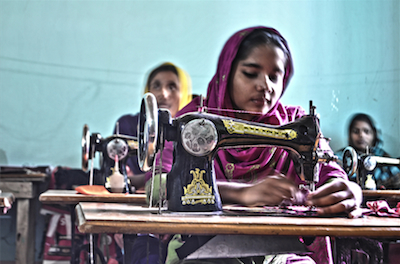
In Bangladesh, a recent garment factory collapse resulted in the death of over 1,000 factory workers, many of which were children who had been sewing garments for American companies such as Wal-Mart and Wrangler.
In the sporting goods industry in India, children as young as seven years old are recruited to sew footballs and soccer balls. Much like the industry in Pakistan, “debt bondage is used to sell children into forced labor” in India, meaning that the children are sold by their parents for money and forced to work until a debt is paid off (Lillie).
All three of these countries employ young children for low wages and in dangerous working conditions to make products for export to foreign countries. These products are made available in vast quantities, thanks to online shopping sites, making them more easily accessible to us than ever before.
Not only have online shopping sites facilitated child labor, but the Digital Age has also affected child labor practices by making supply chains more transparent. Internet and television have made it possible for news to spread fast and to be heard by great masses of people, having the ability to inform the public about companies that have been accused of having their products made by working children.
When people heard that Nike was getting its products from factory workers in unethical working conditions, people protested and suddenly had an interest in this issue (Wilsey & Lichtig). People are quickly learning about companies that get their products from working children and may appear to be opposed to these actions, yet they continue to purchase these items.
Why? Because people are more concerned with their material possessions and physical comfort than with distant child laborers. Love of luxury drives people to continue purchasing items made by working children, increasing the disruption between perception and reality
The rise of child labor
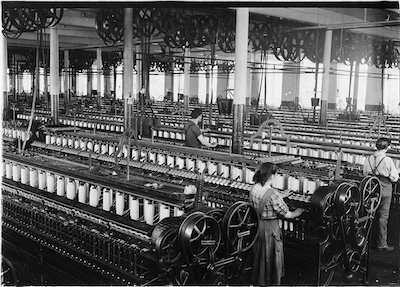
Child labor became a major issue during the Industrial Revolution in the 19th century. As people flocked to cities and new manufacturing processes gave rise to factories, children were needed to work, either to perform jobs that required small hands or to support their families. They worked long hours and were exposed to very dangerous working conditions, as told in “Hard Times” by Royston Pike.
Pike said, “The accidents which occur to the manufacturing population of Birmingham are very severe and numerous, as shown by the registers of the General Hospital . . . many are caused by loose portions of dress being caught by the machinery, so as to drag the unfortunate sufferers under its power” (Pike). Pike tells of a family of four young girls: “Harriet 8 years, Anne 6, Mary 4, and Eliza 2 years old: of these the three elder are employed as lace drawers. Harriet was not quite three when she began to work. Anne was about the same, and Mary was not quite two years old. . . . How early do you think that they leave their homes?—I can tell you what a neighbour told me six weeks ago. . . . ‘[H]er child works at a mill nearly two miles from home, and I have seen that child coming from its work this winter between 10 and 11 in the evening: and the mother told me that one morning this winter the child had been up by 2 o’clock in the morning . . .’” (Pike).
This first-hand account is one of many that describes the hardships that children experienced while working in factories in the Industrial Revolution. While accounts such as these may seem to be an issue of the past, child labor is still just as much a reality as it was during that time. Children today experience the same long work days, low wages, and unhealthy working conditions as children did in the Industrial Revolution.
These social ills of the Industrial Revolution occurred after the Enlightenment when the idea to protect human rights came about. Liberalism arose with thinkers such as John Locke, who proposed the idea that humans are inherently good and that people are capable of coexisting in peace (Sturgis). Liberalism favored a world founded on freedom and equality, in which each individual had the right to life, liberty, and property.
Even with the advancement in society’s recognition of human rights, children were still employed and abused merely to keep up with society’s industrial growth. Just as in the past, we as a society are eager to choose material progress even when it harms our social progress.
It’s even more disgraceful today when we can agree wholeheartedly with the harm caused by child labor in the Industrial Revolution and are still willing to support it out of greed.
What would it take to disrupt child labor?
I’m guilty as much as anyone else of contributing to the rise of materialism—of wanting more than enough, craving the newest trends or the newest gadgets. I go to Amazon in search of cheaper deals than stores offer. I constantly want to upgrade my phone to the newest model in order to stay “up-to-date” in Apple’s latest products.
I’m not saying that wanting these material goods is a bad thing, but it gets dangerous when we are willing to lower our moral standards in order to get them. This mentality prevents us from improving and bettering ourselves as a society as we desire to do.
Kailash Satyarthi, a children’s rights activist and winner of the 2014 Nobel Peace Prize, said the following in a speech, “Let Us March!”:
We live in an age of rapid globalization. We are connected through high-speed Internet. We exchange goods and services in a single global market. Each day, thousands of flights connect us to every corner of the globe. But there is one serious disconnect. It is the lack of compassion. What we need is a transformative compassion that leads to equality, freedom and justice.
Satyarthi, someone who has seen first-hand the impact of child labor around the world, suggests here that we combat materialism and greed with compassion. Compassion is certainly something working children desperately need, but is it enough? What would it take to disrupt child labor?
Perhaps the internet—the same tool that has prolonged the issue of child labor today—could also be the solution.
We see this today on certain food items, where the label lists a code or link for the consumer to be able to find the exact farm or location from which the food was grown or raised. If clothing companies had a similar transparency to their supply chain, they would be more careful about where their products are coming from and consumers would be more aware of how these companies’ products are acquired.
For example, a carpet company called “GoodWeave” requires that each rug is given a label certifying that no child was employed in the making of that rug. In order to earn the label, importers and exporters of the rugs must be licensed under the GoodWeave certification program and agree to have surprise inspections where their carpets are made (“Child-Labor-Free”). The label lists the GoodWeave website for consumers to be able to find the company online and learn about how these rugs are uniquely made, thereby spreading awareness of the fair labor practices they use.
More companies need to be this open with the origin of their products if we want to create cleaner supply chains and put an end to child labor.
We think of ourselves as a progressive society—always growing and advancing in positive ways—yet technological advancements have created new challenges that have never existed before. Technology has disrupted society’s progress by furthering the employment and abuse of children around the world. This occurs even though technology can make crime more transparent.
While child labor has been an issue for centuries, the digital sphere has made it easier for products to be sold on a much larger scale and distributed all over the world. Having the items you need so easily accessible online makes it easy to become a mindless consumer, buying what you want without giving a second thought as to how that item will end up in your hands.
Materialism in the technological age is one of the reasons why child labor is still thriving today, and it is one of the greatest disruptions to the social progress we only believe we are making.
Works Cited
“Child-Labor-Free Certification.” GoodWeave. Web. 13 June 2015. http://www.goodweave.org/about/child_labor_free_rugs.
Lillie, Michelle. “Child Labor Blog Part III: Manufacturing in Asia.” UNODC. United Nations Global Initiative to Fight Human Trafficking, 2015. Web. http://www.ungift.org/knowledgehub/stories/August2013/child-labor-blog-part-iii-manufacturing-in-asia.html.
Pike, Royston. Hard Times. New York, Washington: Frederick A Praeger. 1966. Accessed from http://sp.rpcs.org/faculty/RauchTilstraG/AP%20European%20History/Scanned_readings.pdf
Satyarthi, Kailash. “Let Us March! Kailash Satyarthi. 2014. Web. http://www.kailashsatyarthi.net/speeches/
Sturgis, Amy. “The Rise, Decline, and Reemergence of Classical Liberalism.” Belmont University | Nashville, TN. 1994. Web. 10 June 2015. http://www.belmont.edu/lockesmith/liberalism_essay/the_rise1.html.
Wilsey, Matt, and Scott Lichtig. “The Nike Controversy.” Web.stanford.edu. Web. < https://web.stanford.edu/class/e297c/trade_environment/wheeling/hnike.html
Image Credits
- By USAID (USAID Bangladesh) [Public domain], via Wikimedia Commons
- Lewis Hine [Public domain], via Wikimedia Commons
About the Author

Kristin Lindsey
Kristin Lindsey grew up in Castle Rock, Colorado and currently attends Brigham Young University. She is studying biology and aspires to be a marine biologist someday. She enjoys spending time with family, traveling, scuba diving, and photography.