Leanpub Header

Skip to main content

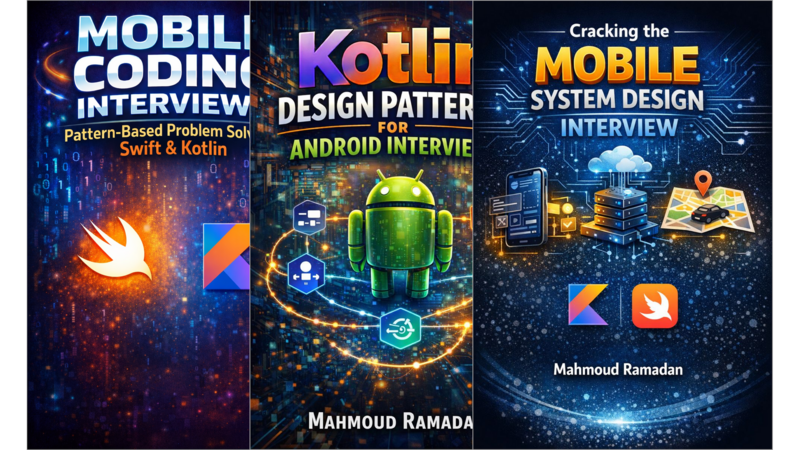
Cracking the Mobile System Design Interview

A Practical Guide to Android & iOS Architecture with Production-Ready Code

Mobile system design interviews aren’t about boxes—they’re about decisions. Learn a clear framework, real-world mobile trade-offs, and proven patterns to design scalable iOS and Android systems with confidence.

Minimum price

$29.99

$49.99

You pay

$49.99

Author earns

$39.99
$

...Or Buy With Credits!

You can get credits with a paid monthly or annual Reader Membership, or you can buy them here.
PDF
EPUB
About

About

About the Book

Cracking the Mobile System Design Interview

Mobile system design interviews are no longer about drawing boxes on a whiteboard. Interviewers want to see how you think about real-world mobile constraints: offline behavior, state management, performance, security, scalability, and trade-offs across iOS and Android.

This book is a practical, end-to-end guide to mastering mobile system design interviews using a clear frameworkmodern architecture principles, and deep, real-world case studies.

Unlike generic system design books, this guide is mobile-first. Every chapter is written from the perspective of a mobile engineer who has faced these interviews—and built these systems in production.

What You’ll Learn

  • How mobile system design interviews are evaluated—and what actually differentiates strong candidates
  • universal 6-step framework you can apply to any mobile design question
  • Core mobile architecture principles: offline-first design, caching, sync, networking, and state management
  • How to reason about trade-offs clearly and communicate decisions with confidence
  • How to design production-grade mobile systems, not toy examples

Real-World Case Studies

You’ll walk through complete system designs for:

  • Social feed applications (pagination, image loading, optimistic updates)
  • Chat and messaging systems (real-time delivery, WebSockets, typing indicators)
  • Offline-first applications (sync engines, conflict resolution, search)
  • Media streaming apps (adaptive bitrate, background playback, downloads)
  • Image loading libraries (SDK design, caching layers, transformations)
  • Ride-sharing apps (real-time location, maps, driver tracking)
  • Fitness and health tracking apps (HealthKit, sensors, workouts)
  • Secure authentication systems (tokens, biometrics, mobile security)

Each case study mirrors actual interview questions and shows how to structure your answer from requirements → architecture → trade-offs → edge cases.

Quick Reference & Interview Cheat Sheet

The book concludes with a compact cheat sheet covering:

  • Common mobile system building blocks
  • Security considerations interviewers expect you to mention
  • Design patterns and pitfalls to avoid
  • Tips to stay structured under interview pressure

Who This Book Is For

  • Android and iOS developers preparing for mid-level to senior interviews
  • Engineers transitioning into system design rounds
  • Developers who want to think more architecturally about mobile apps
  • Anyone tired of vague system design advice that ignores mobile realities

If you want to answer mobile system design questions with clarity, structure, and confidence, this book is your playbook.

Share this book

Author

About the Author

Mahmoud Ramadan

I am Mahmoud Ramadan. I am Android Tech Lead with 12 years of experience in Android Development.

I developed many apps like chatting, augmented reality, streaming, video calling and more. I am passionate about android programming and teaching. https://www.linkedin.com/in/mahmoud-ramadan-abdelwahed/

Contents

Table of Contents

Chapter 1: The Mobile System Design Interview

  1. Introduction
  2. What Makes Mobile System Design Different
  3. What Interviewers Evaluate
  4. Common Mistakes to Avoid
  5. How to Stand Out
  6. Interview Formats
  7. Preparing Effectively
  8. Summary

Chapter 2: A Universal Framework for Mobile System Design

  1. Introduction
  2. The Six-Step Framework
  3. Step 1: Requirements Clarification (5-7 minutes)
  4. Step 2: Define Scope and Constraints (3-5 minutes)
  5. Step 3: High-Level Architecture (10 minutes)
  6. Step 4: Data Layer Design (8-10 minutes)
  7. Step 5: Component Deep Dive (10 minutes)
  8. Step 6: Trade-offs and Optimizations (5 minutes)
  9. Framework Summary Checklist
  10. Summary

Chapter 3: Mobile Architecture Principles

  1. Introduction
  2. Principle 1: Offline-First Design
  3. Principle 2: State Management
  4. Principle 3: Networking Patterns
  5. Principle 4: Caching Strategies
  6. Principle 5: Background Processing
  7. Principle 6: Performance Optimization
  8. Summary

Chapter 4: Design a Social Feed App

  1. Introduction
  2. Step 1: Requirements Clarification
  3. Step 2: High-Level Architecture
  4. Step 3: Data Models
  5. Step 4: Feed Loading Strategy
  6. Step 5: UI Implementation
  7. Step 6: Image Loading Strategy
  8. Step 7: Optimistic Updates for Likes
  9. Step 8: Performance Optimizations
  10. Trade-offs and Alternatives
  11. Summary

Chapter 5: Design a Chat/Messaging App

  1. Introduction
  2. Step 1: Requirements Clarification
  3. Step 2: High-Level Architecture
  4. Step 3: Data Models
  5. Step 4: Real-Time Communication
  6. Step 5: Message Sending Flow
  7. Step 6: Message Delivery Status
  8. Step 7: Typing Indicators
  9. Step 8: Offline Support and Sync
  10. Step 9: UI Implementation
  11. Trade-offs and Alternatives
  12. Summary

Chapter 6: Design an Offline-First App

  1. Introduction
  2. Step 1: Requirements Clarification
  3. Step 2: High-Level Architecture
  4. Step 3: Data Models
  5. Step 4: Offline-First Data Flow
  6. Step 5: Sync Engine
  7. Step 6: Conflict Resolution
  8. Step 7: Full-Text Search
  9. Step 8: Background Sync
  10. Step 9: UI Implementation
  11. Trade-offs and Alternatives
  12. Summary

Chapter 7: Design a Media Streaming App

  1. Introduction
  2. Step 1: Requirements Clarification
  3. Step 2: High-Level Architecture
  4. Step 3: Data Models
  5. Step 4: Adaptive Bitrate Streaming
  6. Step 5: Progress Tracking
  7. Step 6: Offline Downloads
  8. Step 7: Background Audio
  9. Step 8: UI Implementation
  10. Trade-offs and Alternatives
  11. Summary

Chapter 8: Design an Image Loading Library

  1. Introduction
  2. Step 1: Requirements Clarification
  3. Step 2: High-Level Architecture
  4. Step 3: Public API Design
  5. Step 4: Memory Cache
  6. Step 5: Disk Cache
  7. Step 6: Image Transformations
  8. Step 7: Request Deduplication
  9. Step 8: Request Cancellation
  10. Trade-offs and Alternatives
  11. Summary

Chapter 9: Design a Ride-Sharing App

  1. Introduction
  2. Step 1: Requirements Clarification
  3. Step 2: High-Level Architecture
  4. Step 3: Data Models
  5. Step 4: Location Services
  6. Step 5: Real-Time Driver Tracking
  7. Step 6: Map Integration
  8. Step 7: Ride Request Flow
  9. Step 8: Address Search with Autocomplete
  10. Trade-offs and Alternatives
  11. Summary

Chapter 10: Design a Fitness/Health Tracking App

  1. Introduction
  2. Step 1: Requirements Clarification
  3. Step 2: High-Level Architecture
  4. Step 3: Data Models
  5. Step 4: Health Platform Integration
  6. Step 5: Workout Tracking
  7. Step 6: Step Counting
  8. Step 7: Data Visualization
  9. Trade-offs and Alternatives
  10. Summary

Chapter 11: Design a Secure Authentication System

  1. Introduction
  2. Step 1: Requirements Clarification
  3. Step 2: High-Level Architecture
  4. Step 3: Token-Based Authentication Flow
  5. Step 4: Secure Token Storage
  6. Step 5: Token Manager with Auto-Refresh
  7. Step 6: Biometric Authentication
  8. Step 7: Auth Manager (Orchestration)
  9. Step 8: Security Best Practices
  10. Trade-offs and Alternatives
  11. Summary

Chapter 12: Building Blocks & Security Cheat Sheet

  1. Introduction
  2. Architecture Patterns Quick Reference
  3. Data Layer Building Blocks
  4. Networking Building Blocks
  5. Offline-First Building Blocks
  6. Background Processing
  7. Performance Building Blocks
  8. Security Cheat Sheet
  9. Platform APIs Quick Reference
  10. Interview Framework Checklist
  11. Common Trade-off Comparisons
  12. Final Tips
  13. Summary

The Leanpub 60 Day 100% Happiness Guarantee

Within 60 days of purchase you can get a 100% refund on any Leanpub purchase, in two clicks.

Now, this is technically risky for us, since you'll have the book or course files either way. But we're so confident in our products and services, and in our authors and readers, that we're happy to offer a full money back guarantee for everything we sell.

You can only find out how good something is by trying it, and because of our 100% money back guarantee there's literally no risk to do so!

So, there's no reason not to click the Add to Cart button, is there?

See full terms...

Earn $8 on a $10 Purchase, and $16 on a $20 Purchase

We pay 80% royalties on purchases of $7.99 or more, and 80% royalties minus a 50 cent flat fee on purchases between $0.99 and $7.98. You earn $8 on a $10 sale, and $16 on a $20 sale. So, if we sell 5000 non-refunded copies of your book for $20, you'll earn $80,000.

(Yes, some authors have already earned much more than that on Leanpub.)

In fact, authors have earned over $14 million writing, publishing and selling on Leanpub.

Learn more about writing on Leanpub

Free Updates. DRM Free.

If you buy a Leanpub book, you get free updates for as long as the author updates the book! Many authors use Leanpub to publish their books in-progress, while they are writing them. All readers get free updates, regardless of when they bought the book or how much they paid (including free).

Most Leanpub books are available in PDF (for computers) and EPUB (for phones, tablets and Kindle). The formats that a book includes are shown at the top right corner of this page.

Finally, Leanpub books don't have any DRM copy-protection nonsense, so you can easily read them on any supported device.

Learn more about Leanpub's ebook formats and where to read them

Write and Publish on Leanpub

You can use Leanpub to easily write, publish and sell in-progress and completed ebooks and online courses!

Leanpub is a powerful platform for serious authors, combining a simple, elegant writing and publishing workflow with a store focused on selling in-progress ebooks.

Leanpub is a magical typewriter for authors: just write in plain text, and to publish your ebook, just click a button. (Or, if you are producing your ebook your own way, you can even upload your own PDF and/or EPUB files and then publish with one click!) It really is that easy.

Learn more about writing on Leanpub