
Leanpub Header

Skip to main content

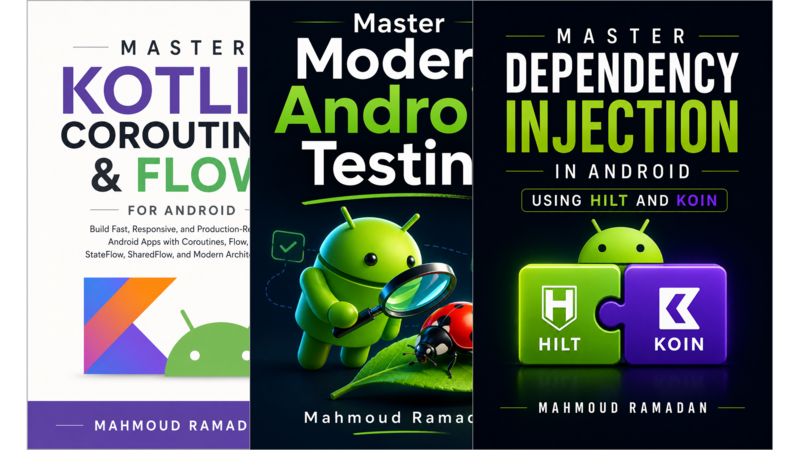
Master Dependency Injection In Android Using Hilt And Koin

Build scalable, testable, and maintainable Android applications with modern Dependency Injection techniques.

This book is 100% completeLast updated on 2026-07-03

Stop writing tightly coupled Android code. Learn how to structure your apps with powerful Dependency Injection using Hilt and Koin—from beginner concepts to production-ready architectures.

Minimum price

$19.99

$39.99

You pay

Author earns

$

Also available for 1 book credit with a Reader Membership

PDF
EPUB
WEB
APP
About

About

About the Book

Full Description

Modern Android development demands clean architecture, modularity, and testability. Dependency Injection is the foundation that makes all of this possible.

In Master Dependency Injection in Android Using Hilt and Koin, you’ll learn how DI works under the hood and how to use it effectively in Android projects of all sizes.

This book is designed for Android developers who want practical knowledge—not just theory.

Inside this book, you will:

  • ch01 — The Case for Dependency Injection
  • ch02 — Dependency Injection by Hand
  • ch03 — The Concepts Frameworks Formalize
  • ch04 — Hilt Fundamentals
  • ch05 — Modules and Bindings
  • ch06 — Components, Scopes, and Lifecycle
  • ch07 — Hilt in Production
  • ch08 — Koin Fundamentals
  • ch09 — Scopes, Lifecycle, and Android Integration
  • ch10 — Koin in Production
  • ch11 — Runtime vs Compile-Time
  • ch12 — Choosing Between Them (and Migrating)

This book is built with real-world examples, production patterns, and practical exercises to help you master Dependency Injection like a senior Android engineer.

Share this book

Bundle

Bundles that include this book

Author

About the Author

Mahmoud Ramadan

I am Mahmoud Ramadan. I am Android Tech Lead with 12 years of experience in Android Development.

I developed many apps like chatting, augmented reality, streaming, video calling and more. I am passionate about android programming and teaching. https://www.linkedin.com/in/mahmoud-ramadan-abdelwahed/

Contents

Table of Contents

Chapter 6 — Components, Scopes, and Lifecycle

  1. 6.1 The Component Hierarchy
  2. 6.2 Components, Scopes, and Lifetimes
  3. 6.3 Scoped vs Unscoped: the Default You Keep Forgetting
  4. 6.4 Matching Scope to Lifecycle (and the Leaks You Avoid)
  5. 6.5 What Each Component Gives You for Free
  6. 6.6 A Worked Scope Decision for Verdant
  7. 6.7 Pitfalls & Misconceptions
  8. 6.8 What’s Ahead

Chapter 2 — Dependency Injection by Hand

  1. 2.1 The Composition Root
  2. 2.2 Wiring Verdant by Hand
  3. 2.3 The Android Problem, Up Close
  4. 2.4 Scoped Containers
  5. 2.5 A Tempting Detour: the Service Locator
  6. 2.6 Why This Doesn’t Scale
  7. 2.7 Pitfalls & Misconceptions
  8. 2.8 What’s Ahead

Chapter 3 — The Concepts Frameworks Formalize

  1. 3.1 The Object Graph
  2. 3.2 Bindings
  3. 3.3 Scope and Lifetime
  4. 3.4 Lifecycles: the Android Boundaries That Matter
  5. 3.5 Qualifiers
  6. 3.6 The Seam: Injecting Into Objects You Don’t Construct
  7. 3.7 One More Axis: When the Graph Is Checked
  8. 3.8 The Vocabulary, Mapped
  9. 3.9 Pitfalls & Misconceptions
  10. 3.10 What’s Ahead

Chapter 4 — Hilt Fundamentals

  1. 4.1 The Shape of What We’re Building
  2. 4.2 Setup
  3. 4.3 @HiltAndroidApp: the Generated Composition Root
  4. 4.4 @Inject Constructors: Teaching Hilt to Build Your Classes
  5. 4.5 The Minimum Module (a Preview of Chapter 5)
  6. 4.6 Entry Points: @AndroidEntryPoint
  7. 4.7 @HiltViewModel: Retiring the Factory
  8. 4.8 What Hilt Actually Generated
  9. 4.9 Pitfalls & Misconceptions
  10. 4.10 What’s Ahead

Chapter 5 — Modules and Bindings

  1. 5.1 What a Module Is
  2. 5.2 @Provides: Building Types You Don’t Own
  3. 5.3 @Binds: Choosing an Implementation for an Interface
  4. 5.4 Choosing Between @Binds and @Provides
  5. 5.5 Qualifiers: Telling Two Bindings Apart
  6. 5.6 Organizing Modules as the App Grows
  7. 5.7 Pitfalls & Misconceptions
  8. 5.8 What’s Ahead

Chapter title

Chapter 7 — Hilt in Production

  1. 7.1 ViewModels with Runtime Values: SavedStateHandle and Assisted Injection
  2. 7.2 Injecting a Worker: Verdant’s Watering Reminder
  3. 7.3 Navigation-Scoped ViewModels
  4. 7.4 Hilt in a Multi-Module Project
  5. 7.5 Testing a Hilt App
  6. 7.6 Pitfalls & Misconceptions
  7. 7.7 What’s Ahead

Chapter 8 — Koin Fundamentals

  1. 8.1 The Koin Mindset
  2. 8.2 Setup
  3. 8.3 Starting Koin: the Composition Root
  4. 8.4 The Module DSL: single, factory, and get()
  5. 8.5 The Constructor DSL: Less Boilerplate
  6. 8.6 Retrieving Dependencies
  7. 8.7 Compile-Time Hilt vs Runtime Koin, Made Concrete
  8. 8.8 Pitfalls & Misconceptions
  9. 8.9 What’s Ahead

Chapter 9 — Scopes, Lifecycle, and Android Integration

  1. 9.1 ViewModels in Compose
  2. 9.2 Runtime Values: Parameters and SavedStateHandle
  3. 9.3 Non-ViewModel Injection in Compose
  4. 9.4 Koin Scopes
  5. 9.5 Qualifiers: named()
  6. 9.6 Pitfalls & Misconceptions
  7. 9.7 What’s Ahead

Chapter 10 — Koin in Production

  1. 10.1 Organizing Modules at Scale
  2. 10.2 Koin Annotations: Codegen and a Safety Net
  3. 10.3 Injecting a Worker with Koin
  4. 10.4 Testing and Verifying the Graph
  5. 10.5 Why Teams Choose Koin: Kotlin Multiplatform
  6. 10.6 Pitfalls & Misconceptions
  7. 10.7 What’s Ahead

Chapter 11 — Runtime vs Compile-Time: Debugging and Verifying Your Graph

  1. 11.1 The Same Bug, Two Timelines
  2. 11.2 Reading Hilt (Dagger) Errors
  3. 11.3 Reading Koin Errors
  4. 11.4 Moving Koin’s Check Earlier
  5. 11.5 Guardrails: a Practical Setup
  6. 11.6 A Debugging Workflow for Each
  7. 11.7 Pitfalls & Misconceptions
  8. 11.8 What’s Ahead

Chapter 12 — Choosing Between Them (and Migrating)

  1. 12.1 Head to Head
  2. 12.2 When Hilt Is the Right Call
  3. 12.3 When Koin Is the Right Call
  4. 12.4 A Decision Guide
  5. 12.5 Migrating Between Them
  6. 12.6 Pitfalls & Misconceptions
  7. 12.7 Closing

The Leanpub 60 Day 100% Happiness Guarantee

Within 60 days of purchase you can get a 100% refund on any Leanpub purchase, in two clicks.

See full terms...

Earn $8 on a $10 Purchase, and $16 on a $20 Purchase

We pay 80% royalties on purchases of $7.99 or more, and 80% royalties minus a 50 cent flat fee on purchases between $0.99 and $7.98. You earn $8 on a $10 sale, and $16 on a $20 sale. So, if we sell 5000 non-refunded copies of your book for $20, you'll earn $80,000.

(Yes, some authors have already earned much more than that on Leanpub.)

In fact, authors have earned over $15 million writing, publishing and selling on Leanpub.

Learn more about writing on Leanpub

Free Updates. DRM Free.

If you buy a Leanpub book, you get free updates for as long as the author updates the book! Many authors use Leanpub to publish their books in-progress, while they are writing them. All readers get free updates, regardless of when they bought the book or how much they paid (including free).

Most Leanpub books are available in PDF (for computers) and EPUB (for phones, tablets and Kindle). The formats that a book includes are shown at the top right corner of this page.

Finally, Leanpub books don't have any DRM copy-protection nonsense, so you can easily read them on any supported device.

Learn more about Leanpub's ebook formats and where to read them

Write and Publish on Leanpub

You can use Leanpub to easily write, publish and sell in-progress and completed ebooks and online courses!

Leanpub is a powerful platform for serious authors, combining a simple, elegant writing and publishing workflow with a store focused on selling in-progress ebooks.

Leanpub is a magical typewriter for authors: just write in plain text, and to publish your ebook, just click a button. (Or, if you are producing your ebook your own way, you can even upload your own PDF and/or EPUB files and then publish with one click!) It really is that easy.

Learn more about writing on Leanpub