
Leanpub Header

Skip to main content

Inflect: A New Computing Paradigm

Every application you use is already dying — frozen at the moment it was built, decaying as the world moves on. This book describes a different paradigm: one where you own your identity, your data lives with you, and software is something you inhabit rather than install. Not a better process. A different foundation.

Minimum price

$19.00

$29.00

You pay

Author earns

$

Also available for 1 book credit with a Reader Membership

PDF
EPUB
About

About

About the Book

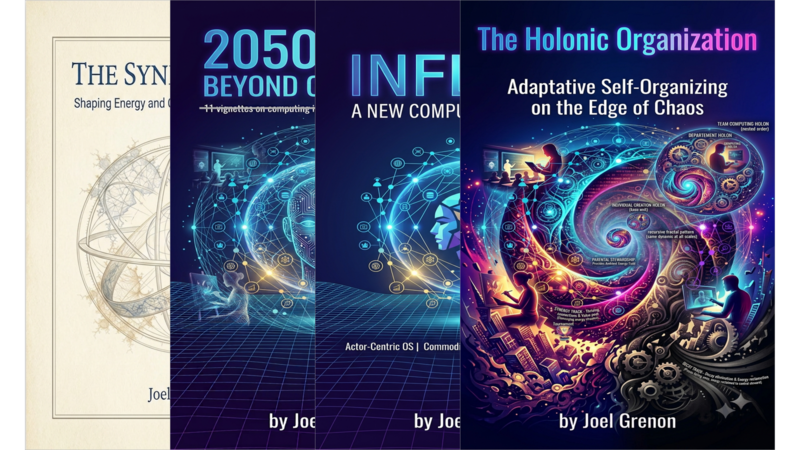
This book is a technical blueprint for a computing paradigm that doesn't exist yet — but could. It diagnoses what's broken in the current model: the snapshot fallacy that guarantees every application decays from the moment it's built, the metal box inheritance that ties our digital lives to devices we happen to own, the fragmentation cost that forces every human to be the integration layer between incompatible systems, and the AI asymmetry that gives machines structural advantages over the people they're supposed to serve. It then describes an alternative — the holon computing paradigm — where every person is an autonomous actor with their own cryptographic identity and persistent selfspace, where software is something you subscribe to rather than install, and where the human is not a leaf at the edge of the network but a node at the center of their own digital existence.


This book is written for software architects, engineers, CTOs, and anyone who suspects that our current way of building software is reaching its structural limits. It is semi-technical: it assumes you've played a role in software development, but it explains the new paradigm from first principles rather than assuming you already believe in it. It draws concrete examples from *2050 — Life in the Mesh* (Book 5 of this series), a narrative projection that shows what daily life feels like when the holon paradigm is fully realized. The appendices extract the architectural requirements from those scenes. The main chapters build the argument that leads to them. Together, they make the case that a different computing paradigm is not just desirable — it's inevitable, and the only question is whether we build it before the old one breaks.

Bundle

Bundles that include this book

Author

About the Author

Joel Grenon

I’ve been in love with software for over 35 years — not just as a profession, but as a lifelong passion. It all started at age 10, writing simple games in BASIC on my Commodore VIC-20, and I’ve never stopped since. I’ve always seen code as a kind of poetry, often reading C source code for pleasure and inspiration. I’m a self-taught learner at heart, always curious, always experimenting, even before studying computer science formally. Over the years, I’ve worn many hats — developer, architect, manager — but my goal has always been the same: to build better, smarter software. In the mid-90s, I embraced Agile ideas early on, realizing smaller steps help avoid wasted effort and align better with real needs. Later, chaos theory and decentralized systems sparked new ideas for self-replicating software and federated databases. Bitcoin and Ethereum only deepened my thinking about what’s possible.

In the past 10 years, I've obsessed with applying chaos theory to software, trying to move away from the structured approach to embrace a more natural evolution, the emergence of software systems from simple self-aware components.

Contents

Table of Contents

Part I - The diagnosis

Chapter 1: The Snapshot Fallacy

  1. The Lifecycle of a Snapshot
  2. It’s Not the Developers. It’s Not the Process.
  3. The Cost We’ve Normalized
  4. Why We Build Snapshots
  5. A Glimpse of the Alternative
  6. What to Take From This Chapter

Chapter 2: The Metal Box Inheritance

  1. The Industrial Inheritance
  2. The Box Defines the Paradigm
  3. Networks: The Lowest Common Denominator
  4. The Paradigm That Never Changed
  5. The Human as the Unit
  6. What to Take From This Chapter

Chapter 3: The Fragmentation Cost

  1. The Slow Accumulation of Shards
  2. The Human as Integration Layer
  3. The Personal Cost
  4. AI Widens the Gap
  5. The Root Cause
  6. The Trend Is Acceleration
  7. What to Take From This Chapter

Chapter 4: The AI Asymmetry

  1. Structural, Not Temporary
  2. The Visual Prison
  3. The Output Constraint
  4. Adding AI to the Current Paradigm Makes It Worse
  5. Closing the Gap

Chapter 5: Agile and the Limits of Process

  1. What Agile Actually Solved
  2. The Structural Limits of Process
  3. The Agile-Industrial Complex
  4. The Question Agile Never Asked

Chapter 6: Cloud, Microservices, and the Limits of Infrastructure

  1. The Decomposition Promise
  2. The Distributed Monolith
  3. The Real Limit

Chapter 7: Blockchain and the Limits of Decentralization

  1. The Ultimate Frozen Snapshot
  2. Decentralizing the Application Doesn’t Dissolve the Application
  3. What Blockchain Got Right

Chapter 8: The Holon Model for Computing

  1. From User to Actor
  2. The Selfspace
  3. Identity as Ownership
  4. Subscriptions, Not Installations
  5. The Substrate
  6. One Architecture, Every Actor
  7. What This Means

Chapter 9: Identity and Trust Without Central Authority

  1. The Key That Is You
  2. The Account Dissolves
  3. Trust That Works Like Trust
  4. Authenticity by Structure
  5. The End of the Security Perimeter

Chapter 10: The Actor’s Information System

  1. The Selfspace
  2. Data That Lives With You
  3. Mutations, Queries, Effects
  4. Perspectives, Not Applications
  5. Recursive Architecture

Chapter 11: Content Without Duplication

  1. Mounted, Not Copied
  2. Versioning Without Version Hell
  3. The Content Chain
  4. What This Means for Media
  5. What This Means for Documents
  6. The End of Duplication as a Business Model

Chapter 12: Compute as an Ambient Field

  1. Devices as Servants, Not Masters
  2. The Electrical Grid for Computing
  3. Specialized Computing as Subscribable Services
  4. The Edge, the Cloud, and the False Distinction
  5. What This Means for Cost

Chapter 13: Ambiences and Collaborative Spaces

  1. How an Ambience Works
  2. Ambiences at Every Scale
  3. The End of “Where Did We Put That?”

Chapter 14: Creating Systems That Adapt

  1. Adaptation Through Autonomy
  2. No Snapshot of the Whole
  3. What Development Means Now
  4. Code Stays With Its Creator
  5. Everyone Is a Publisher
  6. Assembly Without Code
  7. Versioning Controlled by the Subscriber

Chapter 15: AI and Humans as Structural Peers

  1. The Spectrum: Concierge and Agent
  2. The Concierge: Extension of Self
  3. External Agents: Relationships, Not Tools
  4. The Subscription as the Safety Boundary
  5. How Humans Stay in the Loop
  6. Symbiosis, Not Replacement

Chapter 16: From Applications to Ecosystems

  1. From Gatekeeper to Field Provider
  2. Security Improves When You Stop Defending the Perimeter
  3. What Happens to Legacy Systems
  4. The Cost Structure Flips
  5. The Transition

Chapter 17: The Future of Interaction

  1. Multi-Surface, Not Multi-Device
  2. The Cockpit
  3. Interaction Modalities Multiply
  4. Augmented and Virtual Reality as Native Surfaces
  5. The End of Screen Time

Chapter 18: Privacy, Ownership, and Digital Rights

  1. The Reversal
  2. Monetization Without Surveillance
  3. Digital Rights That Work
  4. What This Means for Regulation
  5. What About Those Who Can’t Pay?

Chapter 19: Governance Without Central Authority

  1. The Substrate as a Protocol
  2. Stakeholder Governance
  3. Federation, Not Empire
  4. Standards That Emerge From Adoption
  5. Conflict Resolution
  6. The Danger of Capture

Chapter 20: The Long Transition

  1. The Phased Approach
  2. Where It Starts
  3. The Bootstrap Problem
  4. The Role of Early Adopters
  5. The Inflection Point

Appendix A: Healthcare

  1. The Scene
  2. What Makes This Possible
  3. Why This Can’t Happen in the Current Paradigm

Appendix B: Media & Entertainment

  1. The Scene
  2. What Makes This Possible
  3. Why This Can’t Happen in the Current Paradigm

Appendix C: Scientific Research

  1. The Scene
  2. What Makes This Possible
  3. Why This Can’t Happen in the Current Paradigm

The Leanpub 60 Day 100% Happiness Guarantee

Within 60 days of purchase you can get a 100% refund on any Leanpub purchase, in two clicks.

See full terms...

Earn $8 on a $10 Purchase, and $16 on a $20 Purchase

We pay 80% royalties on purchases of $7.99 or more, and 80% royalties minus a 50 cent flat fee on purchases between $0.99 and $7.98. You earn $8 on a $10 sale, and $16 on a $20 sale. So, if we sell 5000 non-refunded copies of your book for $20, you'll earn $80,000.

(Yes, some authors have already earned much more than that on Leanpub.)

In fact, authors have earned over $15 million writing, publishing and selling on Leanpub.

Learn more about writing on Leanpub

Free Updates. DRM Free.

If you buy a Leanpub book, you get free updates for as long as the author updates the book! Many authors use Leanpub to publish their books in-progress, while they are writing them. All readers get free updates, regardless of when they bought the book or how much they paid (including free).

Most Leanpub books are available in PDF (for computers) and EPUB (for phones, tablets and Kindle). The formats that a book includes are shown at the top right corner of this page.

Finally, Leanpub books don't have any DRM copy-protection nonsense, so you can easily read them on any supported device.

Learn more about Leanpub's ebook formats and where to read them

Write and Publish on Leanpub

You can use Leanpub to easily write, publish and sell in-progress and completed ebooks and online courses!

Leanpub is a powerful platform for serious authors, combining a simple, elegant writing and publishing workflow with a store focused on selling in-progress ebooks.

Leanpub is a magical typewriter for authors: just write in plain text, and to publish your ebook, just click a button. (Or, if you are producing your ebook your own way, you can even upload your own PDF and/or EPUB files and then publish with one click!) It really is that easy.

Learn more about writing on Leanpub