C++ for Embedded Systems
With Exercises and Code Samples for Intermediate Developers


This practical guide gives you the skills to write efficient, reliable, and scalable firmware for modern microcontrollers and connected devices.
Designed for developers with a working knowledge of C++, this book bridges the gap between theory and applied embedded development.
Buying multiple copies for your team? See below for a discount!
About
About the Book
C++ for Embedded Systems
With Exercises and Code Samples for Intermediate Developers
Build real-world embedded systems using the full power of C++.
This practical guide gives you the skills to write efficient, reliable, and scalable firmware for modern microcontrollers and connected devices.
Designed for developers with a working knowledge of C++, this book bridges the gap between theory and applied embedded development.
Each subsection delivers a focused explanation, a complete code sample, and several challenging exercise—without handholding or filler.
You'll learn how to interface with hardware, optimize for real-time performance, and deploy robust systems in resource-constrained environments.
What you'll gain:
• A deep understanding of embedded C++ design principles
• Confidence working with GPIO, UART, I2C, SPI, DMA, and RTOS
• Practical fluency in register-level programming and low-power design
• The ability to build secure IoT devices and connect them to the cloud
• Mastery of modern C++ features tailored for embedded applications
With clear infographics, advanced exercises, and real code for every concept, this book is your blueprint for building professional embedded systems in C++.
Packages
Pick Your Package
All packages include the ebook in the following formats: PDF
The Book + Code Samples + Infographics
Minimum price
Suggested price$29.00$19.00
- Full Code SamplesFull code samples for the book
- InfographicsInfographics of main book concepts
Buying multiple copies for your team? See below for a discount!
Six Pack Economy Package Deal + Code Samples + Infographics
Minimum price
Suggested price$117Six Copies of the book with code and infographics
$77.00
- Full Code SamplesFull code samples for the book
- InfographicsInfographics of main book concepts
Team Discounts
Team Discounts
Get a team discount on this package: The Book + Code Samples + Infographics
Up to 12 members
- Minimum price
- $139
- Suggested price
- $203
Up to 24 members
- Minimum price
- $299
- Suggested price
- $435
Bundles
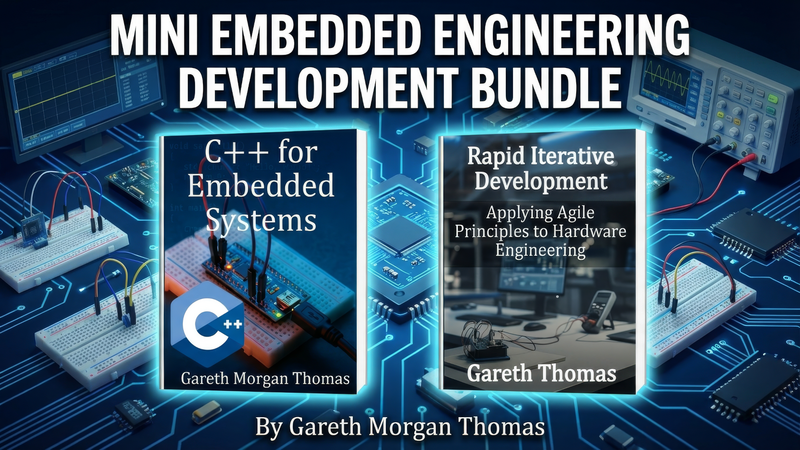
Bundles that include this book
- Pricing
$57.00
Minimum priceBought separately$145Suggested price$97.00
- Pricing
$27.00
Minimum priceBought separately$58.00Suggested price$57.00

Author
About the Author

Gareth Morgan Thomas is a qualified expert with extensive expertise across multiple STEM fields. Holding six university diplomas in electronics, software development, web development, and project management, along with qualifications in computer networking, CAD, diesel engineering, well drilling, and welding, he has built a robust foundation of technical knowledge.
Educated in Auckland, New Zealand, Gareth Morgan Thomas also spent three years serving in the New Zealand Army, where he honed his discipline and problem-solving skills. With years of technical training, Gareth Morgan Thomas is now dedicated to sharing his deep understanding of science, technology, engineering, and mathematics through a series of specialized books aimed at both beginners and advanced learners.
Contents
Table of Contents
Chapter 1. Introduction to Embedded Systems with C++
Section 1. Overview of Embedded Systems
- Defining Embedded Systems and Applications
- Embedded vs. General-Purpose Programming
- The Role of C++ in Embedded Development
Section 2. Setting Up the Development Environment
- Choosing the Right Tools (IDE, Compiler, Debugger)
- Setting Up Toolchains for Embedded C++
- Cross-Compiling for Target Devices
Section 3. Basics of Embedded C++
- C++ Features Suitable for Embedded Systems
- Differences from Standard C++ Development
- Common Constraints in Embedded Environments
Chapter 2. C++ Language Essentials for Embedded Systems
Section 1. Data Types and Memory Management
- Fixed-Width Integer Types and Bit Manipulation
- Memory Allocation and Stack Management
- Using const and volatile for Hardware Access
Section 2. C++ Standard Library Limitations
- Choosing STL Components for Embedded Systems
- Minimizing Memory Overhead
- Writing Custom Data Structures
Section 3. Real-Time Programming Essentials
- Understanding Real-Time Requirements
- Meeting Deadlines and Minimizing Latency
- Trade-offs Between Code Size and Execution Speed
Chapter 3. Hardware and Device Interfaces
Section 1. Working with Microcontrollers
- Understanding Microcontroller Architecture
- Basics of GPIO (General-Purpose Input/Output)
- Interfacing with LEDs, Buttons, and Sensors
Section 2. Communication Protocols
- Introduction to UART, I2C, and SPI
- Implementing Protocols in C++
- Communication Between Microcontrollers and Sensors
Section 3. Direct Memory Access (DMA) and Peripheral Interfaces
- Basics of DMA and Its Applications
- Setting Up DMA in Embedded C++
- Efficiently Handling Peripheral Communication
Chapter 4. Interrupts and Real-Time Constraints
Section 1. Basics of Interrupt Handling
- Introduction to Interrupts and ISRs
- Configuring and Prioritizing Interrupts
- Minimizing Latency in Interrupts
Section 2. Real-Time Operating Systems (RTOS)
- Choosing an RTOS for Embedded C++ Projects
- Task Scheduling and Real-Time Constraints
- Integrating C++ with FreeRTOS or Zephyr
Section 3. Synchronization in Real-Time Systems
- Working with Semaphores and Mutexes
- Handling Critical Sections and Deadlocks
- Best Practices for RTOS Synchronization
Chapter 5. Power Management and Optimization
Section 1. Power Management Techniques
- Understanding Power Modes in Microcontrollers
- Techniques for Reducing Power Consumption
- Handling Sleep and Wake-up Sequences
Section 2. Code Optimization for Low Power
- Minimizing Code Size and Execution Time
- Profiling Power Consumption
- Trade-offs Between Power and Performance
Section 3. Optimizing Memory Usage
- Memory Allocation Strategies for Embedded Systems
- Using Flash and EEPROM for Data Storage
- Avoiding Memory Fragmentation
Chapter 6. Low-Level Programming in C++
Section 1. Register-Level Programming
- Accessing Hardware Registers in C++
- Using Bitwise Operations for Register Manipulation
- Direct Memory Access and Mapping
Section 2. Writing and Optimizing Firmware
- Structuring Code for Firmware Development
- Handling System Initialization and Bootloaders
- Firmware Updating and Over-the-Air (OTA) Updates
Section 3. Error Handling and Diagnostics
- Handling Errors in Resource-Constrained Systems
- Implementing Diagnostic Routines
- Logging and Debugging Techniques for Embedded Firmware
Chapter 7. Interfacing with IoT Devices
Section 1. Overview of IoT in Embedded Systems
- Introduction to Embedded IoT Devices
- Networking Basics for Embedded C++
- Secure Communication in IoT
Section 2. Wireless Communication Protocols
- Implementing Bluetooth Low Energy (BLE)
- Using Wi-Fi for Embedded Systems
- Working with LoRa and Zigbee Protocols
Section 3. Building an IoT Project with C++
- Setting Up an Embedded IoT Device
- Gathering and Sending Sensor Data
- Interfacing with Cloud Platforms
Chapter 8. Advanced C++ Techniques for Embedded Systems
Section 1. Using Modern C++ in Embedded Applications
- Pros and Cons of C++11/14/17 Features in Embedded
- Leveraging constexpr, auto, and lambda expressions
- Practical Examples of Modern C++ in Firmware
Section 2. Metaprogramming for Efficiency
- Bases of Compile-Time Computation
- Using Templates for Efficient Code
- Reducing Runtime Overhead with Metaprogramming
Section 3. Design Patterns for Embedded Systems
- Implementing Singleton, State, and Observer Patterns
- Choosing Lightweight Patterns for Resource Constraints
- Practical Use Cases in Embedded Projects
Chapter 9. Testing, Debugging, and Deployment
Section 1. Unit Testing for Embedded Systems
- Using C++ Unit Testing Frameworks for Embedded Code
- Testing Hardware Interfaces and Protocols
- Mocking and Simulating Hardware for Tests
Section 2. Debugging Embedded Applications
- Using Serial Debugging and Print Statements
- Debugging with JTAG and SWD Interfaces
- Analyzing Core Dumps and Stack Traces
Section 3. Deployment and Maintenance
- Writing a Bootloader for Firmware Updates
- Over-the-Air (OTA) Deployment Techniques
- Maintenance and Version Control in Embedded Projects
Chapter 10. Practical Projects and Case Studies
Section 1. Developing Firmware for Microcontrollers
- Project Setup and Requirements Analysis
- Implementing and Testing Core Firmware Functions
- Performance Optimization Techniques
Section 2. Creating an Embedded IoT Device
- Building an IoT Application with Sensors and Actuators
- Interfacing with a Cloud Platform
- Power Management in IoT Projects
Section 3. Case Study: Real-Time Monitoring System
- Designing a Real-Time Embedded Monitoring Solution
- Handling Data Collection and Processing
- Ensuring Reliability and Accuracy in Monitoring
Also by the Author
Also by the Author
Modern GPU Architecture Second Edition
Modern GPU Architecture Second Edition
Advanced GPU Assembly Programming Second Edition
Humanoid Robots with AI and Simulation
GPU Parallel Computing
Advanced CUDA Programming
Mastering PTX and SASS
Mastering PTX and SASS
Advanced C++ Game Engine Systems
Bare Metal Computing X64 Edition
C++ for High-Performance AI and Machine Learning Applications
Game Engine Foundations With C++
Complete C++ Programming Guide Third Edition
Rapid Iterative Development
Electronic Warfare Systems
The Dark Art and Science of GPS Spoofing Second Edition
Fundamentals of Modern Satellite Design
Python Code Collection for Advanced Satellite Engineering


The Leanpub 60 Day 100% Happiness Guarantee
Within 60 days of purchase you can get a 100% refund on any Leanpub purchase, in two clicks.
See full terms...
Earn $8 on a $10 Purchase, and $16 on a $20 Purchase
We pay 80% royalties on purchases of $7.99 or more, and 80% royalties minus a 50 cent flat fee on purchases between $0.99 and $7.98. You earn $8 on a $10 sale, and $16 on a $20 sale. So, if we sell 5000 non-refunded copies of your book for $20, you'll earn $80,000.
(Yes, some authors have already earned much more than that on Leanpub.)
Learn more about writing on Leanpub
Free Updates. DRM Free.
If you buy a Leanpub book, you get free updates for as long as the author updates the book! Many authors use Leanpub to publish their books in-progress, while they are writing them. All readers get free updates, regardless of when they bought the book or how much they paid (including free).
Most Leanpub books are available in PDF (for computers) and EPUB (for phones, tablets and Kindle). The formats that a book includes are shown at the top right corner of this page.
Finally, Leanpub books don't have any DRM copy-protection nonsense, so you can easily read them on any supported device.
Learn more about Leanpub's ebook formats and where to read them
Write and Publish on Leanpub
You can use Leanpub to easily write, publish and sell in-progress and completed ebooks and online courses!
Leanpub is a powerful platform for serious authors, combining a simple, elegant writing and publishing workflow with a store focused on selling in-progress ebooks.
Leanpub is a magical typewriter for authors: just write in plain text, and to publish your ebook, just click a button. (Or, if you are producing your ebook your own way, you can even upload your own PDF and/or EPUB files and then publish with one click!) It really is that easy.