

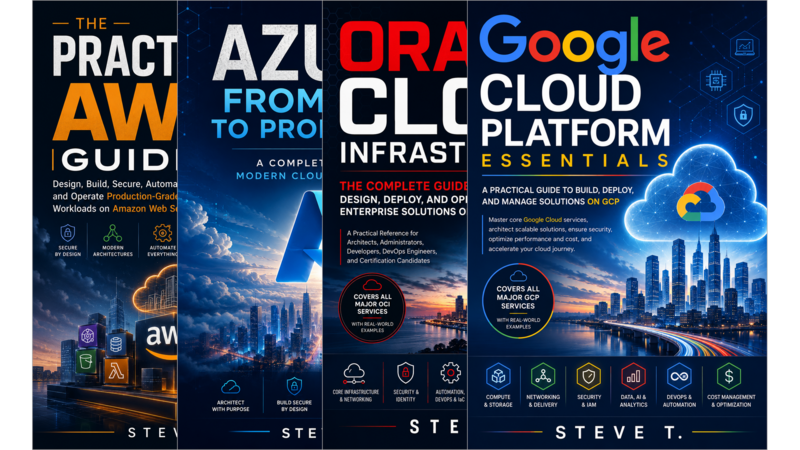

A Complete Guide to Modern Cloud Engineering. Learn to build, secure, and operate Azure workloads at enterprise scale with practical command-line examples.
- About This Book
Introduction: Why Azure, Why Now?
Chapter 1: Azure Fundamentals — The Building Blocks
- Global Infrastructure: Regions, Availability Zones, and Geographies
- Azure CLI Reference: Essential Command-Line Operations
- Identity Primitives: Microsoft Entra ID, Users, Groups, Service Principals
- The Azure Toolchain: Portal, CLI, PowerShell, REST API
- Cost Fundamentals: Pricing Models, Billing Accounts, and Cost Allocation
Chapter 2: Networking Deep Dive
- Virtual Network Design: Address Spaces, Peering, and Subnet Strategy
- DNS, Private Endpoints, and Hybrid Connectivity
- Load Balancing: Application Gateway vs. Standard LB vs. Front Door
- Traffic Manager, ExpressRoute, and VPN Gateways
- Network Security Groups, Azure Firewall, and DDoS Protection
- Real-World Patterns: Hub-and-Spoke, Spoke-to-Spoke, and Transit Gateways
- Azure CLI: Networking Operations
Chapter 3: Identity and Access Management
- Microsoft Entra ID: Core Concepts, Domains, and Tenants
- RBAC vs. ACLs: When to Use Each
- Managed Identities, Service Principals, and Certificate-Based Auth
- Conditional Access, MFA, and Zero Trust Foundations
- PIM for Production Workloads
- Cross-Tenant Authentication and B2B/B2C Scenarios
Chapter 4: Compute Services — Choosing the Right Engine
- Virtual Machines: Sizes, SKUs, and Availability Sets
- Azure Container Instances vs. App Service vs. Functions
- Dedicated Hosts, Spot VMs, and Reserved Instances
- Performance Tuning: NUMA, Storage IOPS, and Network Throughput
- Migration Strategies: Lift-and-Shift vs. Refactoring Compute
- Production Best Practices: Patching, Monitoring, and Recovery
- Azure CLI: Compute Operations
Chapter 5: Storage Architectures
- Blob Storage: Hot, Cool, Archive Tiers and Lifecycle Management
- Disk Storage: Premium SSD, Standard SSD, Ultra Disk — Choosing by IOPS and Throughput
- Files and File Shares: NFS vs SMB, Azure NetApp Files
- Queue and Table Storage: When (and When Not) to Use Them
- Data Transfer: AzCopy, Data Box, ExpressRoute Global Routing
- Production Patterns: Backup, Replication, Encryption, and Compliance
- Azure CLI: Storage Operations
Chapter 6: Databases — From Relational to NoSQL
- Azure SQL Database vs. SQL Managed Instance vs. SQL Server on VM
- Cosmos DB: RU Model, Consistency Levels, and Multi-Region Writes
- PostgreSQL (Flexible Server), MySQL, and MariaDB
- Redis Cache, Apache Kafka, and Event Hubs
- Database Migration Strategies and DR Patterns
- Production Considerations: Backup, Scaling, Monitoring, and Cost
- Azure CLI: Database Operations
Chapter 7: Containers and Kubernetes (AKS)
- Docker Fundamentals in the Azure Context
- AKS Architecture: Control Plane, Nodes, Networking Modes, and Storage
- Node Pools, Autoscaling, and Pod Scheduling
- Image Registry: ACR Integration and Security
- Ingress, Service Mesh, and External Traffic Patterns
- Production AKS: Upgrades, Troubleshooting, and Multi-Tenancy
- Azure CLI: AKS Operations
Chapter 8: Serverless — Functions, Logic Apps, and Event-Driven Architecture
- Azure Functions: Flex Consumption, Premium, and Dedicated Plans
- Durable Functions and Stateful Workflows
- Logic Apps, Event Grid, and Service Bus for Event-Driven Designs
- Cold Starts, Concurrency Limits, and Scaling Behavior
- Serverless + Container Hybrid Patterns
- Cost Modeling: When Serverless Beats VMs and Vice Versa
Chapter 9: DevOps, CI/CD, and GitOps on Azure
- Azure DevOps: Boards, Repos, Pipelines, Artifacts
- GitHub Actions for Azure Deployments
- CI/CD Pipeline Design: Build, Test, Stage, Deploy, Approve
- GitOps with Argo CD on AKS
- Environment Strategy: DEV to QA to STAGING to PROD
- Deployment Strategies: Blue/Green, Canary, Rolling Updates
- Azure CLI: DevOps Operations
- Azure CLI: DevOps Operations
Chapter 10: Infrastructure as Code (IaC)
- ARM Templates vs. Bicep vs. Terraform — Comparison and Migration
- Bicep Deep Dive: Modules, Parameters, and Composite Templates
- Terraform on Azure: Provider, State Management, and Workspaces
- IaC Testing, Validation, and Policy Enforcement
- CI/CD Integration for IaC Changes
- Production Patterns: Module Registry, Versioning, and Rollbacks
- Azure CLI: IaC Operations
Chapter 11: Observability — Logging, Monitoring, and Tracing
- Azure Monitor Fundamentals: Metrics, Logs, and Alerts
- Application Insights: Distributed Tracing and Performance
- Log Analytics Workspaces, KQL Queries, and Custom Dashboards
- Alerting Strategies: Noise Reduction and Escalation
- OpenTelemetry Integration and Cross-Platform Observability
- SRE Practices: SLIs, SLOs, and Error Budgets in Azure
Chapter 12: Governance, Policy, and Compliance
- Azure Policy: Built-In Definitions, Custom Policies, and Assignments
- Blueprints for Standardized Environments
- Microsoft Defender for Cloud: Security Posture and Threat Protection
- Compliance Certifications, Data Residency, and Regulatory Requirements
- Resource Tagging, Cost Allocation, and Showback/Chargeback
- Governance at Scale: Landing Zones and the Well-Architected Framework
Chapter 13: FinOps — Cloud Financial Management
- Azure Cost Management Tools: Budgets, Alerts, and Recommendations
- Reserved Instances, Savings Plans, and Commitment Discounts
- Right-Sizing: VMs, Databases, and Storage
- Spot Instances and Interruptible Workloads
- Tagging Strategy for Cost Allocation
- Building a FinOps Culture: Cross-Team Accountability
Chapter 14: AI and Machine Learning on Azure
- Azure OpenAI Service: Models, Deployment, and Guardrails
- Azure Machine Learning Studio: Pipelines, Compute, and Model Management
- Cognitive Services for Vision, Speech, Language, and Decision
- ML Infrastructure: GPU VMs, AmlCompute, and Real-Time Endpoints
- Responsible AI and Model Governance
- Production Patterns: RAG, Fine-Tuning, and Prompt Engineering
Chapter 15: Troubleshooting and Incident Response
- The Troubleshooting Mindset: Hypothesis-Driven Debugging
- Common Failure Modes: Network Timeouts, DNS, Auth, and Throttling
- Using Azure Service Health, Status Pages, and Resource Diagnostics
- Log Analysis, Trace Correlation, and Root Cause Identification
- Incident Response Playbooks and Post-Mortems
- Resilience Patterns: Retry, Circuit Breaker, Bulkhead, Fallback