7. How did Newton spin rotation into orbits
In Definition 5 Newton defines a new word to describe a new species of force he just invented: centripetal force. Centripetal force is a force that seeks a center. Newton gives four examples of this force: Terrestrial heaviness with which bodies tend to the center of the Earth; iron seeking loadstone; the force holding planets in their orbits and the sling motion. In the case of the sling, the centripetal force manifests itself as the tension on the string, and the stone stretches the string “the more strongly the more swiftly it revolves.”
Newton then projects the properties of the sling rotation to planetary orbits. These properties are radial acceleration, the “endeavor” to fly off and the tension on the string dubbed “force.” According to Newton all orbits are rotational and have the same properties as the sling motion.
Newton’s claim that orbits are rotational is wrong. Newton is spin-doctoring rotation in order to make his occult force the cause of planetary orbits. Rotation and revolution are ruled by different rules and orbital motion is free of the tension on the radius. The tension in the string exists because radius is constrained. In orbital motion such a radial constraint does not exist and therefore, Newtonian force does not exist.
Rules for rotation and revolution are


Rotation is ruled by radian motion, 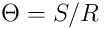 or
or  . According to this rule, for a given radius R, increasing Θ by turning the sling faster, will increase S and consequently, the radius R will want to increase proportionately, but since R is constrained and kept constant by the string, that additional motion belonging to R will manifest itself as tension on the string. The increase in S will be a measure of this tension.
Newton, on the other hand, interprets the sling motion in terms of the force he just defined. As the sling rotates, the stone stretches the string and endeavors to fly off and the centripetal force draws the stone back toward the hand to make the orbit happen. Newton hereby defines force as the cause of the sling orbit. Then Newton claims that the same mechanism creates all orbits because “all bodies endeavor to recede from the centers of their orbits.” For example, the Moon is a body in orbit, and just like the sling, it must be hurled by something, and in this case, that something, according to Newton, is “the hand of God”. (“Despite his well-known disparaging remarks on speculation and metaphysics, Newton developed a teleological theory in the context of his model of physical nature. Teleological reasoning appeared frequently in the form of auxiliary explanations–Newton appealed to teleology whenever he was unable to derive a physical phenomenon from his celestial mechanics. God was Newton’s answer when physics failed him.” page 104, The Philosophy of the Young Kant: The Precritical Project) or gravity. And like the sling, the Moon, too, endeavors to fly off along the tangent but it is held in its orbit by the centripetal force acting instantaneously.
Newton’s attempt to describe planetary orbits as rotational motion fails. The Moon’s orbit is not described by the radian rule. Increasing R does not increase the orbital arc the Moon describes in unit time. On the contrary, the Moon obeys Kepler’s Rule and moves according to the rule 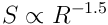 . Unlike the sling motion, increasing R decreases S. This proves that Newton’s story of orbits is propaganda invented to support Newton’s ideology.
In orbital motion the integrity of the radius is not respected because there is no material radius connecting the mover and the moved. In fact, there is no mover. Newton ascribes material qualities to orbital radius which is nothing more than distance created by the orbit. The orbital radius is not constrained because it does not exist. Without the sling the string will continue to exist but without the orbit there will be no radius. Therefore, in orbital motion, there is no radial or “centripetal” acceleration and there is no “endeavor” to fly off. Orbits are inertial, i.e., geometric and Keplerian, and not dynamical and Newtonian. This is proved by the fact that all of the rotational elements Newton projected to orbital motion by turning them into occult qualities must be eliminated in order to describe orbits.
These Newtonian elements, force F, mass m, and acceleration a, are always eliminated from orbital computations. (Keplerian part of acceleration, that is,  , remains, what is eliminated is the Newtonian label acceleration.) This cannot be otherwise because orbits do not obey the radian rule, orbits obey Kepler’s Rule. Newton defined his centripetal force to define orbital motion as rotational motion. But Newton’s force fails to describe orbits and consequently it is eliminated from computations of orbits. Yet, following Newton blindly, physics textbooks still enforce Newton’s absurd explanation of orbital motion.