4. Astronomical Computations in Newton’s Principia
These are the relevant astronomical computations that Newton claimed that proved his dynamical doctrines: Proposition III.4 – The Moon test, Proposition III.8 and Propositions I.57, I.58, I.59 and I.60. Newton is lying because none of these computations prove his dynamical doctrines, because as shown below, these are simple algebraic manipulations of Kepler’s Rule. See Commentary below.
Proposition III.4 – The Moon test
In proposition III.4 Newton merely confirms that Kepler’s Rule is valid for the earth-moon system. Given the unit period t at unit radius r , the period T at any radius R is given by Kepler’s law:
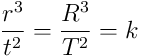
Plugging in the numbers Newton finds that the moon moves according to Kepler’s Rule as expressed in the above equation. No law other than Kepler’s Rule is used in this equation and the proposition only proves that Kepler’s Rule is valid for the earth-moon system.
Using Kepler’s Rule Newton compares the mean motion of an earth satellite near the earth’s surface and at 60 earth radii. Newton uses a pendulum to obtain the orbit of an earth skimming satellite but let’s use the modern value of 5054.75 seconds. By Kepler’s Rule,

where, r is the radius of the earth and it is unity, t is the mean motion of a satellite at r, R is the earth-moon distance which is taken as 60r, T is the mean motion at R which is

and Kepler’s Rule is confirmed.
This proposition proves just this, that Kepler’s Rule is valid for the earth-moon system. No law other than Kepler’s Rule is used in the computations.
Similar calculations existed in Streete’s Astronomia Carolina where Newton first saw Kepler’s Rule. He just copied them and added his own scholastic labels to it.
Proposition III.8
The mathematical content of the proposition III.8 consists of an algebraic transformation of Kepler’s Rule.
Let t be the unit period at unit radius r and T the period at any radius R, then Kepler’s Rule is,
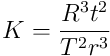
Let R = r, and then,

This ends the first algebraic transformation of Corollary 1. This is it. This is the calculation Newton sold to the world as Newton’s law of universal gravity.
Let’s continue to study how a genius does simple algebra: By Kepler’s Rule
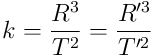
and
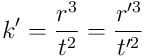
and
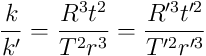
Rearranging,
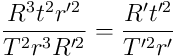
This is the second result of Corollary 1. Newton is considered by the Newtonist propaganda to be the greatest mathematician ever lived and his work here proves that he can do simple algebraic manipulations.
The third result is just:

There are no Newtonian laws used here. Proposition III.8 is not an application of “Newton’s law of gravitation,” as Newton claims, but a simple algebraic transformation of Kepler’s Rule.
None of the propositions Newton proves in the previous books is used to make any of these calculations. This is important to note.
Propositions I.57, I.58, I.59 and I.60
Propositions I.57, I.58, I.59 and I.60 also consist of simple algebraic manipulations of Kepler’s Rule that Newton is trying to sell us as dynamical calculations.
Newton writes Kepler’s Rule as
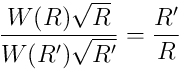
where R, R’ = (R + r), W(R), W(R’) are the given radii and angular motions of two points P and P’.
To make our first algebraic transformation let

The first equation becomes
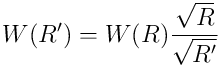
The conclusion of Proposition 58 is: to satisfy Kepler’s Rule at equal distances the angular motion of the greater radii must be reduced by the ratio

For the second transformation, let
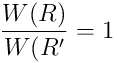
The first equation becomes
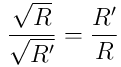
But since Newton altered the constant ratio of angular motions by equating them to unity, Kepler’s proportionality is no longer valid. To satisfy Kepler’s Rule again we must have
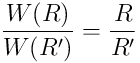
Making this substitution the first equation becomes
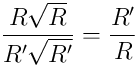
or as Newton puts it:
The axis of the second ellipse – that is, R’ – must be decreased by 1.5 power of the former ratio – that is, (R/R’)1.5.
Commentary
The mathematics in these propositions, which take up four solid pages in the Cohen translation, amounts to simple algebraic manipulations of Kepler’s Rule, the rest is Newton’s dynamical propaganda expressed with labels attached to Kepler’s Rule. The propositions prove none of Newton’s dynamical and occult claims. Instead they show how Newton corrupted the old science of astronomy by introducing into astronomy occult qualities such as force and mass. Newton Newtonized astronomy, i.e. he turned astronomy into scholasticism.
Scholasticism did not disappear after Galileo. Newtonian revolution was not a scientific revolution but a counter-revolution against Galileo to establish a scholastic monarchy under Newton’s name. This became the Newtonist cult whose members now call themselves physicists. This is why physicists insist on using Newtonian occult terms in astronomy even though none of the Newtonian terms are used in calculations of orbits.
After about 300 years of asserting the absolute truth of the Newtonian force physicists finally – but only nominally – deprecated this fundamental dogma of Newtonian physics.
A physical quantity whose unit is named after the founder of the profession can never be eliminated. But physics is infinitely flexible and semantic and physicists have been claiming that force has been subsumed by General Relativistic geodesic or, depending on the case, by force carrying particles or, depending on the case again, by force creating fields.
Instead of letting force die a peaceful death physicists has been resurrecting it under various names. And Newtonism is still taught the first few years of physics education as truth and students routinely measure Newtonian force moving pendulum arms.
Therefore, physicists’ party line that they teach Newtonian mechanics for pedagogical reasons does not hold. Physicists still believe that Newtonian force exists as needed.