7 Volumetric Addition to a Set
A new set of glazes with very little effort
We have already seen the way that volumetric blending enables a large set of related glazes to be mixed up quickly.
The volumetric blending procedure can be used to extend the results beyond the 35 glazes in the standard grid set. With very little extra work, a whole new set can be obtained.
If we initially produce enough of each glaze, we can split the set into two identical sets, keep one as the original and add something to the other. This is actually very easy to do using volumetric methods. In our example we will add titanium dioxide (TiO2).
Adding Titanium Dioxide to the Set
One of the more interesting opacifiers is titanium dioxide. This is usually introduced either as the pure oxide or as rutile, which contains some iron oxide. But it’s not just an opacifier; like many other ceramic materials it serves in a number of roles in a glaze. One of the main characteristics is the way it readily crystallizes from the glaze, even from additions as low as 1% (Hamer*). Depending on the amount added, the crystals cause a number of interesting effects, including bluish-white opalescence and opacity. It also causes interesting textural breakup of colour and matting of the surface. And like most opacifiers it tends to bleach out colour; the more TiO2 we add, the paler the glaze colour becomes.
A useful exercise to do at least once is to add TiO2 to all the glazes in a grid set and see how it affects them. We will examine here a simple way of adding the same percentage of one ingredient (in this case 5% TiO2) to all the glazes in a set.
Method
Summary
1. Make a “double batch” of the original set.. Weigh up twice the usual of each corner glaze (600 instead of 300 grams dry).
Make these up to at least 920ml Equalizing Volume.
Make a note of the Equalizing Volume.
Use a “double batch” Blending Chart (See box.) and blend the glazes.
2. Divide each glaze in half.
Stir each glaze until it is quite uniform and using the veterinary syringe, draw off 48ml from each one and put it in another cup.
3. Add TiO2 suspension with a small syringe.
Weigh out enough TiO2 to provide the 5% for all 35 glazes, suspend it in water and, using a small syringe, measure out the right amount into each cup. In a few minutes we have a whole new set of glazes. There is some maths involved, but it’s simple to follow.
Quantities
| Equalizing Volume (ml) for a “single batch” | Dry Weight per Cup (grams) |
|---|---|
| 700 | 20.6 |
| 695 | 20.7 |
| 690 | 20.9 |
| 685 | 21.0 |
| 680 | 21.2 |
| 675 | 21.3 |
| 670 | 21.5 |
| 665 | 21.7 |
| 660 | 21.8 |
| 655 | 22.0 |
| 650 | 22.2 |
| 645 | 22.3 |
| 640 | 22.5 |
| 635 | 22.7 |
| 630 | 22.9 |
| 625 | 23.0 |
| 620 | 23.2 |
| 615 | 23.4 |
| 610 | 23.6 |
| 605 | 23.8 |
| 600 | 24.0 |
| 595 | 24.2 |
| 590 | 24.4 |
| 585 | 24.6 |
| 580 | 24.8 |
| 575 | 25.0 |
| 570 | 25.3 |
| 565 | 25.5 |
| 560 | 25.7 |
| 555 | 25.9 |
| 550 | 26.2 |
| 545 | 26.4 |
| 540 | 26.7 |
| 535 | 26.9 |
| 530 | 27.2 |
| 525 | 27.4 |
| 520 | 27.7 |
| 515 | 28.0 |
| 510 | 28.2 |
| 505 | 28.5 |
| 500 | 28.8 |
| 495 | 29.1 |
| 490 | 29.4 |
| 485 | 29.7 |
| 480 | 30.0 |
| 475 | 30.3 |
| 470 | 30.6 |
| 465 | 31.0 |
| 460 | 31.3 |
The first part is working out how much dry material there is in one cup of glaze. This varies depending on what Equalizing Volume was used in the blending. To get started, let’s assume that we have made double the usual volume (a “double batch”), and after the blending we’ve divided each glaze into two equal portions. We now have two identical sets of 35 glazes. Working out the Dry Weight of a 1% Addition 1. First we need to work out the dry weight of glaze in one cup. We can use the table on the left, providing that: * A, B, C and D are each 300 gram dry batches (600 if using a “double batch”).* * We have 48 ml of glaze in each cup. * We use 35 cups. * Equalizing Volume is measured in ml.
- Now that we have the dry weight in one cup, it’s easy to work out 1%: 1% Addition = Dry Weight in 1 Cup ÷ 100 Applying this to our example: 1% of 30 grams is 30 ÷ 100 = 0.3 grams.
Working out Volumes for a 5% Addition
Once again we need to launch into some maths, but it’s easy maths and it’s MUCH easier and quicker than weighing out 35 portions and mixing them separately into each cup. Continuing with the example….
Assume we are messy workers, and will spill some! Let’s prepare enough for 40 cups (we only need enough for 35) so we will have a bit left over. We’ve just calculated that a 1% addition to one cup would be 0.3 grams. Therefore a 5% addition would be 1.5 grams. To prepare enough for 40 cups, we would need 40 x 1.5 grams = 60.0 grams.
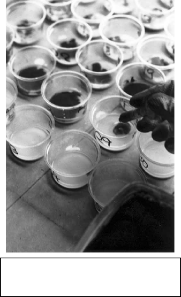
Tip: Use a smaller syringe for this exercise, e.g. 5 ml
Addition Procedure
- Weigh out 60.0grams of titanium dioxide.
- Add water to this and sieve.
- Bring it up to an appropriate Total Volume. (Some easy multiple of 40 would be convenient in this case, perhaps 80 ml?)
- Keeping the solids suspended by gentle stirring, measure out with a small syringe one fortieth of this Total Volume into each of the 35 cups.
- Stir each glaze until the titanium dioxide suspension is uniformly mixed in. The new set is finished and ready for sampling.