Chapter Five: Public Libraries Support ER of Adult EFL Learners in Japan
Hitoshi Nishizawa & Takayoshi Yoshioka
National Institute of Technology, Toyota College, Japan
Abstract
There were many Japanese adults who restarted to learn English after their graduation from college or school, but the learning in EFL setting was often difficult because they stuck to the once learned grammar translation method. They often started to analyze English texts grammatically and to translate them unintentionally. The concentration dropped their reading rate and forced them many hours to finish several pages. As a result, few of them enjoyed reading novels or magazines in English.
Extensive Reading (ER) has been changing the situation gradually since 2002. By reading easy-to-read English books, adult EFL learners found that they could actually read English texts without translation and started to enjoy reading. To answer their needs, more than 10 public libraries have set up special bookshelves and installed easy-to-read English books for ER in Aichi prefecture. For example, Toyota City Library, which already had 10,000 English books before the introduction, purchased 3,000 easy-to-read books from picture books to graded readers, and set introductory lectures teaching why ER was necessary, how to start ER, and how to select appropriate books from the library.
Major users of those books were middle-aged or senior people who had wanted but could not read English novels earlier. Compared to college students in an ER program, they had more knowledge of English but less experience of actually reading or listening to English materials. Their need to start reading from picture books to unlearn translating habits was the same as college students’.
In this paper, we present when, why and how those libraries set up such bookshelves, and what are the current issues and future prospects.
First and Second Waves of Installment
The first wave of installing easy-to-read English books to public libraries had started from Komaki City Library in 2004, was followed by Gamagori City Library, Toyota City Library (Picture 1), and several public libraries in Aichi prefecture (Nishizawa, 2007).
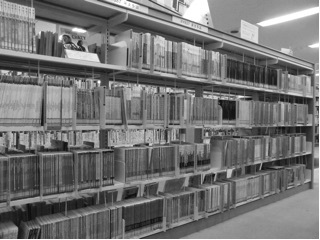
The wave was triggered by Sakai’s (2002) guidebook to one-million-words ER, was encouraged by the active discussions on bulletin boards of SSS website (2001), and was supplied with an exhaustive list of easy-to-read books and Yomiyasusa level (YL): readability levels optimized for Japanese EFL learners (Furukawa et al, 2013). Leaders of a few local governments or the heads of some public libraries led the introductions of several hundred ER books for the lifelong learning of Japanese adults. They were, however, limited to some libraries in Aichi and surrounding prefectures in Tokai region, or a few libraries in big cities such as Tokyo or Kyoto. Although the number of ER books in school/college libraries had increased since then, most public libraries had hesitated to add English books or had not simply recognize such phenomenon for a while.
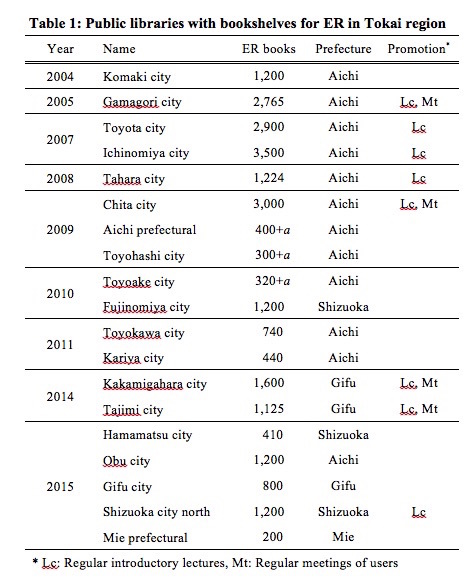
The second wave in 2014 was bigger. Public libraries which had installed or been planning to install ER bookshelves in Tokai region increased more in recent two years, and still seemed to be increasing (Table 1). The difference of the first and the second wave was the decision makers. This time, not only the leaders of institutions but also the librarians had found the benefits of ER for local society and started to promote ER (Sakai & Nishizawa, 2014). We knew the increased interest of librarians from the fact that the first symposium of ER in libraries had participants from 22 public libraries and 20 school/college libraries from wide area of Japan (NIT, Toyota College, 2015).
The librarians recognized that the need of EFL learners was quite similar to the need of Japanese children. EFL leaners required a lot of easy-to-read English books, as children needed easy-to-read Japanese books. Most libraries already had a special corner for children’s books, and some even had a separate building for them, but they did not have English books for Japanese EFL learners. The librarians correctly understood that the books must be easy enough for EFL learners because the books were not for learning English knowledge but just for reading English books fluently and enjoying them.
Promoting ER and Supporting Users
Collecting ER books was the first step for the libraries. The book guide written by Furukawa et. al (2013) and SSS website (2001) supplied the necessary information about ER books. ER practitioners in the region also gave advice adaptable to the local situation. The libraries also had to promote ER itself in their second step because ER was still a new and unknown approach in Japanese schools, where grammar-translation had been and still was the dominant approach.
For promoting ER, many libraries set up introductory lectures, in which the concept and method of ER were explained. Expected benefits of ER appealed to the adults who had learned English the hard way with the grammar translation method in school but had not become fluent readers in English. They usually had enough knowledge of English grammar and vocabulary to start ER, but lacked fluency and had no experience of enjoying reading English materials. Their progress would often be faster than young students’ who had less knowledge of English if they could change their “reading” style from translation to reading. However, it was actually not easy for them to change the reading style because they had their self-image that they were already fluent readers of English texts and they did not need to read any easy-to-read book. It was important in the introductory lectures to distinguish ER from their “reading” using the grammar translation method, and to explain the reason why ER was necessary. Both theory and practice were needed to convince them and a long-term ER program offered convincing data based on a practice.
Practical guidance for selecting appropriate books was also important in the introductory lectures. General guidance was to start from reading as many books as possible from picture books such as Oxford Reading Trees series, to read most of graded readers (GR) in starter and elementary levels, and continued to read GR of headwords fewer than 1,000 or YL lower than 3.0 until total word count exceeded a million words. After reading theat amount, many adult users became able to separate easy books to read from difficult ones and to select appropriate materials for themselves without much help from instructors or veteran readers.
The monthly circulation of Tahara City Library showed that such annual introductory lectures increased the number of checked-out books for the following three months (NIT, Toyota College, 2015). The lectures invited new users to ER books and also activated ER of veteran users. Several libraries held such lectures several times a year for promoting ER further.
Setting up regular meetings of users was another effective method of promotion. In the meetings, there was usually no instructor but the participants talked about their experience of reading and exchanged information related to English books to each other. Such meetings encouraged library users to continue their ER even if they had no friends who enjoyed ER around them. It was also common that a novice user found a role model in one of the veteran users in a meeting and followed her reading history as a guide. The regular meetings held by the college library of NIT Toyota or Tajimi City Library were quite popular among the library’s users.
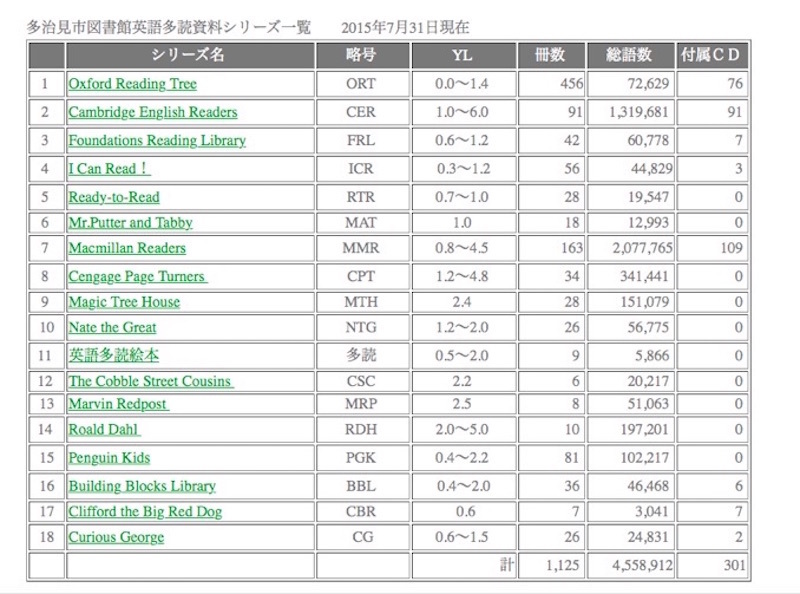
Websites also promoted ER in libraries. For example, Tajimi city library website (2014) put the list of ER books in the library, introduced the newly installed books, and announced the meetings of users or other events related to ER. Websites not founded nor operated by libraries, such as SSS website (2001) and Tadoku supporters website (2013) also supported ER and ER in public libraries by offering bulletin boards where the information of books and the opinions of adult EFL learners were exchanged. They sometimes were the only guide for independent learners, whose nearest library did not have some supporting functions or did not even have enough easy-to-read books for ER. Adult readers had often slowed their reading pace (word / month) when they had read more than 100 thousand words but less than a million words, which must be the period they needed any support the most (Furukawa, Nishizawa, Uruno, Yoshioka, 2007).
Evaluating ER in Libraries
Circulation of ER books was generally higher than the one of Japanese books because ER books for starters had shorter texts and could be read in shorter duration. Their circulation must be compared only with the one of children’s books. However, many users tended to give up ER if there was not enough guidance or support. Circulation might also decline when the regular users improved their reading skills through ER and started to read more difficult books with longer texts because those books required more time to complete. Regular flow of starting users was necessary to keep or increase the circulation of ER books.
Other than higher circulation, ER books in libraries and the supporting events must be evaluated by their functions to activate lifelong learning and to construct a learning community of English or other foreign languages in the region. If the current users, middle- aged or senior people, improve their language skills through ER, they might invite younger people or even school children into the learning community. When ER books in public libraries helped to change the norm of reading from English-to-Japanese translation to simple reading, they must be evaluated by the social impact.
Summary and Expectation
Public libraries in Tokai region had successfully installed special bookshelves holding easy-to-read English books for ER, and started to support lifelong learning of adult EFL learners. Their experiences told us that the books must be very easy, and the users needed guidance for starting ER and support for continuing ER, which might be supplied or organized by the libraries, ER practitioners in the region, or the users. The experience could be transferred to libraries in other regions and even to school/college libraries. If the movement spreads over the country, ER in libraries has the potential to develop a new frontier of EFL learning.
References
Furukawa, A., Nishizawa, H., Uruno, H., & Yoshioka, T. (2007). SSS website: An online community which supports successful extensive reading for learning English, Proceedings of 6th IASTED International Conference Web-based Education, 449-454.
Furukawa, A., Kanda, M., Mayuzumi, M., Miyashita, I., Hatanaka, T., Sato, M., & Nishizawa, H. (2013). Eigo tadoku kanzen bukkuguido [Complete book guide for extensive reading in English] (4th ed.). Tokyo: CosmoPier.
Nishizawa, H. (2007). Toshokan no kyoiku shien, chiiki koken: Toyota kosen no eigo tadoku wo tsujite [Libraries supporting English learning in the region, from the practice of NIT, Toyota College], The annual seminar of college libraries in Tokai region, 61-64.
NIT, Toyota College (2015). Proceedings of Toshokan tadoku heno shotai [Symposium of ER in libraries]. Retrieved from http://www.toyota-ct.ac.jp/dbps_data/material/localhost/e_gakka/tadoku/tadokusiryou_Web.pdf
Sakai, K. (2002). Kaidoku hyokumango! Paperback heno michi [Toward one million words and beyond], Tokyo: Chikuma Shobo.
Sakai, K., & Nishizawa, H. (2014). Toshokan tadoku heno shotai [Invitation to ER in libraries], Nihon tosyokan kyokai.
SSS website (2001). Retrieved from http://www.seg.co.jp/sss/
Tadoku supporters website (2013). Retrieved from http://tadoku.org/
Tajimi city library website (2014). Retrieved from http://www.lib.tajimi.gifu.jp/tadoku.html