Part I - About #tagcoding
Chapter 2 - #tagcoding: why everyone should do it, and how to do it
To Part I - II-ISIC - III-COFOG - IV-SDGS - V-CPC - VI-USlgu - VII-Annexes - VIII-References
Chapter 1 - Introduction
The Internet and social media offer enormous new possibilities for curiosity, ingenuity, creativity and resilience. And over the last two decades they have transformed the way we find and share our ideas, information and knowledge.
Search engines, with Google as a pioneer, and recently also AI chatbots, offer fast ways to find answers to many questions.
Open online encyclopedias exist in many languages. Wikipedia was launched in 2001 and is available in over 300 languages.
Microblogs like Twitter, launched in 2006, now X, Bluesky and Mastodon or social platforms such as LinkedIn, Facebook and many others, offer incredible sharing possibilities and great retrieval options when hashtags are used intelligently.
Despite all the opportunities offered by the Internet and social media, the localization of knowledge, as described by Nobel laureate Joseph Stiglitz at the launch of the Global Development Network (2000), proceeds at a slow pace. Information overload in major languages and the insufficient supply of content in most languages and on many topics contribute to slow learning for more sustainable and inclusive development.
What can we do to make better use of the Internet and social media?
Wikinetix’s mission is to promote and demonstrate the joint impact of four digital skills, the first of which can be considered an atomic habit:
- #tagcoding means that one uses standardized hashtags to relate online information to specific topics in order to structure and retrieve it easily;
- #xy2wiki is about creating a wiki that explains tagcoding hashtags in as many languages as possible;
- #tag2wiki is about creating, maintaining and coordinating wikis for development communications;
- #lean2book is about creating and publishing e-books that leverage the #tagcoding and #tag2wiki wikis.
This e-book has built-in links that make navigating the included reference materials as easy as navigating a wiki. At each level of the hierarchy of contents are tables of contents with links forward to lower-level sections and backward to higher levels. This way, it only takes three or four clicks to get to the specific content of a part, or to return to the part from the more specific content. Of course, the e-book readers also support term search.
The knowledge localization model #tagcoding - #xy2wiki - #tag2wiki - #lean2book offers several features to accelerate knowledge localization and public debate. While #tagcoding is a digital skill available to everyone, the #xy2wiki, #tag2wiki and #lean2book skills require an extra investment of time and means. One #xy2wiki mission is the creation of a multidimensional thematic wiki in any local language through topic-based translation of a reference wiki. Once such a wiki is in place, it can support the curation of content - tagged for a country or local government unit - in the languages of the country or locality, the discovery of forgotten topics, and the rapid provision through translation of new reference content.
Therefore, a #tagcoding - #xy2wiki - #tag2wiki - #lean2book movement is a general-purpose collaborative countermeasure to information overload, (epistemic) polarization into bubbles that no longer meet and other imperfections of mainstream Internet and social media. The proposed coding hashtags and corresponding provision of wikis will empower users in the discursive, instructive and productive use of both the Internet and social media, enable a willingness to listen, and help overcome the polarizing forces of social media algorithms.
How you exploit #tagcoding and the other digital skills that build on it is up to you to explore and learn. It depends on where you are in your personal development and the responsibilities you have taken on in business or society. This e-book is intended to be a companion for the first episode of your #tagcoding journey.
You can also get guidance and inspiration about your possible uses for tags and wikis by exploring one of these open access online resources:
- the Wikiworx platform;
- the Actor Atlas or its EU chapter which contains all the contents of this e-book;
- the Social Capital Wikis;
- the Wikinetix website has some videos that provide brief introductions to hashtags for specific thematic dimensions and online tools that support their use.
The hashtags cover topics that interest active and thoughtful people from all possible professions and fields of study, in all countries of the world and in all spoken languages.
By #tagcoding social media and online content, we can make it globally discoverable and retrievable as if it were in one’s personal library.
On the Internet, this library is globally accessible. Using the territorial hashtags #WWlgu we can create relevant local sections in the global online library. The hashtag #2030library and a dedicated part of the Wikinetix website explore this topic in more detail.
If the tagged content is open access, it becomes part of the public part of that #2030library.
As long as there are social media platforms and search engines that support hashtags, you, your favorite authors, your students, your teachers, and your peers can use systematically defined hashtags to share, discover, and retrieve content.
Summary
The second chapter outlines the reasons for using systematically defined hashtags and explains the digital competencies that are involved if the practice is to be scaled up. The desire for global scaling up should be understood as a continuation of the history of knowledge creation and accessibility.
Each of the following five parts presents hashtags and class descriptions for a specific thematic dimension.
- Part II presents hashtags for the sections, divisions, groups and classes of the International Standard Industrial Classification of All Economic Activities (ISIC revision 4).
- Part III presents the hashtags for divisions, groups and classes of the Classification of the Functions of Government (COFOG).
- Part IV presents the hashtags for the Sustainable Development Goals and Targets.
- Part V presents the hashtags for the sections and divisions of the Central Product Classification (CPC).
- Part VI presents the hashtags for states and counties. The numeric codes in these hashtags are based on the FIPS GeoID’s.
Part VII includes two Annexes:
- Annex 1 lists all the countries and territories in the world, each with its ISO 3166 country code and generic coding hashtags for some of the dimensions covered in this manual: #cofog, #isic and #lgu.
- Annex 2 describes some features of this e-book that support easy navigation through its 300 pages.
Part VIII lists a few references and a brief remark about the author.
#tagcoding: a new digital skill?
In its electronic version, “#tagcoding in the US” aims to be a companion in your exploration of new digital skills that have the potential to transform the way American and other citizens use the Internet and social media. What is at stake is a digital transformation that equips you with tools better suited to meet the great challenges of our time.
This e-book provides #tagcoding conventions for a globally shared multidimensional thematic map with over one hundred thousand topics important for development, personal, public and socio-economic. Codes for sustainable development goals, products and services, economic activities, government functions, can be combined with state, country and county codes to form hashtags for specific topics such as fighting poverty in a state or county. In fact, depending on the specific interest of users, or purpose of a campaign, a single hashtag can be created out of billions to support knowledge sharing on a very specific topic, for instance, on #FlintWaterCrisis: #cofog0630 for Water Supply in Flint, Genesee County (#US26049) (Michigan): #cofog0630US26049. But less specific hashtags may also be used as you may discover by looking up #US26049 in Google or X.
In a sense, we propose a coordination of the thematic space, which is similar to the Cartesian coordinate geometry for space and time. In the thematic space, the thematic dimensions are sustainable development goals, economic activities, governance functions, territorial locality and language. Coordination of the thematic space brings superior expressive adequacy and computational efficiency in digital social exchange, localization of knowledge and articulation of shared and differentiated responsibility.
Searching this e-book can be a first step in a broader engagement with systematized content that already includes tens of thousands of wiki pages, or when you feel like sharing a good read, a brilliant idea, or when you need high quality or recent content or speeches about a sustainable development goal or target, a city, a municipality, a sector of industry, or a government function in a country.
In addition to this e-book and the #tagcoding pivots, other online tools have been defined to support quick and easy discovery of the coding hashtag for a specific topic. See the #tagcoding handbook for more information on these tools and other #tagcoding proposals.
Chapter 2 - #tagcoding: why everyone should do it, and how to do it
There are many possible reasons to start using standardized hashtags. Two are selected to illustrate these reasons: it is a means to overcome the polarizing forces of social media, and it is a means to make the world of knowledge small for everyone.
As #tagcoding is not primarily a skill to practice individually, a series of engagement steps are presented. They address the individual skill and the public tools that make the skill “socially” productive in a digital Public Sphere.
This chapter concludes with a #tagcoding code of conduct and a brief note on the current “organic” global adoption of #tagcoding.
- The thematic, geographic and language division of the global discourse
- Overcoming the polarizing forces of social media
- Make the world of knowledge small for all
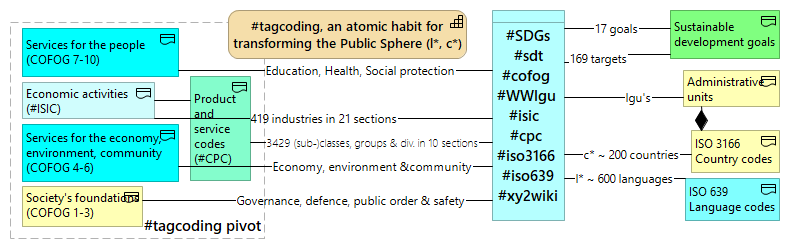
- Thematic dimensions in this e-book
- An atomic habit for the digital age: #tagcoding
- A second step of engagement: #xy2wiki
- A third step of engagement: #tag2wiki
- A fourth step of commitment: #lean2book
- Achieving a digital Public Sphere for your country or language
- Code of Conduct for #tagcoding
- Global adoption of hashtag coding
The thematic, geographic and language division of the global discourse
At the moment of writing, Elon Musk the owner of X has 206.416.510 followers who all get his posts in their timeline - probably upto more than hundred a day. And also non-followers get his posts as “suggested reading”. Do his posts interest us? No one is asking, but on X, except when blocking him, the assumption is yes. No matter the topic he is writing about. By reposting and quoting the opinions and digital cries he likes, and given the algorithms that enforce popular opinions, a single person’s viewpoints have taken over a platform. The digital tsunami, a mixture of information, Disinformation (_D), Misinformation (_M), Propaganda (_P), Satire (_S), Fake news (_F) and Conceptual deception (_C) is hitting all platform users. Hashtags are of no use to him, nor his followers.
These practices have caused a growth at alternative platforms, first Mastodon, and more recently Bluesky. And some users are retreating from X. One of these is the European Federation of Journalists.
Retreating is certainly an option in the X-case, but the use of distinctive hashtags to stratify the global discourse into thematic lines is the proposition of this e-book.
Elon Musk will know a lot about SpaceX, the economic sector of which is “#isic3030 - Manufacture of air and spacecraft and related machinery”, and Tesla (#isic2910 - Manufacture of motor vehicles). And those e-vehicles need batteries, the product of “#isic2720 - Manufacture of batteries and accumulators”. As the manufacturing activities take place in the US and China, the localized hashtags are #isic3030US, #isic2910US and #isic2720CN. That’s about what most would be interested in when reading posts from citizen Elon Musk.
Figure 2.1 shows how thematic dimensions, geographic location, and language are mapped to codes that are then combined to divide into thematic lines the global discourse that may be taking place on a social media platform.
Overcoming the polarizing forces of social media
Recently it has been observed that social media algorithms promote the assertion of one’s own opinions and polarize empowered citizens into bubbles that are no longer found. A Belgian Interior Minister stated: “We have invested in empowerment, but we have forgotten the willingness to listen”.
The resulting question is, then, how to make the will to listen possible through the bubbles.
The good news is that #tagcoding was invented for that purpose: searching for a tagcoding hashtag, before sharing a piece of content or opinion, indicates a willingness to listen, across languages, but also across all sorts of bubbles that social media would otherwise reinforce.
By practicing #tagcoding we can overcome the polarizing forces of social media.
Make the world of knowledge small for all
The “small world “ argument in social network theory emphasizes that people are, on average, only a few connections away from the information they seek.
Singh et al. (2000) in their article “The World Is Not Small for Everyone: Inequality in Knowledge Seeking in Organizations “ contrast the “small world” argument with empirical support for the argument that the network structure does not benefit everyone.
For people who have longer search paths to locate knowledge in an organization and on the Internet, the world is big.
Drivers of inequality in access to knowledge include peripheral status mechanisms and homophily, “love of sameness,” the tendency of individuals to associate and bond with similar others.
Search tools for coding hashtags and systematized hashtags covering all topics in a thematic dimension (see Chapter 4 of the #tagcoding handbook foster heterophilic awareness in search. By taking advantage of Internet and wiki services, it takes only a few seconds to find the coding hashtag for a specific topic in a thematic dimension.
Together, coding hashtags, wikis, and public content serve this purpose: to leverage the Internet and social media to make the world of knowledge smaller for all members of society.
Therefore, the systematized contents referred to in this e-book are offered without a paywall. Your contribution to this e-book allows its author(s) and other volunteers to expand and offer for free a growing collection of systematized content. Together we can demonstrate that #tagcoding of content and the creation of linked wikis are pillars for learning and development, and that they reduce barriers to accessing knowledge that is important for people’s livelihoods.
Thematic dimensions in this e-book
The #tagcoding capability uses thematic dimensions to facilitate knowledge sharing and retrieval:
- Define topic hashtags in a systematic end-user (single-dimensional) topic dimension, e.g. #isic9101 for library and archive activities, and PH, the ISO 3166 country code for the Philippines;
- Create hashtags for multidimensional topics by combining monodimensional topic codes, e.g., combining #isic9101 with PH to get #isic9101PH for library and archive activities in the Philippines;
- Ensuring local language wiki and e-book coverage for all topics in key end-user thematic dimensions (focusing on topics important to a community);
- Provide a way to search for a specific hashtag in a thematic dimension.
Of the end-user thematic dimensions covered in #tagcoding, this e-book has a focus on support for the localization of content as facilitated by the use of #EUlgu (local government unit) hashtags and the “campaign” hashtags for the Sustainable Development Goals and targets.
The hashtags for economic activities, functions of government, and products and services are also included, but the descriptions of the sections, divisions, groups, classes and sub-classes are illustrated but not included in this e-book. Because of their extensiveness, these descriptions are included in separate e-books: one with the hashtags of the economic activities and functions of government (567 pages) and one with the hashtags for products and services (1023 pages).
- Part II - ISIC: “all economic activity” classified in ISIC. ISIC is the abbreviation for International Standard Industrial Classification of All Economic Activities. The class labels and definitions are those of revision 4. The full structure and definition of each of the 400+ classes can be found in Goossenaerts (2024a) or on the United Nations Statistics Division website also.
- Part III - COFOG: “all government functions” classified in COFOG. COFOG is short for Classification of the Functions of Government. The full structure and definition of each of the more than 100 classes can be found in a United Nations Statistics Division publication: Classifications of Expenditure by Purpose: Classification of the Functions of Government (COFOG) or in Goossenaerts (2024a).
- Part IV - SDGs: “all sustainable development goals and targets”. Sustainable Development Goals and targets adopted by the United Nations General Assembly in September 2015 and often abbreviated as SDGs, with the hashtag #SDGs.
- Part V - CPC: “all products and services” classified by CPC. CPC stands for Central Product Classification. The Central Product Classification (CPC) is a comprehensive product classification covering products and services.
- Part VI - US Lgu: “Local government units in the US”. #USlgu hashtags combine the ISO 3166 country code with numeric statistical codes for states and counties as defined in FIPS.
- Annex 1 - ISO 3166 Codes for all Countries
The ISIC, COFOG and CPC classifications may also be consulted online: in English, in French and in Spanish. For languages and local government unit hashtags, only English versions are provided online.
An atomic habit for the digital age: #tagcoding
Common search engines and many social platforms support hashtag coding, but for most social media platforms the use of hashtags is an “intra-platform” feature.
In the case of X, following the discontinuation of hashtag-based timelines several years ago, also hashtag search is no longer open to non-subscribers.
In Mastodon, hashtag search is open to non-subscribers via Mastodon Search.
On social platforms anyone can tag content with a hashtag for the issue in the country to make it part of a national discourse that is visible globally (if hashtag search would be open to non-subscribers of the platform).
This makes the discourse on the topic inclusive. Everyone (on the platform) can contribute, without needing to join a specific group or community, or without needing to be “rich or famous” for the contribution to be noticed.
While social media gives you a means to communicate with your social network, coding hashtags allows you to instantly follow a discourse and address it with your own ideas. This is in contrast to being restricted to bubbles (your own network) or content for the general public. If a discourse is moving at a slow pace, older posts can be easily retrieved and the hashtag helps retrieve posts over a longer period of time.
By having hashtags for specific topics, the expected posting intensity per hashtag decreases, and a much better match between content supply and demand is possible. Think of authors or researchers in a community that has adopted the hashtag code. A topic with many posts would indicate an oversupply of content - many authors writing similar things, or researchers doing similar research - while a topic with no posts would indicate neglect of the topic. By #tagcoding their output and searching for previous work, authors and researchers can better allocate their time so that all topics within a thematic dimension receive adequate attention.
Language-neutral hashtags cover every sustainable development goal or target, every government function, every economic activity, every product or service, and every locality. There is a coding hashtag for each person’s livelihood or public service needs. On the Internet and social media, content coded with hashtags is like a word in a dictionary: when you look it up through a search engine, you will find it.
A second step of engagement: #xy2wiki
Bringing tag-based #coding capabilities to institutions in any country and to millions of citizens using many languages is a major challenge.
Since search engines and Internet browsers allow setting language preferences, a first goal of wiki content for any language is the provision of pages explaining the meaning, system and structure of all tag encoding hashtags in the language. This is the goal of the #xy2wiki program, which can be instantiated for any language through its 2- or 3-character ISO 639 code: for example, #bn2wiki for Bangla, #pa2wiki for Punjabi, #tgl2wiki for Tagalog (http://tgl.wiki), #es2wiki (http://es2.wiki) for Spanish, etc.
Each #xy2wiki wiki must provide in the “xy” language all the content that this e-book contains in English (#en2wiki with url http://en2.wiki or http://www.ens.wiki).
To enable a digital Public Sphere and forge the necessary trust between institutions, citizens and businesses, all tagged content, whether limited to one language or not, is merged into a focused discourse stream, including one for each local government unit. Everyone can have a voice in these streams, and everyone can see what others have shared. Because of their combinatorial nature, tags can be highly specialized or rather general. They can be configured according to the scope level at which the public-private discourse occurs.
A third step of engagement: #tag2wiki
Once the #xy2wiki preparations have been completed, native speaking users of the #tagcoding hashtags can be assured that meaning is shared in a wide variety of inclusive lifeworld related content streams - a digital public sphere, truly public and inclusive becomes enabled.
Once hashtags have been adopted at scale in a country or for a language, the search for hashtags is likely to have a limited horizon in the past. Therefore, it is recommended to curate on #xy2wiki pages the contents of tagged posts that provide quality original content on the relevant topics. The use of similar page and wiki naming conventions facilitates the alignment of pages in different languages and/or countries.
A fourth step of commitment: #lean2book
This e-book uses hyperlinks and hashtags to expand the book’s storyline with content that is on the Internet, on wikis and on social platforms. Keep in mind that the e-book reading device is likely to have access to the Internet. As explained in Annex 3 pdf and epub readers booth support search, bookmarks and inline hyperlinks.
The content referred to can have different access regimes. Content in the public domain is referred to as public content and is available to all under the same access regime, i.e. free of charge and without restrictions on re-use. Content that is protected by copyright or other rights regimes, much of which is found in printed books (#cpc322) or online text-based information (#cpc8431), cannot be reused without the approval of the copyright holder.
The use of hyperlinks in online books or e-books (#cpc84311) such as those published through Leanpub has several advantages:
- The author can avoid rewording and repackaging existing content, and can build on the work of others in a straightforward and transparent way; the author can focus on original contributions;
- Content that is on the Internet can evolve and improve between the time the e-book was first produced and the time one reads it, making use of the hyperlink;
- When hyperlinked content is on wikis or blogs that support discussion or commentary, readers can comment to improve the state of knowledge on a topic or area of interest;
- Authors can harvest discourse encoded with hashtags to periodically update their book or topical article.
Systematized public content, for example on wikis that are maintained through a #tag2wiki curation approach, draws the attention of authors and readers to the possibility of reusing or referencing such content in their work. By using and expanding systematized public content, its quality and usefulness will gradually improve, especially also in languages where there is still little content online.
The expectation of improving the quality of content gives rise to a subsequent return to specific “content” through hashtag searches, both to discourse and to wiki pages and e-books.
While #tagcoding, #xy2wiki and #tag2wiki are collaborative journeys, e-Book creation is often an individual journey.
A digital Public Sphere enabling Democracy
The “public sphere” is generally conceived as the social space in which different opinions are expressed, problems of general interest are discussed and collective solutions are developed in a communicative way. Thus, the public sphere is the central arena of social communication. In large-scale societies, mass media and, more recently, networked media support and sustain communication in the public sphere.
The Federal President of Germany, Frank-Walter Steinmeier, in his opening speech at the eleventh Bellevue Forum “Democracy and the Digital Public Sphere - A Transatlantic Challenge” (1 March 2021) summarizes the expectations regarding the digital public sphere: “Much is expected of the public sphere in a democracy. It must reflect the plurality of society and be accessible to all, encourage reasoned debate, open up spaces for new ideas and policy goals, provide reliable information, and empower people to participate responsibly in democratic processes. These ideals have guided us since the Enlightenment.
Using #tagcoding as a means of promoting and monitoring a discussion topic has a number of advantages, including:
- everyone (with a profile on the platform that allows tagged posts) is empowered to contribute to a discussion or debate, meaning they are truly inclusive;
- when consistently defined hashtags are used, content on very specific topics can be easily retrieved; for example, marine aquaculture in Indonesia has the coding hashtag #isic0312ID;
- the use of #tagcoding by authors and readers encourages collaborative outreach and avoids information overload, as well as the bewilderment it causes;
- each encoding hashtag supports a “search” for the “single version of the truth” for the discourse on the searched platform, at any time and in all languages.
Discourse coded with hashtags helps authors and readers update their knowledge on a wide range of related topics and ideas. In addition, systematized public content, reliable information, can be easily updated and expanded. And translation efforts can be focussed such that a wide body of content gets translated in more languages.
If there is a “public content #xy2wiki” for each language (used in a country), maintained by curators who augment it with relevant new content from posts coded with hashtags, this is an important asset for the country’s digital Public Sphere in each of its languages.
In conclusion: the current use of the Internet and social media contributes less to the digital Public Sphere than is possible with the intensive use of #tagcoding, #xy2wiki and #tag2wiki.
Code of Conduct for #tagcoding
By #tagcoding we can combat information overload and disinformation, avoid over-researched topics and make the world of knowledge small for everyone. Success on this global journey also depends on adhering to certain principles when dealing with content that others have created, and when contributing your own content.
- Respect for everyone’s opinion
- Respect for copyright
- Avoid spamming or aggressive pushing of content
- Contributing to an inclusive and non-polarizing discourse
Respect for everyone’s opinion
Respecting an opinion doesn’t mean endorsing it, especially if it’s harmful or unfounded. It simply means acknowledging the right of others to hold their views and engaging with them constructively.
In online information sharing respecting everyone’s opinion is important for these reasons (list provided by ChatGPT):
- It fosters Open Dialogue: Respect encourages people to share their thoughts without fear of judgment or ridicule. Open dialogue is essential for learning, growth, and the exchange of ideas.
- It promotes Understanding and Empathy: Respecting opinions, even when we disagree, helps us understand different viewpoints and the experiences that shape them. This builds empathy and reduces prejudice.
- It encourages Critical Thinking: Exposure to diverse perspectives challenges our own beliefs, helping us think critically and refine our views. Disagreement can be a tool for intellectual growth if handled respectfully.
- It strengthens Democratic Principles: A healthy democracy thrives on diverse opinions. Respect ensures that all voices, especially minority ones, are heard, fostering a more inclusive society.
- It prevents Polarization: Disrespect often leads to hostility and division. Respecting others’ opinions helps maintain civility, even in disagreement, reducing the risk of extreme polarization.
- It leads to Better Solutions: Collaborative problem-solving benefits from multiple perspectives. Respecting different viewpoints allows for a comprehensive analysis, leading to well-rounded solutions.
By using tagcoding hashtags the author indicates that he or she will respect other opinions on the topic, that the content tagged and shared is not harmful or unfounded to the author’s knowledge, and that the author will engage constructively with responses to the shared content.
Respect for copyright
It doesn’t make much sense to discover a piece of content through a coding hashtag, and then copy or repeat it, and post it with the same hashtag or a neighboring hashtag (e.g. a different country code). Your content is likely to appear in the same search result as the copied content.
Rather, if you want to reinforce the original author’s message, retweet or repost, like, favorite or +1.
By #tagcoding a new work, the author expresses confidence that its content does not infringe on the copyrights of others, or does not merely repeat what is already available (online).
Avoid spamming or aggressive pushing of content
A common practice in (social) media to reach a wider audience is to repeat the same post regularly or in many places.
For example, on X, some post the same content weekly, daily or more frequently. On LinkedIn or Facebook we can post the same content to multiple groups, etc. Tagging with #tags on a public platform makes this multiple posting unnecessary to reach your target audience (as long as you have adopted the #tagcoding conventions, and your target audience is familiar with the hashtags).
By using hashtags coding, the author or publisher chooses not to spam, because of the excess of content pushing attitudes directed at readers. Post once, and then let readers discover the content, through the hashtags in the content, when they need to. This is called “on-demand”.
Contributing to an inclusive and non-polarizing discourse
A speech has questions and answers. Authors tend to use print and social media to share their answers and opinions, even without questions being asked.
Where can people express their burning questions? Or opinions that they feel are relevant to the public?
People working in a “neglected” economic activity can add appropriate coding hashtags to their question. A question can gain prominence when it is liked by others, or recognized by an expert. And when a capable answerer comes across a featured question, they can be sure that the answer coded with #tags will be appreciated.
The barriers to joining the discourse are much lower on an “open social platform” than on a closed group of application users, or on a closed platform.
By #tagcoding questions they become part of an inclusive discourse, in addition to the answers and arguments.
If the opinion is intended for a social media bubble away from public debate, tagging is not recommended: the use of #tagcoding hashtags indicates that the content is not intended to polarize, but is meant to serve in public debate.
Global adoption of hashtag coding
Adopting #tagcoding at scale is a societal challenge, especially since there is no (direct) commercial or political interest in such adoption.
Some coding hashtags have been “organically” adopted on a global scale. This is the case for the hashtags of the Sustainable Development Goals: #sdg1, #sdg2 to #sdg17. For these hashtags, on X, it is not uncommon that more than a hundred posts per day, or even per hour, are shared. If you are interested in a specific topic, for example the fight against poverty in the EU, the hashtag #sdg1 won’t help you much. On the other hand, if all posts tagged with #sdg1 about fighting poverty in the EU also carried #sdg01EU or #sdg1EU, a simple search for these tags would retrieve the content you are interested in.
Also, some people have intuitively used #sdgKE to share content about sustainable development in Kenya.
Since the beginning of 2018, some knowledge institutions are using hashtags for the Sustainable Development Goals, for example:
- “#sdt1714 - improve policy coherence for sustainable development;”
- “#sdt123 - by 2030 halve per capita food waste at retail and consumer levels, and reduce food losses throughout production;”
- “#sdt61 or #sdt061 - by 2030, achieve universal and equitable access to safe and affordable drinking water for all;”
- “#sdt055 or #sdt55 - ensure women’s full and effective participation and equal opportunities for leadership at all levels of decision-making.”
The abundance of #covid19 content, along with the desire of many to ensure that content reaches a specific audience, has inspired many people, including government agencies, to combine #covid19, and more recently also #omicron, with ISO country codes or US state codes. Due to the pandemic and the widespread communication about it through social media, the use of certain forms of #coding tags has increased.
This increased usage has also highlighted the need for “internationally agreed” #tagcoding conventions to avoid homonyms on global platforms such as X and LinkedIn.
Consider the following: around the world, two-character ISO country codes are widely used, usually in combination with #covid19, e.g. #covid19CA for Canada, #covid19CO for Colombia or #covid19IL for Israel. In the United States, on the other hand, it is common to use state abbreviations, such as CA for California, IL for Illinois, CO for Colorado, resulting in the same variants of the #covid19 tag with a very different meaning.
What happens? When users on the “periphery” of a hashtag discover that their distinctive tag codes are already being used in the “core”, they are likely to abandon their good practices. Which is unfortunate because they were doing the right thing. The impact is that users on the periphery are deprived of a platform utility.
For a fair use of a global platform, homonyms in hashtags should be avoided… as a matter of etiquette on the network. It is especially a responsibility of users in the “core”.
The alternative for a US state is a code starting with #covid19US. You could then add the state abbreviation, for example to form #covid19USCA. Or use the state census code, which is 06 for California, to form #covid19US06.
Despite their usefulness for organising content on the Internet and social media, structured hashtags do not easily spread organically. I therefore urge all readers of this e-book to actively promote them in the areas and for the states and counties of their interest, especially also for domestic and local use.
Note that the alphabetical part of the hashtag is not case-sensitive. It also cannot include non-alphanumeric characters, except for the underscore “_”. In longer hashtags of several words it is common to capitalize the first character of each word, as in #MeToo or #AddisAbabaActionAgenda.