Annex 2 - Navigating features in this e-Book
This e-book is not an ordinary e-book. It is explicitly designed to use hyperlinks to online and inline content.
Because of its size, and because it is, like a dictionary or encyclopedia, not intended for linear reading, it is recommended to use:
- the search function provided by both pdf and epub readers;
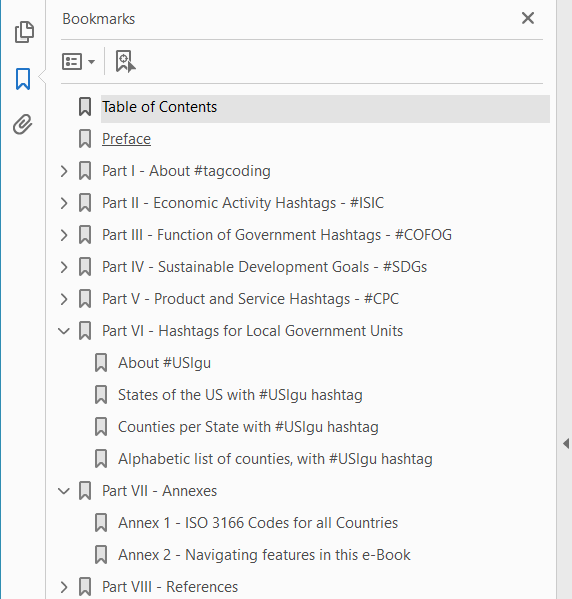
- the bookmarks for part and chapter headings, which show the overall structure of the e-book (See Figure A.1).
As long as the pdf and epub versions do not support bookmarks for sections below the chapters, use inline hyperlinks based on the TOCs of the sub-sections, with a backlink from the sub-section to the containing section where the TOC is located.
- Hyperlinks to online content
- Inline Hyperlinks
- Other uses of hashtags
- Provide #tagcoding manuals in your language
Hyperlinks to online content
Hyperlinks to online content make it a media enhanced book.
In the pdf version of the e-book, such hyperlinks appear as footnotes.
A media enhanced book offers benefits to participants in the knowledge chain. These benefits are based on the use of hyperlinks and hashtags to extend the story of the book with content that is available on the web and with discourse on social platforms. Content that is in the public domain is called content commons and should, in principle, be available to all under the same access regime, free of charge and with no restrictions on re-use. Content that is protected by copyright is called proprietary content. It can be accessed for a fee or for free, and cannot be re-used without permission from the copyright holder. Access conditions should be comparable for all participants in the same market.
Using hyperlinks to online content commons and proprietary content has several advantages:
- The author can avoid rewriting and repackaging existing content, and can build on the work of others in a direct and transparent way;
- Content on the web can evolve and improve between the time the e-book is created and the time it is read using the hyperlink;
- If the hyperlinked content is in wikis or blogs that support discussion or commentary, readers can add comments to further improve the state of knowledge in the area covered.
Systematised content commons referenced by hyperlinks alert authors and readers to the possibility of contributing to the wider dissemination of content commons or using them in other situations where they can be of benefit. By using and expanding the systematised content commons, their quality and usefulness will gradually improve.
Inline Hyperlinks
While editing the #tagcoding manuals, which often amounted to putting wiki content into e-book format, I missed the convenience of wiki breadcrumbs to navigate from subsections higher up in the content hierarchy. Markdown and related editing formats support linking within a piece.
This e-book and the #tagcoding manuals make extensive use of inline hyperlinks for tables of contents of chapters, sections, and subsections, for links to return to the next level up in the content hierarchy, and for links between chapters and between sections.
In this way, a thousand-plus page #tagcoding eHandbook can be read with the convenience of a wiki without being online. Within the source text, #tagcoding hashtags are used to tag the sections that define them. And access to the source code for the classifications is (or will be) included in the purchase of the e-book on leanpub. This makes it easy to reuse the source text or parts of it in other electronic publications or websites.
Other uses of hashtags
Using hashtags as a means of promoting and tracking a discussion topic also has several advantages, including:
- Anyone with a platform profile that allows tagged posts can contribute to the discussion (or better yet, the platform can allow non-members to read the discussion),
- When systematically defined hashtags are used, it becomes possible to discuss very specific topics, e.g. marine aquaculture in Indonesia via #isic0312ID.
- The use of hashtags by authors and readers supports collaborative scoping and avoids information overload,
- Each hashtag supports a “single-version-of-the-truth” search for the discourse on the platform(s) searched, at any point in time, and across languages.
Tagged discourse helps authors and readers update their knowledge about a particular topic.
If necessary, an author can update and republish an e-book, as supported by Leanpub, for example.
Realized as wikis, the systematized content commons can also be easily updated.
The expectation of improved quality provides a reason to return to specific “content commons” or hashtag searches later.
The systematized content commons in the #tagcoding guidelines are intentionally offered for free. Together we can demonstrate the feasibility of content commons and tagged discourse as pillars for development and low barrier access to knowledge that matters to people’s livelihoods.
Provide #tagcoding manuals in your language
While the #tagcoding handbook is already available in a few languages, providing systematized content commons in other languages will help reach a wider readership and user base for the Societal Architecture. In this way, we can overcome the digital and knowledge divide globally and achieve more poverty reduction and sustainable development impacts. Cooperatively, we can also make such provision [economically viable] (http://convention.worx.wiki/article:economic-sustainability).
A number of conditions mutually reinforce each other as enablers for the translation of this e-book:
- The 2030 Agenda hashtags defined in the Actor Atlas are language independent;
- Google Translate supports page-by-page translation of Content Commons;
- Translating models in modeling tools is efficient as only the elements (and comments) need to be translated to translate all views;
- Leanpub supports royalty sharing according to an agreed split between author and (co-)translator.