10. Modularity, if you must
I’m convinced that people who designed and specified JPA were not aware (or were ignorant) of modern modularity trends.10 For a long time I’ve been trying to put things into domain named packages (sometimes low-level technical domains, as it happens with complex layered software) and as a next step I naturally started to split big JARs into smaller ones rather across vertical (domain) lines instead of putting everything from one layer in a single JAR.
If you have all your entities in a single JAR you have no problem altogether. But if you fancy to
split the entities into multiple JARs – including their definitions in
persistence.xml – then you’re venturing beyond the JPA specification. JPspec,
section 8.2 Persistence Unit Packaging says:
This does not explicitly forbid using multiple persistence.xml files but I believe it implies we
should not do it. It’s actually the other way around – we can have multiple persistence units
in one XML, that’s a piece of cake.
Everybody knows layers
I decided to experiment with modularization of applications after I had read Java Application Architecture: Modularity Patterns with Examples Using OSGi [JAA].11 After that I couldn’t sleep that well with typical mega-JARs containing all the classes at a particular architectural level. Yeah, we modularize but only by levels.
I’ll use one of the projects from my past as an example. We had one JAR with all entity classes,
sometimes it was called domain, sometimes jpa-entities (admitting the anemic domain
model).
Then we had our @Service classes in a different JAR – but all of them in one – accessing
entities via DAOs. Service layer was used by a presentation layer. Complex logic was pushed to
specific @Components somewhere under the service layer. It was not domain-driven but it made
sense for us and the dependencies flowed clearly from the top down.
Components based on features
But how about dependencies between parts of the system at the same level? When we have a lot of
entity classes, some are pure business (Clients, their Transactions, financial Instruments), some
are rather infrastructural (meta model, localization, audit trail). Why can’t these be separated?
Most of the stuff depends on meta model, localization is quite independent in our case, audit trail
needs meta model and permission module. It all clicks when one thinks about
it – and it is more or less in line with modularity based on features, not on technology or
layers. Sure we can still use layer separation and have permission-persistence and
permission-service as well (later we will see an example where it makes a lot of sense).
Actually, this is quite a repeating question: Should we base packages by features or by layer/technology/pattern? It seems that the consensus was reached – start by feature – which can be part of your business domain. If stuff gets big you can split them into layers too, unless you find even more suitable sub-domains.
Multiple JARs with JPA entities
So we carefully try to put different entity classes into different JAR modules. Sure, we can just repackage them in the same JAR and check how tangled they are with Sonar but it is recommended to enforce the separation and to make dependencies explicit (not only in the [JAA] book). My experience confirms it quite clearly – contracts of any kind must be enforced.
And here comes the problem when your persistence is based on JPA. Because JPA clearly wasn’t
designed to have a single persistence unit across multiple persistence.xml files. So what are
these problems actually?
- How to distribute
persistence.xmlacross these JARs? Do we even have to? - What classes need to be mentioned where? E.g., we need to mention classes from an upstream JARs
in
persistence.xmlif they are used in relations (which breaks the DRY principle). - When we have multiple
persistence.xmlfiles, how to merge them in our persistence unit configuration? - What about the configuration in
persistence.xml? What properties are used from what file? (Little spoiler, we just don’t know reliably!) Where to put them so we don’t have to repeat ourselves again? - How to use EclipseLink static weaving for all these modules? How about a module with only
abstract mapped superclass (some
dao-commonmodule)?
That’s quite a lot of problems for an age when modularity is so often mentioned, too many for a technology that comes from an “enterprise” stack. And they are mostly phrased as questions – because the answers are not readily available.
Distributing persistence.xml – do we need it?
This one is difficult and may depend on the provider you use and the way you use it. We use
EclipseLink and its static weaving. This requires persistence.xml. Sure we may try keep it
together in some neutral module (or any path, as it can be configured for weaving plugin), but
that goes against the modularity quest. What options do we have?
- We can create some union
persistence.xmlin a module that depends on all needed JARs. This would be OK if we had just one such module – typically some downstream module like WAR or runnable JAR. But we have many. If we madepersistence.xmlfor each they would contain a lot of repetition. And we’d reference downstream resource which is unacceptable. - We can have dummy upstream module or out of module path with union
persistence.xml. This would keep things simple, but it would be more difficult to develop modules independently, maybe even with different teams. - Keep
persistence.xmlin the JAR with related classes. This seems best from the modularity point of view, but it means we need to merge multiplepersistence.xmlfiles when the persistence unit starts. - Or can we have different persistence unit for each
persistence.xml? This is OK, if they truly are in different databases (different JDBC URL), otherwise it doesn’t make sense. In our case we have rich DB and any module can see the part it is interested in – that is entities from the JARs it has on the classpath. If you have data in different databases already, you’re probably sporting microservices anyway.
We went for the third option – especially because EclipseLink’s weaving plugin likes it and we
didn’t want to redirect to non-standard path to persistence.xml – but it also seems to be the
right logical way. However, there is nothing like dependency between persistence.xml files. So if
we have b.jar that uses a.jar, and there is entity class B in b.jar that contains
@ManyToOne to A entity from a.jar, we have to mention A class in persistence.xml in
b.jar. Yes, the class is already mentioned in a.jar, of course. Again, clearly, engineers of
JPA didn’t even think about possibility of using multiple JARs in a really modular way.
In any case – this works, compiles, weaves our classes during build – and more or less answers questions 1 and 2 from our problem list.
It doesn’t start anyway
When we have a single persistence.xml it will get found as a unique resource, typically in
META-INF/persistence.xml – in any JAR actually (the one JPA refers to as “the root of
persistence unit”). But when we have more of them they don’t get all picked and merged magically
– and the application fails during startup. We need to merge all those persistence.xml files
during the initialization of our persistence unit. Now we’re tackling questions 3 and 4 at once,
for they are linked.
To merge all the configuration XMLs into one unit we can use this configuration for
PersistenceUnitManger in Spring (using MergingPersistenceUnitManager is the key):
1 @Bean
2 public PersistenceUnitManager persistenceUnitManager(DataSource dataSource) {
3   MergingPersistenceUnitManager persistenceUnitManager =
4     new MergingPersistenceUnitManager();
5   persistenceUnitManager.setDefaultDataSource(dataSource);
6   persistenceUnitManager.setDefaultPersistenceUnitName("you-choose");
7   // default persistence.xml location is OK, goes through all classpath*
8   return persistenceUnitManager;
9 }
Before I unveil the whole configuration we should talk about the configuration that was in
the original singleton persistence.xml – which looked something like this:
 1 <exclude-unlisted-classes>true</exclude-unlisted-classes>
 2 <shared-cache-mode>ENABLE_SELECTIVE</shared-cache-mode>
 3 <properties>
 4   <property name="eclipselink.weaving" value="static"/>
 5   <property name="eclipselink.allow-zero-id" value="true"/>
 6   <!--
 7   Without this there were other corner cases when field change was ignored.
 8   This can be worked-around calling setter, but that sucks.
 9   -->
10   <property name="eclipselink.weaving.changetracking" value="false"/>
11 </properties>
The biggest question here is: What is used during build (e.g. by static weaving) and what can be put into runtime configuration somewhere else? Why somewhere else? Because we don’t want to repeat these properties in all XMLs.
Now we will take a little detour to shared-cache-mode that displays the problem with merging
persistence.xml files in the most bizarre way.
Shared cache mode
We wanted to enable cached entities selectively (to ensure that @Cacheable annotations have any
effect). But I made a big mistake when I created another persistence.xml file – I forgot to
mention shared-cache-mode there. My persistence unit picked both XMLs (using
MergingPersistenceUnitManager) but my caching went completely nuts. It cached more than expected
and I was totally confused. The trouble here is – persistence.xml don’t get really merged.
The lists of classes in them do, but the configurations do not. Somehow my second persistence XML
became dominant (one always does!) and because there was no shared-cache-mode specified, it
used defaults – which is anything EclipseLink thinks is the best. No blame there, just another
manifestation that JPA people didn’t even think about this setup scenarios.
If you really want to get some hard evidence how things are in your setup put a breakpoint
anywhere you can reach your configured EntityManagerFactory and when it stops there dig deeper
to find what your cache mode is. Or anything else – you can check the list of known entity
classes, JPA properties, anything really. And it’s much faster than guessing.
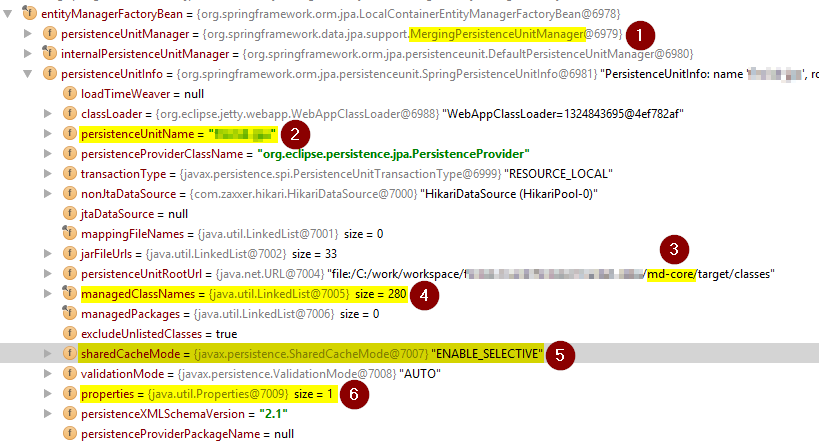
In the picture above we can see the following:
- We’re using Springs
MergingPersistenceUnitManager. - Persistence unit name is as expected.
- This is the path of “the root of the persistence unit”. It’s a directory here, but it would be a JAR in production.
- Our managed classes (collapsed here).
- Shared cache mode is set to
ENABLE_SELECTIVE– as required. - Other cofigured properties.
Luckily, we don’t rely on the persistence.xml root anymore, at least not for runtime
configuration.
Putting the Spring configuration together
Now we’re ready to wrap up our configuration and move some of repeated configuration snippets from
persistence.xml into Spring configuration – here we will use Java-based configuration (XML works
too, of course).
Most of our properties were related to EclipseLink. I had read their weaving manual, but I still didn’t understand what works when and how. I had to debug some of the stuff to be really sure.
It seems that eclipselink.weaving is the crucial property namespace, that should stay in our
persistence.xml, because it gets used by the plugin performing the static weaving. I debugged
Maven build and the plugin definitely uses property eclipselink.weaving.changetracking
(we set it to false which is not default). Funny enough, it doesn’t need eclipselink.weaving
itself because running the plugin implies we wish for static weaving. During startup it gets
picked though, so EclipseLink knows it can treat classes as statically weaved. This means it
can be pushed into programmatic configuration.
The rest of the properties (and shared cache mode) are clearly used at the startup time. Spring configuration may then look like this:
 1 @Bean public DataSource dataSource(...) { /* as usual */ }
 2
 3 @Bean
 4 public JpaVendorAdapter jpaVendorAdapter() {
 5   EclipseLinkJpaVendorAdapter jpaVendorAdapter = new EclipseLinkJpaVendorAdapter();
 6   jpaVendorAdapter.setShowSql(true);
 7   jpaVendorAdapter.setDatabase(
 8     Database.valueOf(env.getProperty("jpa.dbPlatform", "SQL_SERVER")));
 9   return jpaVendorAdapter;
10 }
11
12 @Bean
13 public PersistenceUnitManager persistenceUnitManager(DataSource dataSource) {
14   MergingPersistenceUnitManager persistenceUnitManager =
15     new MergingPersistenceUnitManager();
16   persistenceUnitManager.setDefaultDataSource(dataSource);
17   persistenceUnitManager.setDefaultPersistenceUnitName("you-choose");
18   persistenceUnitManager.setSharedCacheMode(
19     SharedCacheMode.ENABLE_SELECTIVE);
20   // default persistence.xml location is OK, goes through all classpath*
21
22   return persistenceUnitManager;
23 }
24
25 @Bean
26 public FactoryBean<EntityManagerFactory> entityManagerFactory(
27   PersistenceUnitManager persistenceUnitManager, JpaVendorAdapter jpaVendorAdapter)
28 {
29   LocalContainerEntityManagerFactoryBean emfFactoryBean =
30     new LocalContainerEntityManagerFactoryBean();
31   emfFactoryBean.setJpaVendorAdapter(jpaVendorAdapter);
32   emfFactoryBean.setPersistenceUnitManager(persistenceUnitManager);
33
34   Properties jpaProperties = new Properties();
35   jpaProperties.setProperty("eclipselink.weaving", "static");
36   jpaProperties.setProperty("eclipselink.allow-zero-id",
37     env.getProperty("eclipselink.allow-zero-id", "true"));
38   jpaProperties.setProperty("eclipselink.logging.parameters",
39     env.getProperty("eclipselink.logging.parameters", "true"));
40   emfFactoryBean.setJpaProperties(jpaProperties);
41   return emfFactoryBean;
42 }
Clearly, we can set the database platform, shared cache mode and all runtime relevant properties
programmatically – and we can do it at a single place. This is not a problem for a single
persistence.xml, but in any case it offers better control. We can now use Spring’s
@Autowired private Environment env; and override whatever we want with property files or even
-D JVM arguments – and still fallback to default values – just as we do for database property
of the JpaVendorAdapter. Or we can use SpEL.
This is the flexibility that persistence.xml simply cannot provide.
And of course, all the things mentioned in the configuration can now be removed from all our
persistence.xml files.
I’d love to get rid of eclipselink.weaving.changetracking in the XML too, but I don’t see any way
how to provide this as the Maven plugin configuration option, which we have neatly unified in our
parent POM. That would also eliminate some repeating.
Common base entity classes in separate JAR
The question 5 from our problem list is no problem after all the previous, just a nuisance.
EclipseLink refuses to weave our base class regardless of @MappedSuperclass usage. But as
mentioned in one SO question/answer, just add dummy
concrete @Entity class and we are done. You’ll never use it, it is no problem at all. And you can
vote for this bug.
This may be no issue for load-time weaving or for Hibernate, but I haven’t tried that so I can’t claim it reliably.
Cutting cyclic dependencies
Imagine we have two modules – users and permissions – where permissions depends on the
users module. Module users contains User and Role entity while permission module contains
Permission and RolePermission association that is mapped explicitly because it contains some
additional information. See the following picture:

users and permissionsObviously, Role cannot depend on RolePermission because that would cross module boundaries
in a wrong direction. But when the Role is deleted we also want to remove all related
RolePermission (but not Permission, of course). Imagine we have RoleDao and
RolePermissionDao and both these are derived from some layer supertype
named BaseDao. This handy class implements all common functionality, including delete(...)
method that in the process calls common preDelete(entity) method. For convenience this is
already pre-implemented, but does nothing.
Were all the classes in a single module our RoleDao could contain this:
1 @Override
2 protected void preDelete(Role entity) {
3   QRolePermission rp = QRolePermission.rolePermission;
4   new JPADeleteClause(entityManager, rp)
5     .where(rp.roleId.eq(entity.getId()))
6     .execute();
7 }
With separate modules it’s not possible because QRolePermission (just like RolePermission)
is not available in the users module.
Sure, we can argue whether we have the entities split into modules properly – for instance, is
Role really a concept belonging to User without considering permissions? However after moving
Role to the permissions module, we would have problem with @ManyToMany relationship named
roles on the User class – which is naturally the owning side of the relationship – as it
would go against module dependency.
When the cycle occurs it may also indicate that one of the modules is too big. In our case we
used User in the permission module, but it is not really necessary in the entities directly.
It is used by upper layers of the module so maybe we should split the modules like this:

users and permissions dependency with introducing another module.Now users module can depend on permission-persistence and bring RolePermission where it
really belongs.
In the following cases we will focus on the relationship between the entities Role and
Permission – this time with modules users always depending on the permissions module (which
more or less matches permissions-persistence from the previous picture). Let’s see how we can
model that many-to-many relationship and how it can cross module boundaries.

@ManyToMany follows the dependency.First we use implicit role_permission table without explicit entity. Role is a natural owner
of the information about its Permissions and Permission doesn’t necessarily need the list of
the roles using it. It gets interesting when we introduce RolePermission explicitly as an entity
– perhaps because there are additional attributes on that association.

RolePermission in users.Notice that the database relational design limitations, dictating where to put the foreign key,
are actually quite useful to decide which way the dependency goes. The module knowing about
RolePermission table is the one that depends on the other one. If it wasn’t that way
we would get invalid case with cyclic dependency like this:
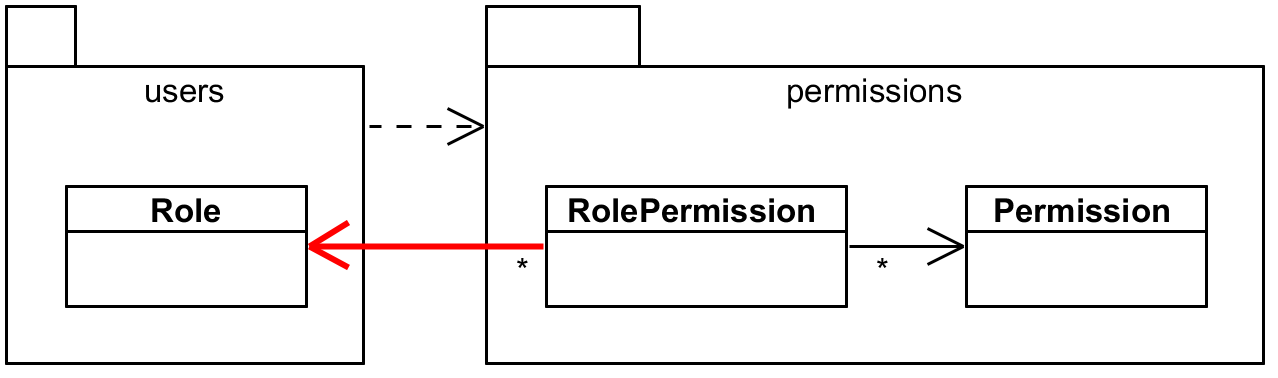
RolePermission in permissions forms a cycle.We either need to reverse the dependency on the module or split one module into two like shown
previously with permissions. If we absolutely needed this dependency from users to
permissions and also the “red arrow” then something else in the users model depends on
permission – which is a case for splitting users module. (This is rather unnatural, previous
case for splitting permissions was much better.)
In any of these cases we still have a problem when we delete the “blind” side of the relationship.
In the pictures of valid cases it was the Permission entity. Deletion of a Permission somehow
needs to signal to the users module that it needs to remove relations too. For that we can use
the Observer pattern that allows us to register
an arbitrary callback with a DAO.
It will be implemented by already mentioned BaseDao to make it generally available. The following
example demonstrates how it can be used when explicit RolePermission entity is used:
 1 // in some dao-base module
 2 public abstract class BaseDao<T> ... {
 3   private List<PreDeleteHook<T>> preDeleteHooks = new ArrayList<>();
 4
 5   public void delete(T entity) {
 6     preDeleteHooks.forEach(h -> h.preDelete(entity));
 7     entityManager.remove(entity);
 8     ...
 9   }
10
11   public interface PreDeleteHook<E> {
12     void preDelete(E entity);
13   }
14
15   public void addPreDeleteHook(PreDeleteHook<T> hook) {
16     preDeleteHooks.add(hook);
17   }
18   ...
19 }
20
21 // in users module
22 public class RolePermissionDao extends BaseDao<RolePermission> {
23 	public static final QRolePermission $ = QRolePermission.rolePermission;
24
25   @Autowired PermissionDao permissionDao; // from downstream permissions module, OK
26
27   @PostConstruct public void init() {
28     permissionDao.addPreDeleteHook(this::deleteByPermission);
29   }
30
31   // this method "implements" PreDeleteHook<Permission>
32   public void deleteByPermission(Permission permission) {
33     new JPADeleteClause(entityManager, $)
34       .where($.permissionId.eq(permission.getId()))
35       .execute();
36   }
37   ...
38 }
39
40 // no special changes in PermissionsDao, it can't know about users module anyway
Using unmanaged association table with @ManyToMany would require to find all the Roles having
this permission and removing it from its permissions collection. I, again, vouch for more
explicit way as that “delete all relations that use this permissions” is simpler and likely more
efficient.
Conclusion
- JPA clearly wasn’t designed with modularity in mind – especially not when modules form a single persistence unit, which is perfectly legitimate usage. Just because we use one big legacy database it doesn’t mean we don’t want to factor our code into smaller modules.
- It is possible to distribute persistence classes into multiple JARs, and then:
- We can go either with a single union
persistence.xml, which can be downstream or upstream – this depends if we need it only in runtime or during build too. - I believe it is more proper to pack partial
persistence.xmlinto each JAR, especially if we need it during build. Unfortunately, there is no escape from repeating some upstream classes in the module again just because they are referenced in relations (typical culprit when some error makes you scream “I don’t understand how this is not an entity, when it clearly is!”).
- We can go either with a single union
- If we have multiple
persistence.xmlfiles, it is possible to merge them using Spring’sMergingPersistenceUnitManager. I don’t know if we can use it for non-Spring applications, but I saw this idea reimplemented and it wasn’t that hard. (If I had to reimplement it, I’d try to merge the configuration part too!) - When we are merging
persistence.xmlfiles it is recommended to minimize configuration in them so it doesn’t have to be repeated. E.g., for Eclipselink we leave only stuff necessary for built-time static weaving, the rest is set programmatically in our Spring@Configurationclass.
There are still some open questions but I think they lead nowhere. Can I use multiple persistence
units with a single data source? This way I can have each persistence.xml as a separate unit.
But I doubt relationships would work across these and the same goes for transactions (without XA
that is).