2. Surveying the Biblical Options
Let’s avoid reductionism
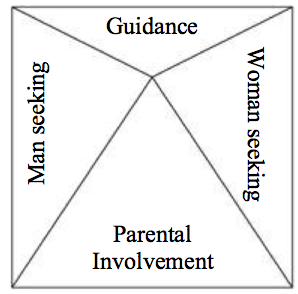
The five Scriptures to the left expose the fallacy of reductionists. Some reductionists insist on the “freedom” of seeking a wife without any parental involvement, while others have presented a paradigm of parentally guided betrothal. Some emphasize the Lord’s choice of a spouse so heavily that they become passive, waiting for a spouse to drop out of heaven (so to speak), while others do not seek the Lord’s guidance enough. Obviously, God should be in the equation (Prov. 19:14), parents should ordinarily be involved in the process for both sons and daughters (Jer. 29:6), sons should usually be active in the process of taking wives (1 Thess. 4:4; Jer. 29:6a), and daughters should have a choice in the matter too (Numb. 36:6). The ideal is to have all four perfectly matched, as in the diagram that follows on the next page.
But what happens if parents do not have the mind of the Lord? What happens if parents believe that a son or daughter should not get married? What happens in the case of fornication? What happens if the man, the woman, and the parents all want the marriage to happen, but the church rightly points out that the marriage is unlawful? What happens if there are no parents? Though this is ordinarily an issue between families, there are times when both church and state may be appealed to or must step in to help. We live in an imperfect world, and the Bible shows the flexibility to be able to handle every circumstance that we might face.
For example, the way two young people search for a marriage partner (Gen. 2:21-25; Ps. 45; 1Cor. 7:36-37) might look different from the pursuit of marriage by an older man and widow (Ruth 3-4; 1Cor. 7:39). Likewise, the process of a master and a female slave getting married (Ex. 21:7-11) will likely take a somewhat different route than the marriage of two young people who are under the authority of their parents (Ps. 45; 1 Cor. 7:33-38), though neither marriage should be a forced marriage, and all of the Biblical principles we will look at under “form” must be followed.5 Since the master acts in a parental capacity with a slave (see Gal. 4:1-2; Gen. 14:14; 17:23), he is in the unusual situation of marrying someone under his authority to another person under his authority (Ex. 21:9). This is quite different than two families negotiating a marriage for their respective children. It is my contention that the Bible presents more than one model for finding a spouse, though the universal principles (the form) apply to all. The following are some of the models that I see in Scripture:
Marriages without a time of discussion or betrothal
Model 1 – Arranged Marriage Without Betrothal
There are times when sons and daughters think so much like their parents and/or matchmaker that they are able to get married to the one selected for them without a time of personally discussing their compatibility for marriage or a time of betrothal. While the Bible is against forced marriages as well as marriages that are contracted while the children cannot give informed consent, it does present arranged marriages as one viable option. This is still the preferred option in many countries. Of course, all marriages need to be willingly entered into by both the man and the woman or it is not a “covenant” (Mal. 2:14; Prov. 2:17). But on this model the bride and groom are not involved in the search for a spouse. This was the situation with Adam and Eve (Gen. 2:21-25). God gave them to each other and they got married the same day they met. It could be argued that since God was a perfect parent He should not be considered a model for how marriages of sinners and by sinners are conducted. But the fact of the matter is that marriages could be lawfully covenanted in this way. Examples of such marriages are: Adam and Eve (Gen. 2:21-25), Isaac and Rebekah (Gen. 24), Onan and Tamar (Gen. 38:8), and Ishmael’s marriage arranged by his mother (Gen. 21:21). While this was not the normal practice in the Bible, there were circumstances that warranted not having a prolonged waiting period.
Model 2 – Marriage of Necessity.
The Levirate marriage (Deut. 25:5-10; cf. Gen. 38:8-11; Ruth 3:9-4:13; Matt. 22:23-28) involved an obligation to marry that did not require a season of discussion or betrothal. The only decision that was made was whether to reject the marriage or not (Deut. 25:7-10; Ruth 4:5-8).6 This marriage was entered for two reasons: 1) to raise a seed for the dead brother, and 2) to redeem the widow out of very difficult circumstances. In the situation of Ruth, she had two options: Boaz and an unnamed “close relative.” Obviously Ruth was hoping for Boaz, but the text seems to indicate that in these dire circumstances, either one would have been a good choice. This again illustrates that both seasons were not considered absolutely necessary prior to marriage. However, it should be emphasized that there was no forced marriage, or it would not have been a true marriage covenant, which implies a mutual agreement to marry. Both Deuteronomy 25 and Ruth 4 show that there was a way out of such a marriage.
Model 3 – Marriage to a Slave.
The marriage of a master to a slave who had been captured in war could have been a tremendous blessing to the slave (see Deut. 20:14 with 21:10-14; and by analogy Ezek. 16:1-14). Though Deuteronomy 21 indicates that conversion was required before marriage, and the time for mourning and conversion was set at one month,7 there is no indication that there was a time of extended discussion or a time of betrothal required. The description of God’s bride in Ezekiel 16:1-14 seems to be an application of this passage: 1) Israel was treated as being a foreigner from an enemy people, with the father being an Amorite and the mother being a Hittite (v. 2), 2) Israel was rescued from destruction (vv. 5-6), 3) the rescued girl was young enough to meet the requirements of the law (vv. 4-6), 4) Israel was a woman without property, 5) as she grew God saw that she was beautiful, 6) and verses 8-9 discuss an entering into the covenant of marriage, which is “the time of love” when his garment covered her nakedness. Both passages almost treat it as an act of charity. However, it must be strongly insisted upon that both parties would have needed to agree to the marriage or it would not be a covenant agreement (see Ezek. 16:3,8 where God enters into an oath and covenant with his bride).
Model 4 – Marriage after Fornication.
What should a father do when his daughter has been lured into fornication? The Bible gives two options. Exodus 22:16-17 did not require marriage, since the father could refuse to give her to the young man (v. 17). But at the same time, it is clear that the father and daughter were in a legal position to force the young man to marry (v. 16). In the case of Shechem and Dinah (Gen. 34:1-31), Jacob gave permission for Shechem to marry Dinah, and Shechem immediately took her to his house (v. 26). One reason there was no time of discussion or betrothal was because fornication jumped the gun and missed the whole purpose for those seasons that we will discuss below. The point of listing this is to demonstrate the flexibility Scripture has to meet all situations.
Marriages with betrothal alone
Model 5 – Marriage of Economic Necessity.
Not all slave marriages were without betrothal. Exodus 21:7-11 discusses marriage of a master to his slave after “he had betrothed her to himself.” A time of discussion was obviously not necessary to get to know the woman since the master dealt with the woman and had gotten to know her quite well. The woman was a slave because of debt, and the dowry was the release of the debt to the parents. This economic negotiation necessitated a betrothal. Notice that the betrothal was just as binding on the master as a betrothal would be to a non-slave. If he broke the betrothal, she was a free woman (v. 8) and the master would lose the dowry of the forfeited debt. Once married to the woman, he could not treat her as a slave since she had all the liberties of a married free woman (vv. 9-10), the debt forgiveness being the bride price.8 Again, both the betrothal and the marriage covenant require that she enter into this voluntarily. There is no such thing as a valid “shot-gun” marriage in the bible. Though we do not have slaves in America, there are applications that can be made from the lesser (the slave) to the greater (the free). For example, this passage clearly teaches that any abuse equal to or greater than the abuse described in verse 10 was grounds for divorce. One application that could be made is that a time of discussion may not be necessary if two people have grown up together and the families know the couple quite well. There is no reason why such a couple could not move immediately to betrothal if they so desired.
Model 6 – Arranged Marriage with betrothal.
A sixth model shown in the Bible is for free people to enter into arranged marriages. Some examples would be the promised hand of Merab in marriage to whoever would slay Goliath in 1 Samuel 17:25, the betrothal of Merab to David in 1 Samuel 18:17 (which betrothal Saul broke), the subsequent giving of Merab to Adriel (v. 19), and the betrothal of David to Michal in 1 Samuel 18:21-27 (with 2 Sam. 3:14). Though there are likely others, I cannot prove that they took place without a prior season of discussion. Many such marriages have been entered into using this model in the last few years, and for the most part they have been successful.
Marriages after a season of discussion and betrothal
Model 7 – Discussion and Betrothal.
It is the assumption of this book that the vast majority of betrothals were contracted only after the parents and the potential bride and groom had engaged in sufficient research to make them convinced that the marriage would be a good one. As we will see, a time of talking about the two people’s compatibility for marriage involves researching and “seeking” the right spouse while betrothal is a commitment to marry. There is ample evidence that research was engaged in by both parents and children. Even daughters were normally expected to think through the implications of whom they would marry. For example, the law of Moses said of the daughters of Zelophehad, “Let them marry whom they think best” (Numb. 36:6). It is this last option that is the safest way of finding a wife, the most common way of finding a wife, and the way designed to prepare the couple to start their marriage solid and strong. The rest of the book will seek to demonstrate that this is the case.
“find wives …”
– Jeremiah 29:6
“who can find a virtuous wife?”
– Proverbs 31:10
“he who finds a wife”
– Proverbs 18:22
“Let them [the daughters of Zelophehad] marry whom they think best…”
– Numbers 36:6
“Are you pledged to a woman? Do not seek to be released. Are you free from such a commitment? Do not look for a wife.”
– 1 Corinthians 7:27 TNIV
“A wife is bound by law as long as her husband lives; but if her husband dies, she is at liberty to be married to whom she wishes, only in the Lord.”
– 1 Corinthians 7:39