6. Is There a Place for Pre-Marital Romance?
Betrothal - Delightful Romance
There are some who go overboard in their attempts to stay pure and speak of not giving their hearts away until after they are married. But this is the whole point of betrothal in the Bible. It is a time in which the betrothed couple seeks to grow in friendship, seeks to learn the art of male-female communication, and seeks to become expert in expressing non-sexual love, endearment, care, and consideration for each other. Indeed, it is these non-sexual expressions of love that set up a healthy pattern for the rest of their marriage. How many women wish their husbands knew how to show love in more ways than in bed? Well, betrothal is the perfect period in which to practice what should be a lifetime of wooing each other’s hearts. Hosea 2:14-23 speaks of an ideal betrothal (that of God with His betrothed, Israel – see vv. 19-20), and speaks of this time as a time of wooing (“I will allure her… I will speak tenderly and to her heart” – v. 14 Amplified).
Though Scripture warns that there are dangers involved in the allurement of romance, God tells His betrothed, “I will allure her… and speak comfort to her” (Hos. 2:14), and this romantic allurement would be so effective that it would cause Israel to sing (v. 15) and make heaven and earth seem to resonate (vv. 21-22). It is clear that this couple has fallen head-over-heels in love with each other. Though still betrothed (see vv. 19-20), the woman would transition from using the very formal “sir” (Hebrew Baal) to the more intimate “my man” (Hebrew Ishi), which was a more romantic and informal type of address that was used by both married people and betrothed couples.80
Other indications of increasing romance are that the groom-to-be speaks “to her heart” (literal Hebrew of Hos 2:14), gives her gifts (v. 15a), helps her dream about the future (v. 15b - “door of hope”), helps her to feel comfortable in the covenant of betrothal (v. 18), and helps her to gradually become comfortable with the fact that they belong to each other (v. 23). All these verses are expressions of being “in love” and show a couple that is comfortable in finally giving their hearts away. Once the covenant of betrothal has been entered into, this is the best time for a couple to learn non-sexual ways of expressing their love. Hosea makes it very clear that all this romantic communication (vv. 14-15) and all these expressions of “lovingkindness” (v. 19) can be done in a manner that guarantees total purity and propriety, for God said, “I will betroth you to Me forever; yes, I will betroth you to Me in righteousness and justice, in lovingkindness and mercy; I will betroth you to Me in faithfulness, and you shall know the LORD” (vv. 19-20). So Hosea 2 is a passage that shows the possibility of maintaining purity and propriety at the same time as romancing the heart of the other person.
In a similar way, Jeremiah 2:2-3 speaks of the “love of your betrothal” (v. 2) and “the kindness of your youth” before the actual marriage takes place. It too describes this relationship as having purity in form when it describes it as being “holiness to the LORD” (v. 3), but it does so in the context of intimate relationship (“went after Me in the wilderness”). It is a beautiful balance of form and freedom that should instruct our betrothals.
Betrothal – Time For Developing Habits and Skills for Marriage
Before I recommend specific activities for the time of betrothal, let me mention that betrothal is explicitly said to have as one of its purposes the developing of habits and skills for a lifetime of marriage. Romancing the heart of each other is not uncontrollable emotion, but involves thought, creativity, action, words, social involvement with other friends, etc. For example, Jeremiah 2 implies specific activities during the betrothal that showed the considerate “kindness of your youth” (Jer. 2:2), the creative expressions of “love” (v. 2), emerging expressions of leadership and followership (“when you followed Me” – v. 2), and new patterns of worship and devotions together (“Israel was holiness to the LORD” – v. 3).
Hosea 2:14-23 also implies developing skills and habits that would benefit a marriage. These include the art of wooing (“I will allure her”), leadership (“I will bring her”), learning to comfort (“speak comfort to her”), gift giving (“I will give her…”), love and respect (v. 16), patterns of righteousness (v. 19), justice (v. 19), mercy (v. 19), and keeping one’s word (“faithfulness”). It is during this time that the relationship can be set on a God-centered foundation rather than a selfish one (v. 20). This is the time to highly develop the art of communication (vv. 21-22). Though there are sexual skills to be learned after marriage, these other issues are the types of things that many marriages are weak on. What better time to learn them and make habits of them than during betrothal? The rest of this book will seek to give some guidance on a few of these areas.
Exercising leadership while under leadership
Every man is going to be under authority yet also has opportunities to exercise authority. Hopefully the young lady and her parents have seen the kind of submission and leadership that the young man has. A wise father will test such leadership throughout the discussion process so that the young lady can witness what it is that she will be submitting to. But betrothal is also an excellent time to develop this leadership in submission. The young lady is still under the father’s authority until such time as she is married (Gen. 2:24; Numb. 30; 1 Cor. 7:37-38). Numbers 30 is particularly clear that the woman cannot make unilateral vows apart from her father’s permission “while in her father’s house” (vv. 3,16). However, it is wise for a parent to give more and more leadership to the betrothed man to give him practice in leading a wife. If a father is not willing to relinquish any degree of leadership, the young man should submit and wait. However, the wisest course is to not keep the man passive throughout the betrothal.
The five languages of love
While every person tends to be stronger in one language of love than another, it is wise to seek to grow in the expression of all five languages of love. These are
- The expression of encouraging words (1 Cor. 8:1)
- Acts of service (1 John 3:18)
- Gift giving (John 3:16; Eph. 5:25)
- Quality time (John 15:15)
- Physical touch and closeness
Encouraging words are especially encouraging when they are accompanied with the same body language. It is good for all of us to work on our body language and make sure that it lines up with what we are seeking to communicate verbally. Greeting each other with a big smile and the words, “I am really glad to see you,” are quite different than a shy “Hi” with eyes avoiding his. Depending on the couple, teasing and flirting can be words that build up. Expressions of thanks and appreciation for the other person’s actions of love, notes, and special cards are great ways of expressing encouraging words. Trying to see things from the other person’s view, or asking questions of clarification, or affirming respect for the other person’s view (even if you haven’t been convinced yet) can go a long way when there are disagreements. Praising the other person in front of others is another way of being encouraging.
Acts of service are a natural way of expressing love. The more varied and creative these are, the better. These acts of service could be anything from the more mundane tasks of cooking, washing dishes, helping to clean the new house, putting gas in the car, etc. to the more creative services of opening the car door, buying a dinner date, or helping to pick up the dishes.
Gift giving might seem obvious. “Doesn’t this involve things like a dinner out, a bouquet of flowers, a box of chocolates, or a special book?” Yes, but it can be much more. Gifts do not need to be expensive to be meaningful. Obviously a well thought out gift shows special interest in the other person. However, even spontaneous gift giving “on the fly” (the buying of a treat at the zoo, the whimsical purchase of hat at a fair, etc.) can be very meaningful as well.
Quality time is something that Jesus had with the Father continually, and he urged us to have as well. Quality time with your partner involves more than reading the newspaper together or watching a movie together. It involves careful listening to what the other person is saying and/or feeling and responding to him or her with care. It involves conversational basketball. It involves working together, walks in the park, and doing things that the other person likes (even if it isn’t your favorite). It is a willingness to share time out of a busy schedule to fellowship. It is an essential element of friendship.
Physical touch is a language of love that should be used with care by anyone who is betrothed since any physical touch has the potential of getting the sexual motors going. However, some couples will have no problem with a hug around the shoulder while with family, sitting together in a “love seat,” a lift with the hand into a horse-drawn carriage, occasional holding of hands, etc. Each couple will need to measure whether (or to what extent) physical touch can be used for the expression of affection, always keeping 1 Corinthians 7:1 in mind. Obviously if the father of the young lady forbids any touch, the couple can joyfully show submission even if they might disagree. But it would be well worthwhile for a betrothed couple to at least study some of the many ways of expressing physical affection and love to each other, and to review those throughout their marriage.
Interact with other friends
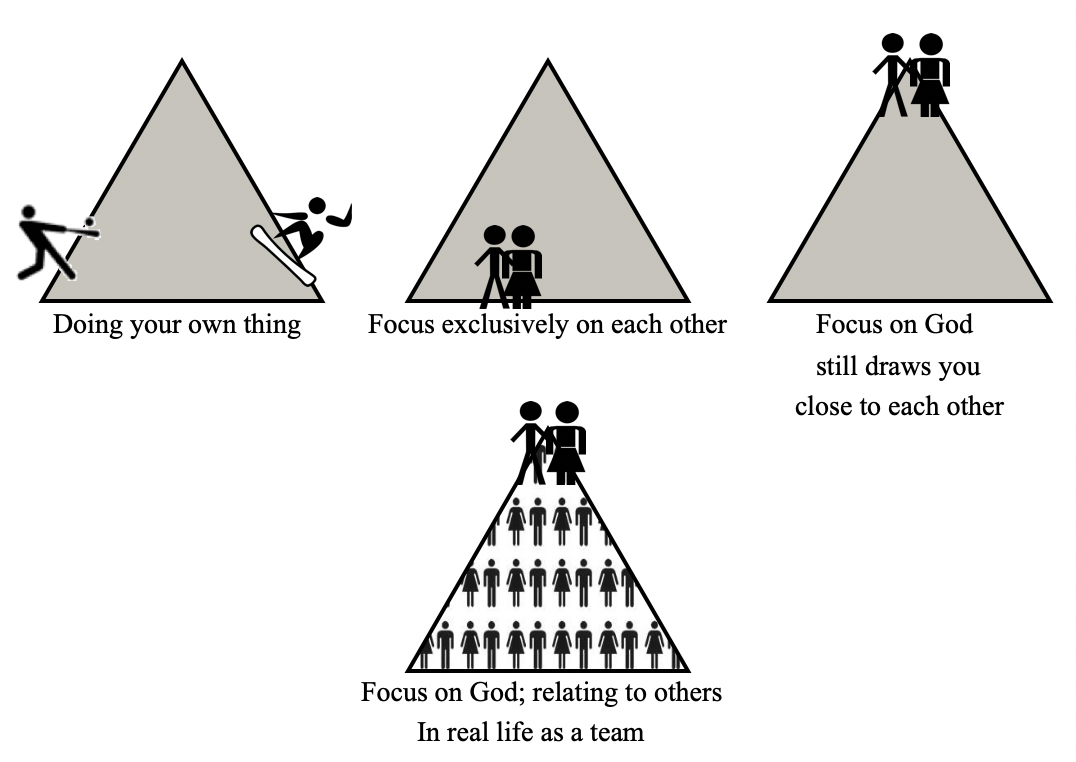
It is easy for a betrothed couple to be so lost in the wonder of love that they forget their responsibilities and their friends. But to be totally self-focused sets up patterns of selfishness that could be carried into marriage. It is wise to use at least some of the time of betrothal to jointly minister to the needs of others by continuing friendships, continued attendance at social activities, continued involvement (perhaps even jointly) in church activities and community activities. What is done during betrothal should set the tone for what is done during the rest of marriage. Your primary responsibility is to each other, but if you care for each other, you will seek to get out of your shell and continue to be part of the world around you.
Spend extra amounts of time with each other
Nevertheless, the previous point needs to be balanced with the fact that your most important relationship is your fiancé. You should step back from some of the responsibilities that you have to ensure that you have enough time to prepare for the wedding, minister to each other, and romance each other. What is true for the first year of marriage (Deut. 24:5) should also be true for the time of betrothal (Deut. 20:7). Scripture says,
When a man has taken a new wife, he shall not go out to war or be charged with any business; he shall be free at home one year, and bring happiness to his wife whom he has taken.
– Deut. 24:5
And what man is there who is betrothed to a woman and has not married her? Let him go and return to his house, lest he die in the battle and another man marry her.
– Deut. 20:7
Both Jeremiah 2 and Hosea 2 imply that those who are betrothed spend a great deal of time together. Parents and friends should be sensitive to this need and not make as many demands upon their time as they used to.
Make sure God is the foundation and goal for all that you do
Finally, make God the foundation and goal for all that you do. It is very easy to become so wrapped up in each other during betrothal that God becomes excluded from your thoughts. But if God is to bless your relationship, He must be at the center of all.
It is my prayer that this would be a time of joy and not of undue stress. Look to the Lord, your Joy-Giver, throughout the process. As pictured on the following triangle, the closer you draw to God, the closer you will draw to each other. You do not want your time before and after the wedding to be so focused on each other that you remain distant from the Lord who alone can build a house that will last.