5. Maintaining Purity
General Biblical Guidelines
Miscellaneous commands
The whole process, all the way through to marriage, must be traversed with absolute sexual purity and with integrity of heart. The following Scriptures should be foundational for those who are seeking a spouse:
Flee sexual immorality.
– 1 Cor. 6:18
Flee also youthful lusts.
– 2 Tim. 2:22
…make no provision for the flesh, to fulfill its lusts.
– Rom. 13:14
It is good for a man not to touch a woman.
– 1 Cor. 7:1
Do not arouse; do not stir up [sexual] love before its time.
– Song 2:7; 3:5; 8:4 in NAB
For this is the will of God… that each of you should know how to acquire his own spouse in sanctification and honor, not in passion of lust, like the Gentiles…
– 1 Thes. 4:3-4
Of course, many godly men and women have found these admonitions even more difficult to keep during the days leading up to marriage. This makes it all the more troubling that so many books advocate an approach to seeking a spouse that almost guarantees failure on these issues.
The question of this chapter is, “How can one express the ‘love of your betrothal’ (Jer. 2:2) and remain ‘betrothed to one husband… as a chaste virgin’” (see 2 Cor. 11:2)? The goal of parents is not only to get their children to the marriage as virgins, but to keep them chaste in spirit and body the whole way. It is clear that betrothed people were supposed to relate to each other in strict “righteousness,” “justice,” and “faithfulness” (Hos. 2:19-20; Jer. 2:2; see also Deut. 22:15,17,20; Matt. 1:19), yet still get to “know” each other in “lovingkindness” and “devotion” (Jer. 2:2; Hos. 2:19-20). Paul expresses the heart of many parents when he tells the church, “For I am jealous for you with godly jealousy. For I have betrothed you to one husband, that I may present you as a chaste virgin to Christ.” The jealousy of a parent for his daughter’s purity is important. But though Jews expected a chaperoned accountability, God implies that there could be a degree of privacy for the couple to share their hearts with each other at least during the betrothal stage (Jer. 2:2). This chapter will deal with general and specific principles related to purity during a season of discussion and betrothal. When implemented, these principles will continue to guard the hearts of couples throughout their marriage.
1 Thessalonians 4:1-8 – How to acquire a spouse
1 Thessalonians 4:1-8 is an important passage that gives instructions to every believer (“each of you”) on “how to acquire his own vessel [wife] in sanctification and honor.”64 These instructions do not merely constitute wise advice from a man. They carry full apostolic authority (“we urge and exhort in the Lord Jesus” - v. 1) and they reflect the moral authority of Jesus Christ Himself (“commandments we gave you through the Lord Jesus” - v. 2). Paul insisted that anyone “who rejects this does not reject man, but God, who has also given us His Holy Spirit.” (v. 8). So these issues are not legalistic additions to the Bible, but are Biblical blueprints designed for God’s honor (v. 1 – “to please God”) and our good (v. 6-7 – “because the Lord is the avenger of all such…God did not call us to uncleanness, but in holiness.”). In this passage Paul lays out the following rules to maintain purity while acquiring a wife:
First, Paul commands “that you abstain from sexual immorality” (v. 3). “Sexual immorality” is any sexually stimulating contact outside of marriage. As the Song of Solomon makes clear, sexual contact must be defined much more broadly than simply intercourse.65 It includes any kisses, touch, talk, dancing, or actions that lead either party to be sexually aroused. Proverbs contrasts the righteous sexual arousal (“enraptured”) caused by a wife’s kisses, arms, and breasts with the sinful sexual arousal (also “enraptured”) caused by a seductress’ kisses and the embrace of her arms (Prov. 5:1-23). Sexual immorality includes any and all of the foreplay that arouses sexual desires. This command cannot be taken for granted because even among mature believers, fornication is a very real danger if the following rules are not followed.
Second, Paul commands believers to be totally set apart to the Lord in their relationship (“in sanctification” vv. 3-4). To be set apart means to be separated to the Lord from the world’s ways of doing things.
Third, Paul calls every man to “acquire his own wife in… honor” (v. 4). Anything that would dishonor this woman must be avoided. A good question to ask is, “Would I be embarrassed by what I did to her if she later married someone else?”
Fourth, during this stage when you are seeking “to acquire a wife,” do not arouse the “passion of lust” (v. 5). Note that this verse doesn’t just forbid the couple from fulfilling the passion of lust (i.e., sexual fulfillment by intercourse); it forbids the passions of lust from arising in the first place. Anything that arouses these passions must be scrupulously avoided. To fail to do so is to play with fire. Paul will reinforce this command again in 1 Corinthians 7:1 by ruling out all touch that “ignites the fire” of sexual desire. Because of the strong temptations to rationalize, it is helpful to note that kisses (Song 1:2), hand under head (Song 2:6), petting (Song 5:4-5), and embraces (Song 1:3; 2:6; 8:3) can definitely be sexually arousing. If the mind and heart are not guarded, even innocent things like the beauty of feet (Song 7:1), “the curves of … thighs” (Song 7:1), “tresses” of hair (7:5), privacy (Song 1:4), ornaments (Song. 1:10-11), perfume (Song 1:12; 3:6; 4:10), eye to body appreciation (Song 4:1-8; 5:11-16), hand to head contact (Song 2:6; 8:3), leaning on each other (8:5), a right handed embrace (Song 2:6), and gazing into the face (Song 2:14) can be a temptation as well. The mind is a powerful thing, and as we will see, setting up rules like the Muslims do will not solve the problem. The heart itself must be guarded by God’s grace so that we “make no provision for the flesh, to fulfill its lusts” (Rom. 13:14). This book is not seeking to lay down a list of appropriate and inappropriate touches (which may be different from couple to couple). Rather, it is encouraging couples to avoid all sexually arousing touch until marriage. It is not a formula, but a principle of living. Formulas let you down, whereas principles of gracious living apply to every circumstance.
Fifth, we should not imitate the way the world gets a spouse: (“not in the passion of lust, like the Gentiles who do not know God” v. 5). Robert Andrews has unwittingly failed on this point by using a secular model of sexual progression to define his view of courtship. (More on that below.) God has his own blueprints in the Bible, and we need to turn to those.
Sixth, Paul commanded every believer to not “take advantage of” the person whom he is considering for marriage. Just because one person is not aroused by physical touch does not mean that the other partner will not be. Sensitivity to the holiness of the other person must be heightened. Again, what is proper must be defined by the Bible, not by culture. Andrews should exegetically show that the kinds of touch he is advocating are all proper.
Seventh, the man who is seeking to acquire this woman must make sure that he does not “defraud his brother in this matter” (v. 6) of passions. There are differences of view as to whether the person defrauded is the woman’s father or the woman’s future husband, but since the defrauding has to do with sexual passions (which only a future husband has a right to), I believe that it is the future husband who is defrauded. The point of the passage is that with respect to “this matter” of sexual passions, the suitor must not take what is not yet his to take.66 John Thompson states: “But who is this brother that is being defrauded? It can only be the woman’s future spouse!” Leon Morris agrees: “The future partner of such a one has been defrauded…. It reminds us that all sexual looseness represents an act of injustice to someone other than the two parties concerned.”67 Until a person is totally committed in betrothal, anything he is doing to this woman is potentially being done against another man. So don’t relate in any way to this woman that you would regret if you didn’t end up marrying her. This defrauding is not limited to sexual intercourse. We know this for two reasons: first, Verse 6 says that even though others may not find out, God will know and avenge.
Second, The phrase “this matter” indicates that Paul doesn’t want the “passion of lust” robbed from the future husband because sexual desire (“passion”) is the right of the husband and wife alone. This means that any use of each other that arouses sexual desire is taking something that belongs to the future spouse alone. Therefore this phrase rules out most forms of dating because of the sexual feelings and romantic attachments that are taken from each other.
Obviously, once betrothal has happened, the previous point does not apply to the same degree that it would before betrothal (the couple are pledged to be married, and nothing but a divorce could separate that). But even though betrothal is the time of developing romance and giving the heart away (see Jer. 2:2 - “The love of your betrothal.”), it is still a time when sexual purity must be maintained (“I will betroth you to me in righteousness… I will betroth you to me in faithfulness” – Hos. 2:19-20). A betrothed woman must be able to be presented by the parent to the husband as a chaste virgin (2 Cor. 11:2).
Paul anticipates the flippancy of some who think that stolen kisses are no big deal by warning us that this is indeed a serious matter: “because the Lord is the avenger of all such, as we also forewarned you and testified… Therefore he who rejects this does not reject man, but God, who has also given us His Holy Spirit.” (v. 6). Failure to keep these rules will almost guarantee failure. Paul knows human weakness, and he knows how easy it is for us to rationalize our compromise of the commands of God.
Eighth, we are to avoid all “uncleanness” in our relationship (v. 7). This would involve not just sexual intercourse, but any sexually stimulating actions.
Ninth, we are to actively pursue holiness in the relationship (v. 7). This gives the whole time a God-centered focus.
1 Corinthians 7:1 – Premarital touch
1 Corinthians 7:1 says, “It is good for a man not to touch a woman.” Some commentators take the phrase “touch a woman” as a euphemism for “to marry a woman,” and agree with the NIV paraphrase (“It is good for a man not to marry”), teaching that Paul was strongly recommending against marriage. This would make verse 1 a parallel to verse 26. While this is a possible interpretation, there are several arguments that stand strongly against it.
First, this appears to contradict Paul’s words in the very next verse where Paul commanded the Corinthians, “let each man have his own wife, and let each woman have her own husband” (v. 2). Why would Paul command (the Greek is in the imperative) something that he has just said is good not to do?68 That seems like an extremely awkward way to argue his point.
Second, the Greek word for “touch” has sexual connotations, and is not a synonym for “marry.” Its primary meaning is to cause burning to take place, to light a fire, or to kindle a fire. The derivative meanings are to have close physical contact, to cling to, to touch intimately, or to have sexual contact.69 Though the word “touch” could have non-sexual connotations (and often does), it frequently referred to any kind of physical touch that would ignite the flames of passion. But in the ancient world the full phrase, “to touch a woman,” referred to some kind of sexually stimulating contact with a woman, whether within marriage or outside of marriage.70 The straightforward meaning of the term has caused some commentators to take it as an encouragement for married people to abstain from sexual relations. However, this too violates the context, which immediately calls for regular sexual relations within marriage (vv. 3-5). Why say that it is good to abstain from sexual relations within marriage and then immediately command every married couple to engage in regular sexual relations and to not deny one another (v. 7)? Though this interpretation takes the correct meaning of the term, it fails to apply it to the right people – singles.
Third, the context itself confirms that Paul was calling upon Christians to avoid any touch prior to marriage that would arouse sexual desires. The kind of touch he was talking about was always immoral outside of marriage (v. 2a) yet was commanded inside of marriage (vv. 2b-5). What kind of touch would be considered “sexual immorality” before marriage, but would be considered an obligation after marriage? It is a touch that renders the Biblically commanded “affection due” to a spouse (v. 3), any touch that demonstrates authority over the other person’s body (v. 4), and any touch that relates to sexual hungers (implied in “lack of self-control” – v. 9). The implication is that the fiancé in verses 25-40 does not yet have authority over the other person’s body (cf. 2 Cor. 11:2). The lady remains under her father’s protection until marriage (vv. 36-38). The further implication is that they should indeed deprive one another of their sexual desires prior to marriage (the opposite of v. 5), they should show self-control (vv. 5b, 9) and they should not “burn with passion” (v. 9). In context Paul is ruling out sexual touch or anything that arouses sexual desires.
The previous considerations rule out three interpretations: First, Paul was not promoting the single life. Instead, he was commanding marriage as the norm for “each man” and “each woman” (v. 2) just as Genesis 2 did. This conclusion is supported by the fact that Paul later considered any prohibition of marriage to be a doctrine of demons (1 Tim. 4:1-3) that was completely contrary to his normal desires (“I desire that the younger widows marry, bear children…” – 1 Tim. 5:14). It is also supported by a close analysis of Paul’s arguments in the rest of the chapter which show that marriage was the norm while singleness was only temporary advice that applied during “the present distress” (v. 26).71
Nor was Paul promoting abstinence within marriage. This ascetic interpretation flies in the face of the sexual imperatives in verses 2-5, the language of obligation in verse 3 (ὀφειλομένην = to owe something; ἀποδιδότω = to pay something due), the issue of authority/lack of authority in relation to their bodies (v. 4), and the moral dangers involved in long abstinence (v. 5). This interpretation is foreign to Paul’s thought.
Nor is Paul ruling out all touch of women before marriage (as some Christians have taught). For example, Paul is not referring to the kind of touch that a man would have for his sister. 1 Timothy 5:2 admonishes us to treat “younger women as sisters, with all purity.” Certainly some forms of brotherly/sisterly touch might become inappropriate if they began to enflame passions, but the prohibition in verse 1 is not a prohibition of all touch, but a prohibition of any touch that might stir up sexual desires.
The bride of Song of Solomon gives sound advice to the virgins of Jerusalem when she charges them: “Do not arouse, do not stir up love before its own time” (Song 2:7; 3:5; 8:4 in NAB). The love that is being stirred up is sexual love. Certainly “it is better to marry than to burn with passion” (1 Cor. 7:9), but it is better to not start those sexual fires in the first place through touch (v. 1). God’s will for couples seeking marriage is to “flee sexual immorality” (1 Cor. 6:18) and to “flee also youthful lusts” (2 Tim. 2:22). He calls them to “make no provision for the flesh, to fulfill its lusts” (Rom. 13:14).
A Detailed Study and Interaction With an Alternative View
Now that we have laid down the general principles, it is time to analyze in detail what this looks like. I will be using Robert Andrews’ book, The Family: God’s Weapon of Victory, first edition, as a foil with which to interact with mistakes people have made in both form and freedom. I am using his book as a foil for three reasons. First, because two chapters in the book have led a number of people into needless stress and even sin. This is because Robert Andrews has neglected key elements of Biblical form and has consequently misinterpreted the true nature of freedom. The second reason I am using his book as a foil is because Andrews’ book is the best book that I have read on the subject of family and comes very highly recommended by me. I would like people to have the needed corrections to the book so that they can benefit from the rest of what he had to say. The third reason I am using his book as a foil is that it brings up all the issues that need to be discussed in this chapter: issues of “love at first sight,” gazing into one another’s eyes, romantic talking, holding hands, deep communication of vision, hand around the waist or shoulder, and kissing. It is my hope that people will benefit from both his book and from my interactions with it. My goal is for the body to grow by means of iron sharpening iron.
The Primary Areas of Disagreement with Robert Andrews
The chapters where the most problems can be found in Robert Andrews’ book are chapters 15 and 18. In chapter 15 I especially take issue with the following sections: “Get me to church on time – the sexual progression,” “Steps to Oneness,” “The total package,” and “Sexual progression summary.” In chapter 18 I especially take issue with the following sections: “Establishing a courtship relationship,” “During courtship,” and “Engagement!”
Though he describes steps 4-12 of his “steps to oneness” as being “sexual” in nature, he believes that steps 4-6 are appropriate in courtship and that steps 7-9 are appropriate in engagement. The three “sexual” steps he allows during “courtship” are holding hands, arm to shoulder contact and hand to waist contact. The three steps that he approves of for engagement are mouth to mouth kissing, hand to head contact and eye to body perusal. He believes the twelve steps outlined are the normal, sequential steps that should be taken in a healthy relationship.
There are three problems with this approach. The first is that Andrews does not seek to justify his “steps to oneness” from Scripture. Nor does he seek to define each step by Scripture. Instead, Andrews has simply adopted a secular sociological model established by Desmond Morris, a zoologist/anthropologist. It is “man’s wisdom,” not the wisdom of God.
Second, this is a formulaic approach to finding a spouse that is not sensitive to great differences that occur among individuals. While it is true that one couple may find holding hands to not in any way arouse sinful desires, another couple may react quite differently and stumble into sin by using these steps. The Bible’s approach does not try to push everyone through the same formula. Instead, it provides principles which must be applied by the Spirit’s help to unique people and unique circumstances. Formulas tend to lead to immaturity because there is no need to think, apply Scripture or seek the Spirit’s wisdom - you just apply the formula. But formulas also have a tendency to lead to either legalism or moral failure. They can lead to legalism if a person insists that each of these steps is necessary to achieve a godly marriage (when Scripture does not insist on any of his “pre-marital” steps). On the other hand, it can lead to moral failure if a person feels pressured to kiss or engage in other body contact that would turn him/her on sexually. As we will see, the Bible requires wisdom to avoid sin, not formulas.
Third, it is disconcerting that Andrews would view any sexual touch as appropriate prior to marriage. We have already demonstrated that when Paul said, “It is good for a man not to touch a woman” (1 Cor. 7:1), he had in mind all touch that ignites sexual arousal. Andrews believes that six of the nine “sexual” steps are appropriate prior to marriage. He says, “Sex is not intercourse alone. Sex is the total package, beginning with holding hands.” (p. 204)
But this last statement brings up a fourth objection. I am not convinced that his characterization of what is sexual and what is not sexual is accurate in all situations. For example, on steps 1-3 Andrews says, “At this point, little if any bonding has occurred. Either or both parties can stop the relationship because the sexual progression has not begun.” However, his comments after steps one and two belie this: “Where have I been?” “Their eyes meet. There is magic in the air.” As we will see in the next section, even these steps can be sexually intoxicating given the right people, the right circumstances and the right frame of mind. On the other hand, is it always true that “hand to hand” contact is “the first ‘sexual’ contact” (p. 203)? I think these issues need to be defined Biblically, which we will now seek to do.
It is more complex than Andrews’ formula shows
Andrews rightly admonishes his readers to “flee sexual immorality” (1 Cor. 6:18) and to “flee also youthful lusts” (2 Tim. 2:22). He calls them to “make no provision for the flesh, to fulfill its lusts” (Rom. 13:14). Those are great admonitions. However, it is foolish to think that only steps 10-12 would make provision for the flesh. Steps 10-12 are so obviously wrong for an unmarried person that we would agree with Andrews’ assessment that they are only appropriate to marriage.72 Andrews lists steps 10-12 as 10) hand and mouth to breast, 11) hand to genital and 12) genital to genital. But Song of Solomon indicates that in the right context all twelve steps (and many more) can be intoxicatingly erotic. Song 6:5 says, “Turn your eyes away from me, for they have overcome me.” His very gaze was intoxicating her with sexual desire. This is not to say that every look from her husband had that effect, and it would be legalistic to say that betrothed couples may not look at each other at all. But we need to recognize that even a look can go too far. Scripture cautions us, “Do not arouse, do not stir up love before its own time” (Song 2:7; 3:5; 8:4 in NAB). It is saying that anything that stirs up sexual love before marriage should be avoided, whether it is physical or not. Sexual love is “like flames of fire” (Song 8:6) and “many waters cannot quench love” (Song 8:7). To get the fires of sexual desire started is a dangerous thing. You simply cannot start down the slippery slope of any sexual touch without violating Song 2:7; 3:5, and 8:4.
However, avoiding sin in our romance is more complex than simply setting up a legalistic set of rules. Some Muslims have sought to avoid sin by covering their women head to toe and avoiding all physical contact prior to marriage. Scripture does set guidelines and hedges in place, but it does not see all non-sexual sight and touch as inappropriate. How do we define what is and is not sexual? Anything can have the potential of being sexual during a romantic betrothal. But this does not mean that we are to avoid meeting together. On one occasion, a glance at the feet or hips would not stir up sexual passion, but in the right situation Solomon confesses that the beauty of feet and “the curves of your thighs” (Song 7:1) was intoxicating and “the king is held captive by your tresses” (7:5). That is certainly sexual language. Likewise a kiss (Song 1:2; 4:11; 5:13,16; 7:9; 8:1), privacy (Song 1:4), ornaments (Song 1:10-11), perfume (Song 1:12; 3:6; 4:10), eye to body appreciation (Song 4:1-8; 5:11-16), hand to head contact (Song 2:6; 8:3), leaning on each other (8:5), a right handed embrace (Song 2:6), gazing into the face (Song 2:14), embracing chest to breast (Song 1:13), as well as the obvious examples of steps 10-12 are all capable of quickly leading to the final act of love.
Couples need to guard their hearts by not putting themselves into situations where innocent acts could easily lead to guilty acts. Given the right circumstances, Solomon confessed to his wife that even “one look of your eyes” has “ravished my heart” (Song 4:9) and a “link of your necklace” had the same effect. I use these illustrations to point out that even what might be permissible in some contexts for a betrothed couple could lead to sin in other contexts. This requires personal maturity on the part of the couple, not simply formulaic rules. Only those who “walk in the Spirit” will “not fulfill the lust of the flesh” (Gal. 5:16). A set of rules will not fix the problem. Such a couple might need to back away from even innocent things should their hearts begin to be ravished. Any touch that amounts to “foreplay” violates the command to not defraud (1 Thes. 4:6). It is also making provision for the flesh, to fulfill its lusts (contrary to Romans 13:14).
The good and the bad of the twelve steps
Let’s consider each of the twelve steps that Andrews lists and try to discern the liberties and cautions that the Scriptures set before us.
Step 1 – Eye to person. He notices her across a crowded room. “Where have I been?” he says.
This eye to person contact could have quite a wide range of meaning from negative (stare, leer, peek, gape, oggle, undress with one’s eyes, longing eyes) to neutral (notice, glance) to positive (observe, recognize, watchful). Obviously the maturity of the heart will dictate whether this step violates Matthew 5:28 or whether it is a godly observation such as Boaz had of Ruth (Ruth 2-3). Boaz’s objective analysis of Ruth’s marriageability is a very good example of this step being useful. However, it would be legalistic to say that this step is necessary. Many good marriages have been contracted via a mail romance with eye to person contact not being made until late in the game. Isaac and Rebekah didn’t see each other till their wedding day (Gen. 24:64-67). It would be legalistic to insist that this be a needed step for a Biblical marriage to take place. It may be preferable for any given couple, but not necessary.
A further observation that needs to be made is that it is naïve to say that this step cannot be sexual. Judges 14:1 shows that Samson fell into sin at this first step. Judah contracted a bad marriage because his heart became committed at this very first step (Gen. 38:2). One of the reasons for parental supervision and involvement (see below) is because it is hard for people to be completely objective. However, single men and women must guard their hearts and make sure that they do not allow their hearts to be given away prematurely. For example, it is clear that the eye to person contact in Song of Solomon 4:1-8; 5:11-16; and 7:1,5 is descriptive of a person who has completely given his or her heart away to the other person. As such, it would not be appropriate to a person considering marriage since one needs to guard against stirring up love before it’s time (Song 2:7; 3:5; 8:4) or committing one’s heart before he or she had evaluated whether the other person meets the Biblical qualifications. The point of this discussion is that formulas do not show the complexities of life.
Step 2 – Eye to Eye. Their eyes meet. There is magic in the air!
While there is nothing wrong with eye-to-eye contact prior to intentions being stated (it is inevitable), we need to recognize the naiveté of thinking that eye-to-eye contact is always non-sexual. Proverbs 6:25 speaks of the power of a prostitute’s eyes – “Do not lust after her beauty in your heart, nor let her allure you with her eyes.” If it is possible to give your heart away to a prostitute because of eye-to-eye contact, even a godly man and woman can give their hearts away without intending to. Think of the intoxicating power of the godly bride’s eyes in Song of Solomon 4:9. The husband says, “You have ravished my heart, my sister, my spouse; you have ravished my heart with one look of your eyes.” Does this mean that there should be no eye-to-eye contact before marriage? Of course not. Legalistic rules do not provide for solid marriages. But when “magic is in the air” (as Andrews words it) we must immediately guard our heart sufficiently to investigate the character, worldview, calling and other fundamental issues that are foundational to a good marriage. It is hard to reason objectively without such caution.
I am not saying that God cannot make people romantically “fall in love at first sight.” But neither is it the foundation for a godly marriage. This appears to be what happened with Jacob and Rachel (Gen. 29). And interestingly, it appears to be the eyes that made the heart connection with Rachel and it was the eyes that made him not attracted to Leah – “Leah’s eyes were weak, but Rachel was beautiful of form and appearance” (v. 17). So I am not disagreeing with Andrews when he says that this is often a step in romance. But we need to recognize the power of this step and not treat it as inconsequential. Many a man is committed by step two without having done any of the Biblical steps of evaluation first.
While this step does not mention the communication that happens with other facial expressions, this non-verbal communication can be quite powerful. Consider the myriad ways that the face can communicate without saying a word: grinding his teeth, her face grew pale, he blushed, his face turned red with anger, radiant, beaming, interested, frown, smile, grin, pursed lips, knitted brow, worried look, bemused, puzzled, expressionless face, glower, chin jutting out, clenched jaw, gaped, “her mouth fell open,” “he had a determined look on his face,” “her face grew soft,” serene face, troubled face, tight lipped, joyful, bedraggled, tousled, flustered, shocked, pleased, proud look, despise, look down on, snarl, “curled his lip,” sneer, “the lights went on,” “her face became clouded,” astonished, friendly, cruel, aloof, poker face, bored. Obviously, most of these words do not relate to finding a spouse, but evaluation of a person’s character should sometimes take into account non-verbal communication.
Step 3 – Voice to voice. This is a get-acquainted time as the couple gets to know one another. There are no overt sexual overtones. This step occurs in a group setting.
Obviously hearing each other speaking in a group setting can be a wonderful way of evaluating other people in a relaxed way. However, this too takes maturity so as not to use deceit and flattery to make an impression. Often, those who are “fishing for a mate” can come across differently when talking with someone that they are interested in than they might with others. But this is where many different kinds of group settings can be helpful in seeing the real person (church fellowships, work events, hospitality, political events, etc).
However, in this list of developing oneness, voice-to-voice communication should have been included under the previous sections about a time of discussion and betrothal as well. This is true for two reasons: First, it is imperative that Christian young people discuss such issues as worldview, doctrine, values, presuppositions, calling, passions, etc. long before their hearts begin to romantically bond. The purpose of a time of discussion is not romantic bonding, but finding out if the other person is really qualified to be a spouse.
The second reason is that betrothal is a great time to practice romantic communication that is not sexual in nature. Many a married woman wishes that her husband knew how to be endearing without feeling like such words will always be the prelude to sexual touch. Quality time and encouraging words are needed throughout marriage, and the time of betrothal is a great time to practice such voice-to-voice communication unhampered with sexual agendas. It will develop habits and patterns of speech that will strengthen a marriage later. In fact, it is one of the main purposes for betrothal. The time of betrothal is a time of preparation for marriage through non-sexual communication, endearment, planning, and service.
Having agreed that voice-to-voice communication need not be sexual, we should not be so naïve as to think that words cannot begin to lead a person down a slippery slope into sin. They can. The book of Proverbs not only warns people about non-verbal seduction, but warns about the “seductress who flatters with her words” (Prov. 2:16; see 6:24; 7:5), whose “mouth is smoother than oil” (Prov. 5:3), and who can smoothly rationalize sin with her speech (Prov. 30:20). It is not simply seductive kissing that makes “the mouth of an immoral woman a deep pit” (Prov. 22:14), but also the communication that comes from that mouth. Communication is complex and requires the grace and wisdom of the Holy Spirit to keep it godly. Not even all non-sexual talk is appropriate between those who are not courting with parental approval.
Step 4 – Hand to hand. “We are a couple.” They have decided to continue the progression. This is the first “sexual” contact.
There are at least four problems with the way Andrews has worded this: seeing any sexual contact as being appropriate prior to marriage, seeing any “progression” of sexual contact prior to a commitment (betrothal) being made, seeing all hand-holding as involving sexual contact, and making hand-holding an expected thing during courtship.
I am first of all amazed that Andrews would allow for any “sexual contact” prior to marriage. If (for the sake of argument) we were to agree that holding hands was sexual in nature, then 1 Corinthians 7:1 would rule it out. Any “touch” that kindles sexual desires before marriage is considered “sexual immorality” (1 Cor. 7:1-2). Scripture admonishes us to “flee youthful passions” (2 Tim. 2:2 ESV), not to play with them. Though this book does not say that people should avoid holding hands before marriage, we should not be naïve about the power of touch. In the illustration that Andrews gives, “She finds the touch of his hand to be an almost erotic experience.”73
Second, to give allowances for a progression on the sexual scale (as his whole paradigm does) is also dangerous. Andrews describes the progression from the first sexual touch to the next:
When he holds her hand, both notice the level of excitement is considerably lower than it was the first time. The sexual law of diminishing returns is now operative: There must be deeper, more intimate physical contact to receive the same stimulation as the previous sexual encounter produced.74
Once a person starts to give in to actions that pique sexual desire, the sexual desires continue to grow stronger and stronger in a slippery slope that drives irresistibly towards coitus. Paul did not speak of easing one’s way into sexual progression, but rather said, “make no provision for the flesh, to gratify its desires” (Rom. 13:14 ESV). One should stay as far away from the sexual “progression” as he can. Later in this book I will distinguish between sexual romance and non-sexual romance.
This brings up a third objection. I think we are going beyond the Bible if we insist that all hand-holding is sexual in nature. If it was, it should be avoided prior to marriage. And some couples will have to avoid holding hands if they are to make no provision for the flesh. But they should not make rules for others regarding holding hands if the Bible has not made such rules. And this highlights the difference between following principles and following paradigms. The principle is that we should not engage in any touch that arouses sexual feelings. This might mean quite different things for different people. Indeed, it might entail becoming more strict as one goes further into betrothal. A paradigm puts everyone through the same experience (making some fall into sin and causing others to miss legitimate romance). Parents often feel, “If it was good for me, it should be good for my children.” But your children may have greater vulnerabilities to lust than you did. It is much better to give the principle – “Make sure that you seek to guard your hearts during courtship. Make sure you guard your sexual desires during betrothal and avoid anything that stirs them up.” It is quite conceivable that a woman might be able to hold hands with no kindling of the sexual desires while her fiancé is not able to do so. She needs to be sensitive to his weakness and not push the issue. It is quite conceivable that both are able to hold hands at the beginning of their betrothal, but as time passed, it became a temptation to sin. Only the individual can know those boundaries and avoid them. A rule will not achieve the same thing. I am not saying that a couple cannot make stricter rules for themselves because of the dangers that they feel, but in this section I am trying to avoid legalism. Scripture indicates that holding hands can be a sign of affection with absolutely no sexual intimation, as children holding hands with a mother (Is. 51:18) and God holding our hand (Ps. 73:23; Is. 41:13; 42:6). There can also be other reasons for holding a person’s hand. Jesus drew Peter’s mother-in-law to her feet by the hand when he healed her (Mark 1:31), as He did another unmarried girl (Matt 9:25). Peter did much the same with Tabitha (Acts 9:40-41). So there is at least a theoretical possibility that a betrothed couple could express their affection for each other through holding hands.
But neither would I want to insist that this should be a normal part of the process of deciding whether to marry or for betrothal, as Andrews does. I see no requirement for it in the Bible. The Bible indicates that parents should not press their children to do anything that might cause them to stumble (Mark 9:42; 1 Cor. 8:13; 2 Cor. 11:29). Instead, they should encourage their children to apply the universal principles in a way that will keep them pure all the way until marriage (2 Cor. 11:2).
Step 5 – Arm to shoulder. This is the first signal that “I want to protect you.”
The fifth step that Andrews recommends is “arm to shoulder” contact. He says, “This is the first sign that I want to protect you.” But is she his to protect during this time? Second, is it premature for him to pull her to his side prior to her father giving that permission? Based on our definition, this is the period to try to decide whether they are to be married at all, so why would the man presume to affirm this kind of belonging? Until the father gives permission to marry (as, for example, in betrothal), she is not his to protect.
The second problem I have is that “arm to shoulder” could mean different things. This could be a greeting that one would give to a mother or sister (see 1 Tim. 5:2). Or it could be a quick, innocent expression of love and affection that would be appropriate to betrothal. Or it could be a more sensual and prolonged touch that leads to sexual arousal. So even if this step were applied to betrothal, it would have to be qualified. It is unfortunate that Andrews believes that physical contact of some sort is necessary for a budding romance to be “alive and well.”
Step 6 – Hand to waist. At this stage of vision, deeply held beliefs, values, and life goals are shared. This is an opportunity to know one another rather intimately without sexual pressure.
The sixth step that he gives is hand to waist. He states,
At this stage vision, deeply held beliefs, values, and life goals are shared. This is an opportunity to know one another rather intimately without sexual pressure.
This hand to waist contact does not flow from a commitment to the woman since there is still a “chance to get out of this relationship without someone being seriously hurt.”75 But if these steps are truly part of “a slippery slope to intercourse” as Andrews affirms, 76 I fail to see why he would advocate getting onto the “sexual progression” at all, let alone before there is a commitment. Furthermore, what the hand to waist has to do with vision, deeply held beliefs, values and life goals, I fail to see. The second sentence seems to be more the driving reason for putting the hand to the waist – deeper physical intimacy. But the problem once again is that this season is not the time for intimacy, but the time for discovering whether they are to be married in the first place. I see this as a form of embrace. Ecclesiastes 3:5 tells us that there is a time to embrace and a time to refrain from embracing. 1 Corinthians 7:1 indicates that any time that embracing leads to sexual arousal prior to marriage, it is not the time to embrace. Song of Solomon indicates that any time that it arouses sexual love before its time, it is inappropriate.
Step 7 – Face to face (mouth to mouth). Kissing occurs for the first time. Much time seems to be spent gazing into each other’s eyes. Care must be taken as the motor is now running. The wedding had better be approaching.
Step 7 takes place during betrothal on Andrews’ plan. Two of the things that Andrews allows at this stage can be highly erotic: gazing for prolonged times into each other’s eyes and kissing mouth to mouth. Even his definition of this stage admits that this is playing with fire. But the question comes, “Why must care be taken while kissing and gazing into each others eyes as opposed to care being taken to avoid kissing and gazing into each other’s eyes?” I want to give Biblical information on these two points because they have formed a stumbling block for so many people. But first, let me point out that Andrews himself shows how inappropriate this is simply by discussing the issue. He says,
God designed the slippery slope to end in intercourse, two people becoming one flesh. For anyone to think that he or she can stop the progression whenever they choose is foolish and naïve… Sex is not intercourse alone. Sex is the total package, beginning with holding hands. We do not hold hands with members of the same sex. Why? Because even holding hands is sexual in nature. Each step, beginning with holding hands, is designed by God to lead one step nearer the ultimate goal of sexual union.77
As a counselor I have seen many couples end up engaging in the ultimate goal of sexual union because they have caved into social pressure to engage in the previous steps. It is foolish. God tells us to “flee sexual immorality” (1 Cor. 6:18) and to “flee also youthful lusts” (2 Tim. 2:22). He calls us to “make no provision for the flesh, to fulfill its lusts” (Rom. 13:14). He clearly tells us not to touch each other in any way that will ignite the fires of sexual desire (1 Cor. 7:1). We are to avoid being on the slippery slope altogether because it is almost impossible to put the brakes on once you are heading down the slippery slope. As Andrews himself notes, “It is impossible to overemphasize the power of the sex drive when it is unleashed. Whatever starts the sexual engine must be avoided if purity is the goal.”78 Much of what Andrews says elsewhere does promote purity, but he is sending mixed messages with chapters 15 and 18.
Gazing into each other’s eyes for prolonged periods
The eyes are the windows of the soul. As such, they are vehicles of communication that are profound. A couple with pure hearts can look into each other’s eyes with no problem, but this gazing can very quickly and suddenly lead to arousing sexual desires. Song 6:5 says, “Turn your eyes away from me, for they have overcome me.” The person in this passage is experiencing the intoxicating desires that locked eyes can produce. On the other hand, loving looks should not be forbidden completely. Each couple will need to distinguish through mature dependence on the Spirit where their hearts are.
Kissing mouth to mouth
Though a kiss is also a kind of touch, and should be evaluated according to the principles given above, it might be useful to see what the Scripture says about kissing. It must be admitted that not all kissing of the opposite sex is wrong. For example, the whole church is admonished to “greet one another with a holy kiss” (Rom. 16:16; 1 Cor. 16:20; 2 Cor. 13:12; 1 Pet. 5:14). While the early church interpreted this admonition as applying women to women and men to men, the text does not say so. Indeed the admonition indicates that a “holy” kiss was commanded to guard against the possibility of an unholy kiss. From this it might be easy to conclude that greeting a fiancé in the same way one greets her mother in church could be appropriate. However, as with every other ethical decision, one must not only look at the rules of Scripture, but must also analyze what the Scripture says about the inner disposition and the outer circumstances.79 The Scriptures seem to indicate that the ethics of kissing are framed not just be rules, but also by the inward heart and by the changes in the outward circumstances.
For example, Song of Solomon 8:1-2 seems to indicate that what is appropriate in respect to kissing changes as soon as there is any romantic relationship involved. It says,
Oh, that you were like my brother, who nursed at my mother’s breasts! If I should find you outside, I would kiss you; I would not be despised. I would lead you and bring you into the house of my mother, she who used to instruct me.
This passage indicates that the kind of kissing appropriate between a brother and sister would be inappropriate (“despised”) when engaged in by the couple in public. Whichever way one interprets that passage (are they betrothed or married?), it seems to at least indicate that the “who” and the “where” can change the appropriateness of a kiss. Those two factors made a kiss that was appropriate in one circumstance inappropriate in another. Thus it is not enough to look at the rules of Scripture. One must also examine the inward heart and the outward circumstances.
Another example is the situation of Jacob and Rachel. Jacob kissed Rachel when he first met her and had found out that she was a cousin (Gen. 29:11-12), but after a month passed and Laban discovered that he had grown to love her (vv. 14-19) there appears to be no more contact (vv. 20-25). This could explain the lack of recognition of Leah’s voice, kiss, body, gestures, etc.
Of course, we must be cautious about deriving norms from examples like this, but they do illustrate that circumstances change when a couple is engaged. It is the opinion of this author that kissing will almost always become sexual when engaged in by a betrothed - even if it doesn’t start that way. Any kissing that is sexual violates the principles on the former pages. However, all the Scriptural data is presented below so that the reader can make his own ethical decision on this subject:
Statistical Analysis of Kinds of Kissing in the Bible
The following list comprises a comprehensive catalogue of types of kissing in the Bible.
- Parents (or grandparents) kissing sons & daughters (Gen. 27:26-27; 31:28; 31:55; 48:10; 50:1; 2 Sam. 14:33; 1 Kings 19:20; Luke 15:20)
- Related same-sex males kissing (Gen. 29:13; 33:4; 45:15; Ex. 4:27; 18:7)
- Related same-sex females kissing: (Ruth 1:9; 14)
- Non-related same sex males kissing (1 Sam. 10:1; 20:41; 2 Sam. 15:5; 19:39; 20:9; Matt. 26:48-49; Mark 14:44-45; Luke 7:45; 22:47-48; Acts 20:37)
- Non-related, non-romantic opposite sex kissing (Gen. 29:11; Luke 7:38; Luke 7:45)
- Sexual kissing that is sinful: (Prov. 5:3; 7:13; 22:14)
- Sexual kissing that is pure: (Song 1:2; 4:11; 5:16; 7:9; 8:1)
- General invitation to greet with a holy kiss (Rom. 16:16; 1 Cor. 16:20; 2 Cor. 13:12; 1 Thes. 5:26; 1 Pet. 5:14). Though the early church interpreted this as men kissing men and women kissing women, the text does not say.
- Religious kissing of idol, etc: (1 Kings 19:18; Job 31:27; Hos. 13:2)
- Metaphorical kissing: (Ps. 2:12; 85:10; Prov. 24:26; 27:6)
Here is a breakdown of the numbers:
| Type of Kissing | # times | % |
|---|---|---|
| Parents/children kissing | 8 | 17 |
| Related same-sex males kissing | 5 | 11 |
| Related same-sex females kissing | 2 | 4 |
| Non-related same-sex males kissing | 10 | 21 |
| Non-related, non-romantic opposite sex kissing | 3 | 6 |
| Sexual kissing that is sinful | 3 | 6 |
| Sexual kissing that is pure | 5 | 11 |
| General invitation to greet with holy kiss | 5 | 10 |
| Religious kissing of idol, etc. | 3 | 6 |
| Metaphorical kissing | 4 | 8 |
| Total | 48 | 100 |
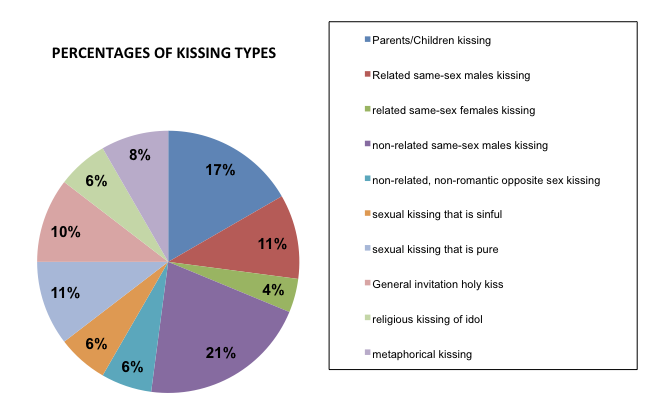
While norms cannot be gained from narrative passages (unless God or His representative is approving), there are some interesting facts that should be noted from these Scriptures. 100% of opposite-sex kisses on the mouth are described as sexually stimulating (Prov. 5:3; 7:13; 22:14; Song. 1:2; 4:11; 5:16; 7:9; 8:1). 100% of “French kissing” is connected with either immoral sex (Prov. 5:3; 22:14) or marriage sex (Song 4:11; 5:16; 7:9). Scripture warns against impurity in kissing by calling for the church to only engage in a “holy kiss” (Rom. 16:16; 1 Cor. 16:20; 2 Cor. 13:12; 1 Thes. 5:26). In my 31 years of counseling I have found that when young couples begin to kiss, they inevitably start down Andrews’ slippery slope of sexual stimulation. There is a reason why many courtship and betrothal advocates call for the first kiss to be on the day of the wedding. Kissing is described in Scripture as having an exhilarating and powerful effect upon one’s body.
Step 8 – Hand to head. This signifies complete confidence. Who do you allow to touch your head? Only those you trust completely.
There is a wide range of nuance for “hand to head.” This could be a perfectly appropriate praying of blessing upon the head of another person. This is something that anyone might do with a mother or sister, so would not necessarily be ruled out for betrothal. But Song of Solomon also describes the head in erotic ways: “His left hand is under my head, and his right hand embraces me.” (Song 2:6; 8:3). Certainly that hand to head action was highly erotic and utterly inappropriate prior to marriage. The fact that Andrews lists this under a sexual progression troubles me, but hand to head by itself would not necessarily be sexual. Once again, the Scripture’s approach is simpler and avoids legalistic rules. It simply asks all parties to honestly evaluate whether the touch engaged in kindles sexual desire. If so, avoid it.
Step 9 – Eye to body. This is not sexual in nature. “I’ve grown accustomed to the tent in which you live.”
The ninth stage that Andrews lists is eye to body perusal. Can a person notice the beauty of a woman without lust (Gen. 29:17; Esther 1:11)? Yes. Can a woman notice the beauty of a man without sin (Gen. 39:6)? Yes. Jesus was not blind. The narrators of Scripture describe the beautiful form of men and of women (Gen. 12:14; 24:16; 26:7; 29:17; 39:6; Deut. 21:11; 1 Sam. 9:2; 16:18; 25:3; 2 Sam. 11:2; 14:27; Esth. 1:11; 2:7; Job 42:15; Song 1:16; etc.). But obviously caution needs to be exercised since (contrary to Andrews’ assertion) what might be innocent one moment can become quickly lustful due to our sin nature (Matt. 5:19,28; Mark 7:21; see Gen. 39:6-7; 2 Sam. 11:2; etc.).
Andrews lists the last three steps as reserved for marriage. These steps are:
Step 10 – Hand and mouth to breast.
Step 11 – Hand to genital.
Step 12 – Genital to genital.
Scripture is quite clear that there are to be no sexual relations during betrothal (Deut. 22:13-21; Matt. 1:18-25) or any time outside of marriage. Andrews rightly sees these last three steps as only appropriate to marriage. The breasts are supposed to ravish the husband (Prov. 5:19; Song 1:13) and are inappropriate for anyone else to touch romantically (Ezek. 23:3,21). It is impossible to read the Song of Solomon without seeing that steps 10-12 are appropriate to marriage, and to marriage alone.
Having looked at these steps, we can come to several conclusions:
- The steps are not Biblical steps.
- The steps aren’t logically progressive steps. Even he seems to see step 9 as less erotic than step 7. Any step can quickly progress to any other step.
- Not all steps need to always be seen as sexual.
- It is much simpler and better to follow the general principles of Scripture and avoid anything that will arouse sexual desire and/or to back off from anything that does so. Therefore, if hand-holding is sexual, it must be avoided. If hugging is sexual, it must be avoided. If kissing is sexual, it must be avoided. If a hand around the waist is sexual, it must be avoided.
Andrews’s advice is radical in our age, but it is not radical enough. On page 204 he says,
I can hear someone saying, “Andrews, you have gone too far. Do you really believe that holding hands is sexual and should be avoided?” Yes, I do, until the appropriate time… When I gave this material many years ago a married woman came up to me afterwards. “I never thought of it before,” she said, “but when I first held hands with my husband it definitely was an erotic experience. I can see that holding hands starts the motor.
Having standards that preclude any sexual contact with members of the opposite sex until a permanent commitment is made may incur the world’s temporary ridicule, but that is a small price to pay for sexual purity, for after all, “Whoever therefore wants to be a friend of the world makes himself an enemy of God” (James 4:4).
Those are good words indeed. But the “proper time” to get the sexual motors moving is not before marriage. Paul says that the “touch” of 1 Corinthians 7:1 that ignites the fire should be reserved to marriage (v. 2). There is no gradual entering into sexual touch before marriage in these verses. There is no start down the slippery slope of no return of sexual desire. It is hard enough to keep such passions in control without fanning the flames hotter. To reiterate once again, God’s will for couples seeking marriage is to “flee sexual immorality” (1 Cor. 6:18) and to “flee also youthful lusts” (2 Tim. 2:22). He calls them to “make no provision for the flesh, to fulfill its lusts” (Rom. 13:14).
“I remember you, the kindness of your youth, the love of your betrothal, when you followed Me in the wilderness, in a land that was not sown. Israel was holiness to the LORD.”
– Jeremiah 2:2-3a
“I will allure her…and speak to her heart… I will betroth you to Me forever; yes, I will betroth you to Me in righteousness and justice, in lovingkindness and mercy; I will betroth you to Me in faithfulness, and you shall know the LORD.”
– Hosea 2:14,19-20
“I am jealous for you with godly jealousy. For I have betrothed you to one husband, that I may present you as a chaste virgin to Christ.”
– 2 Corinthians 11:2