Command Line Applications For NLP
We will use both my NLP library from a prior chapter as well as the library for using OpenAI’s GPT-5 model to write two command line utilities.
Re-using the NLP Library For a Command Line Utility to Identify Categories or Topics in Input Text
This program is a command-line utility written in Gerbil Scheme that acts as a wrapper for a Natural Language Processing (NLP) library (that we saw in an earlier chapter) to perform text classification. The script is designed to be highly versatile, capable of accepting text input either directly from command-line arguments or from a piped stream via standard input, making it a useful component in a shell-based data processing pipeline. Its core purpose is to take a block of text, send it to the NLP engine for analysis, and then extract a list of classification categories from the resulting data structure. After extracting these categories, it performs a minor cleanup operation on each one—removing a trailing .txt file extension—before printing each clean category name on a new line to the console.
The code for this example can be used interpretively using gxi or compiled into a static application.
Listing for categories.ss:
 1 #!/usr/bin/env gxi
 2
 3 (import :nlp/main
 4         :nlp/nlp
 5         :std/iter
 6         :std/misc/ports)  ;; read-all-as-string
 7
 8 (export main)
 9
10 (def get-categories (lambda (x) (map car (cadddr x))))
11
12 (def (remove-txt str substr)
13   (if (string-suffix? substr str)
14       (substring str 0 (- (string-length str) (string-length substr)))
15       str))
16
17 (def (main . args)
18   (let* ((input-str (if (null? args)
19                         (read-all-as-string (current-input-port)) ; piped stdin
20                         (string-join args " ")))                  ; argv
21          (response (nlp/main#process-string input-str)))
22     (for (s (get-categories response))
23       (displayln (remove-txt s ".txt"))))
24 )
This command line utility can either use all command line arguments, joined as a string with interleaving spaces, or text can be piped into the utility via stdin.
The core logic resides within the main function which first determines the source of the input text. The (if (null? args) …) expression is a standard idiom for a command-line tool, allowing it to function seamlessly whether it’s receiving data through a pipe or as direct arguments. After capturing the input, the program makes a single call to the external nlp/main#process-string function, which handles the complex task of NLP analysis. The program concludes by iterating through the results with a for loop, processing each identified category and printing it to standard output using displayln.
Two small helper functions provide insight into the data the script is handling. The get-categories function uses a combination of cadddr and map car, which tells us that it expects a very specific nested list structure from the NLP library and is designed to extract a list of names from it. This tight coupling to the library’s output format is common in wrapper scripts. The second helper function remove-txt is a simple string manipulation function whose existence is required because the raw category data from the model includes file extensions that are not desired in the final output.
Here we build an executable and run both the compiled and linked executable and also run interpretivey using gxi. We also take input from the command line or via stdin:
 1 $ gxc -O -exe -o categories categories.ss
 2 /tmp/gxc.1757624261.449784/nlp__utils.scm:
 3 /tmp/gxc.1757624261.449784/nlp__fasttag.scm:
 4 /tmp/gxc.1757624261.449784/nlp__proper-names.scm:
 5 /tmp/gxc.1757624261.449784/nlp__category.scm:
 6 /tmp/gxc.1757624261.449784/nlp__main.scm:
 7 /tmp/gxc.1757624261.449784/nlp__nlp.scm:
 8 /tmp/gxc.1757624261.449784/categories.scm:
 9 /Users/markw/GITHUB/gerbil_scheme_book/source_code/command_line_NLP/categories__exe.scm:
10 /tmp/gxc.1757624261.449784/nlp__utils.c:
11 /tmp/gxc.1757624261.449784/nlp__fasttag.c:
12 /tmp/gxc.1757624261.449784/nlp__proper-names.c:
13 /tmp/gxc.1757624261.449784/nlp__category.c:
14 /tmp/gxc.1757624261.449784/nlp__main.c:
15 /tmp/gxc.1757624261.449784/nlp__nlp.c:
16 /tmp/gxc.1757624261.449784/categories.c:
17 /Users/markw/GITHUB/gerbil_scheme_book/source_code/command_line_NLP/categories__exe.c:
18 /Users/markw/GITHUB/gerbil_scheme_book/source_code/command_line_NLP/categories__exe_.c:
19 Marks-Mac-mini:command_line_NLP $ ./categories health exercise vitamines
20 health_exercise
21 health_nutrition
22 Marks-Mac-mini:command_line_NLP $ ./categories.ss health exercise vitamines
23 health_exercise
24 health_nutrition
25 Marks-Mac-mini:command_line_NLP $ cat ~/GITHUB/Clojure-AI-Book-Code/docs_qa/data/health.txt | ./categories.ss
26 computers_ai_search
27 health
28 Marks-Mac-mini:command_line_NLP $ cat ~/GITHUB/Clojure-AI-Book-Code/docs_qa/data/health.txt | ./categories
29 computers_ai_search
30 health
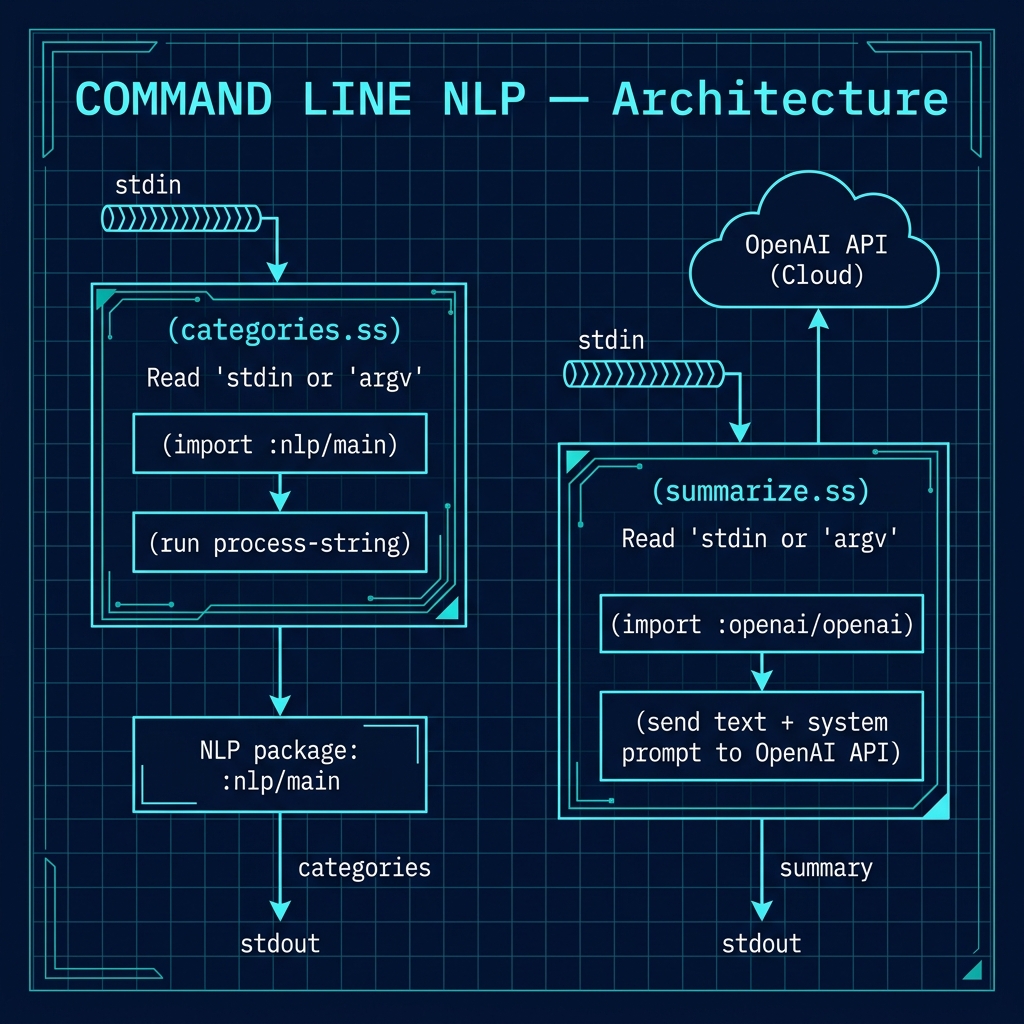
The following architecture diagram shows the structure of the command-line NLP utilities, illustrating how the categories.ss tool wraps the native NLP library and how the summarize.ss tool delegates to the OpenAI API for text summarization.
Using OpenAI’s GPT-5 model To Summarize Input Text
The example file summarize.ss is similar to the previous listing of categories.ss except we use the OpenAI GPT-5 odel with a system prompt instructing the model to summarize input text:
 1 #!/usr/bin/env gxi
 2
 3 (import :openai/openai
 4         :std/iter
 5         :std/misc/ports)  ;; read-all-as-string
 6
 7 (export main)
 8
 9 (def system-prompt
10 #<<PTEXT
11 You ar a master at libguistics, technology, and general knowledge. When given input
12 text you return an accurate summary of the text. You only return the summary,
13 no other text.
14
15 HERE IS THE TEXT TO SUMMARIZE:
16
17 PTEXT
18 )
19
20
21 (def (main . args)
22   (let* ((input-str (if (null? args)
23                         (read-all-as-string (current-input-port)) ; piped stdin
24                         (string-join args " ")))                  ; argv
25          (response (openai/openai#openai (string-append input-str system-prompt))))
26     (displayln response)))
As in the last example, we build a compiled and linked executable but run the script both with the gxi interpreter and then again with different input text using the executable file:
 1 $ gxc -O -exe -o summarize summarize.ss
 2 /tmp/gxc.1757631133.993665/openai__openai.scm:
 3 /tmp/gxc.1757631133.993665/summarize.scm:
 4 /Users/markw/GITHUB/gerbil_scheme_book/source_code/command_line_NLP/summarize__exe.scm:
 5 /tmp/gxc.1757631133.993665/openai__openai.c:
 6 /tmp/gxc.1757631133.993665/summarize.c:
 7 /Users/markw/GITHUB/gerbil_scheme_book/source_code/command_line_NLP/summarize__exe.c:
 8 /Users/markw/GITHUB/gerbil_scheme_book/source_code/command_line_NLP/summarize__exe_.c:
 9 ld: warning: ignoring duplicate libraries: '-lcrypto', '-lgambit', '-lm'
10 Marks-Mac-mini:command_line_NLP $ cat ~/temp/Clojure-AI-Book-Code/docs_qa/data/health.txt | ./summarize.ss
11 The text contains three parts: practical self-care and stress-management tips (live one day at a time, do enjoyable activities daily, show love, bathe to relieve tension, help others, prioritize understanding over being understood, improve appearance, schedule realistic days with breaks, be flexible, and stop destructive self-talk); a physician’s commentary on running injuries arguing that overuse and mechanical explanations have driven shoe- and orthotic-focused treatments, recounting a heel injury despite frequent shoe replacement and predicting a needed paradigm shift in shoe design and training; and a list of brief medical definitions covering terms such as adaptive immunity, addiction, ATP, adequate intake, agoraphobia, amnesia, amputation, anaerobic/anaerobic exercise, dry eye, duct, upper airway resistance syndrome, urea, ureter, and urethra.
12 Marks-Mac-mini:command_line_NLP $ cat ~/temp/Clojure-AI-Book-Code/docs_qa/data/economics.txt | ./summarize
13 The text describes the Austrian School of economics—founded by Austrians such as Carl Menger, Eugen von Böhm-Bawerk and Ludwig von Mises—which stresses the spontaneous ordering role of the price mechanism, skepticism about mathematical modelling because of subjective human choices, and advocacy of laissez-faire policies, strict enforcement of voluntary contracts, and minimal government intervention. It also defines economics as the social science studying production, distribution and consumption of goods and services (formerly called political economy), distinguishes microeconomics (behavior of individual agents and markets) from macroeconomics (aggregate issues like unemployment, inflation and growth), and emphasizes that economic agents face scarcity, have multiple ends and limited resources, and make choices to maximize value subject to informational and cognitive constraints. The text notes the professionalization of economics since about 1900, with widespread university programs and graduate degrees.
Optional Practice Problems
- Category Confidence Display: Update
categories.ssto output the calculated confidence score next to each identified category instead of only printing the category name. - Dynamic Summarization Length: Modify
summarize.ssto accept a--max-sentencesparameter, and interpolate this parameter into the system prompt text to guide the model on the summary’s target length. - Proper Name Extraction Command: Write a new executable command-line program
names.ssthat takes a path to a file or reads from standard input, processes the text using:nlp/main, and lists all identified proper names.