Chapter Three - Preparation
“The highest priority as a bad guy would be to subvert our election system. The reason is: you can take over a country without firing a shot. If you can decide who the leaders are, if you can put judges, if you can answer constitutional questions any way you want, over a period of time—you’re not going to do it in one election, it’s going to take a bunch of elections—but you can take over a country. And that would be my top priority (as a bad guy). Nuclear weapons would be a close second, but the top one would be elections.”
—Jeffrey Lenberg, nation-state vulnerability expert in the May 9, 2022 Otero County, New Mexico Emergency meeting who previously demonstrated vote swapping in Antrim County, Michigan
Preparation
2020 was filled with what could be called distractions but in reality were outright attacks on the American people. While those occurred, the preparation phase was shaping the battlefield. Published in 1999, a translated version of the original People’s Liberation Army documents, Un-Restricted Warfare, by Col. Qiao Liang and Col. Wang Xiangsui provides context for how the George Floyd incident might relate to or be part of the same attack upon our country. In particular, chapter 7: Ten Thousand Methods Combined as One: Combinations That Transcend Boundaries, the authors argue for the necessity to exceed the previous limitations of warfare, perhaps in Machiavellian fashion going beyond acceptable methods laid down in The United States Department of Defense Law of War Manual, a guide to international humanitarian law. Qiao and Wang go on to discuss supra-national combinations, that is efforts that include national, international, and non-state organizations. The fog of war makes seeing how all these elements work together difficult.
Preparation to subvert elections occurs on multiple levels, local, state, national, as well as international, not limited to the domains of law, electronic systems, and psychological operations. By following the money one can learn details about election software and hardware vendors. By reading certifications and testing protocols one can learn that they do little to secure a system from continuous cyber threats. By reading the fine print of vendor contracts one can learn who is liable when things go awry. The unraveling of this national and local election theft is likely to take some time; it’s implications may be difficult for some of us to comprehend, but try we must. What other option do we have?
Subversion can occur legally or illegally, constitutionally or unconstitutionally, ethically or unethically, by individuals or by coordinated groups. In the pages that follow, bear in mind that the mere fact that something is legal does not make it right. In the elections domain, a statute could be well intentioned but in practice weaken the fairness or transparency of an election. To give just one obvious example: just because ballot dropboxes found their way into state statute in a bi-partisan manner does not make drop boxes a friend of fair elections—dropboxes offer a chain-of-custody gap that calls into question almost every ballot placed into them. Statutes that leave gray area present further difficulties.
In studying Minnesota election laws, one can follow the history of a particular statute over time by clicking on the links at the bottom of the Revisor’s webpage. Did the changes to a particular statute make elections more fair or less fair? Did attempts to provide access to one vulnerable voting group such as ADA voters lead to the potential for fraud? Did judge-ordered changes amount to encasing fraud within the process itself—for instance, by what metric are signatures verified? Did the waiving of witness and signature requirements (going around the Legislature) for absentee ballots in 2020 make it more convenient for voters? Probably. But it also opened the door to ballot trafficking rings discovered by Gregg Phillips and Catherine Engelbrecht, somewhat weakly highlighted in the documentary 2000 Mules which D’souza made a lot of money on. For perhaps a better documentary, try the free documentary film, Let My People Go produced by Professor David Clements.
Electronic systems must be tested, certified, and programmed prior to elections in order for them to function properly and as designed. The Election Assistance Commission certified less than 6% of Minnesota counties and certified none of its internet connected e-pollbooks, which are really just iPads with a centralized-access feature set enabled, and who knows what else.
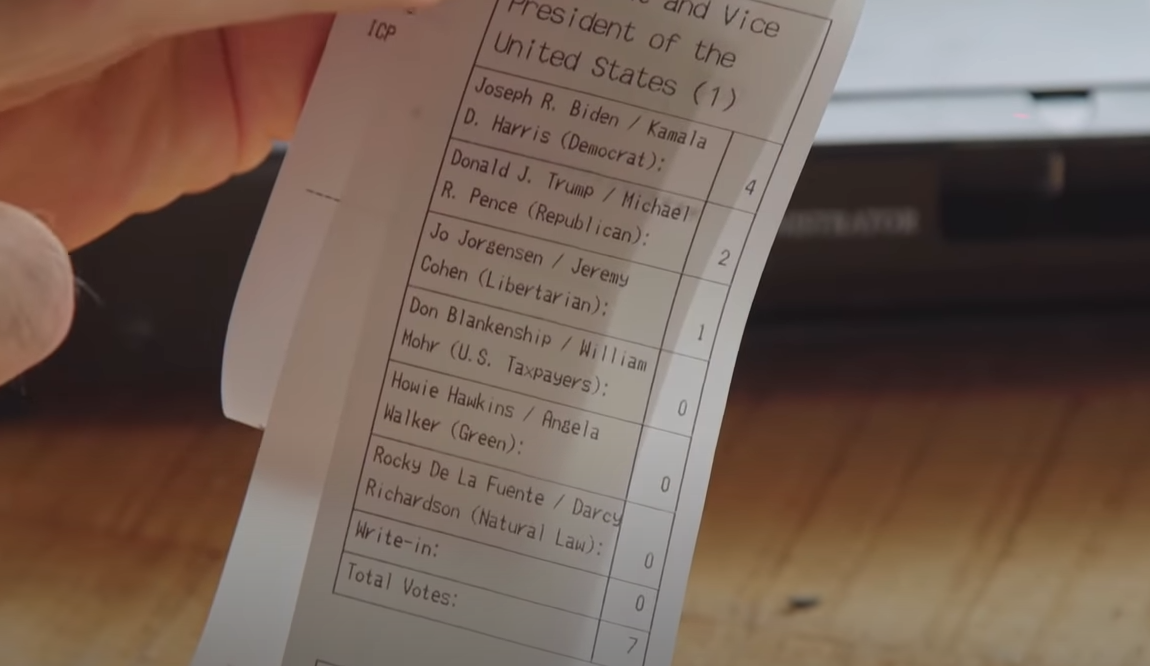
The DS200, a scanner and tabulator from ES&S, was used in almost all Minnesota counties, and could easily have contained 4G wireless modems, as were found in the same model of tabulator in the Antrim County, Michigan investigation in late 2020 after it was discovered that thousands of votes had been flipped. In 2024 public accuracy tests, in places like Carver County, it was confirmed that a Verizon 4G R2 modem (2-way cell phone communication) was present and active on the tabulator. Similar was discovered in other counties, such as Washington, eviscerating the claim from 2020 that there is no internet connection—even if there weren’t then, there are Now, and were during the 2024 election. Who had access to real-time information from the tabulators and electronic poll pads?
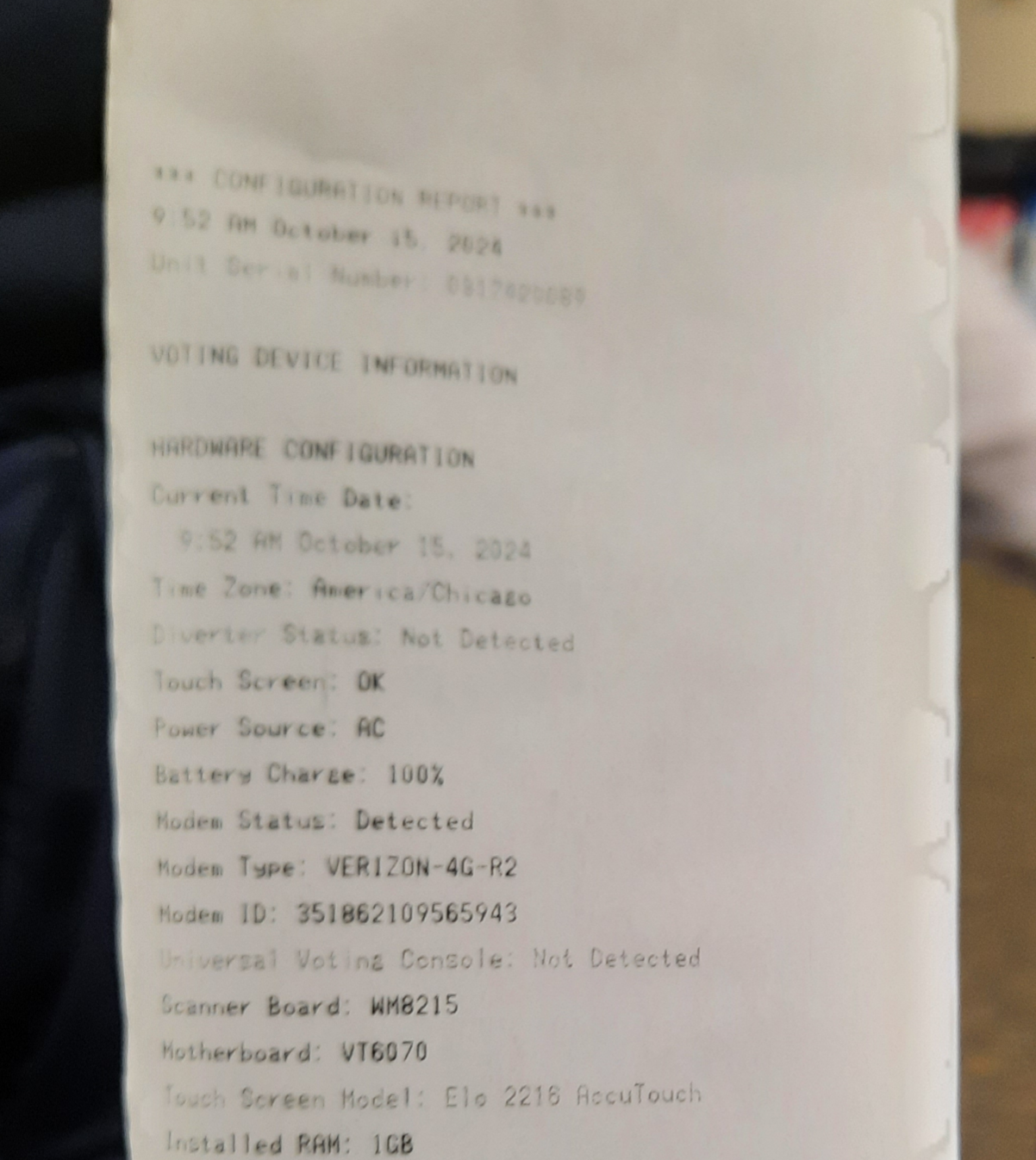
Electronic voting equipment and election management software from Dominion and Hart also had known vulnerabilities as shown at conventions like DEFCON 27 in 2019. Minnesota participates in the Electronic Registration Information Center(ERIC), having joined in 2014, which shares voter registration and other data between states, ostensibly to maintain clean voter rolls but a service which could be used to artificially inflate them. Were there any anamolies in the statewide voter registration system (SVRS) prior to or after the 2020 election in Minnesota?
It should be noted that there are currently groups working hard to develop software to ‘replace’ ERIC, and it’s my opinion that this is a waste of time because what is to stop the misuse of the next system? Meanwhile, there is a case to be made that voter registration is redundant, at least at the state level. Why can’t simple voter lists be kept at the county level and paper pollbooks be used to check in eligible voters with proper ID at each voting precinct on election day?
In the psychological realm, in mid-2020 George Floyd dominated news cycles. Covid-19 was also a daily discussion topic on and offline. This provided distraction, air cover, and justification for procedural changes which flew in the face of existing Minnesota law. Since, unusually high turnout in the absentee/mail-in category is anchored against the astronomical 60%, or 1.9 million (1,900,000) reported ballots in 2020, 700,000 of which were still not connected to a voter—700,000 MORE votes than voters—in the official system, the Statewide Voter Registration System (SVRS) even on November 29, 2020, 25 days after the election and 5 days after Secretary Simon and four others on the MN State Canvassing Board certified the election despite a petition to the MN Supreme Court asking for a pause until errors and omissions could be addressed.
To be covered in a separate book, in the runup to 2022 elections, there have also been reports of deliberate manipulations of delegate lists in addition to possible influence operations to position establishment candidates for the MNGOP endorsement and attempt to seed doubt beneath strong grassroots candidates who want to serve the interests of the people, not clandestine masters. The delegate disenfranchisement issue in Otter Tail County continued in 2024 and even into 2025 with new leadership continuing to fail to bring rogue elements into alignment with state election law and the MNGOP constitution. A no-endorsement occurred in the Boyd-Fischbach matchup when even with shockingly high spending and an ‘endorsement’ from Trump in addition to leaving out a large group of duly elected delegates, almost all of whom if not all were pro Boyd… that particular race went to a primary in August 2024, where Fischbach prevailed. Meanwhile, over a million dollars flowed in from about 50 congresspeople, friends of Tom Emmer, to Joe Teirab’s CD2 campaign where Taylor Rahm, who had already won the endorsement 75%/25%, was persuaded to step aside from his campaign.
Minnesota Statutes and Election Law
Let’s start with just a sample of Minnesota election laws and orders which affected the rules and procedures in the November 2020 general election:
- Election day registration allowed by Minnesota Statute 201.061 Subd.3 (legal since 1974, when Minnesota became the second state to allow it)
- Voter ID not required by law
- Dropboxes for absentee and mail-in ballots allowed by Minnesota Statute 203B.082 (58% of 2020 votes were reportedly absentee/mail-in ballots in Minnesota, over 1.9 million votes and more than 1.2 million more than the prior election)
- LaRose v. Simon - 1) Removed witness requirements for mail voters in Primary - 2) Extended the deadline to accept mail ballots (2 days) - STIPULATION AND PARTIAL CONSENT DECREE - Read LaRose Order 62 CV 20 3149 Order on July 31 Motions
- NAACP v. Simon - 1) Removed Witness Requirements for mail voters in General, 2) Extended the deadline to accept mail ballots (7 days), 3) MN Supreme Court Scheduled for September 3, 2020 - STIPULATION AND PARTIAL CONSENT DECREE - Read NAACP Order 62 CV 20 3625 Order on July 31 Motions
- This judicial complaint argues Judge Sarah Grewing’s decision not to recuse herself from above cases
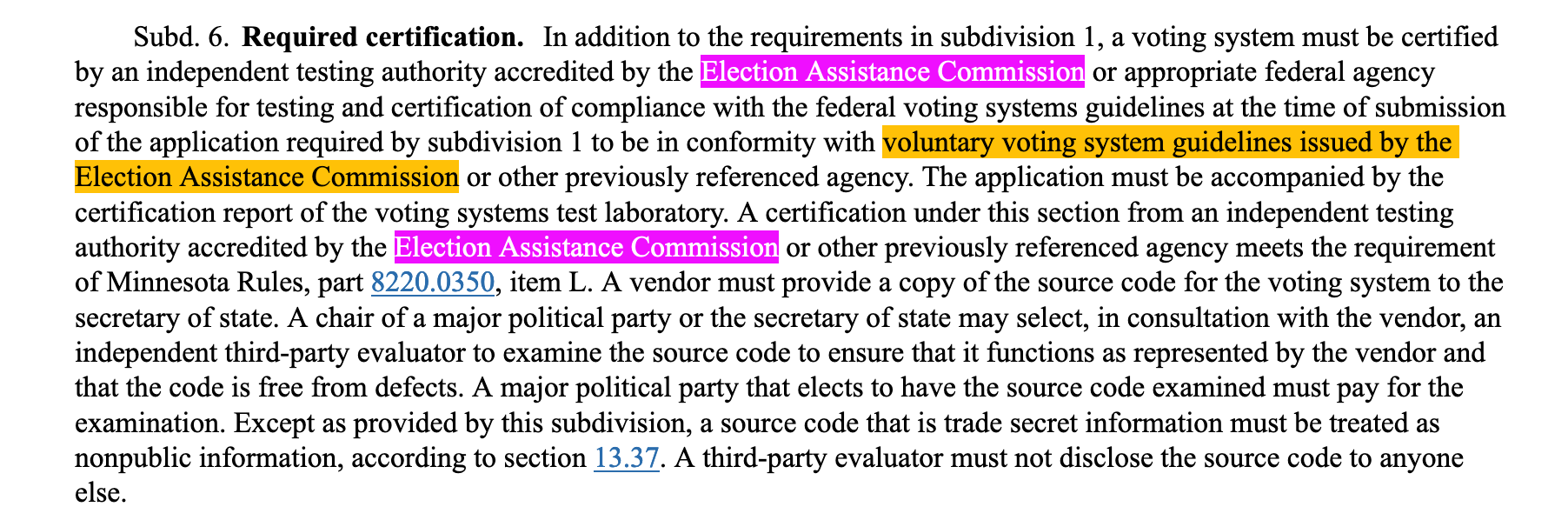
- Minnesota Statute 206.57 Subd.6 Required Certification reads in part: “…a voting system must be certified…in conformity with voluntary voting system guidelines issued by the Election Assistance Commission…” Is it true that if not in compliance with VVSG 2.0, voting systems are therefore not in keeping with 206.57 Subd.6 Required Certification? The EAC has not certified any independent testing laboratories to perform the “VVSG 2.0” certification. (See also the EAC’s Voting System Testing and Certification Program Manual Version 3.0).
Discussion
No. 3 and No. 4 were put into motion after the MN Legislature, in April 2020, rejected Secretary of State Steve Simon’s request for irrevocable power to alter election law during a pandemic. Note that while Simon was the ‘target’ of NAACP v Simon and LaRose v Simon, he was actually participating in a play to circumvent the Legislature, which was ordered by biased Judge Sarah Grewing, a former staffer of Senator Amy Klobuchar, clearly a conflict of interest that 170 complaints argued should have led to her recusal.
No. 7 is included because this provides just one legal basis upon which to stand for county commissioners who choose to refuse to certify local elections in the primaries or midterm elections. It is one thing for the secretary of state to foist electronic voting equipment upon the counties. It is another thing for the county commissioners to certify an election just run on equipment that may violate election statutes like Minnesota Statute 206.57 Subd.6 Required Certification. If county commissioners are taken to court for withholding their certification, they may ask for the machines to be opened or to examine the source code. In that event, it will be interesting to see if either request is granted.
Modern Electronic Election Systems
On January 6, 2017 the Department of Homeland Security designated elections as critical infrastructure, alongside food, water, and electricity.
About three months before the election, on July 28, 2020, the Cybersecurity and Infrastructure Security Agency (CISA) identified the following components as lacking security in its Critical Infrastructure Security Resilience Note:
- voter registration systems
- epollbooks
- ballot preparation
- voting machines
- tabulation systems
- official websites
- storage facilities
Besides storage facilities, each of these components has undergone digitization in recent years.
Not long after the election, on November 12, 2020, CISA Assistant Director Bob Kolaksy, along with other members of the Election Infrastructure Government Coordinating Council (GCC) Executive Committee, made a joint statement declaring that “The November 3rd election was the most secure in American history… There is no evidence that any voting system deleted or lost votes, changed votes, or was in any way compromised.”
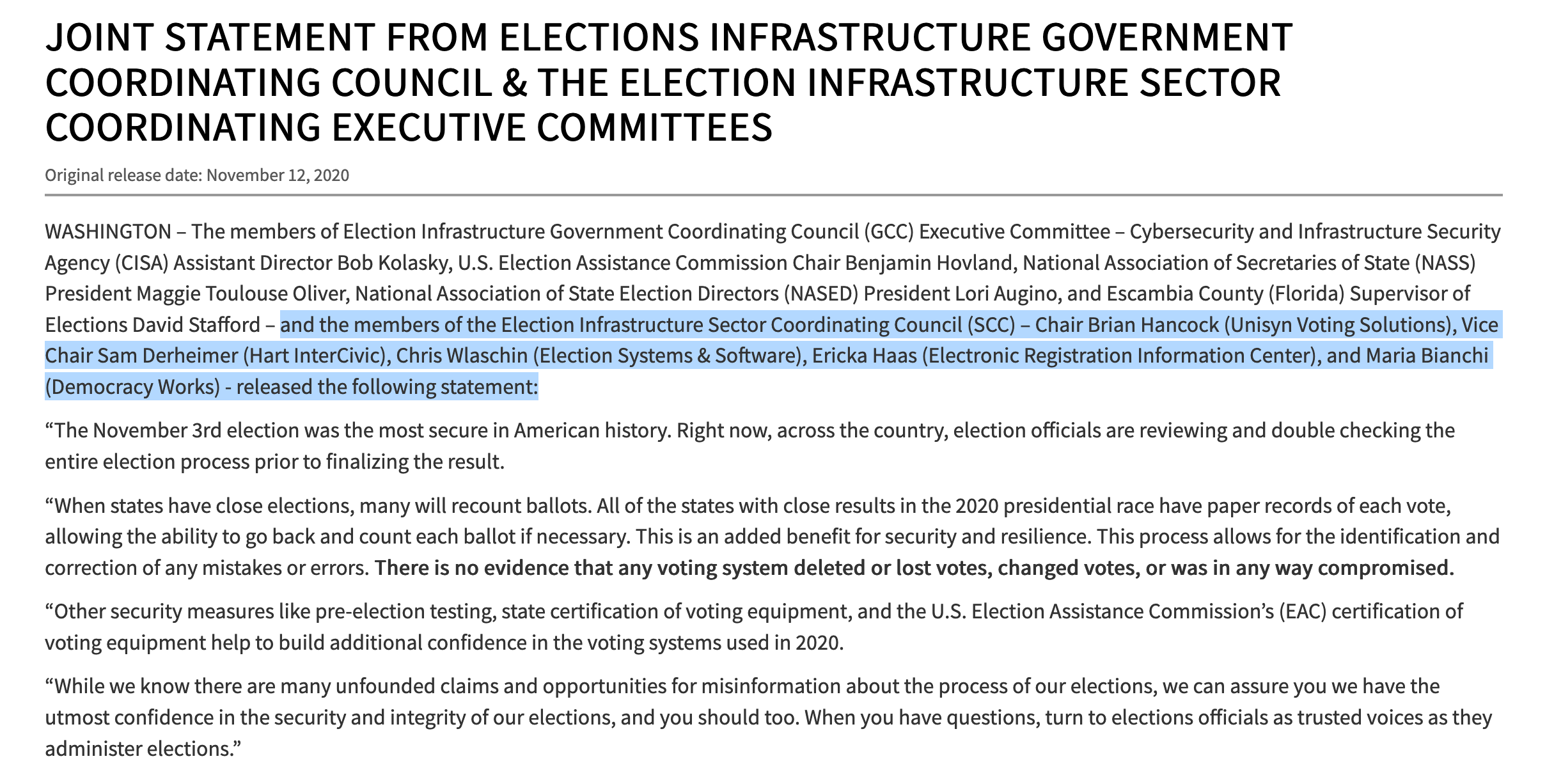
Rick Weible, in a workshop at the Big Lake City Hall on Wednesday May 25, 2022, pointed out that this statement could not have included a review of Minnesota, since Minnesota’s Canvassing Board would not certify the election until November 24, 2020.
Further, would it be unreasonable to ask Bob Kolasky how CISA’s analysis which produced the Critical Infrastructure Security and Resilience Note had changed between late July and mid November?
About a year and a half later, on June 3, 2022, CISA issued an advisory, “Vulnerabilities Affecting Dominion Voting Systems ImageCast X”, which focuses on Dominion (but ES&S and Hart also have glaring vulnerabilities) and may have been released to get ahead of a potential leaking of the Halderman report. The advisory detailed weaknesses including hidden functionality and improper protection of alternate path. Now, the Halderman report focuses on the internet connectivity of election equipment. But, I tend to agree with Draza Smith that we shouldn’t over-focus on that given what she wrote on Telegram in March, 2022: “The thing we need to get everyone to understand is that it is the software the vendors have baked into the machines that is cheating the American people.”
It’s not that internet connectivity isn’t a problem—it’s a big problem because for one thing, it allows centralized real-time communication between devices. But internet-connected, networked, or remote-accessable devices aren’t the only vulnerability. Even a machine without internet connectivity can be a huge problem for fairness and transparency based on its programming or chosen configurations.
Now, let’s take the CISA-identified components one at a time.
The Statewide Voter Registration System (SVRS)
The registration files known as voter rolls or rosters are critical because they store the data which helps determine who in the state is eligible to vote. An extract of these files is pulled into the epollbooks to allow a voter to receive a ballot if voting in person on election day.
Inflated rolls facilitate mail-in ballot schemes and support machine manipulation. It seems plausible that non-profits like the Electronic Registration Information Center (ERIC) could provide support to states using inflated rolls through “reports that show voters who have moved within their state, voters who have moved out of state, voters who have died, duplicate registrations in the same state, and individuals who are potentially eligible to vote but are not yet registered.”
For instance, if member states like Minnesota do not remove voters who have moved out of state or have died, then the result is an inflated voter roll. Even if the dead or out of state voter votes, that vote technically counts since that individual will be on the statewide voter registration system with a voter ID in the system. On the second night of the Cyber Symposium, I met someone named Russ working on several problems including the problem of voters on voter rolls in multiple states.
But how would you verify for yourself that voter rolls are inflated, providing an ample supply of ready-to-launch voters, a credit or slush fund to be used during the attack phase?
Voter rolls and histories are public information that you can request from the Minnesota Secretary of State’s website for $46. Note that your request is made at a particular moment in time. However, if you request a list before and after an election, as people like Rick Weible did for the November 3rd, 2020 General Election, and you are handy with database management (these are big files) then you can see how the lists changed. If you were to continue to request lists every few weeks, then you could see how the lists change over time, sometimes dramatically. Even still, it is unclear what version of the data is being handed over by the state. (Going forward, it should not require experts in database management to hold our government accountable.)
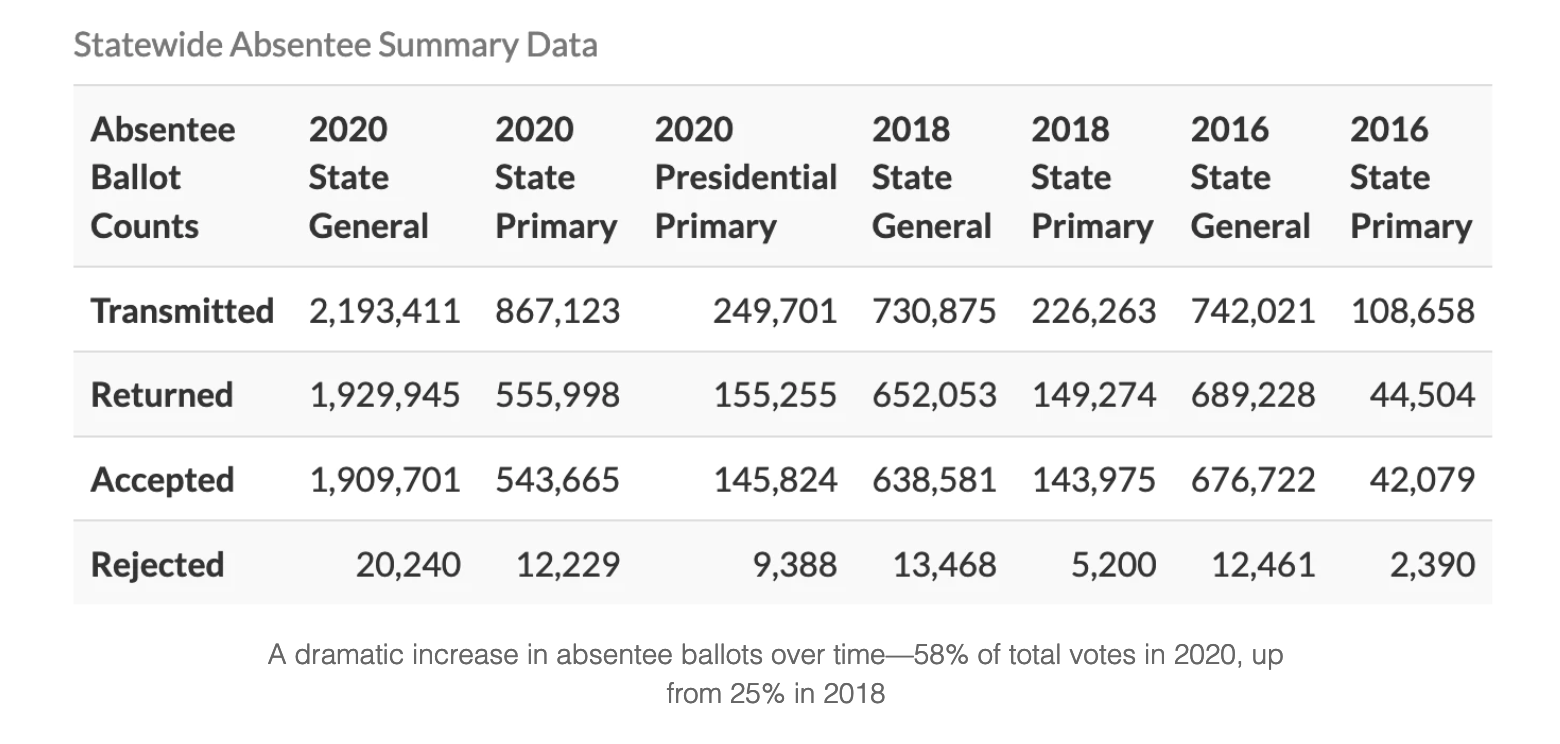
It was these voter rolls and histories that allowed Rick Weible to discover that more than 700,000 reported absentee votes reported by the secretary of state’s website were not yet connected to a voter in the SVRS on November 29, 2020, only 25 days after the election and a mere 5 days after the Minnesota State Canvassing Board certified the results of the 2020 General Election. This fact alone is major cause for concern because it means that the Office of the Secretary of State during that period would not have been able to prove the election was above board as apparently the work had not been completed yet. (Even a fully paper based system would not require that much time.) Note: These kinds of delays were repeated in 2022.
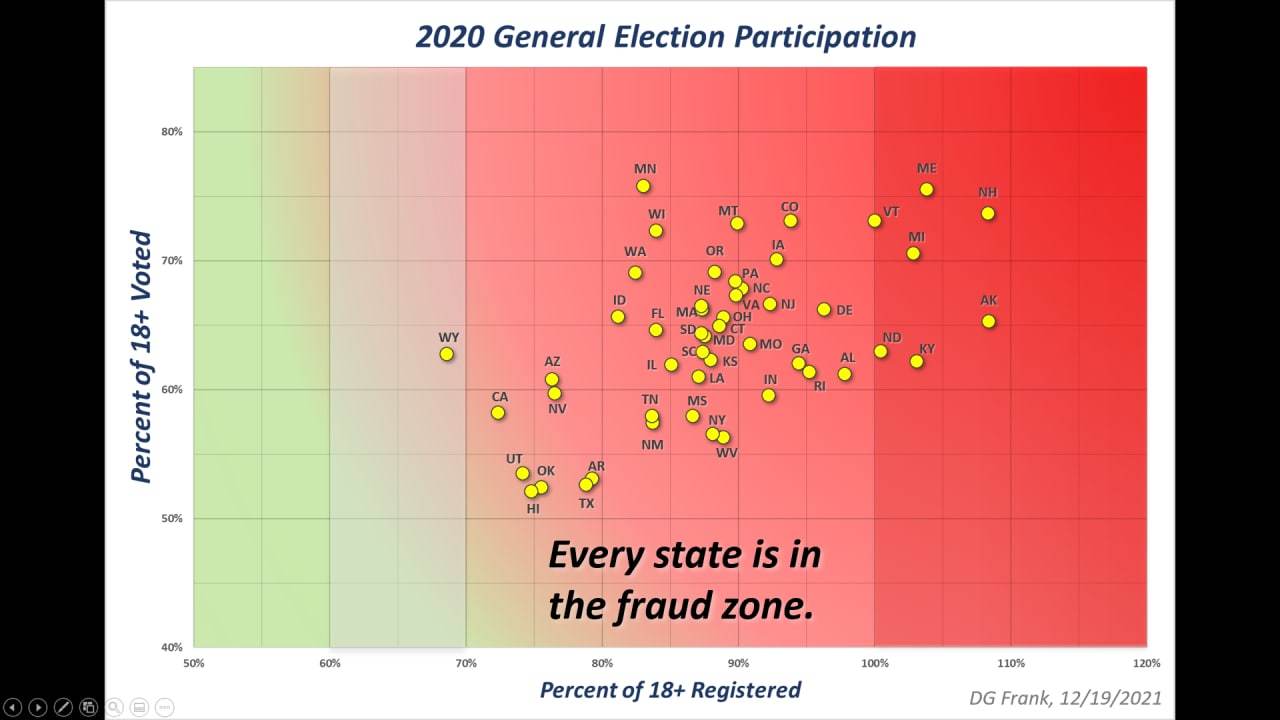
When comparing voter rolls with census population data, having been shown to be elevated in many ‘blue’ states through analysis of Seth Keshel and others, one can chart turnout of the voting age population. In the following chart, we see that Minnesota ranks 1st in voting age population turnout, an indicator of fraud. When the Minnesota Secretary of State boasts of high voter turnouts, is he actually deceptively bragging about how much fraud has occurred? (It should also be noted that the Office of the Secretary of State often defines voter turnout as number of eligible voters who voted, expressed as a percentage, instead of the standard definition which is the number of registered voters who voted expressed as a percentage. Voter turnout numbers with the latter standard definition put many Minnesota counties into the 90% and higher range in 2020, an absurd rate—if voters were really so eager to vote, why aren’t city level elections, primary elections, and even midterm elections challenging that 2020 rate?)
The USEIP Canvassing Report from March 11, 2022 visited 4,601 of 9,472 residences in Douglas, El Paso, Pueblo, and Weld Counties, Colorado. They found that about 8% of voters (123,852 of 1.1M) were affected by unexplained irregularities in Colorado’s voter rolls and voting records.
This rate of irregularities was similar to a 30-county canvassing effort led by Robin Sylvester in Minnesota, which as of early 2022 had canvassed about 2,000 homes and found just under 300 suspicious records.
In neighboring Wisconsin, Jeffrey O’Donnell’s analysis of data from August 2021 voter rolls showed over 7 million separate voter records in a state with less than 6 million people.
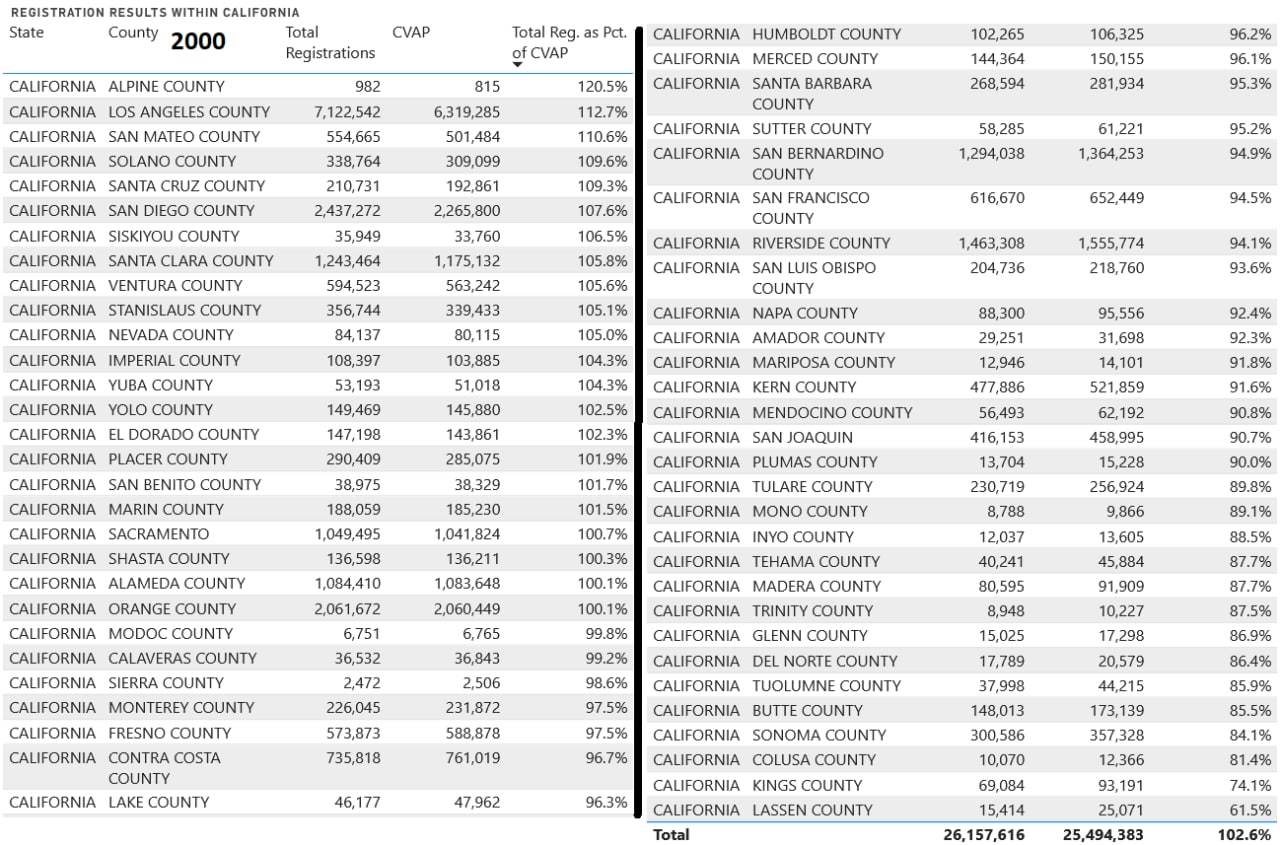
Rick Weible has acquired voter rolls and histories from multiple states. When examined collectively, the inflation either inspired by or influenced directly by organizations like the Electronic Registration Information Center (ERIC) is plain to see. We have since learned that there is a connection between Soros-funded Catalist and ERIC which helps to decrease the number of people on ERIC’s ‘Eligible but Unregistered’ EBU list. According to the EAVS report compiled by the EAC, there were 103,701,513 registration applications between the close of registration in 2018 and the close of registration in 2020, a 4x increase for the equivalent timeframe for the 2016 general election. The result of helping people become registered leads to head-scratching outcomes like this in California.
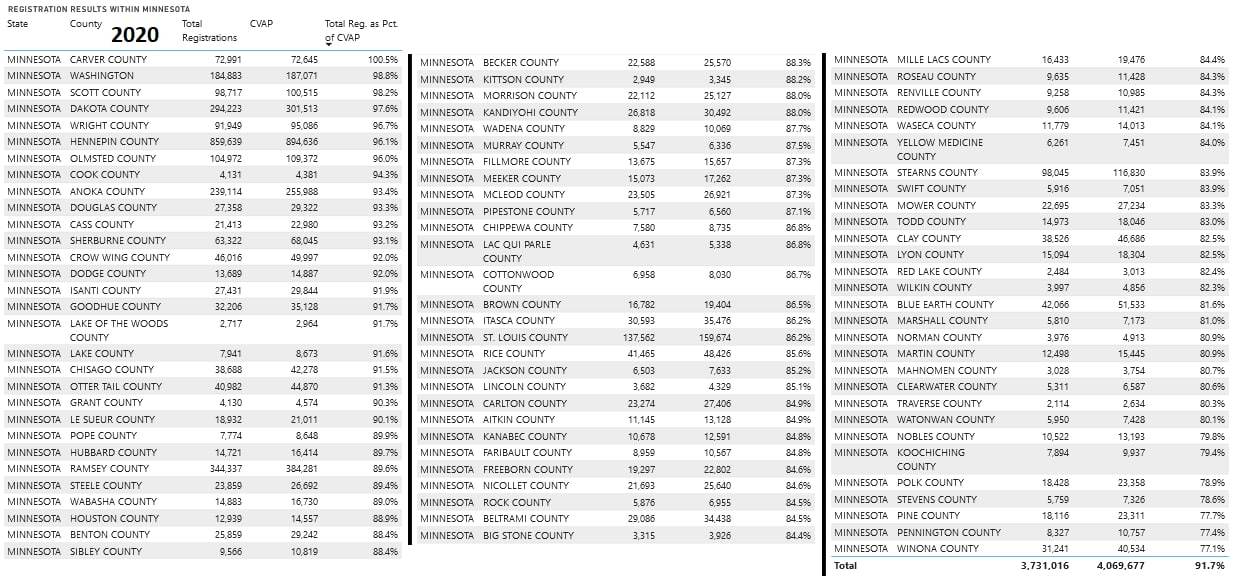
Minnesota is not much better, with for instance Carver County having more registered voters than citizens of voting age population.
E poll pads (electronic poll books)
Electronic poll pads are generally connected to the internet via wifi or cellular so that they can both receive a precinct-level extract of the statewide voter registration system or are at minimum a digital file if not connected or networked.
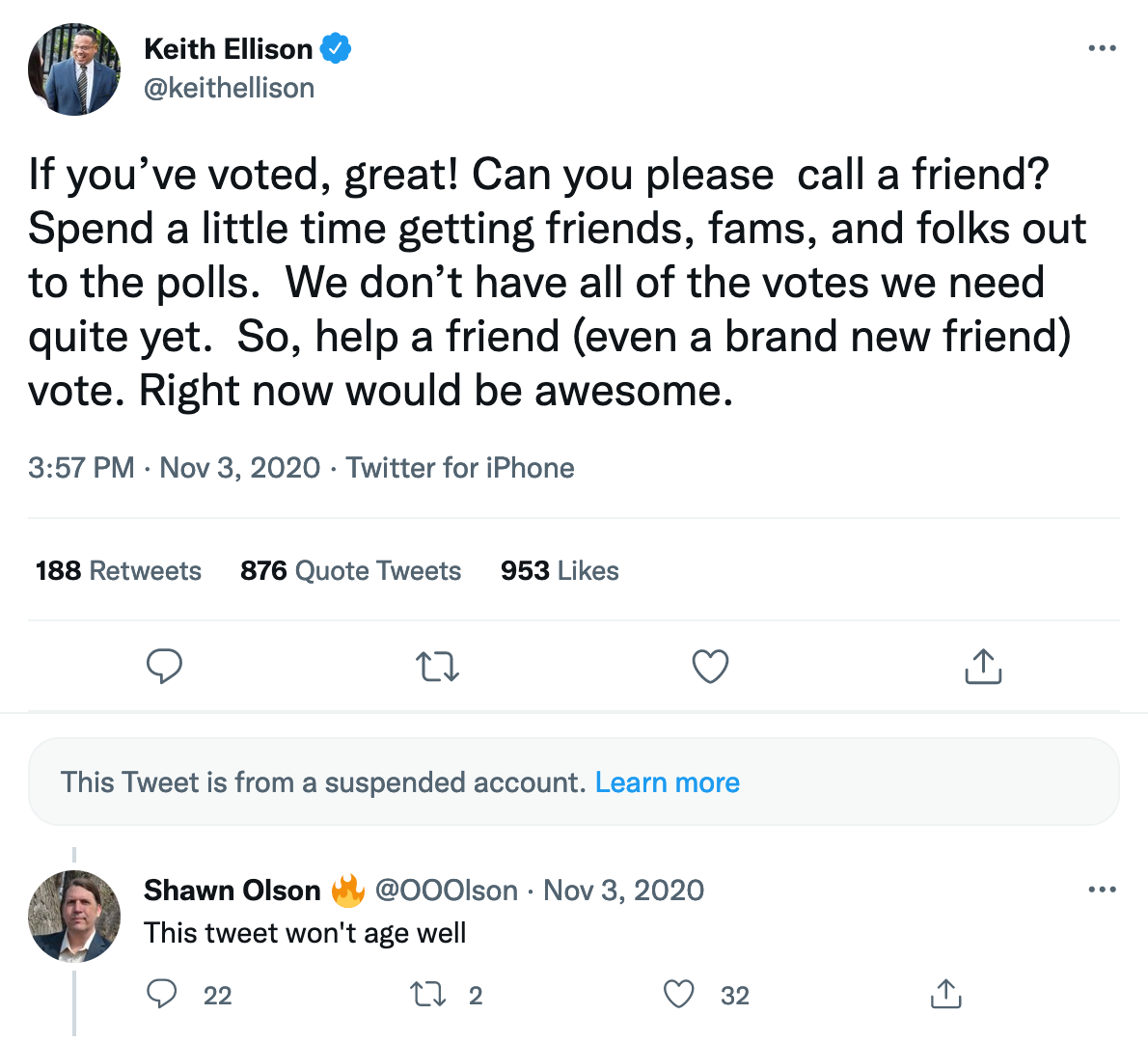
The internet connection also provides for real-time updating which conceivably would have allowed the Minnesota Attorney General to make a certain tweet at 3:57pm on election day, which may have been a signal to the ballot mules, or simply panic.
In January 2025, the Anoka County Elections Manager confirmed that precinct-level access to the number of remaining ballots is viewable by a centralized system available to him and others.
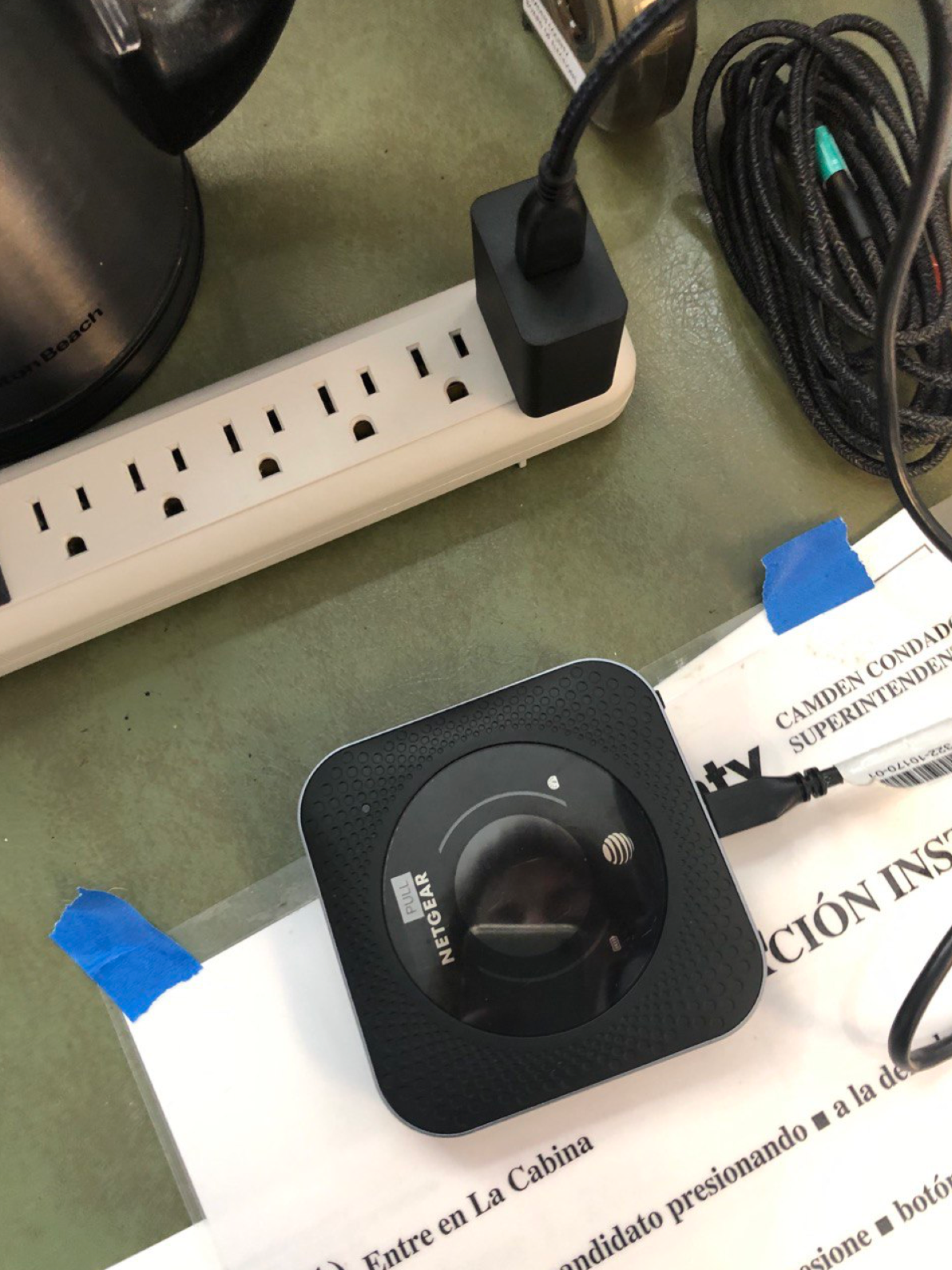
As an example of the importance of such a connection, in the New Jersey primaries in early June 2022, evidence of the Nighthawk providing internet connectivity to 8 Tenex epollbooks was documented at one polling place. For the first three hours, no one noticed. Then, the county board of elections office called one of the senior poll workers on her cell phone to remind her to set up the Nighthawk because prior to that the board officials were unable to monitor the processing of voters.
In 2016, when Rick Weible was the mayor of St. Bonifacius, he hacked into the proposed iPads from KNOWiNK within minutes. Then he declined to sign a contract to use them in St. Bonifacius (his council voted No), even while receiving the threat of a lawsuit. His was the only city in Hennepin County not to use epollbooks (they used paper pollbooks) in the following election, but this did not stem the major rollout to counties like Anoka in 2018, which coincided with a major shift in especially Democrat voter turnout, both in a 2014/2018 (midterm comp) or from 2016/2018 (presidential to midterm comp).
As shown on the Verified Voting website, a majority of counties in Minnesota use the KNOWiNK Poll Pads, which are essentially converted iPads for epollbook use. However, about 20 are still not using these electronic poll pads, which are not certified by the Election Assistance Commission (EAC). Rick Weible has spoken about cloud issues that were documented in Sherburne County on election day, 2020, and in 2024 discrepancies were found between the Secretary of State’s website and precincts like Clear Lake in Sherburne County, documented by researchers.
Ballot Preparation
Ballot preparation is a complicated process. But Patrick Colbeck does us a favor of simplifying the complex in his book, The 2020 Coup:
“Ballots are another key election infrastructure component with security vulnerabilities. Modern ballots are much more sophisticated than a piece of paper with checkboxes next to names. Today’s ballots are sophisticated paper and/or digital documents. In fact, in some cases, ballots are replaced by Direct-Recording Electronic (DRE) voting machines.
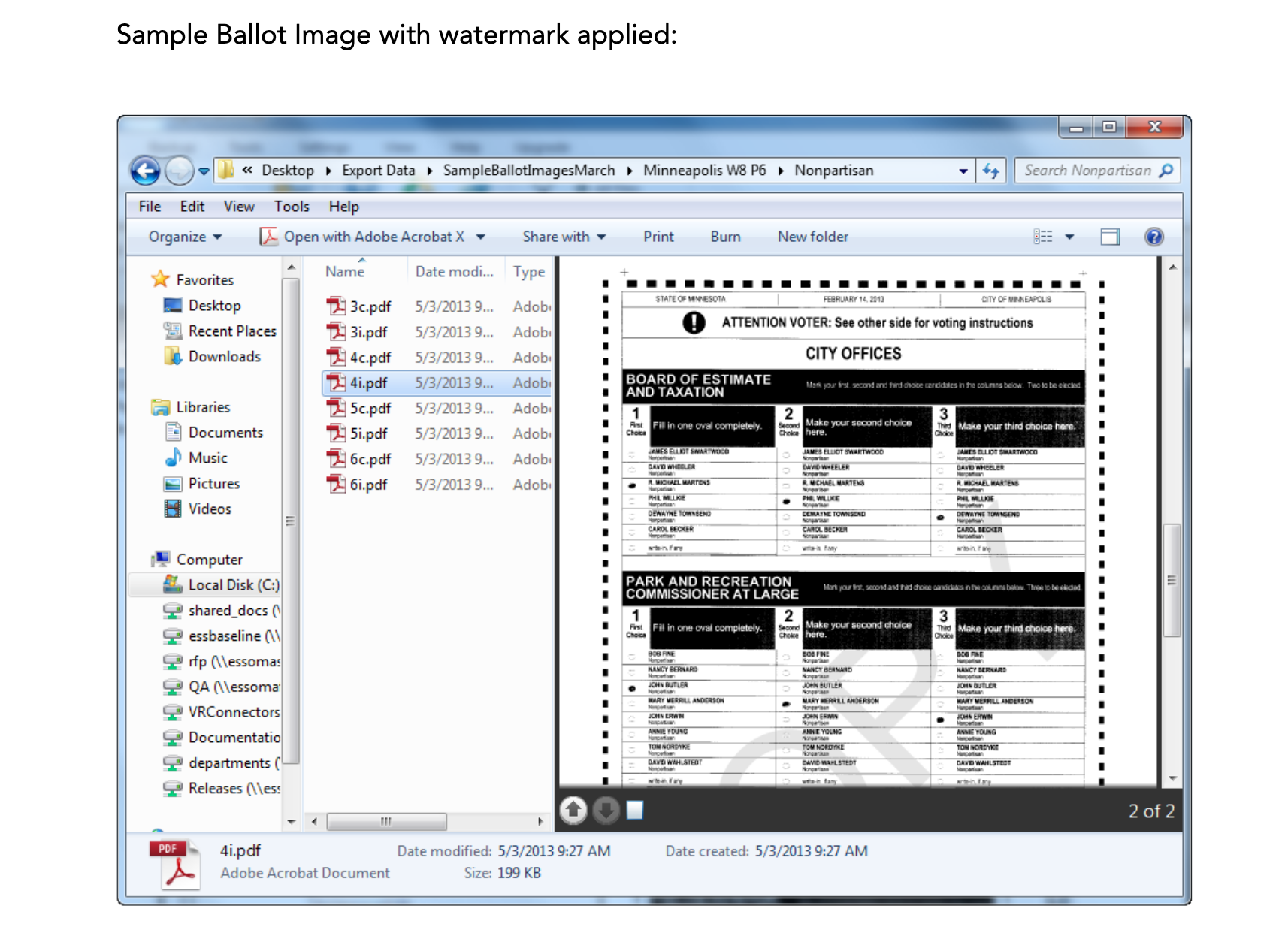
“Ballot preparation is a complicated process of overlaying political geographies with the contests and candidates specific to each district and then translating those layouts into unique combinations of ballot data. Ballot preparation data takes multiple forms such as ballot images (both paper and electronic), the data files necessary to build ballot images, audio files for special use ballots, and specific files for export to external systems such as websites for Uniformed and Overseas Citizens Absentee Voting Act (UOCAVA)-focused digital systems. Ballot preparation also generates the data necessary for tabulating votes within a voting machine and aggregating tabulated votes within a jurisdiction or state. This process is usually completed in an election documents and records management system (EDRMS), which is special software designed to manage documents and records throughout the document lifecycle, from creation to destruction. Access to the information in such systems would enable anyone attempting to subert the integrity of an election with the information necessary to create ballots independently of election officials. Of course, ballots are also where voters record their votes. Vote tallies are generated from the information on ballots therefore their integrity is very important to protect.”
After watching 2000 Mules Erin Clements asked where the NGOs that printed the ballots for the mules may have gotten the ballot formatting and ballot styles to correctly print ballots. I imagine True the Vote’s Catherine Engelbrecht and Gregg Phillips’ team were asking the same questions, leading to their follow-on work from the Wisconsin hearing in March 2022 to the Maricopa County senate hearing in early June to the work on the ground in Yuma County.
While Minnesota uses paper ballots in all 87 counties, we are not hand-counting them, but instead relying on computers to first scan and then read the ballot image created.
Because there is no hand tally, we are putting our trust completely in the voting machines and tabulation systems to properly scan, tally, and record the votes on each paper ballot and the aggregation of those totals. There is no way for the public to verify the accuracy unless a manual human hand count and hand tally is done on the spot. Numerous demonstrations by the likes of Rick Weible or Mark Cook in Searcy County, Alabama, have shown this to be effective. See uscase.org or openelectionrecords.org for more and to setup your own trainings.
The voting machines, also called tabulators, scan and tally the votes. Simply put—but the process is anything but simple—the tallies from the tabulators are then aggregated in tabulation software known as an election management system. Results from this election management system are then supposed to be passed through reporting providers like Edison Research and eventually through the media to your living room. However, Jeffrey O’Donnell and Draza Smith have speculated that this election night reporting could well be theater and not directly connected to actual results recorded in tabulators.
Voting Machines
The most common voting machines is otherwise known as a tabulator. These optical scanners take in paper ballots and then are essentially interpreting pixels on a bitmap and translating that into vote tallies.
Vendors largely keep to themselves their standards for interpreting ovals. In certain situations, the tabulators are programmed to send ballots to adjudication, where election judges are responsible (not the voter) for deciding the intent of the voter. This includes situations like blank ballots, overvotes, ambiguous marks, and ballot misreads.
It’s conceivable that these tabulators make mistakes that humans would not make. Erin Clements demonstrated evidence of this from the Otero County audit in the Otero County Special Meeting on June 9, 2022. She concluded, “The tabulators are not smarter than people.”
In that same audit, there was a software mismatch between the tabulators and the election management system (a violation of the election code in New Mexico law), and yet the mismatch did not prevent the tabulation systems from processing vote tallies.
Here is a table of electronic voting equipment used in Minnesota’s 2020 general election, provided by Dan Sundin, part of the decentralized Telegram group mentioned in the introduction, who despite not living in Minnesota did me a favor and pulled this information from each of the county websites (in addition to precinct-level results for all counties).
| County Name | Absentee and Mail Ballot Tabulation Equipment | Assistive Voting Equipment |
|---|---|---|
| Aitkin | ImageCast Central | ImageCast Evolution |
| Anoka | Digital Scan 200, Digital Scan 450, Digital Scan 850 | AutoMARK |
| Becker | Model 100 | AutoMARK |
| Beltrami | Digital Scan 200, Digital Scan 450 | AutoMARK |
| Benton | Digital Scan 450 | AutoMARK |
| Big Stone | Verity Scan | Verity Touch Writer |
| Blue Earth | Digital Scan 200, Digital Scan 450 | OmniBallot |
| Brown | Digital Scan 450 | AutoMARK |
| Carlton | Digital Scan 200 | AutoMARK |
| Carver | Digital Scan 200, Digital Scan 450 | AutoMARK |
| Cass | Digital Scan 200, Digital Scan 450 | OmniBallot |
| Chippewa | Digital Scan 200 | AutoMARK |
| Chisago | Verity Central, Verity Scan | Verity Touch Writer |
| Clay | Digital Scan 200, Digital Scan 450 | AutoMARK |
| Clearwater | Digital Scan 200 | AutoMARK |
| Cook | Digital Scan 200 | AutoMARK |
| Cottonwood | Digital Scan 200 | AutoMARK |
| Crow Wing | ImageCast Central | ImageCast Evolution |
| Dakota | ImageCast Central | ImageCast Evolution |
| Dodge | Digital Scan 200 | AutoMARK |
| Douglas | Digital Scan 200, Digital Scan 450 | OmniBallot |
| Faribault | Digital Scan 200 | AutoMARK |
| Fillmore | Digital Scan 200 | AutoMARK |
| Freeborn | Digital Scan 200, Digital Scan 450 | AutoMARK |
| Goodhue | Digital Scan 450 | AutoMARK |
| Grant | Digital Scan 200 | AutoMARK |
| Hennepin | Digital Scan 200, Digital Scan 850 | AutoMARK |
| Houston | Digital Scan 200 | AutoMARK |
| Hubbard | Digital Scan 450 | OmniBallot |
| Isanti | Digital Scan 200 | OmniBallot |
| Itasca | Digital Scan 200 | OmniBallot |
| Jackson | Digital Scan 200 | OmniBallot |
| Kanabec | Digital Scan 200 | AutoMARK |
| Kandiyohi | Digital Scan 200 | AutoMARK |
| Kittson | Digital Scan 450 | AutoMARK |
| Koochiching | Digital Scan 200 | AutoMARK |
| Lac Qui Parle | Digital Scan 450 | OmniBallot |
| Lake | Digital Scan 200 | AutoMARK |
| Lake Of The Woods | Digital Scan 200 | OmniBallot |
| Le Sueur | Digital Scan 200 | AutoMARK |
| Lincoln | Digital Scan 200 | AutoMARK |
| Lyon | Digital Scan 200 | AutoMARK |
| Mcleod | Digital Scan 200, Digital Scan 450 | AutoMARK |
| Mahnomen | ImageCast Evolution | ImageCast Evolution |
| Marshall | Digital Scan 850 | AutoMARK |
| Martin | Digital Scan 200, Digital Scan 450 | AutoMARK |
| Meeker | Digital Scan 200 | OmniBallot |
| Mille Lacs | Digital Scan 200 | AutoMARK |
| Morrison | Digital Scan 200, Digital Scan 450 | AutoMARK |
| Mower | Digital Scan 200 | AutoMARK |
| Murray | Digital Scan 200 | AutoMARK |
| Nicollet | Digital Scan 200 | AutoMARK |
| Nobles | Digital Scan 200 | AutoMARK |
| Norman | Digital Scan 200 | AutoMARK |
| Olmsted | Digital Scan 850 | AutoMARK |
| Otter Tail | Digital Scan 200 | AutoMARK |
| Pennington | Digital Scan 200 | AutoMARK |
| Pine | Digital Scan 200, Model 100 | AutoMARK |
| Pipestone | Digital Scan 200 | OmniBallot |
| Polk | Digital Scan 450 | OmniBallot, AutoMARK |
| Pope | Digital Scan 200 | AutoMARK |
| Ramsey | Digital Scan 850, Verity Central, Verity Scan | Verity Touch Writer, AutoMARK |
| Red Lake | Digital Scan 200 | AutoMARK |
| Redwood | Digital Scan 200 | AutoMARK |
| Renville | Digital Scan 200 | AutoMARK |
| Rice | Digital Scan 200, Digital Scan 450 | AutoMARK |
| Rock | Digital Scan 200 | OmniBallot |
| Roseau | Digital Scan 200 | OmniBallot |
| St. Louis | Digital Scan 200, Digital Scan 850, Model 100 | AutoMARK |
| Scott | ImageCast Central, ImageCast Evolution | ImageCast Evolution |
| Sherburne | ImageCast Central | ImageCast Evolution |
| Sibley | Digital Scan 200 | AutoMARK |
| Stearns | Digital Scan 450, Digital Scan 850 | AutoMARK |
| Steele | Digital Scan 200 | AutoMARK |
| Stevens | Digital Scan 200 | AutoMARK |
| Swift | Digital Scan 200 | OmniBallot |
| Todd | Digital Scan 200 | OmniBallot |
| Traverse | Digital Scan 200 | AutoMARK |
| Wabasha | Digital Scan 200 | AutoMARK |
| Wadena | Digital Scan 200 | AutoMARK |
| Waseca | Digital Scan 200 | OmniBallot, AutoMARK |
| Washington | Digital Scan 850, Verity Central | Verity Touch Writer, AutoMARK |
| Watonwan | Digital Scan 200 | AutoMARK |
| Wilkin | Digital Scan 200 | OmniBallot |
| Winona | Digital Scan 200 | AutoMARK |
| Wright | Digital Scan 200, Digital Scan 450 | AutoMARK |
| Yellow Medicine | Digital Scan 200 | AutoMARK |
Another way to view which equipment was in use in 2020 or will be in use for 2022 is on the Verified Voting website.
Remember, there are known and potential vulnerabilities in all voting machines, but let’s zoom in for a moment on the most-used equipment in Minnesota.
ES&S DS200s were used in 65 of Minnesota’s 87 counties in 2020.
In April 2021, the DS200 used in Antrim, County Michigan was found to have a 4G wireless modem installed within the enclosure of the machine.
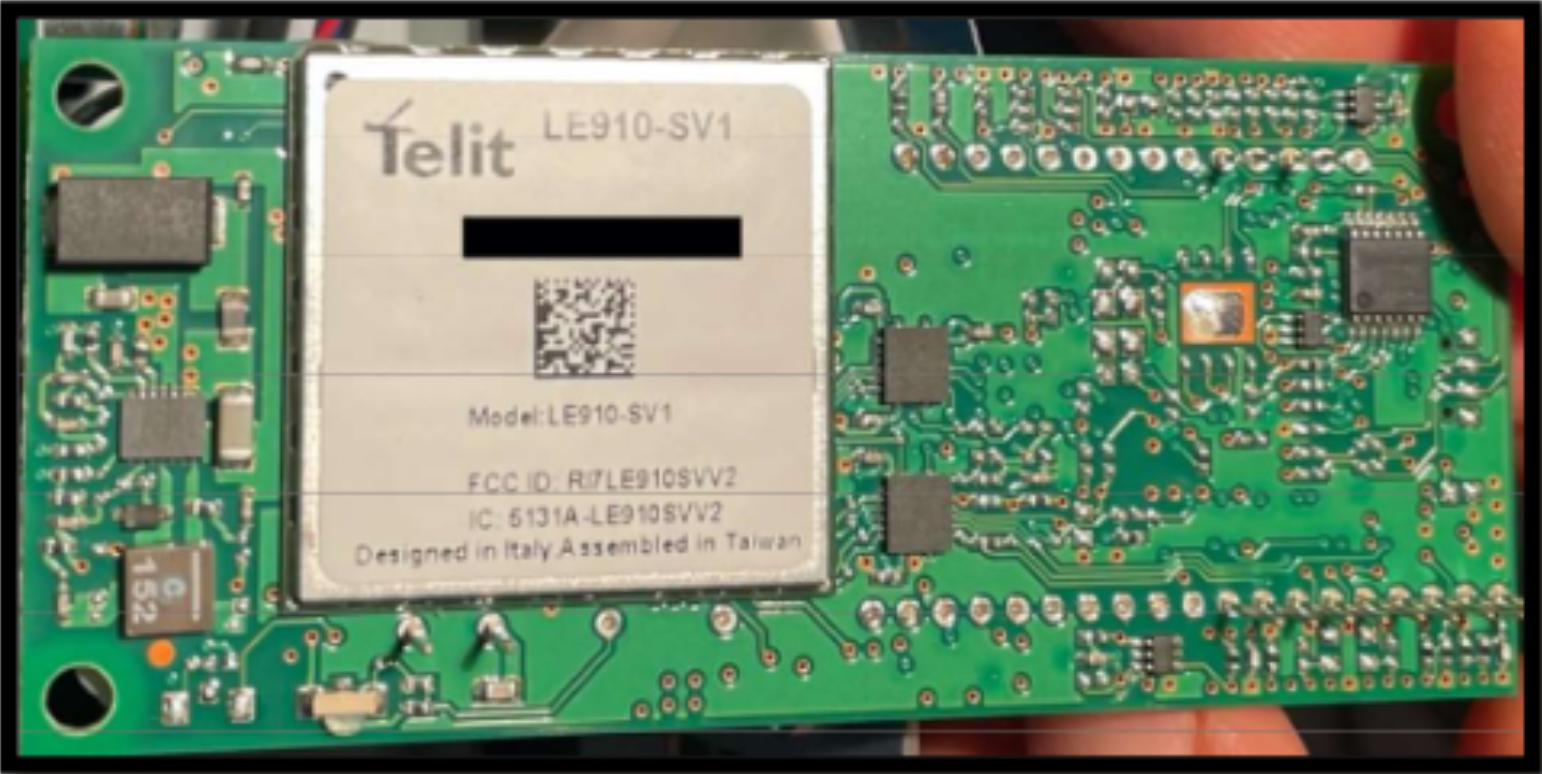
Furthermore, the exhibit describes how the card was “utilizing a commercial Verizon SIM card with an APN configuration specific to the ES&S DS200 provisioning. Testing revealed that the same SIM card could be utilized in a separate wireless hotspot device and the device could then join the same APN as the ES&S voting machines. An unauthorized user could gain access to this APN by an extra SIM card pre-provisioned for this APN, or by removing a SIM from an operational device and using it in another device.”
To repeat: This wireless modem was found on an enclosed part of the machine. Therefore if these same or similar wireless modems were also installed on the DS200s throughout Minnesota, it would be invisible to election judges, poll challengers, and even election officials regardless of whether the machines were certified. Under Minnesota law, it is not required that every machine be certified, only the model of machine. (From 206.57 Subd.1, “Examination is not required of every individual machine or counting device.”) Testing can be limited to certain requirements which evidently can miss the presence of a 4G wireles modem.
The presence of these would seem to also disqualify a voting system according to the VVSG 2.0 (relevant to county commissioners considering whether to certify their upcoming local elections):
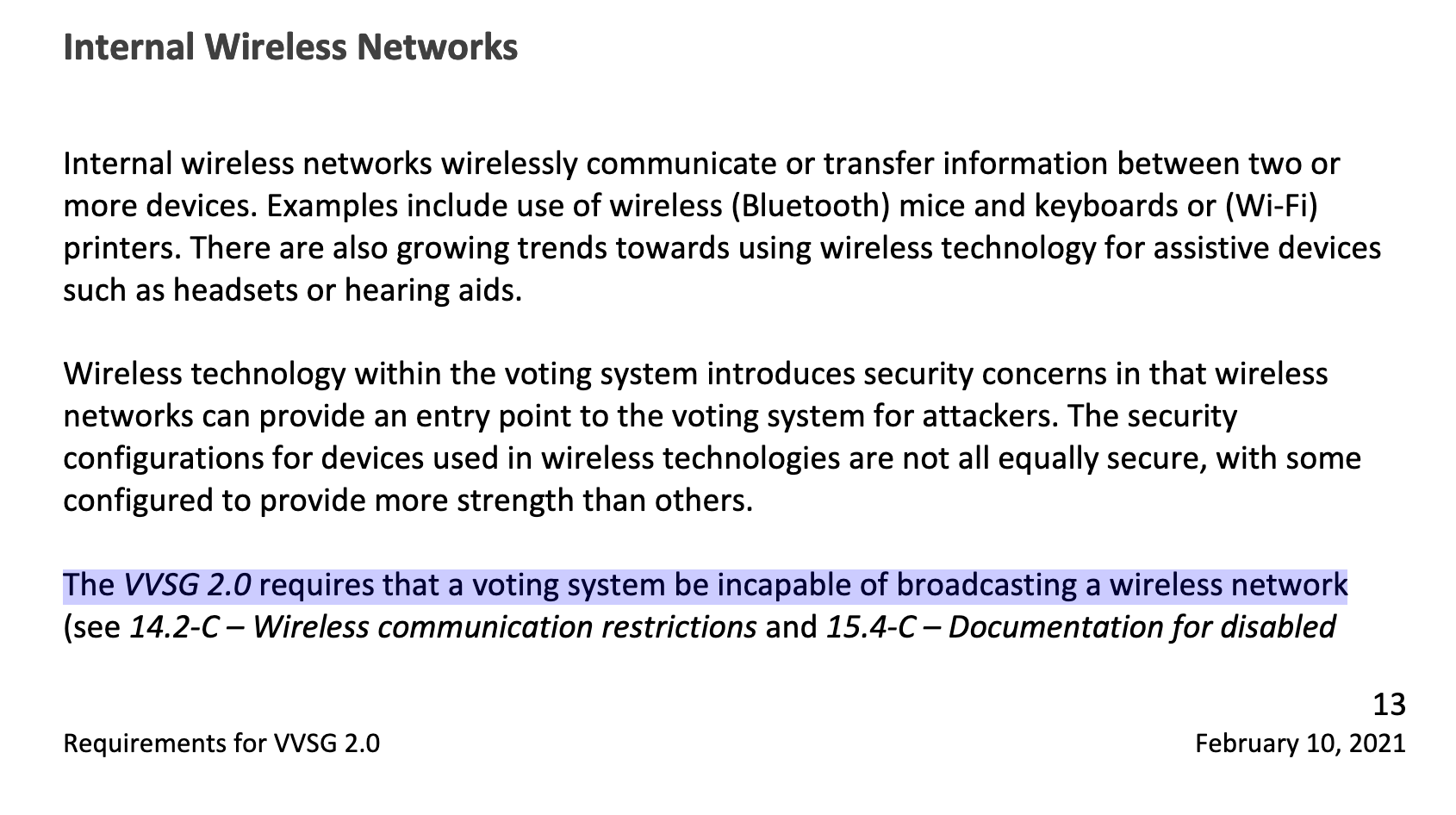
I also include this information in the preparation phase of our discussion because this 4G wireless modem implementation would likely need to be installed before or during the election in order to be used by bad actors.
Additionally, scientist Dr. Douglas Frank has called the ES&S DS200 “one of the most hackable ballot scanners in the country”. Because the code is not open source, it is difficult to know all the vulnerabilities that may exist. And since its “System and Method for Decoding Marks on a Paper Ballot” is proprietary, patent law means ES&S owns that intellectual property. That being said, former cyber analyst for the Air Force Jake Stauffer’s vulnerability report is revealing, demonstrating among other details that “file systems are not encrypted [which] allowed the team to recover system configuration information, password hashes, and ES&S specific binaries.”
To understand how the DS200 plays into the overall system, here’s a diagram ES&S sent to Travis County, Texas in a contract proposal.
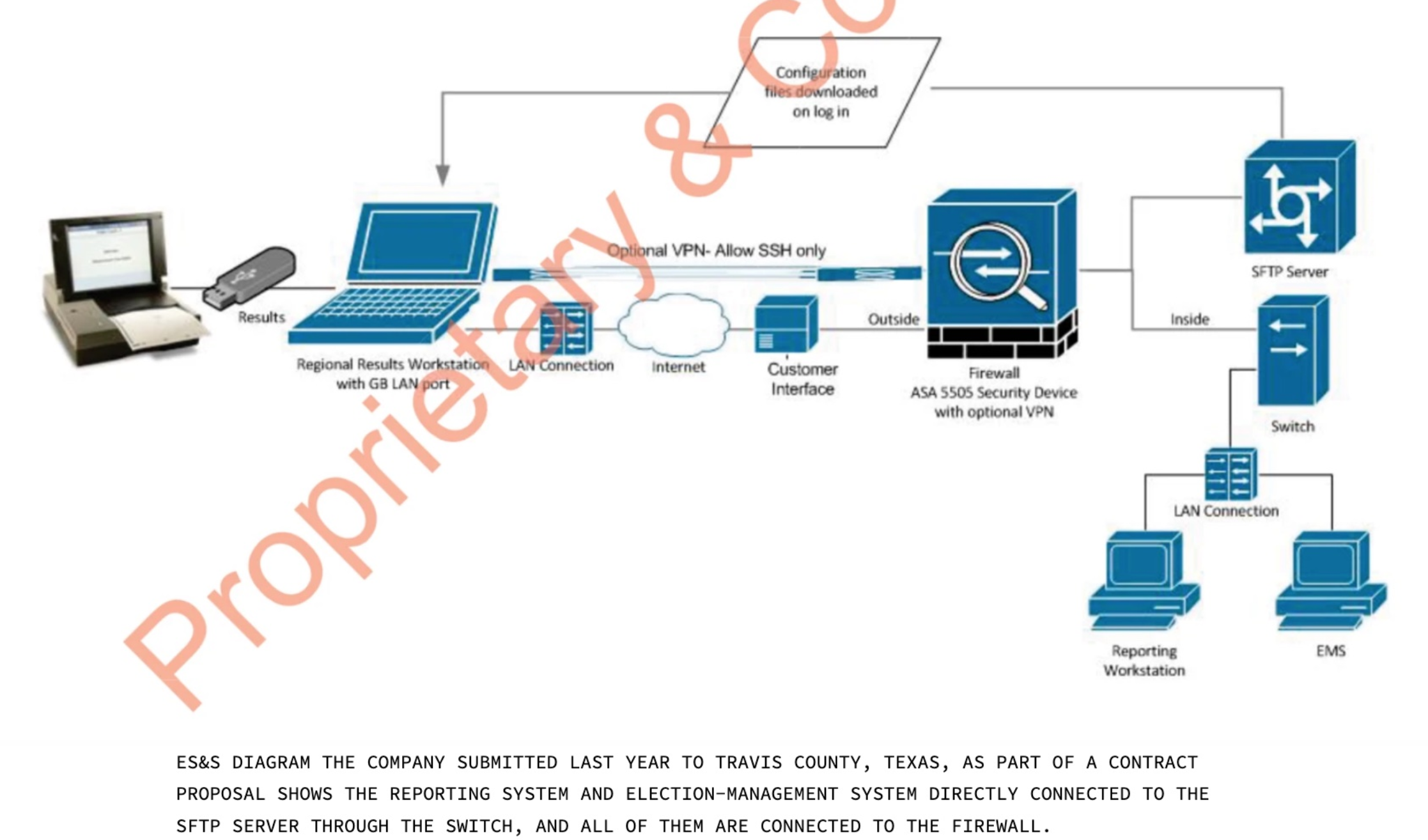
To make matters worse, however, there are apparently settings on the DS200 which allow the ballot images to not be saved (reducing the audit trail) and potentially configuration settings which turn off the Cast Vote Record (CVR) report functionality. EDIT: This last point was actually disinformation from secretary of state offices, meant perhaps to throw citizens off the scent of these vital election records which by federal law must be retained for a minimum of 22 months.
Turning off the functionality to generate the ballot image portion of the cast vote records is troublesome.
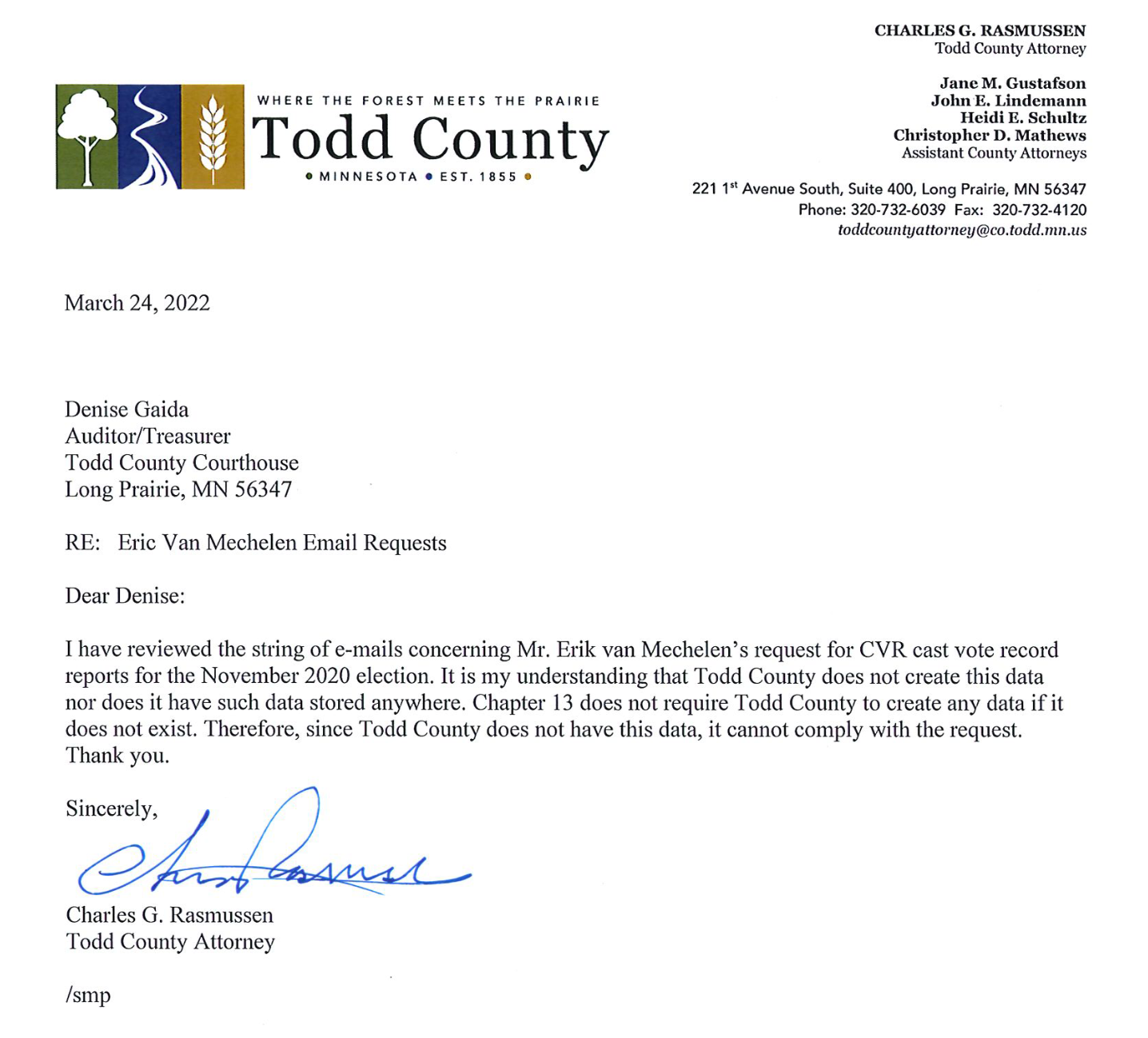
But the following letter and those like them from auditors, attorneys, and administrators at counties all over Minnesota demonstrate a basic lack of understanding of how our votes are being counted and tallied. If those administering the elections don’t even know how the computers work, that’s a big deal.
Here’s a letter I recieved from the Todd County Attorney after initially starting the conversation with the Todd County Auditor. Note: Went to Todd after a friend suggested starting there since, after all, Dr. Frank had said we should vote like the Amish.
*Please note that although we have focused on the ES&S DS200s, there are several Minnesota counties that use Dominion ImageCast machines and several that use Hart Verity Scan tabulators. Equipment from these vendors are also insecure from cyber threats. These vendors, in one case, have also deleted election records prior to the 22 month federal retention, constituting a federal crime, as admitted to by the Chisago County Auditor over the phone (recorded) when I was simply asking for the cast vote records. She said they weren’t available because the vendor had performed an update, which to me sounded similar to the Tina Peters situation in Mesa County, Colorado, except in that situation Peters retained a before and after computer image to allow comparison of the databases, revealing evidence of an election crime.
Along with obvious cyber vulnerabilities, vendors are not open with their source code (and by statute do not have to be) and therefore vote-manipulating software could be baked in. Furthermore, because of a supply chain that too often had its origin in CCP-controlled China, the components of these machines could represent the point of vulnerability.
This all said, any commissioners opting to withhold their certifications of local elections (shortly after election day) could for just one instance request a micro-audit, to be performed in under a day, of their voting machines to ensure that security and accuracy were maintained throughout the election. Better still, they could pass resolutions to perform extensive post-election audits of all the precincts and all the races in those precincts.*
Contracts
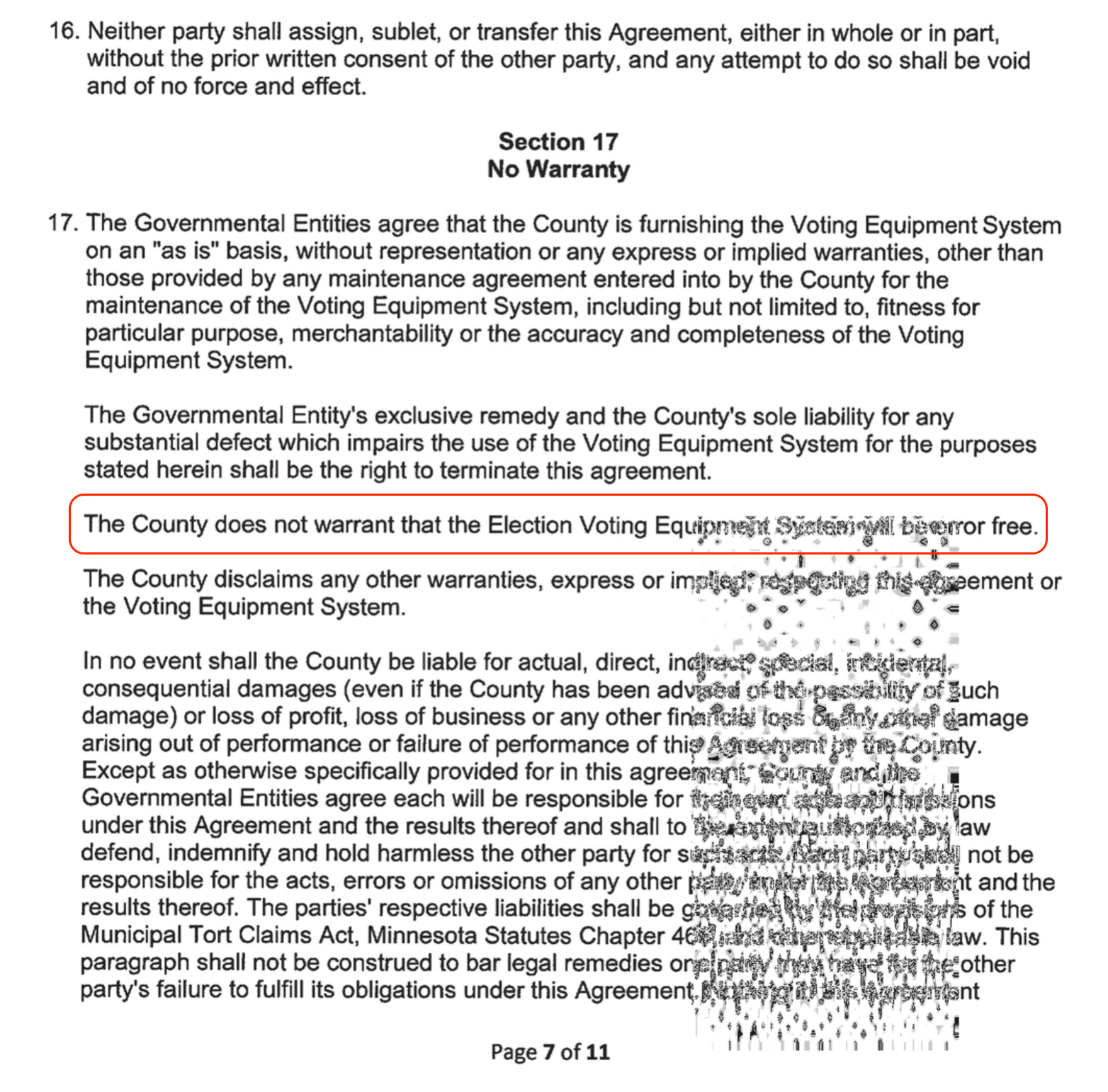
One of my friends has repeated, “It’s in the contract.”
Researchers across Minnesota and the country have read numerous manuals from the vendors, training materials, guides from the secretaries of state, and of course, the contracts themselves.
Tabulation Systems
Here again I lean on Patrick Colbeck’s description, this time from page 10 in The 2020 Coup:
“Tabulators are critical election infrastructure components with significant security vulnerabilities. At the precinct-level, tabulators are used to read a ballot, convert the ballot image to votes, and add the vote data on a given ballot to the running tally of votes stored in a digital table. Precint-level vote tallies are then aggregated by centralized vote tabulation systems at the municipal, county, and state levels. Collectively, these systems help determine and communicate the results of an election. If tabulators are compromised, they can shift votes from one candidate to another. These votes shifts can change the results of an election.”
Dan Sundin’s description of ES&S’s ElectionWare is helpful to understand how important the tabulation system is:
“ElectionWare runs in the Server computer (which may just be a workstation depending upon the customer deliverable). ElectionWare is key, as it does all the related work in generating the Election Project Files, the optioning of the races, districts, precincts and splits of those precincts. It downloads the related information in to all of the collection points, ExpressVote BMD, DS200 Scanners at the precincts, and sets up the Central Count Site Scanners, DS450, DS850 and now DS950. It also creates all the PDF Ballot files for professional printing and for creation via the Ballot-on-Demand print feature.”
The following diagram shows how five elements of the ES&S EVS tabulation system is put together, which include:
- Election Data Management
- Ballot Formatting and Printing
- Voting Equipment Configuration
- Voting and Tabulation
- Results Consolidation and Reporting
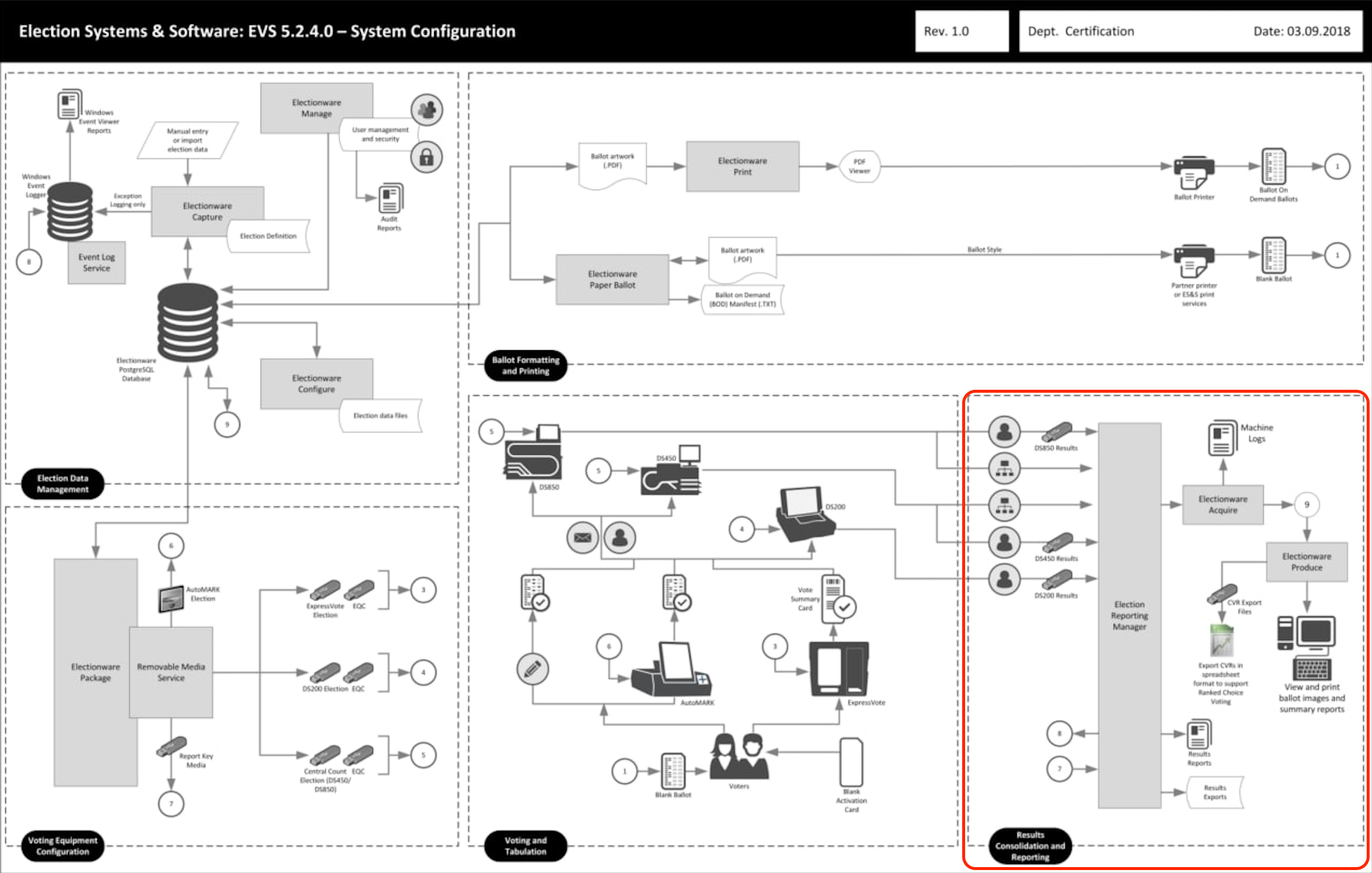
In the 3/15/2022 Nye County, Nevada County Commissioner’s meeting cyber security consultant Mark Cook described his experience with computers pre-internet in the CompuServe and Prodigy days, then as a consultant to protect companies from threats and seal off vulnerability, and finally with election systems.
Today, Dominion is a popular voting system which uses Microsoft SQL database, one which Mark was and is very familiar with as he used SQL databases from day 1. In the same meeting, he discussed how within the first minute of getting his hands on a Dominion system, he was able to access the backend and change votes…without leaving a trace.
In the Antrim County, Michigan investigation, where there were a confirmed 7,000 votes flipped (in the 2020 election), nation-state vulnerability expert Jeff Lenberg demonstrated vote swapping that allowed the election management system and tabulator printouts to match (for the canvass). The problem? The EMS and the tabulator tapes would not match the paper ballots initially scanned through the tabulator. (This is still one of my favorite videos and mirrors a mock election experience that Draza Smith, Col. Shawn Smith, and Mark Cook created alongside Patrick Colbeck at the Cyber Symposium. Once you see how easy it is to swap votes, it cannot be unseen, and this is only one of many exploitable vulnerabilities.)
In 2021, when Tina Peters learned that a Dominion vendor was planning to visit her office to make a software update, she took action in line with her statutory duties to preserve election data as the Mesa County Clerk. She worked with consultants to save a copy of the before and after image of her Dominion Voting Systems (DVS) Election Management System (EMS) servers, which data analysts then began investigating to detect what Dominion’s “Trusted Build” may have changed.
It turned out to be a lot.
The three Mesa County reports go into much detail on findings, some of which was alluded to in the Selection Code documentary.
These not so trust-worthy software updates were performed by Dominion employees across the country, possibly destroying evidence of election tampering and manipulation. It is possible that such an update may have occurred in the six Minnesota counties using the Domininon Voting System (DVS) Election Management System (EMS). So far, just the one before/after image of the servers exists. For her contributions, the Mesa County Clerk, Tina Peters, who first began telling her story in the August 2021 Cyber Symposium, has been politically imprisoned for a sentence of 9 years.
Influence Operations
I have chosen to borrow the term influence operations from Patrick Colbeck since it is less frequently used when compared to psychological operations or psyops. The screens which bring us our daily inspiration and fear, information from loved ones and our 2-minute’s hate (à la 1984), are seemingly a blessing and a curse.
A blessing because it is only with the internet that information can be shared quickly enough and widely enough to outflank centralized media platforms and censorship regimes.
But a curse because influence operations are deployed on those screens which provide an unobstructed path to our brain, unless one is armored up and discerning wisely.
For me, the most significant influence operations in the preparation phase in Minnesota were George Floyd, its extended aftermath, and of course, Covid-19.
At the time I lived not far from 38th and Chicago.
A few months later, I biked there once and another time went on foot. Roads were blocked making it difficult for locals to leave area in cars. Shops were closed replaced by vendors selling t-shirts and BLM masks. Flowers were laid before the provocative murals and around the monument at the intersection. Into the beginning of 2025, it is still unclear whether the area will be properly cleaned up so the business owners there can continue operating, or whether various monuments and displays can remain, or even whether it will be turned into a walking mall.
In the days following May 25, 2020, there were protests and looting and riots. The 3rd precinct police station burned. It was a trying time to the point that I even asked one of my clients if I could take time off from a gig. One protest organized by Royce White, then a candidate for Congress, as well as a 2024 candidate for US Senate, led thousands to the Federal Reserve, where they prayed, an interesting and significant choice that got the attention of many, though I missed it at the time.
Covid-19 led to the deployment of eerily similar lockdowns and language worldwide—language precedes manifestation. The monthly discussion groups I’d held ended and I resorted for a time to arguing needlessly with friends online. One day I saw Jacob Frey, Mayor of Minneapolis, jogging maskless near the fairly crowded Stone Arch Bridge—that evening he was wearing a mask announcing new recommendations and rules. Then came the experimental vaccines, only qualifying to be called as such because of dictionaries redefining the term. Perhaps suspecting I had exercised my right not to partake, a Mayo Clinic ICU doctor before a pickup soccer game asked if I had questions about Covid-19. Boy, did I ever.
It was great to see people like Lisa Hanson, who I would later meet at an Otter-Tail related event in CD1, defy shutdown orders and unfairly spend 60 days in jail and people like Mark Bishofsky organize rallies at the St. Paul Capitol. When Mayor Frey and Mayor Carter announced in a joint press conference the vaccine card requirements, I wrote this article questioning their judgment.
Months later, I was on the phone with the head of a hospital in Seattle who predicted that the inventors of the mRNA vaccines would get Nobel prizes. Maybe they will. But so did Barrack Hussein Obama before many realized what he was up to. When I asked this head of hospital if he got his booster, he said he probably wouldn’t get the next one because now there were alternative treatments…
The chaos played into the enemy’s hands.
They kept us divided, distracted, demoralized.
The subversion of our elections was well under way.
All the while, preparations continued to be made for the election with little if any reporting of substance regarding the consent decrees which stripped witness and signature requirements from absentee ballots, nor the mass installment of Zuckerboxes, nor the careful calibration of electronic equipment such as tabulators and iPads from vendors like KNOWiNK to give the centralized controllers eyes and ears throughout election day.
As part of the Attack Phase, to that we turn next.