Chapter Six - Defense
“Are you ready?”
- Mark Cook
The Defense Phase is where the attackers try to defend against what Patrick Colbeck calls the meddling kids from discovering what they did. It involves cover ups, destruction of physical and digital evidence (Dominion’s Trusted Build), slow walking and infiltration of livestreamed election audits (the Maricopa audit), media bullying, and lawfare. Unfortunately, it has too often involved government officials, further eroding the people’s trust in the system.
This phase began on election night 2020 and in many regards we remain in this phase, even in early 2025, with respect to 2020 but also now to 2022 and 2024.
Some object to the prospect of coordinated fraud on the grounds that it would not be so easy to cover up.
But if there were people smart enough, sophisticated enough, and resourceful enough to pull off such a heist nationally (and likely involving international and supranational components), wouldn’t it stand to reason that they would have some kind of plan to get away with it? They did, although in retrospect it was a bit sloppy and there were eyes on their actions. For example, people like Patrick Colbeck, author of The 2020 Coup, were on the scene at the TCF center in Detroit serving as a certified Poll Challenger when the vans arrived in the early morning hours.
The people that did this may be clever, but it was an uphill task to pull every lever and not spring a leak.
The first leak was on election night when there was a coordinated pause to vote counting in multiple states.
That alerted millions if not tens of millions to the subversion right from the start. It was only a matter of time before the riddle could be solved, despite extensive interference from many you might have thought would have supported election accuracy and transparency, but who have revealed that they do not.
Part of Their Plan?
At the Cyber Symposium, Dr. Shiva gave a presentation which detailed the connections between the various players and mentioned a few of their published playbooks. These are recently coming into view in a different way through the work of people like @DataRepublican on X. One of these publications was The Long Fuse, by the Election Integrity Partnership.
On page 3, the ‘Data Cleanup’ phase immediately follows the election. What data exactly needed to be cleaned up?
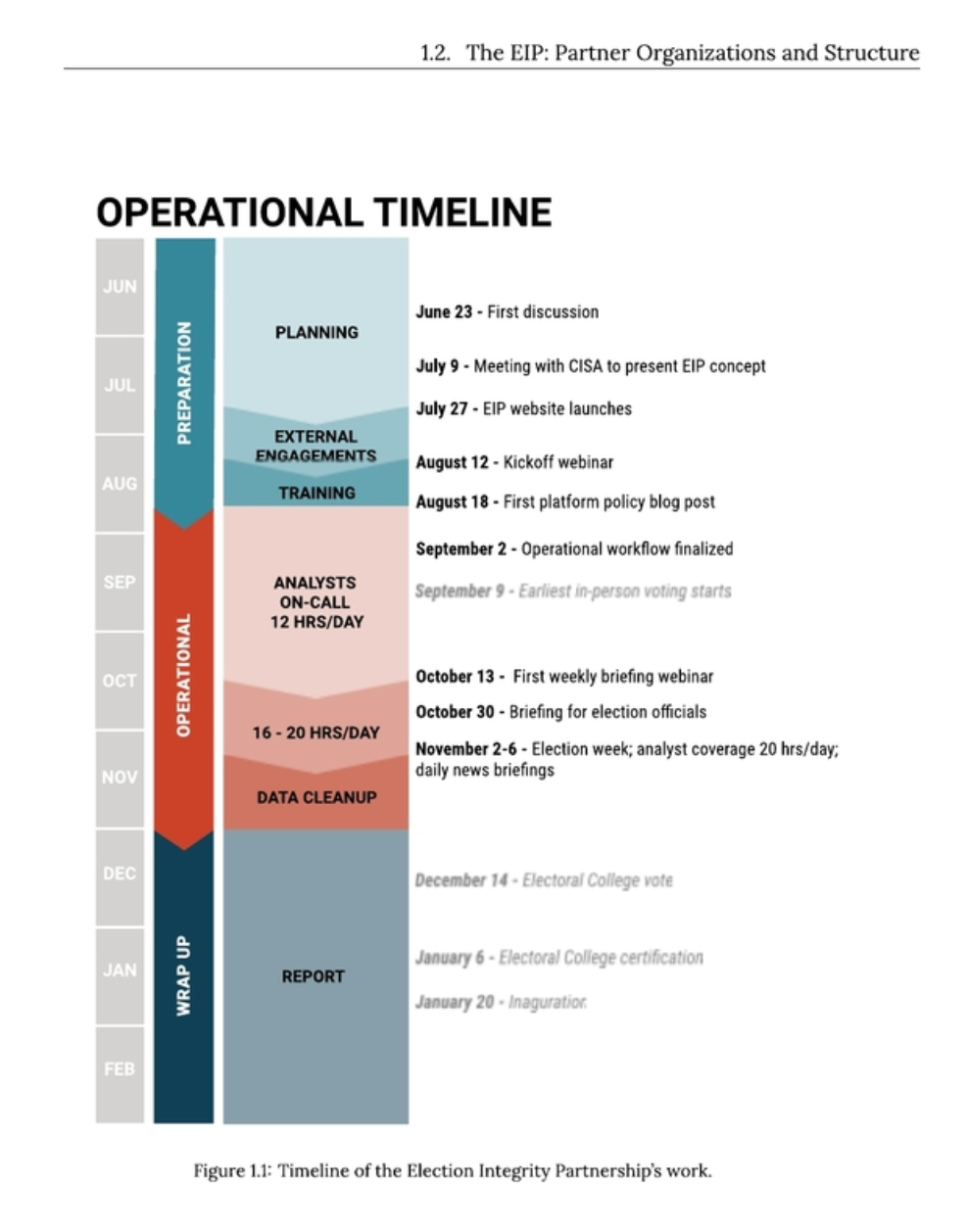
Part of the data cleanup being done would need to happen with the voter rolls. Public requests of these rolls and comparisons between them show large changes across time in registrations. Presumably this could cover up large additions of phantom voters just prior to elections.
But what is harder to cover up is detailed comparisons across counties in a single state, as was shown by Erin Clements in New Mexico’s voter rolls, or the proof of database manipulation in the Mesa County, Colorado Dominion Trusted Build.
700,000 Reported Absentee Voters Not Connected in SVRS
Rick Weible’s database analysis of Minnesota’s statewide voter registration system (SVRS) highlighted that there were more than 700,000 absentee voters reported than documented in the SVRS five days after the MN Canvassing Board certified the election.
In other words, 700,000 MORE votes than voters. Did these ballots even exist?, one wonders.
In a June 7, 2022 GGP meeting in Dakota County, former Election Manager of Dakota County Andy Lokken said that after the fact comparative analysis of SOS-reported data with the SVRS data was not an effective way to verify results.
Then how should an election be verified by the people?
Bear in mind that no statewide nor any county-wide full forensic audits (of all election materials, not a recount of ballots) has been done in Minnesota, ever. Citizens have faced considerable resistance from those responsible for ensuring that no voter is disenfranchised and have succeeded in finding numerous indicators and proof that election processes were not followed according to statute and that the results are therefore seriously in question.
Regarding the absentee voters: If the SOS data was not at all consistent with the SVRS data 25 days after the November 3, 2020 election, when was it going to be? And how did the MN State Canvassing Board certify the election 5 days prior with such a large discrepancy? To repeat, on November 29, 2020, just 5 days after the MN Canvassing Board certified the election, more than 700,000 reported absentee voters were not connected in the statewide voter registration system.
This fact alone should have triggered a statewide audit and uproar from any elected officials that care about election integrity. If you are unsure about your local elected officials, ask them what they think about this issue and whether they believe we ought to have higher standards for our absentee ballot process as it pertains to data accuracy in our statewide voter registration system.
Many are not aware that although there is a clause about party balanced absentee ballot board judges (those who process the absentee ballots as they come into the counties), the counties have the option to simply staff those boards with their own employees who do not have to be balanced from the major political parties. In essence, the statutory oversight is minimal regarding absentee, which, in 2020, was the majority of ballots at 58%, or 1.9 million (1,900,000).
From the perspective of the defense phase relating to absentee ballot coverup, deflection and obfuscation of the 700,000 ballot delta that Rick called out (it still remains unresolved) should be expected—the general public learning this certainly threatens to undermine the credibility of those at the helm.
Minnesota Post Election Review Reveals Missing Ballots
The local media likes to report on the success of risk-limiting audits (RLAs) which are known as post-election reviews (PERs) in Minnesota. Let’s discuss why these are not suitable to demonstrate the total accuracy and integrity of a machine-driven and absentee-driven election.
In Minnesota only about 3% of of precincts per county are subject to a post-election review according to Minnesota Statute 206.89 POSTELECTION REVIEW OF VOTING SYSTEMS, although counties can opt to do more.
In 2022, there were at least two counties that opted to do a few more, mostly to appease advocates.
Then, in 2024, spurred on by the Anoka County Election Integrity Team (ACEIT), the Oak Grove City Council voted 5-0 in favor of performing a post-election review of all four of their precincts, hopefully for all the contested races as well. 7 cities in total desired this out of 21 municipalities in Anoka County.
A post election review hand counts ballots returned by the optical scan ballot counters in select precincts.
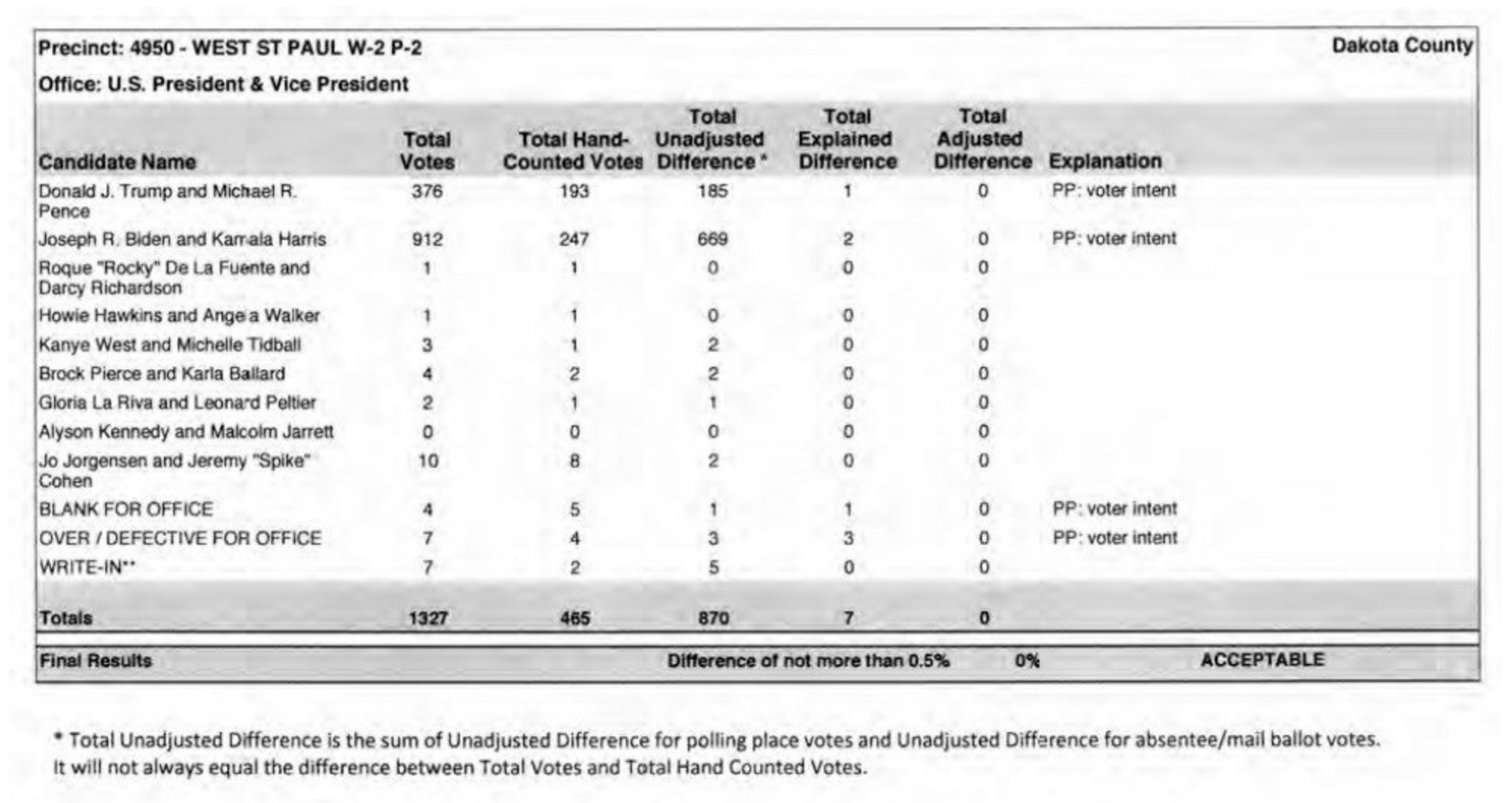
Stepping back to 2020, in a postelection review in Dakota County’s Precinct 4950, WEST ST PAUL W-2 P-2, the total unadjusted difference was 870 votes. 7 of those 870 votes were explained, but 863 were not explained. Why then does the total adjusted difference (the last column) show all zeros? The total adjusted difference should read 863 (870 minus 7). Even with 65% (863 out of 1327) of the total votes in this postelection review left unexplained, the Final Results row says this is a “Difference of not more than 0.5%” and the Total Adjusted Difference is “0%”, deemed “ACCEPTABLE”.
Of course, this is clearly not acceptable and it begs the question: How many more precincts would turn up red flags like this if more postelection reviews had been done? And how many more red flags might be raised if proper audits were done? Is this why cast vote records (CVRs) and corresponding ballot images have not been forthcoming from local election officials? With this work being shown to Minnesotans, it would be strange if they were not asking for audits and accountability.
What this example demonstrates even more is the difficulty of reconciling the paper ballots to the machine counts. If a top-down simulation is being run that needs to be backfilled after the fact with ballot (or printer) deliveries to precincts and counties 2000-Mules style, but that last-minute work isn’t completed, then the outcome would be what we’ve seen in Dakota County’s Precinct 4950.
If the reader thinks the comment in the previous paragraph about printers is a joke, it is not. Two Dominion printers arrived on the day of the post-election review in Dakota County described above, although their bill of lading showed there had been an attempt not to have them arrive on that exact day. Yet there they were.
What’s more, by comparing the increases to Trump votes (from hand count to total votes) with the increases to Biden votes (from hand count to total votes), we also gain insight into how an weighted ratio algorithm might have been used to increase Biden votes by almost 269% while Trump votes only increased by 95%.
You be the judge. Was this data cleaned up well?
When Kim Bauer received in June 2022 the receipts from post-election reviews done in Dakota County for 2020 as well as 2021 (when her school board election took place), it was discovered that some of the post-election review documentation differed from the originals. I sat in on one meeting where Dan Wolbert and Rick Weible asked the election manager Andy Lokken and his boss for more information and to my knowledge it still has not been resolved.
It was far from the only issue from 2020 onward.
A Petition to Stop the Certification of Minnesota’s Election
Based on the postelection review above (but not only that) it was correct for Susan Shogren Smith to properly serve a petition to each member of the Minnesota State Canvassing Board prior to its certification of the 2020 election, in part reading:
“Minnesota candidates for office and voters have come forward with affadavits detailing concerns and observations about the ignored and failed election processes in counties across the state…If this Court does not take action to prevent the certification of the Minnesota election until a complete, bi-partisan statewide audit of the election occurs, including election materials, our election system, and the trust of the voters, will be irreparably harmed.”
The MN State Canvassing Board is the sole entity identified in the MN Constitution carrying the duty to canvass the statewide election results. However, the MN Supreme Court erroneously ruled (in my opinion) that all 87 counties had to be served. Therefore the case was dismissed without a hearing on the facts on Friday afternoon, December 4, 2020. This dismissal was critical to meeting the the safe harbor deadline of December 8, 2020.
Since that time, every point made in the petition has been confirmed by the work of Rick Weible and others, including “issues related to procedure, observer and election judge access, voter intimidation, lost ballots, lost absentee envelopes, missing election materials and questionable ballots… [and] concerns about voting equipment transmitting results during the early counting period on election day.”
Susan Smith also helped the Minnesota Election Integrity Team (MNEIT) to file five election contests for senate and congressional races.
Those and the two that Edwin Hahn helped to prepare were all dropped, although not until well-known and now infamous lawyers such as Marc Elias of the east coast Perkins Coie signed into the cases pro hac vice (out-of-state).
The cases were dropped without looking at the evidence. And there was a lot of evidence which Jose Jimenez, Ali Hopper, and the team had collected from attending about 60 out of 87 post-election reviews throughout the state following the 2020 election.
Then something happened.
Susan Smith was brought before a hearing with Judge Castro of Ramsey in 2021 and there it was wrongfully decided she had committed fraud on the court. (See the Bonus Chapter for more.)
The details of this are too much for this particular book, but they are essential background for anyone who wants to understand the layers of the system we are caught up in and why our government and related systems requires an immediate and complete audit, top to bottom, and bottom to top, in order for Minnesota to be revived.
The reader is encouraged to read this briefing submitted by Susan Smith at the close of a disciplinary hearing brought against her by the Lawyers Board which does an amazing job of summarizing the landscape, climate, and timeline of events related to the five election contests in 2020 and the petition to stop the certification, which are certainly relevant to Minnesota voters and the people of Minnesota generally. Look for the Respondent’s Post-Trial Brief for File No. A23-1890.
If you can’t find it, simply read the brief here.
Before going into just few details from counties I interacted with in 2022, and a few since… I want to discuss pushing back against tyranny and the significant matter of the missing (or withheld) cast vote records and ballot images from previous elections, in particular 2020 and 2022.
Where Are the Cast Vote Records?
Cast vote records (CVR) are automatically generated when the tabulator interprets the ovals selected by a voter from the digital image (known as the ballot image) it creates when a voter (or election worker) inserts the ballot into the tabulator/scanner.
These have been a standard since 2005.
The cast vote records and their corresponding ballot images were denied to the public in Minnesota throughout 2022 and 2023 before the 93rd Legislature admitted they existed by putting them into Minnesota Statute 206.845, Subdivision 3.
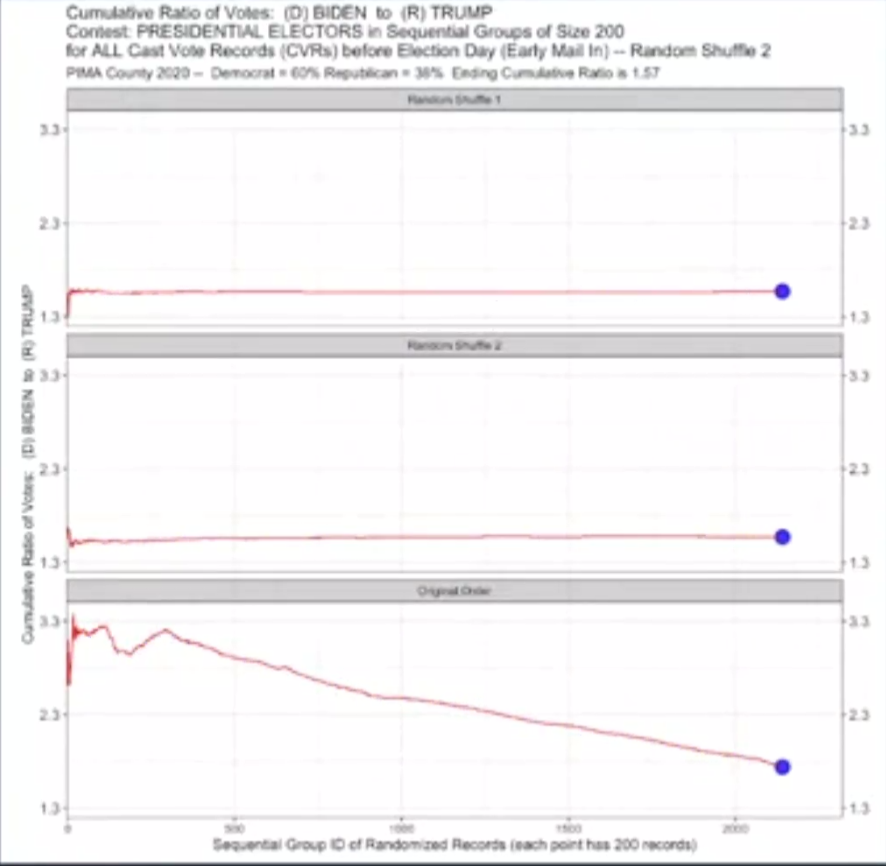
Have a look at this CVR from Pima County.
The top two graphs look good.
But the third (bottom) CVR is not realistic. The only way that could happen is if there happened to be several thousand Biden ballots show up at the same time. Then you might see that driving toward the setpoint. But this graph clearly shows a defiance of the law of large numbers.
To date no CVR reports have been shared with the public for 2020 (except Fillmore County, partials from others) despite numerous public data requests to county election officials and their offices throughout the state. (In 2022, Chisago County shared its August 9, primary election report, not ballot images.)
Here’s just one response from the Todd County Attorney:
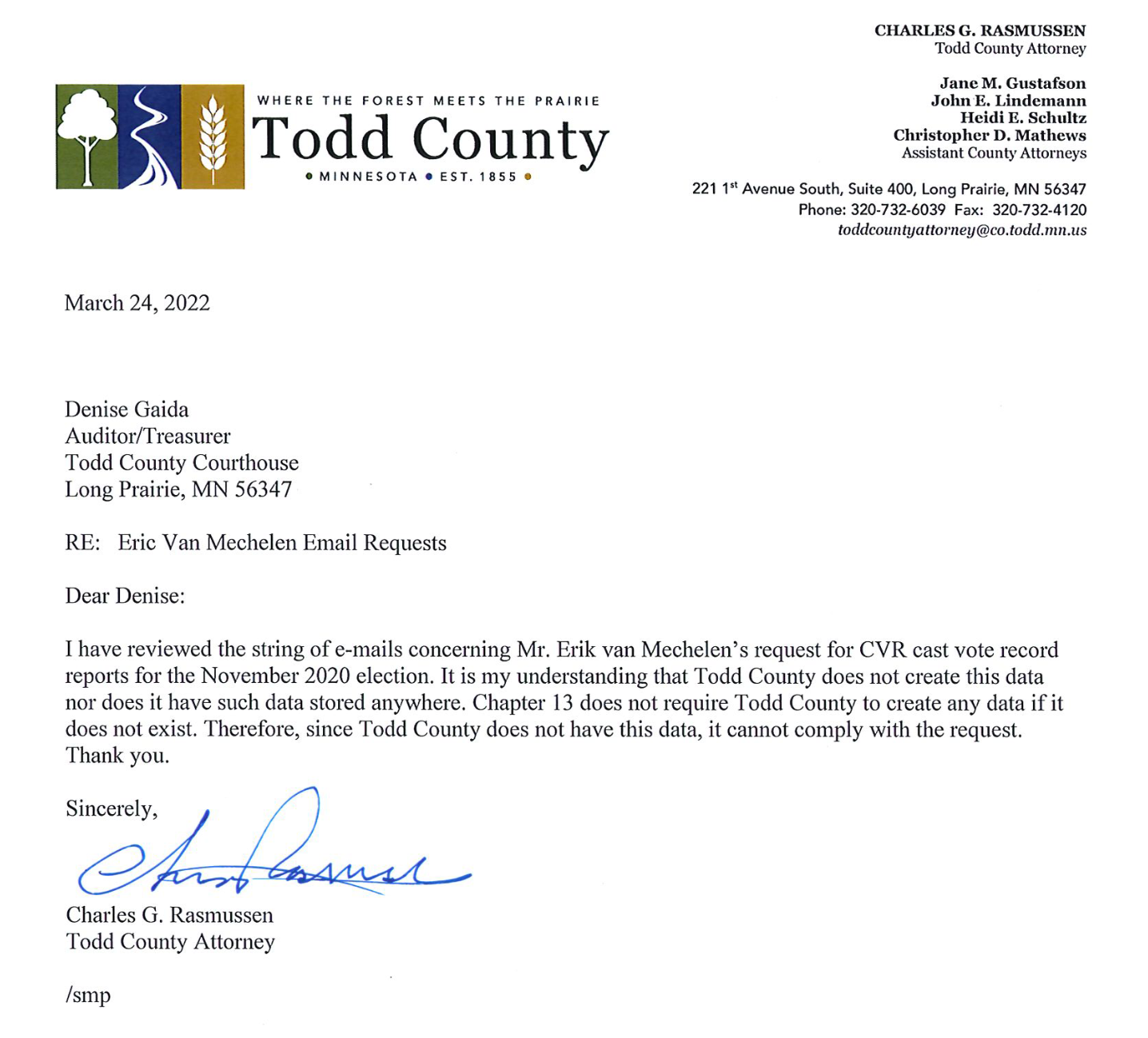
But ES&S’s own manuals describe the availability of this functionality.
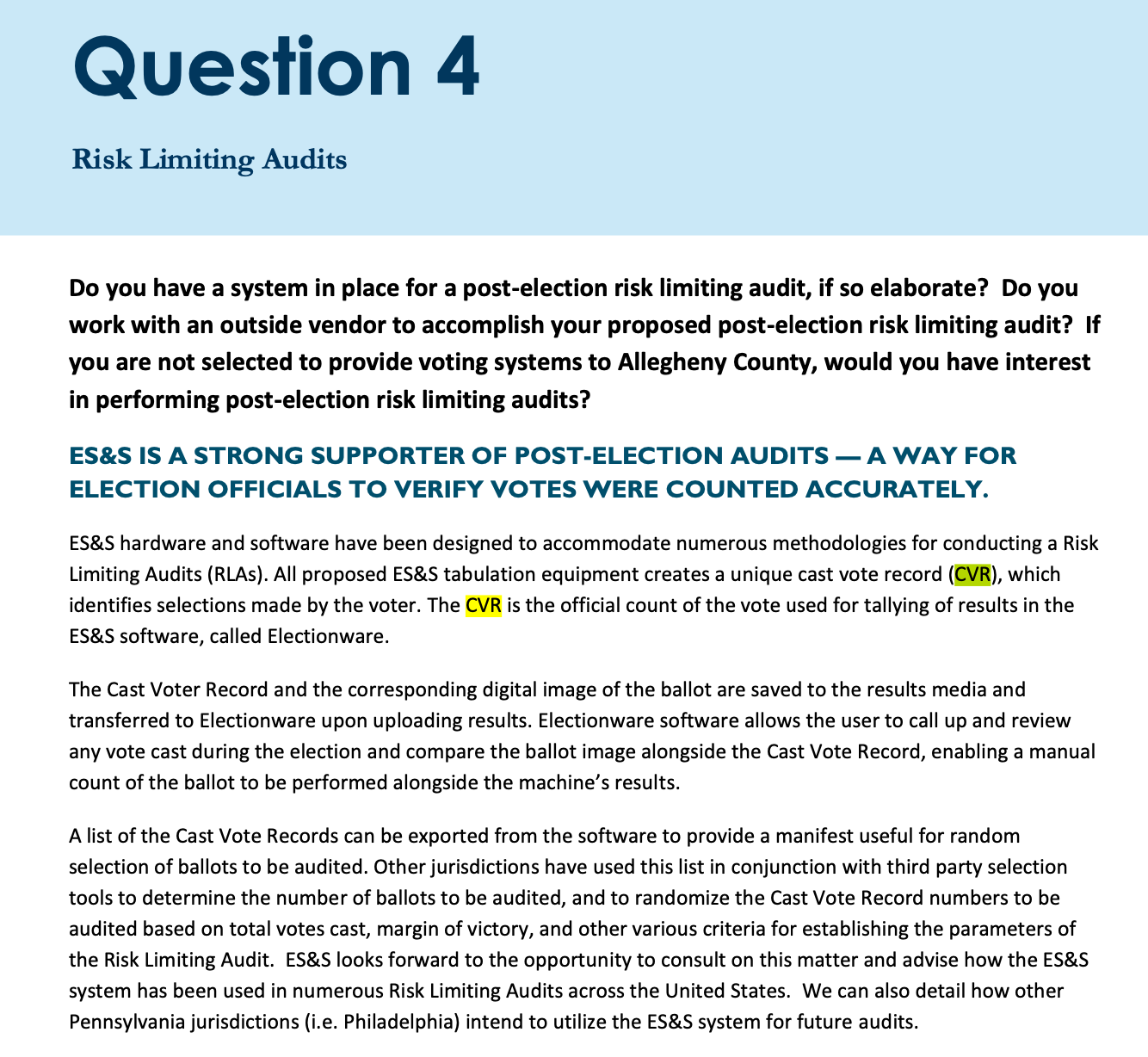
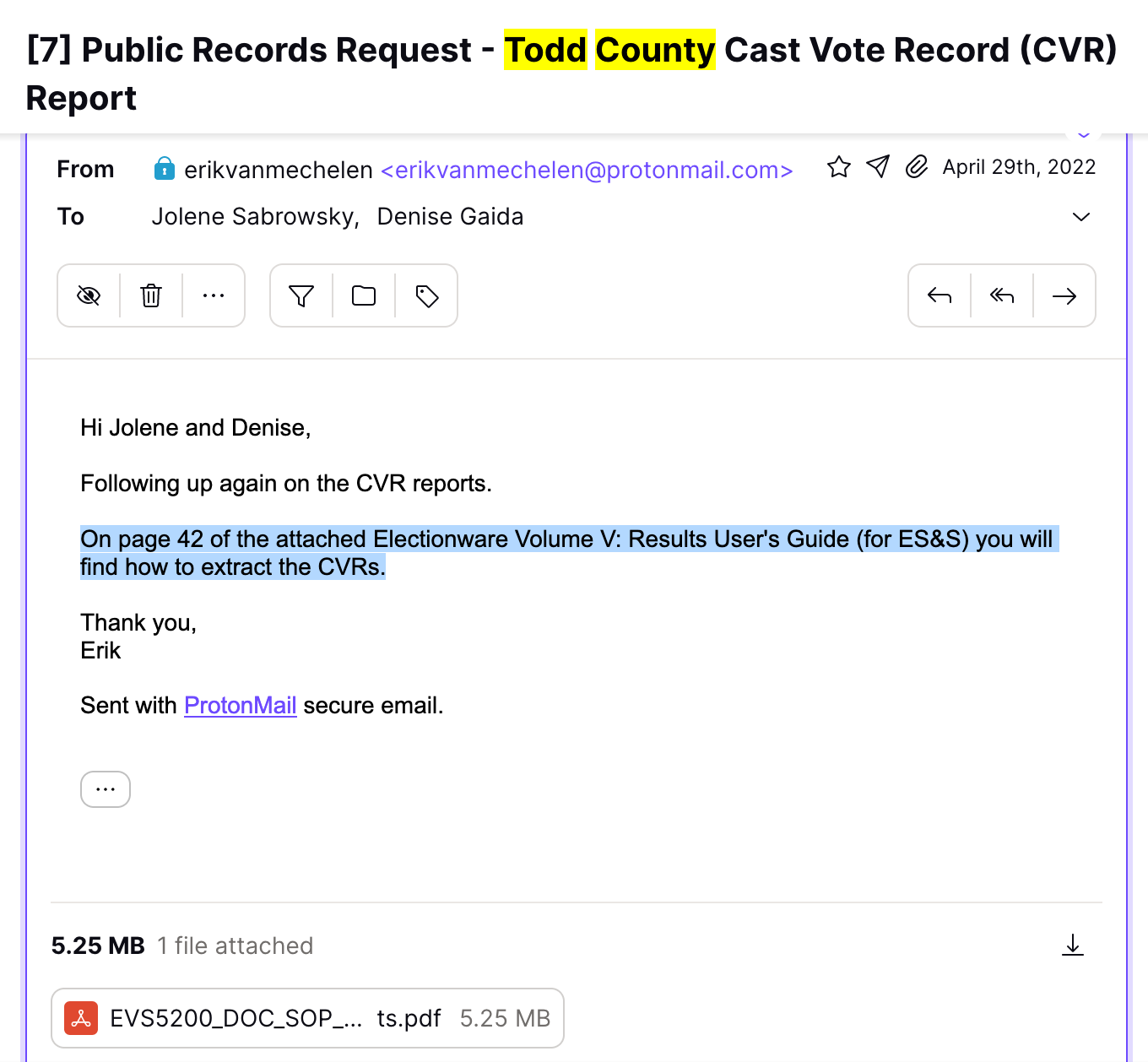
I even sent the Todd County election officials a PDF of how to extract the CVRs, which are page 42 of the ES&S Electionware Volume V: Results User’s Guide.
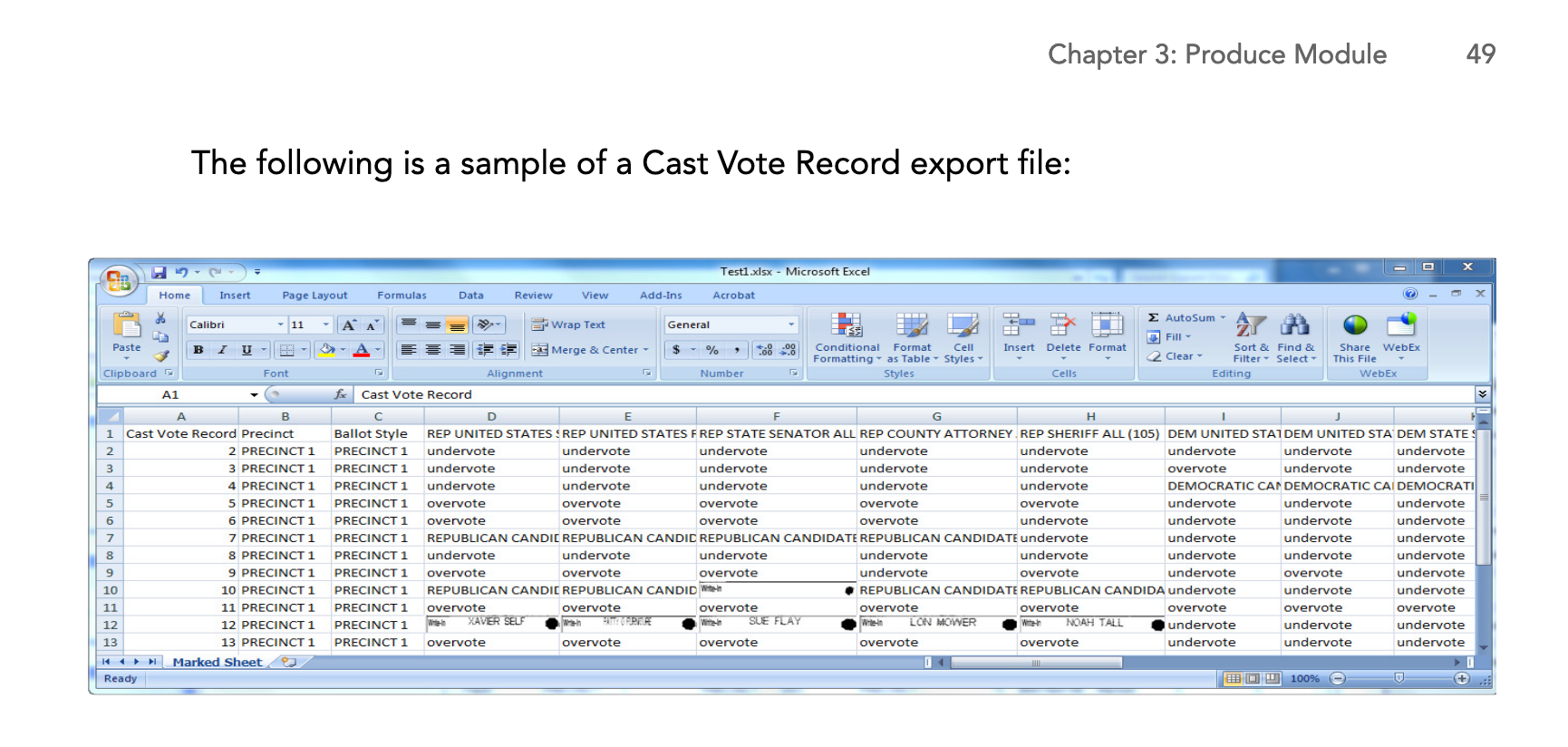
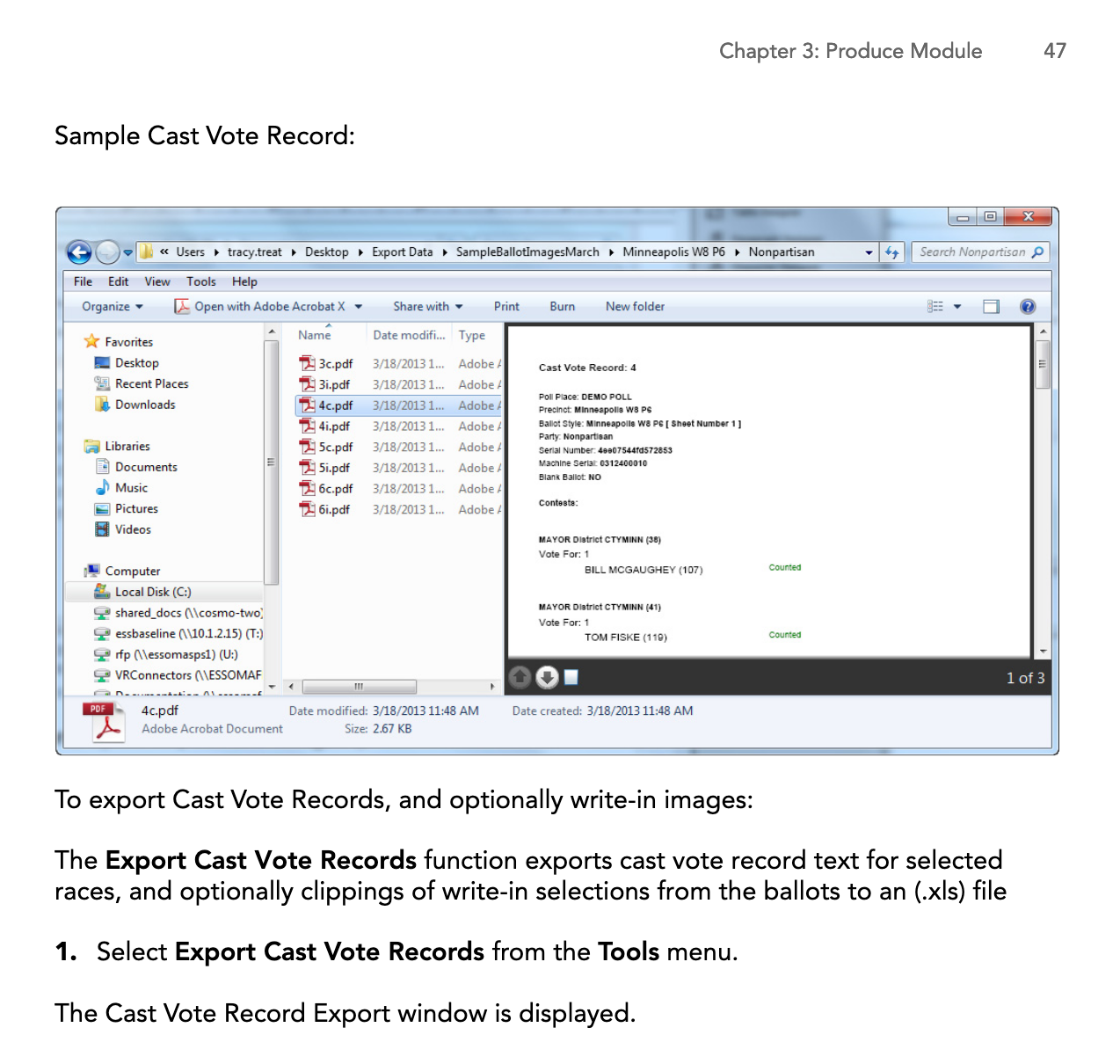
No response was given to the following email since I sent it on April 29, 2022.
I have tried to sort out how CVRs might have been turned off (they cannot be, otherwise the machines cannot be used according to their certification), or if there is a language game being played, or if the CVRs might be stored somewhere else or called something else. Minnesota Statute 206.845 Subdivision 3. Cast Vote Records does clarify this for us by stipulating that the ballot image portion of the cast vote records are not to be made public in Minnesota. Why not?
From a document titled “Ballot Image Information on ES&S Systems issued November 1, 2018, it appears that the EVS Electionware user can specify which ballot images are to be saved on the DS200 and Central Scanners (DS450/DS850): 1) All images, 2) Write-In Images Only, 3) No images. Could these configurations at all be related to whether the CVRs are saved?
The technical details may not be clear, but the truth is states like Rhode Island and select counties in other states have received their CVRs which exposed the machine problem. Minnesota is using the same hardware and software from the same vendors as these other states, primarily DS200 tabulators from Election Systems & Software (ES&S) and Electionware, or Dominion’s or Hart’s equivalents.
But in Minnesota the people were told they didn’t exist, at least according to the responses Minnesotans have so far received from their county officials. Could the Office of the Secretary of State or the vendors have been guiding the counties on how to respond to these requests?
On June 24, 2022 I spoke on the phone with the county auditor in Chisago County to learn more about why they don’t have the CVRs. In this phone call, the county auditor shared that Hart had done an onsite software upgrade about a month prior (around May 2022) which archived the 2020 election. I’m not sure whether this is in violation of the 52 USC §20701 22-month election data retention records, but it sure seems like it.
On the phone call, the county auditor of Chisago County stated that she had already asked the vendor who said the CVRs could not be recovered. To her credit, the Chisago County Auditor stated that she had made a note to save that report in upcoming elections, to which I expressed gratitude. The 2022 cast vote record report was produced for Chisago from their Hart systems as a PDF readout. Ballot images were not provided.
This is not the first time software vendors have put election officials in a bad position through software upgrades, with the most high profile example being in Mesa County, Colorado, where the clerk, Tina Peters, has been politically imprisoned.
Going forward, it is also important to urge counties to make the cast vote records public immediately following elections, as is done by for example, Dodge County, Wisconsin, just to our eastern border.
Dominion and Hart also produced CVRs. In Hart’s case, it produces a CVR (basic to counting ballots and their vote opportunities): Out of Idaho a Technical Reference Manual “Ballot Scanning and Review Software” Terms: Cast Vote Record (pages 10, 11, 14, and 189); CVR (pages 10, 11, 14, 18, 163, 164, 214) and 131, 133, 135) …
Pushing Back Against Tyranny
On Day 2 of the Cyber Symposium I found a chair near the front, stage left. Not far away Dr. Frank and Mark Cook continued to explore and explain the server images provided by Tina Peters (highlighted in the [S]election Code documentary). I had noticed Captain Seth Keshel come in and wanted to speak with him. Not long before this Code Monkey’s lawyer had apparently suggested they not examine the server images since they may have been acquired illegally (I belive this to be untrue, as it is the duty of county clerks to preserve election materials and data). I learned from the person who gave me a ride from Minneapolis that a few of them in the back were looking at the same server images and feeding Dr. Frank and Mark Cook information. Dr. Frank’s calming intonation, “This is better than PCAPs” still holds true today.
When Seth finished speaking with Wendy Rogers and Sunny Borrelli, I introduced myself. He said to focus on the collar counties around the Twin Cities like Wright, Scott, etc. Seth’s point was that we would face too much opposition in counties like Hennepin, Ramsey, Dakota, or St. Louis. And given the progress teams have made in places like Wright and Dakota, and more recently in Anoka, his trend and political analysis was not wrong to highlight them. But as time passed it was also clear that breakthroughs might also be achieved in more rural, lower population counties, of which there are many across our 87-county state.
Months later, my friend Nathan and I had been thinking about where to focus in Minnesota. Nathan said, Why not Todd County? David Clements had been urging folks to find rural counties where county commissioners might be more willing to put election discussions on the agenda or even pass favorable resolutions. And, after all, Dr. Frank’s refrain is “Vote Amish,” a nod to elections without unneeded technology. Todd County is one of the Amish hotspots in Minnesota. So I sent Todd County a data request for their 2020 cast vote record (CVR) report on the same day I sent a request for one from Hennepin County.
I tell this story in wrapping up the chapter on the enemy’s coverup to illustrate a lesson encapsulated by Stargate SG-1’s Season 5, Episode 5 - Red Sky, wherein the SG-1 team causes the disruption of a sun near a planet protected by the Asgard. Unbeknownst to the locals, SG-1 seeks help from the ‘Grand Council’ Asgard. In the conclusion, it is unclear whether the solution attempted by the SG-1 team and the local population was successful, or if the Asgard had helped them out after all.
In other words, it’s important to try, to take actions, which is all that can be owned—the emotional attachment to any outcome need not be.
And wouldn’t you know it? Within moments of writing the above lines (Thursday, June 16, 2022) I stumbled upon a page in the ES&S DS200 Operator’s Manual, which explained that if the ballot images are turned off, then so are the cast vote records.
Now, this is critical.
First, for emphasis, understand that the scanners cannot interpret the ovals on the ballots (the voter decisions) directly from the paper ballot itself. The ballot image file must first be created digitally, and then the interpretation is done and saved within the tabulator itself.
If the ballot image functionality were indeed turned off, then the scanner is not doing much of anything at all. It certainly isn’t counting votes or tallying votes, and should not be used in an election.
If indeed it is discovered that ballot images were turned off in any tabulators in Minnesota during the 2020 election, it calls the entire election into question immediately based on the utilization of equipment in a manner not certified.
Such a decision would resolve much of the confusion I’d had up to this point regarding cast vote records (CVR) and the seeming lack of any in Minnesota from the 2020 election. But if this function HAD been turned off, then the entire election was a scam. On this line of thinking, with ballot images turned off, the results would have had to have been generated with an algorithm, assigning results to precincts that the Secretary of State’s websites then reported. (Then the work would begin to prepare ballots to match during the post-election reviews… as has been discussed, over 60%, or more than 800 ballots, were found to be missing in just ONE of Dakota County’s randomly chosen precincts.)
Page 57 of the ES&S Operator’s Manual explains how if the ballot images are turned off, so are the cast vote records. I was so excited to find this that I immediately posted the following on my Telegram channel.
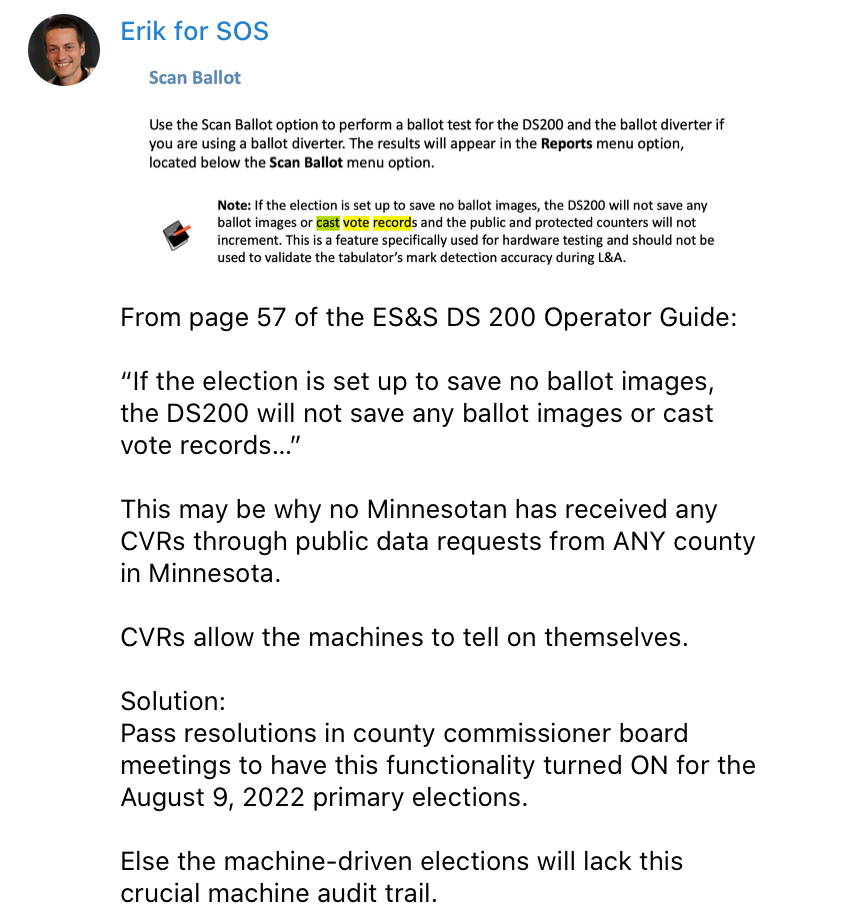
Note that even the manual says this feature should only be used for hardware testing, not for public accuracy tests, not during actual elections.
If the sole purpose of having the tabulators is turned off, then tax payers are paying for a machine that is useless and calls the integrity of election administration deeply into question.
Crow Wing County
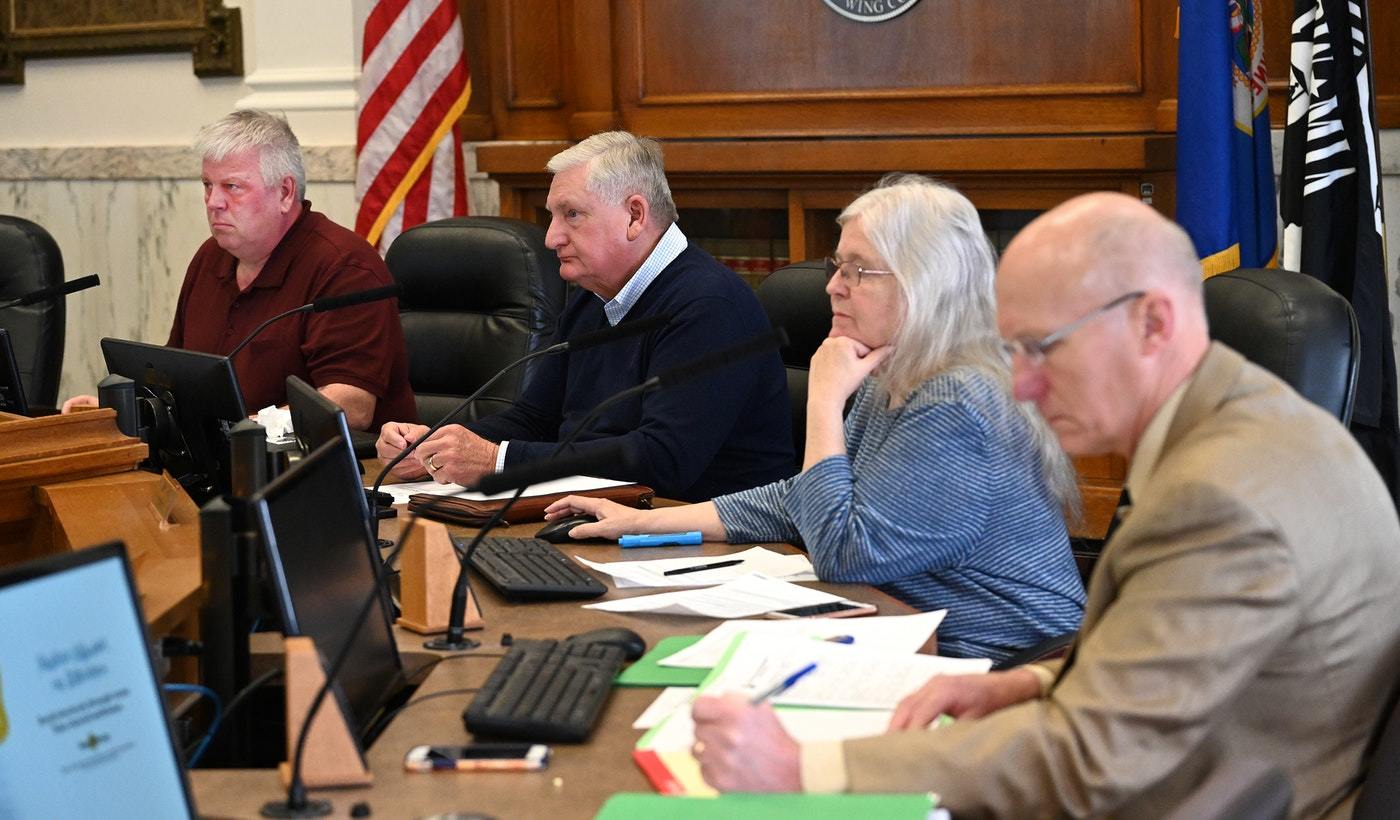
After multiple commissioner board meetings attended by dozens of Minnesotans who didn’t trust the results of the 2020 election, the commissioners were finally persuaded in late December to pass a resolution seeking an audit. Don Ryan, the County Attorney, interpreted Minnesota law and advised that the county could not unseal its own ballots, and so the request was made to Secretary of State Steve Simon, who declined to undertake a full forensic audit of all election material and data.
In their resolution, which passed 4-1, the commissioners stated that the board “continues to have faith in the 2020 election results as valid and reliable but it is equally troubling that there are citizens who still have a sincerely held belief that it was not”, suggesting they did not wholeheartedly agree with their constituents and were perhaps going ahead with the resolution as a matter of appeasement. In May 2022, at least one of the same commissioners was afraid to open an email with a link to 2000 Mules when candidate for house rep Doug Kern sent it to the Board.
All this said, Crow Wing was the only county to request such an audit from the secretary of state.
So, how did Secretary Simon respond?
“Our office will not engage in a vague and impossibly broad search for unspecified misconduct based on anyone’s gut feeling, hunch, or belief — no matter how sincerely held,” Simon said. “The 2020 general election, which took place almost 15 months ago, was fundamentally fair, accurate, honest, and secure across Minnesota.”
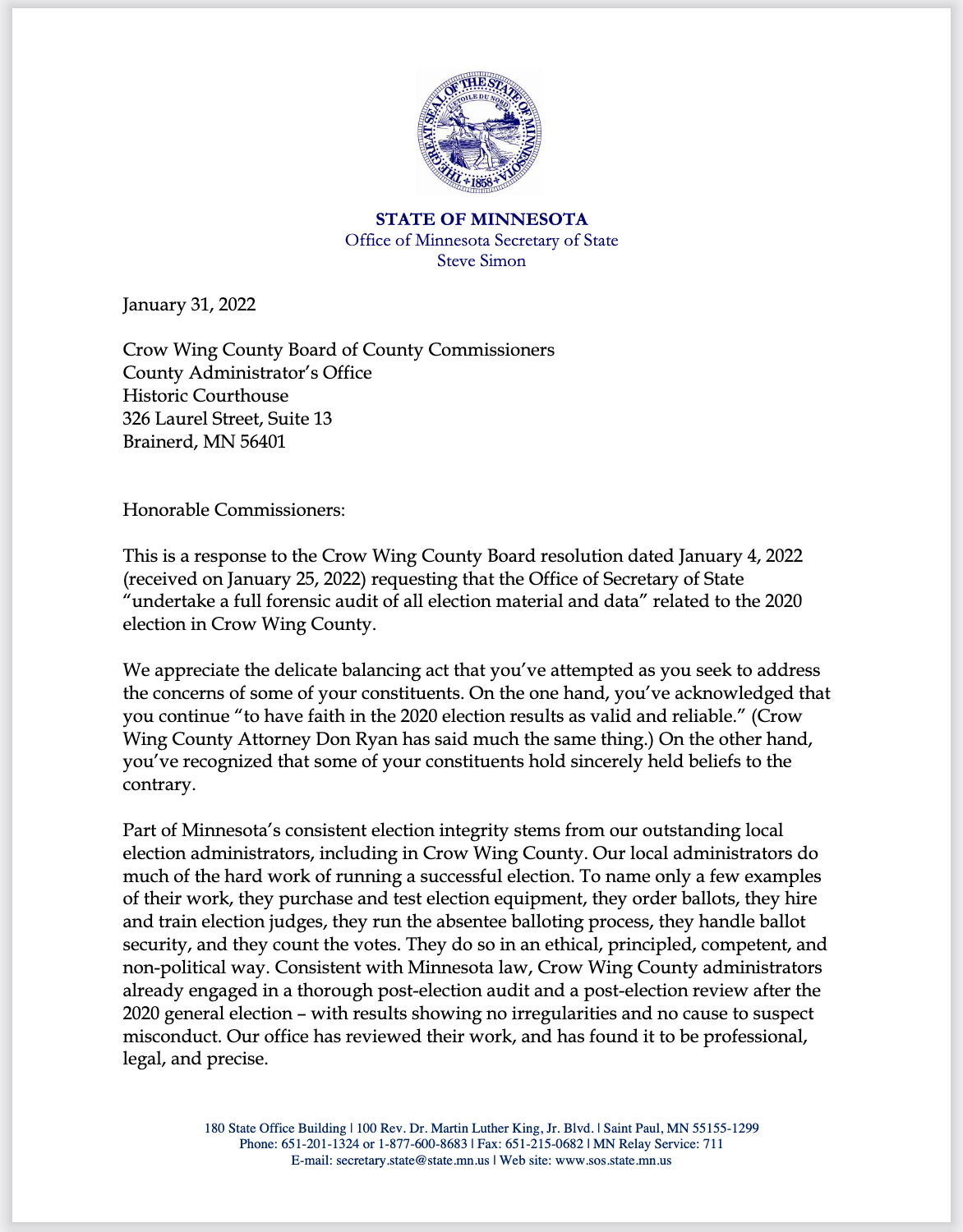
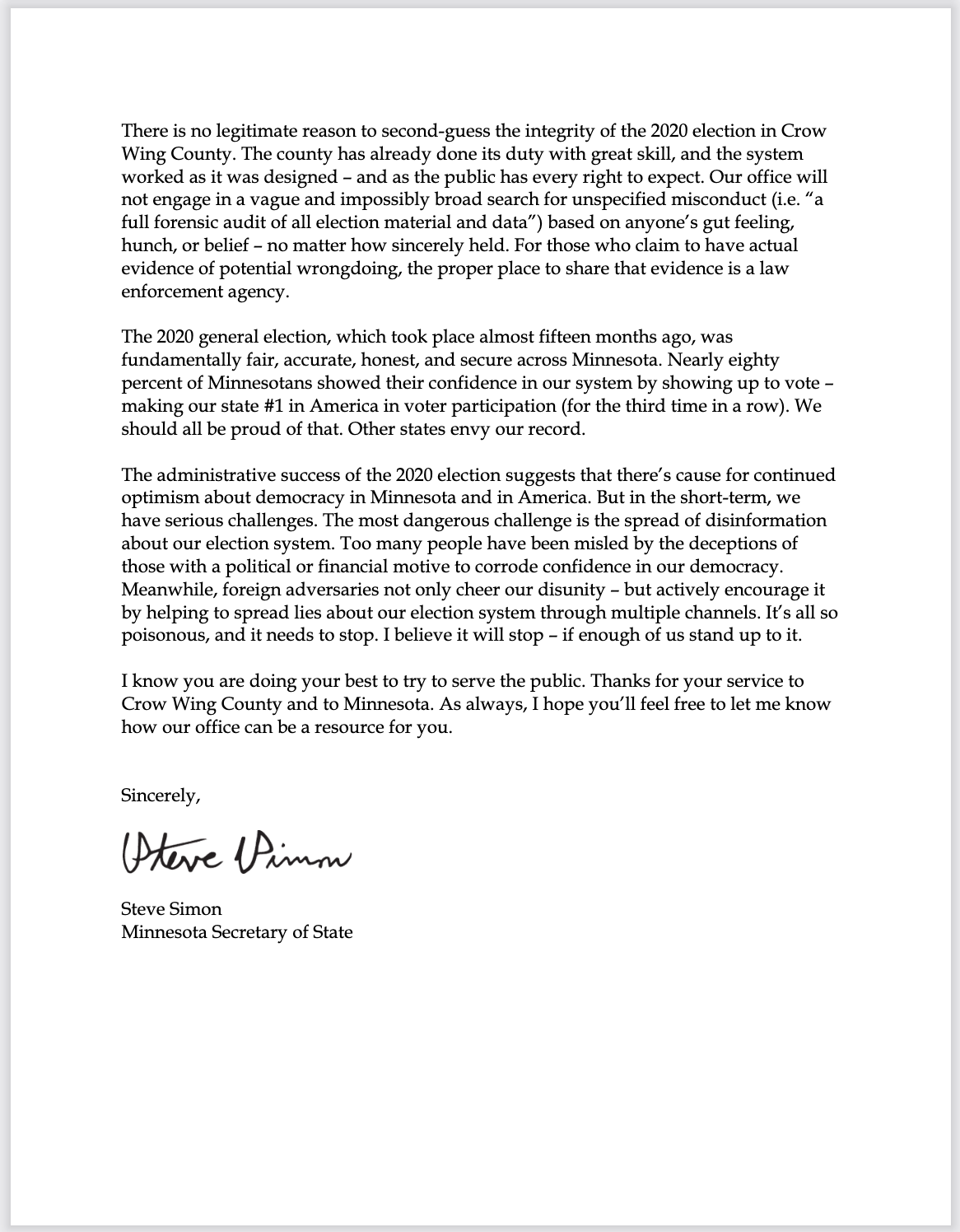
If the Secretary of State had complied with the commissioners’ request, election materials and machines may have been audited. This would have been a proper audit instead of a post-election review or a recount which simply audits the results.
Why should the machines and data be audited? Because, as was shown by Jeff Lensburg in the Antrim County, Michigan case, votes can easily be swapped which would not be identified in a canvass, postelection review, or risk-limiting audit (recount). I had also seen this for myself when Sean Smith, Mark Cook, and Draza Smith along with Patrick Colbeck created a mock election at the Cyber Symposium in 2021 where they demonstrated a similar concept.
However, if the machines and full chain of custody—of both materials and data— were to be audited, the vulnerabilities described in earlier chapters could be exposed.
Secretary of State Steve Simon made this decision in January, 2022, missing an opportunity to demonstrate transparency in Minnesota’s election process and systems.
Since then, an even faster method to verify whether the paper ballots match the machine count (as scanned through the tabulators) has been identified.
Dakota County
When the people with Rick Weible’s help found indications that the results Dakota County announced for Kim Bauer’s 2021 School Board race in ISD 196 may not have been accurate, they began requesting information from the county to try to reconcile the mismatching information.
To this day, the data in the statewide voter registration system and the reported results from the county and the reported results from the school district have not been reconciled.
In May of 2022 I sat in a closed door meeting where the county election officials tried to explain what they thought happened but were unable to satisfyingly do so. This meeting in particular gave me insight into the depth of the problem we face, since it is my opinion that some election officials simply do not understand the technical details of the software and hardware (it is complicated), whereas others may very well understand but be held back from helping us by some as yet to be discovered reason.
In that particular meeting also was the election official’s boss, who tried to steer the meeting. He previously had said I could not record the county commissioner meetings, when of course I could (and did) seeing as they are open meetings, an indication that he didn’t know the laws governing county commissioner meetings or an intent to dissaude me.
On June 7, 2022, Rick Weible spoke to Dakota County about their software, recommending they return to hand counting and hand tallying.
That day, the county commissioners voted favorably on not approving drop box voting and returning to party balance on absentee ballot boards while Andy Lokken described Minnesota’s unique situation, which is “so unique that it creates delays in getting software here.”
There is more work to do since Dakota County (and every county in Minnesota) still uses the modern electronic voting systems which are highly vulnerable to subversion.
Wright County
The teams in Wright County were successful in convincing the county commissioners there to hold a workshop dedicated to election integrity with Rick Weible as the speaker, on May 17, 2022.
At the close of this meeting, it was decided that a joint task force would be put in place involving county commissioners, election officials, and members of the public.
On August 1, 2022, I attended the counties public accuracy test (PAT) ahead of the August 9 primary election. One of the employees took a photo of me and a few others while we sat and waited for the election manager to be ready to take questions. Eventually I got to ask questions and had almost a half hour conversation with several employees, including their tech team, about the value of cast vote records. One of the IT people, who claimed to have worked on a nuclear sub, said that because of the air gap, their systems were secure.
Morrison County
After Jeremy Pekula went on the radio asking whether the county commissioners were going to take action, he received another invitation to meet.
In mid May 2022, after speaking on the radio alongside Jeremy in the morning, we met that afternoon with the County Administrator, two county commissioners, the head election official, and the deputy election official.
We shared some of the information already discussed in this book.
We asked whether they would like to have an item on the agenda in a forthcoming county commmissioners meeting.
So far they have not agreed to do so.
Stearns County
Growing up, even while living overseas in Gabon, Indonesia, or China, my family would return to Minnesota every year, usually over the summer, to visit our family. Often we would stay at my aunt and uncle’s home in St. Cloud (and sometimes in Stevens County, where my mother grew up).
Sandy Klocker and I first met outside the building at the Cyber Symposium held in Sioux Falls, South Dakota, in August 2021.
She was holding a sign with Biden wearing clown-face and made light of the fact that Biden was elected via election fraud.
Later Sandy would invite me to join her in speaking with the Stearns County Auditor and the deputy. In that meeting, I admired Sandy’s pointed questions. For instance, we learned that only a small percentage of the 80+ tabulators used in the upcoming primary elections were actually tested. (It’s not a requirement for every tabulator to be tested before the public.) On this point, furthermore, the standards for maintenance once a particular machine has been certified are quite minimal. (Here’s a great FOIA opportunity to learn how well, or not, the equipment in your area is maintained.)
Sandy went to many commissioner meetings, alongside others, and was a leading voice in putting her commissioners to task for their inaction. In an event she held mid-August 2022 I commended her for all the detailed investigation she’d done into her local government.
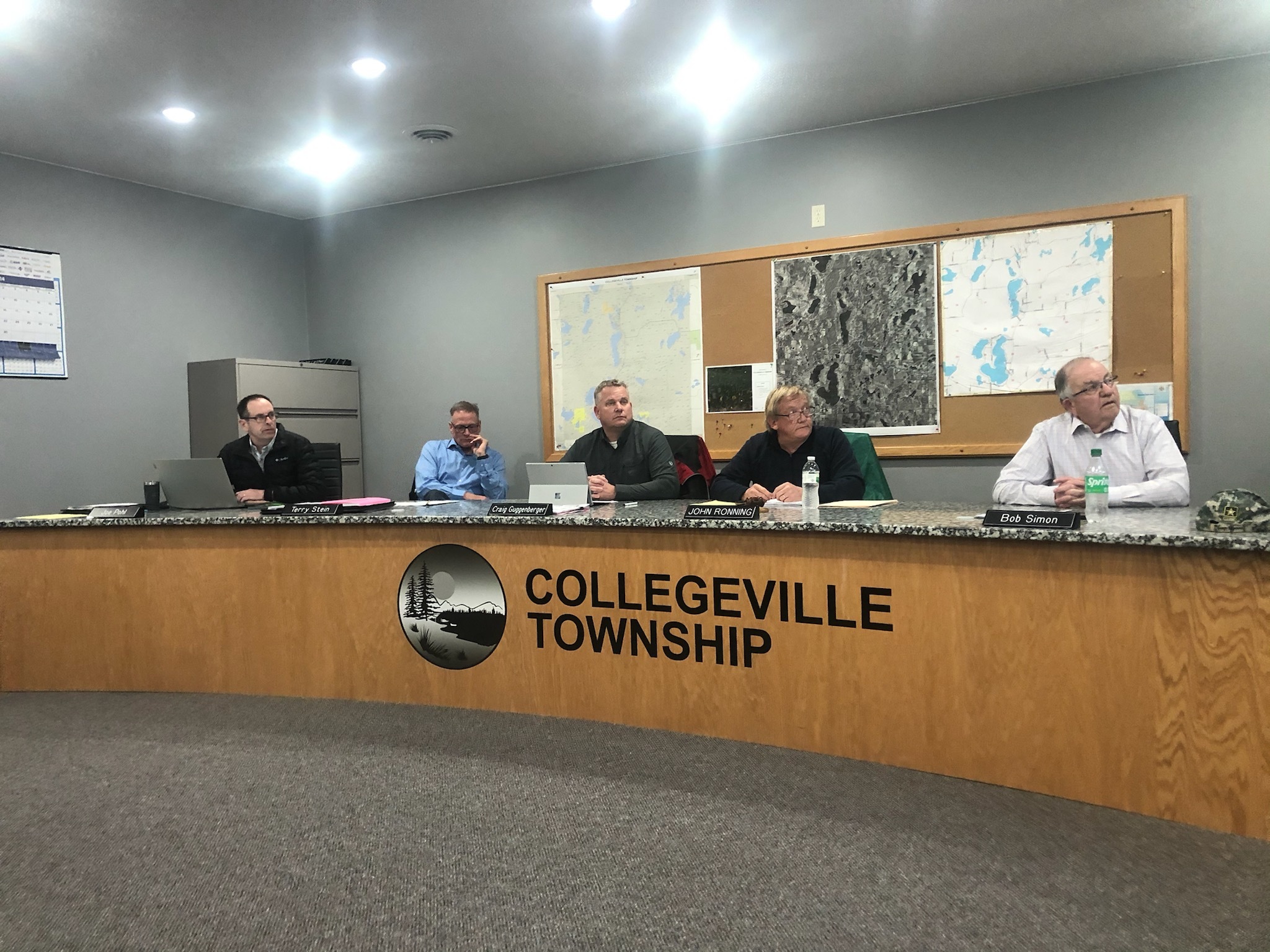
Stearns County seems to be going the wrong direction with regard to integrity, where in Collegevill in 2024 they seemed poised to move away from in-person in-precinct voting, choosing to limit voters to the mail-in only option. After making that decision, Sandy spread the word, and 150 people showed up in the pouring rain… her township reversed the decision.
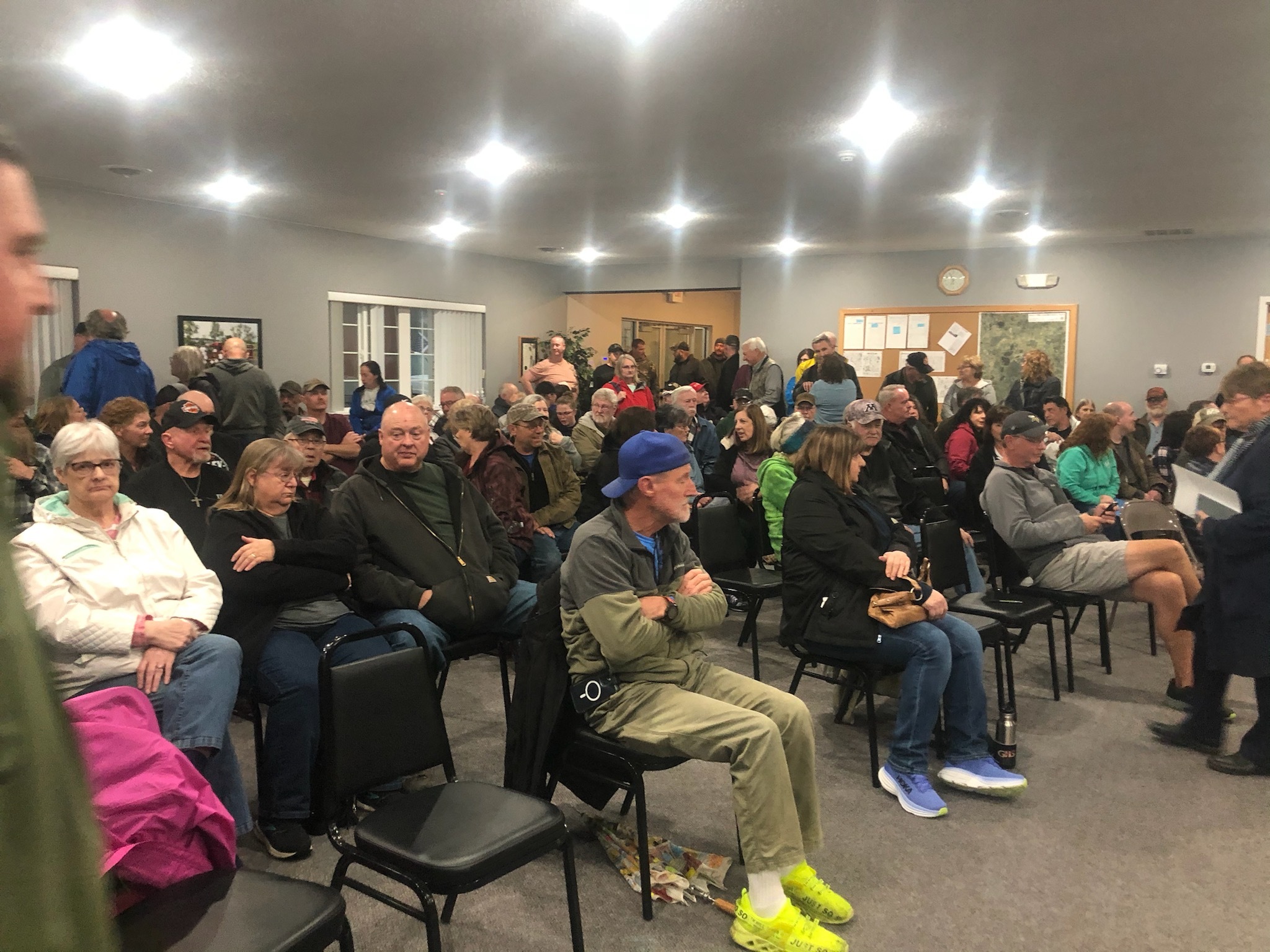
Advocates like Sandy have raised awareness and continue to hold strong even when the going gets tough. The mail-in voting reversal above shows that building relationships, raising awareness, and getting decision-makers to the point of decision is all possible with diligent effort and persistent focus.
Sherburne County
Teri Dickinson was very effective in organizing people to attend county commissioner meetings in Sherburne County starting in early 2022 if not well before. She even once gave up her precious speaking slot to give me three minutes to anchor a slate of speakers including Kari Watkins, on April 19, 2022, my first time speaking in a county commissioner setting. I stressed the opportunity for the commissioners to take in all the information and find it in themselves to make history by removing the machines. Later I learned that on that day, 246 years prior, was the Battle of Lexington and Concord, if the history can be relied upon… History indeed!
The Sherburne county commissioners refused to (so far) have a public hearing or agenda item during the county commissioner board meeting despite multiple weeks of open forum comments like Rick Weible’s here sharing critical vulnerabilities with Sherburne’s modern electronic voting equipment. This inability to listen or disinterest in the facts led Kari Watkins to step up and run for county commissioner herself. She later would become a town board supervisor.
Sherburne would later take center stage in two cases.
In July, the #2 of the MN Office of the Secretary of State, David Maeda, was given a 20-minute agenda item to discuss elections. The County Auditor, who is soon retiring (as of May 2024) also spoke. Unusually, there was media there, photo and video. Maeda said he disagreed with Rick Weible that Sherburne had put a new software system in. That particular issue became the focus of a Supreme Court Petition, case no. A22-1081 which Bill Kiefer and I signed onto as petitioners. It was dismissed on laches (therefore not on the merits).
Then, in August, a first amendment violation was committed against Teri Dickenson, witness by many and caught on video. She was simply stating that the commissioners had been unhelpful, but then the chair signaled to the administrator who cut her mic and asked the bailiff to escort her out. That happened on August 2. They commissioner team would apologize formally 14 days later, perhaps to mitigate potential action against them for the violation.
Because of roadblocks at the county level, the action teams pivoted to meetings with the townships.
A Haven Township meeting on June 20, 2022 started out with the usual disappointments and interference. Instead of Rick Weible’s presentation starting the 7 p.m. meeting, as had been promised, he and those attending who had travelled to attend were made to wait until almost 9 p.m. once other items at the supervisor’s meeting had been completed. Rick was then offered 10 minutes. After negotiation, he was given around 40 minutes, with the supervisor’s interjecting with questions.
The meeting was then adjourned after the Chair said her eyes were glazing over, but three of the supervisor’s stayed around to hear more of Rick’s presentation, which went about another hour.
By the end, one of the supervisors said to me walking out of the building, “If we don’t get to hand count here, I’m not going to certify the election,” refering to the primary on August 9.
This was music to my ears.
Anoka County
I’ll not soon forget the first time commissioners actually listened to me.
A few minutes before, I’d parked near the entrance to the Anoka County Government Center on a chill day in Fall 2022. The primaries had come and gone and there was much to do.
Anoka is Minnesota’s fourth largest county by population. Its government center is located not far from where the Rum and Mississippi river meet.
After parking, I nodded to some workers cleaning up the sidewalk outside, snapped a photo for the memory book, and went inside. As I waited for the elevator across from the Elections office, I wondered how many of the employees understood the magnitude of the problem. Elections could quite easily be rigged, and they could be rigged without the staff knowing about it. Like a flawless surgery, you go under, wake up, and carry on living your life without really knowing what the surgeon did when he opened you up.
Reaching the seventh floor, Derek spotted me right away and came to shake my hand and bring me into the commissioner board room. There were just four of us: Derek, Brenda, Lisa, and myself. We walked right up to the raised desks where most of the commissioners were preparing for their upcoming meeting.
Derek said hello and introduced me.
I used the time card analogy to make my point: If there was a disagreement on the pay stub and the time card system, wouldn’t the employee and management want to look into it?
There we would be a log of activity in the time card system to double check.
Same goes for our electronic election equipment, especially the tabulators. They have audit logs, as well as cast vote records (CVR), which are produced and created automatically in these electronic scanners since 2005, when the Election Assistance Commission’s (EAC) Voluntary Voting Systems Guidelines (VVSG) 1.0 standards were put in place. Cast Vote Records are also defined by the National Institute of Science and Technology (NIST), which is part of the federal U.S. Department of Commerce, which determines standards for weights and measures. This is why cast vote records need not be defined in election codes within each state.
In simple terms, though, cast vote records or a CVR report can refer to multiple components of the records:
- For ES&S (nation’s and Minnesota’s top vendor) equipment, there is the data stored on the tabulator, which gets moved to the Electionware computer by an encrypted thumb drive
- There is a report that the Electionware computer can give in various formats
- There are also the ballot images—these are a scan of the ballot producing a digital copy on which the ovals are interpreted for candidate vote tallying
Now, interestingly, after some considerable delays from county auditors, county administrators, and others responding to valid public records or public data requests in nearly if not all counties statewide, none were shared for 2020, except from one county, Fillmore.
(There is email proof—waiting to validate this—from the secretary of state that confirms what was suspected once responses from the counties seemed eerily similar.)
With the cast vote record file, the ballot images, and the paper ballots, those three pieces of information let anyone see that elections are secure without any detriment to the security of those systems. This was ostensibly the tradeoff Americans made when ushering in the electronic voting systems in the early 2,000s. (There is whistleblower testimony from the warehouses that produced the hanging chads for Palm Beach County, Florida, that even that spectacle was planned, as discussed in Chapter 1.)
As awareness about cast vote records grew, articles appeared, such as in MinnPost, contributed to by Max Hailperin, who is close with Secretary Simon, indicating that cast vote records are not very useful. This was a pivot once Mike Lindell’s nationwide call for these records encouraged many to not merely ask for them but properly request them. In Minnesota Statutes, Chapter 13 details data practices. It could no longer be denied that they existed, as had occurred for me the first time receiving such a notice from the Todd County Attorney in early Spring 2022.
Curiously, in the 93rd Legislature, in May 2023, two things happened that were far from the only notable amendments to what is now about 536 pages of election law (much longer than all the laws in the original Minnesota law book from 1849).
- The ballot image portion of the cast vote records was made non-public data under Chapter 13
- Electronic tabulators were mandated for any precincts that had previously used them (which was nearly all, if not all of the approximately 4,000 precincts statewide)
Now, no citizen of Minnesota had come close to seeing a ballot image as a result of the coordination hinted at above, so it was interesting to see #1.
#2 was curious because, regardless of whether one trusted the security, transparency, accuracy, verifiability, and accessibility of electronic counting and tallying in the manner described above, shouldn’t towns, cities, and counties still have the option of choosing how to run their own elections? Most people just want the number of votes in to equal what comes out and to be able to see that for themselves, with their own eyes. Some towns, like Baldwin and Haven in Sherburne, had backed down from potential lawfare after receiving communications from Sherburne County Auditor and Attorney about the towns’ resolutions to hand count their 2022 midterm elections in parallel with the machine count.
This discussion so far hasn’t touched on absentee, early, or mail-in ballots. This method of voting category comprised 60% of all certified votes for Minnesota’s 2020 presidential race. It just so happened that the man currently sitting in the secretary’s seat for Minnesota had helped to make elections far less secure in 2020 by participating in the scheme whereby he was sued by the NAACP and LaRose leading to the consent decrees which waived the witness signature requirements for absentee mail-in ballots and extended the deadline for receiving them.
The floodgates had been opened. All told, almost 60 percent of Minnesota’s ballots being absentee or mail-in, which helped “Biden” receive 1,717,077 votes, according to the certified totals, improving upon Clinton by 349,252 votes, a record, despite Trump picking up votes. Secretary Simon, who was the Vice Chair of the Democratic Association of Secretaries of State, and who would in October appear on the cover of Time Magazine, declared the 80 percent voter turnout a resounding success. Since, he’d declined to audit Crow Wing County after the people showed up in five or six consecutive county commissioner meetings demanding one be done to the point that the commissioners passed a resolution to that effect, if the Secretary of State would help them… In early January of 2022, surprising no one, he said that he would not.
That day in Anoka, I wish I had had time to properly share what I’d learned with the commissioners. Previous to that, I’d spoken at Sherburne County and several other counties, some north of the metro, some south. Like almost everyone else, whenever I spoke it was limited to about 3 minutes or less. There was one Sherburne County commissioner who said it was good practice to limit ones thoughts to two minutes. I don’t disagree with her even though I disagreed with her decision to call the bailiff to remove my friend from the podium, violating her 1st amendment rights, on August 2, 2022. (I have more videos from that day.)
After speaking with the commissioners, Derek said we had their attention. I felt it too. They had actually listened. Whether they would do anything with the information remained to be seen.
The team in Anoka County grew.
They meet weekly, on Mondays. Emails go out, which I’m cc’d on, before and after the meeting, with agenda topics, and follow-ups. They work in small groups between meetings, on the six main topics they are focusing on, including hand counts.
One of their team, Lisa, invited me to a town board meeting in Linwood in 2022 where I learned the clerk knew about cast vote records and was in my opinion in favor of hand counts.
The group is a steady 15-20 people now, as of 2025, including from nearby counties.
What groups do you know about that meet every week, face to face, spending hours before and after these meetings, and between meetings, preparing and following up on to-dos, open questions, and activities to educate the public, their local political parties, and elected officials?
I don’t know many with such commitment.
One day, the commissioners decided to put in a public comment period, at the end of the commissioner board meeting. Anyone could speak on any topic, but it was a good opportunity to help them learn and get on the public record about election integrity. I spoke two or three times more alongside the team before the commissioners and we started putting recordings of these speeches online because the county turned off the live recording during this public comment period, strangely.
The team gave about 80 speeches to the Anoka County commissioner board before shifting focus to cities.
Not without its flaws, I venture this group is far more organized than some government groups, but that is beside the point.
What is relevant is how much knowledge they’ve accrued about the election and voting process, systems, and codes (laws). They know more than most elected officials, including those who vote on election code amendments in St. Paul. This is just a fact that could be proven by putting any randomly chosen team member side by side with any randomly chosen legislator.
What is also relevant is this team’s experience in presenting such information concisely to the county board and now in slightly longer formats (30-60 minutes) on invitation to norther cities in Anoka County.
The fact that they are being invited speaks volumes about their credibility, the value they bring, and the public and local government-level interest. At the Oak Grove presentation in late January 2024, attendees were provided thumb drives with the presentation materials and, importantly, templates to about 11 resolutions that they could pass locally to improve election integrity.
Relevant too are the two election integrity resolutions which have been passed in multiple counties at the precinct caucus and basic political organizing unit (BPOU) level, including in the Minneapolis BPOU where the party still advocates openly for misplaced ideas like early voting, which actually help those with access to those systems cheat, if they want to.
Finally, in Anoka, what is further relevant is I predict the southern cities will one day soon take interest as well.
On April 29, 2024, one of their projects bore fruit, when the Oak Grove City Council voted 5-0 in favor of expanding their post-election reviews—a hand count audit—to all four of their city’s precincts for all races with more than one candidate. I imagine this will ignite the spirit of many more city councils in Anoka County and around the state.
Oak Grove and Ramsey later canceled their electronic poll pad agreements as well. In Oak Grove’s case, it was prior to the 2024 general election, prompting a letter which included input from the county auditor, county attorney (threatening felonies if paper poll books were used instead of electronic) and input from the Minnesota Secretary of State, Steve Simon, all trying to argue that cities HAD to use electronic poll pads, even though the Minnesota Statutes say the cities can decide for themselves.
In 2025, two commissioners voted AGAINST buying new KNOWiNK poll pads, what some view as the Trojan horse of Minnesota elections.
Other Counties
I’ve had great interactions with people from many more counties beyond those just described, such as Carver, Ramsey, Hennepin, Scott, Cass, Isanti, Chisago, Washington, Lincoln, Lyon, Faribault, Olmsted, and Fillmore (where the only CVR from 2020 was produced, although without ballot images), Otter Tail, Benton, Todd, Mille Lacs, Clay, Saint Louis, and Lake, and almost certainly others that I have failed to list here. I believe there are people from every county engaged.
Some of those stories may make it into the next book, which is currently in progress, which takes a more narrative approach than this one.
Each conversation keeps me up to speed on the goings-on and helps me learn or improve how I speak or encourage those who ask for help.
Never think that your work is going unnoticed. And even if it does seem to be, remember that small actions ripple outward to affect those around you…
Even with the defense phase (cover up and destruction of evidence) of the election coup falling apart, so far no county commissions (in Minnesota) have decided to return to hand counting paper ballots as many of their constituents desire—instead, counties plan to run elections on very similar if not the same software which managed the 2020 election. This would be unwise if fair and transparent elections are desired.
I fully support the many people continuing to go to their county commissioner board meetings to inform them of available fixes and simple alternatives to voter registration, tabulation, reporting, and verification. Examples exist.