Chapter Seven - What We Can Do
“It takes very little talent or creativity to complain about problems. After all, the people directly impacted by a problem, and eventually those indirectly impacted by the problem, feel the weight and consequences stemming from it. When I speak in front of an audience, I need not complain at length about the violations of liberty underway in America, because the people know the personal toll exacted by those who corrupt the foundation of self-government. The audiences come to hear solutions and to commit to action.”
—Captain Seth Keshel, Veteran Lesson VII: Leaders Create Solutions (Ten Lessons for Every Day)
“Never tell people how to do things. Tell them what to do and they will surprise you with their ingenuity.”
—General George Patton
Let’s briefly cover what’s been done, what’s being done, and what still yet can be done right here in Minnesota.
What Recent Laws were Added or Amended?
No-excuse mail-in began in 2014 leading to large increase in absentee/mail-in ballots and votes.
- A 1987 law made it possible for precincts to switch to mail-in only
- In 2016 the thresholds from 1987 were lowered; outside metro precincts with fewer than 1,000 registered voters, metro areas with fewer than 400, could opt for mail-in only
- There are currently 1,000+ precincts (out of 4,000 statewide) whose voters may only vote by mail (mail ballots can be hand-delivered, but no in-precinct election day voting allowed)
Minnesota’s 93rd Legislature (2023):
- electronic tabulators mandatory if previously used at one or more precincts, for those precincts
- the ballot images part of cast vote records non-public records
- illegal immigrants can get a driver’s license
- 16-yr-olds are now in voter roll and ID pool
As seen in MS 206.58 AUTHORIZATION FOR USE. Subd. 1 Municipalities., ‘‘Once a municipality has adopted the use of an electronic voting system in one or more precincts, the municipality must continue to use an electronic voting system for state elections in those precincts.’’.
This statute does not address the ex post facto nature of the law: When counties chose to use electronic equipment they would not have known this law was going to be passed later, removing their choice. Additionally, it is unclear whether redrawing precinct lines would refresh the option for the county.
For ballot images MS 206.845 BALLOT RECORDING AND COUNTING SECURITY. Subd. 3 Cast vote records. shows, after the ordered list of 5 items, an additional line of text: ‘‘Data stored as images are protected nonpublic data under section 13.02. It is unclear why a sixth item with this information was not put into the numbered list, but rather listed below. Perhaps it was a late addition during drafting?
The entire subdivision on cast vote records was added in 2023 after many Minnesota county auditors, county attorneys, and even the MN Secretary of State suggested they either were turned off, did not exist, or were not accessible. Note: If cast vote records were to be somehow turned off, this action would decertify that tabulator according to the Election Assistance Commission (EAC).
For all 2023 election laws in a 536-page pdf, click here.
Additional amendments are in the works for 2024.
For instance, added to MS 204C.20 BALLOTS; NUMBER TO BE COUNTED. will be a subdivision which reads: Subd. 5. Precincts with ballot tabulators. In precincts using ballot tabulators, once the final count of ballots agrees with the number of ballots to be counted, election judges must immediately prepare the summary statement in accordance with section 204C.24 and seal the ballots in accordance with section 204C.25 for return to the county auditor. The effective date will be June 1, 2024. Read more about HF4772.
This new subdivision would seem to be aimed at preventing a parallel hand count on election day after the ballots have gone through the electronic tabulator.
What Can Towns, Cities, and Counties Do?
For an updated list, visit Project Minnesota - (https://projectminnesota.com/local)(https://projectminnesota.com/local)
Even with the Legislature and MNSOS seeming to have considerable influence, counties and municipalities (cities/towns) can do quite a bit… Consider:
- Using paper poll books (as of 2024, still have option)
- Hand counting ballots (when 2023 law was passed, it was an ex post facto law, meaning when counties chose to in past use electronic voting equipment/tabulators, they could NOT have known they would later be mandated)
- Administer and process OWN absentee/mail-in ballots instead of outsourcing to county
Further options, once completed the above:
- If have mail-in only precincts, reversing prior decision and return to in-person voting in precinct - View Sample Resolution
- Expanding the postelection review to include as many precincts as possible and as many races on the ballot as possible
- Passing a resolution to ensure that no city employees are used for absentee ballot boards, but instead only party-balanced election judges
In 2024, the 94th Legislature (2024) introduced a new subdivision in MS 204C.20 BALLOTS; NUMBER TO BE COUNTED. which seems to hinder this idea, even though hand counting is definitely allowed and prescribed in certain conditions within Minnesota law, such as for recounts and post-election reviews. So, why limit the ‘check and balance’ that trained election judges could do on election night in their precincts to verify a race or two?
The above menu is a starting point. Pursuing even just the first 3, sometimes referred to as The Oak Grove Way, would go a long way in your town, city, or county, especially if this approach is taken at scale across the state. The powers that be simply do not have enough resources to counter such an approach, which is why they resort to trying to control language, narrative, process, personnel, and legislative levers.
If pursuing any of the above and facing resistance, ask oneself: Why should anyone object if the goal is a secure, transparent, verifiable, and accessible election and these approaches are within the currently written election codes?
If the laws change in response to your efforts, then so be it, as it will at minimum help to alert your neighbors to the depth and scale of the issue of reclaiming control of our local government.
What is the Simplest Legislative Change at the State Level?
An amendment to the following is provided on Project Minnesota - https://projectminnesota.com/beautiful
To make elections trustworthy and verifiable to all voters at minimum cost, consider:
Cities, towns, and counties will decide how to conduct their elections, so long as:
- On election day, voters present a government ID to receive a ballot
- All voting occurs face to face, in person, in precinct, on paper ballots
- Ballots and votes are counted in the precinct by humans and reported first at the precinct level
With such an approach, it can be seen that there is:
- No need for voter lists, rolls, or databases centralized at the state level, as currently exists within the Statewide Voter Registration System (SVRS)
- No need for absentee, early, or mail-in voting, which aligns with many countries and removes chain of custody problems
- No need for electronic equipment, computers, or networks of any kind
Instead, the will of the people, through decision-making at the city, town, and county level, determines how best to carry out their elections, so long as it is in keeping with the principles of integrity, security, transparency, verifiability, acessibility, and accuracy.
Instead of 536 pages of laws, why not try the above?
To be solution-oriented, a 3-page bill which included much of the above was presented to every Minnesota senator and every member of the house of representatives in 2024, all 201 of them. The collective interest was zero as measured by email responses. In 2023, one well respected (for the moment) senator said he didn’t think an election bill which included hand counting would get through committee, but also did not offer to try, even if I authored the bill.
Local Action
The rest of the chapter shares a few action items to make a commitment to.
Remember, it is possible to have actual elections that are not controlled by computer software or easily exploited by other means like mass mail-in ballots without chain of custody. We know this because we did it in the not-distant past! (As seen in Chapter 1.)
The simplest way might be to return to hand counting paper ballots in small, manageable precincts. Local control and oversight. That is easy to understand, and implementable right now. There is no reason for county commissioners to wait for further data to come in.
Although I prefer the simplicity and the community involvement (imagine neighbors getting together on election day to count the votes together), but I recognize that hand counting paper is not the only way.
Rick Weible and three more authors from three other states authored a paper on Gold Standard Elections, which are secure, transparent, verifiable, and accessible. The paper looks at each stage and layer of the election process from lens of each of those four dimensions.
It is state legislatures around the country that will decide how they want to make elections fair again, and possibly to make every voter’s vote count for the first time in decades.
It’s possible. It’s happening.
While we wait for the legislators to get their act together, get started in your local town, city, and county.
Small Counties with Great Potential
22 out of 87 Minnesota counties had fewer than 5,700 votes in 2020 and could perhaps more swiftly move to hand tallying, which is already acceptable by law (it is the disaster backup plan and counties can redraw precincts to avoid using the tabulators).
These counties could be places to find county commissioners more interested in putting an election integrity item on the agenda during county commissioner board meetings, or even making a courageous decision to pass resolutions to remove electronic voting equipment as seen in Nye County, Nevada and Otero County, New Mexico.
| County | Votes |
|---|---|
| Big Stone | 2916 |
| Clearwater | 4632 |
| Cook | 3699 |
| Grant | 3569 |
| Jackson | 5693 |
| Kittson | 2552 |
| Lac Qui Parle | 3974 |
| Lake of the Woods | 2375 |
| Lincoln | 3058 |
| Mahnomen | 2254 |
| Marshall | 5016 |
| Murray | 4812 |
| Norman | 3357 |
| Pipestone | 4859 |
| Red Lake | 2145 |
| Rock | 5139 |
| Stevens | 4966 |
| Swift | 5100 |
| Traverse | 1833 |
| Watonwan | 5090 |
| Wilkin | 3354 |
| Yellow Medicine | 5422 |
Skeptics might rightly point out that having fair and transparent elections in such small counties wouldn’t change the outcomes of larger statewide elections. But we have to start somewhere to inspire change and to say No to tyranny.
Meanwhile, at least you who may live in a smaller area (by population) can feel better about the school board member, commissioner, or representative you elect given the extra measures taken to secure those elections.
Objections to Hand Counting
Time and money.
The good news is that hand counting is cheaper, more reliable, and saves a lot of money in the short and long run.
What is often left out of these discussions are three simple facts:
- Many will volunteer their time to be trained on hand counting and then help to hand count on election day - this is proven by the countless hours spent by hundreds of thousands (if not millions) nationwide who have researched the facts, learned about local government processes, and joined in advocacy for more trustworthy elections… the majority of this work for almost all people has been completely volunteer-based.
- The amount of staff and vendor time (and the dollars budgeted or spent for that time) dedicated to training on electronic equipment, whether tabulators or epollbooks or the associated software and modules, would all disappear when the equipment is put in the recycling bin. The expensive contracts to purchase and maintain all of this would also be saved.
- Even if a manual human hand count somehow were to take more time and cost more, it would still be worth it to know that the will of voters equaled the certified outcomes.
Time
In a meeting with election officials and commissioners in Morrison County in 2022, one objection that was raised was the effort involved in hand tallying.
If additional man power is needed to hand count paper ballots in precinct polling places on election day, 204B.195 TIME OFF FROM WORK TO SERVE AS ELECTION JUDGE allows for absence without penalty.
Also, I have met many people who have said they would count the votes for no compensation just so that everyone can regain confidence that the election was conducted fairly and transparently in their precinct and county.
Minnesota Statute 204C.04 EMPLOYEES; TIME OFF TO VOTE in subdivision 1 already provides the Right to be Absent in order to “appear at the employee’s polling place, cast a ballot, and return to work on the day of that election, without penalty or deduction from salary or wages because of the absence.”
This statute makes mass absentee and mail-in ballots moot.
Money
In the same Morrison County meeting, there was concern that the county was already locked into a rather large contract with the software and hardware vendor. That was a sunk cost if they were to switch to hand tallying. Jeremy Pekula made the point that over time hand counting would be much cheaper and welcomed by the community.
*In 2024, the ACEIT team in Anoka, whose work can be seen at Project Minnesota - https://projectminnesota.com/anoka - documented the cost and effort of hand counts, showing they are affordable and effective, by reviewing local recently held recounts.
How Much Do Machine Elections Cost?
In earlier chapters we discussed the problems inherent to the ES&S DS200 tabulators that were in use in 65 of 87 Minnesota counties during the 2020 election.
But this was not the only ES&S equipment in play. In 2020, some counties began upgrading to DS450s and DS850s.
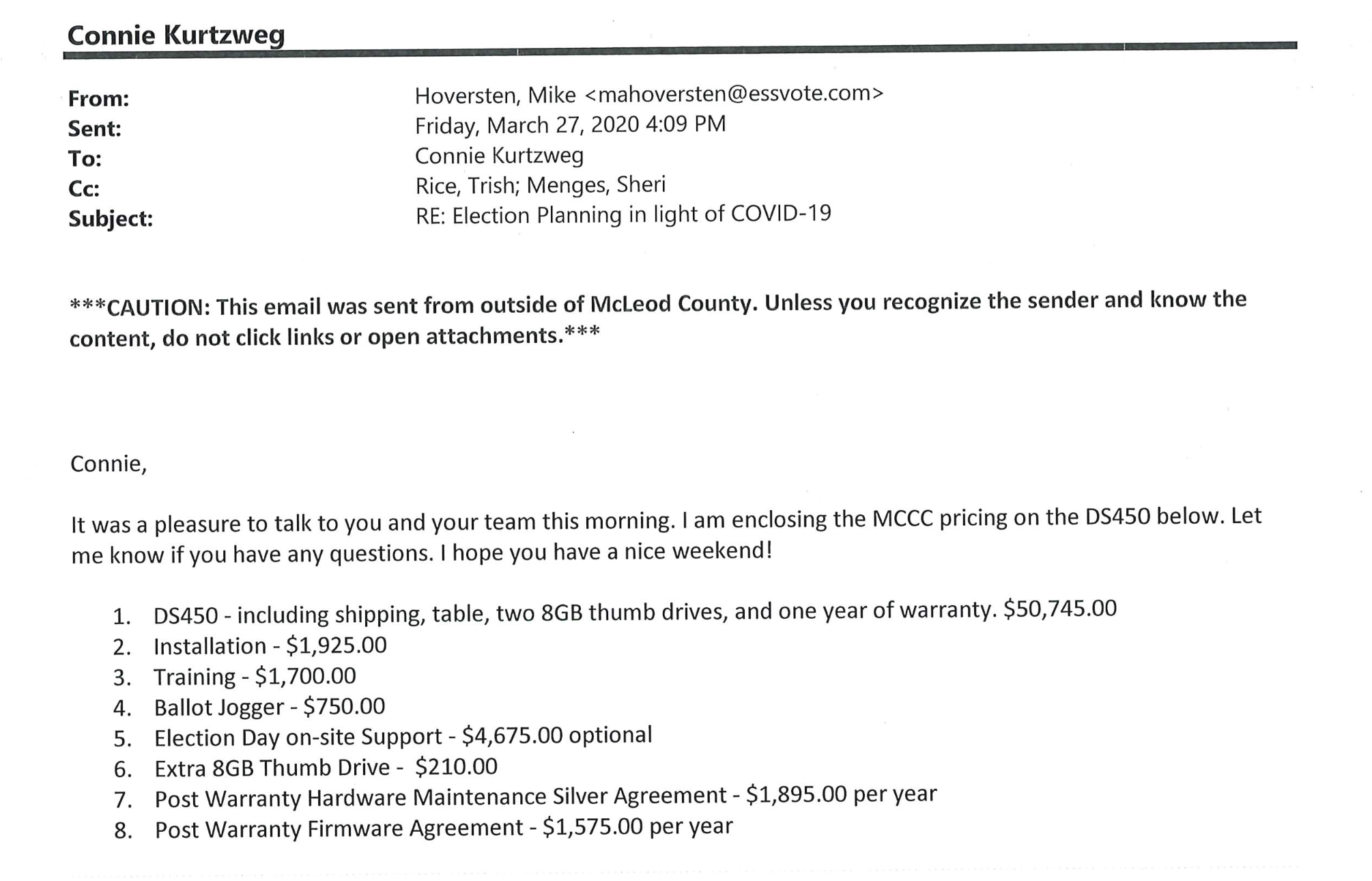
While county commissioners in other states have described these machines as being built in Omaha, Nebraska, both the DS450 and DS850 are made in Germany.
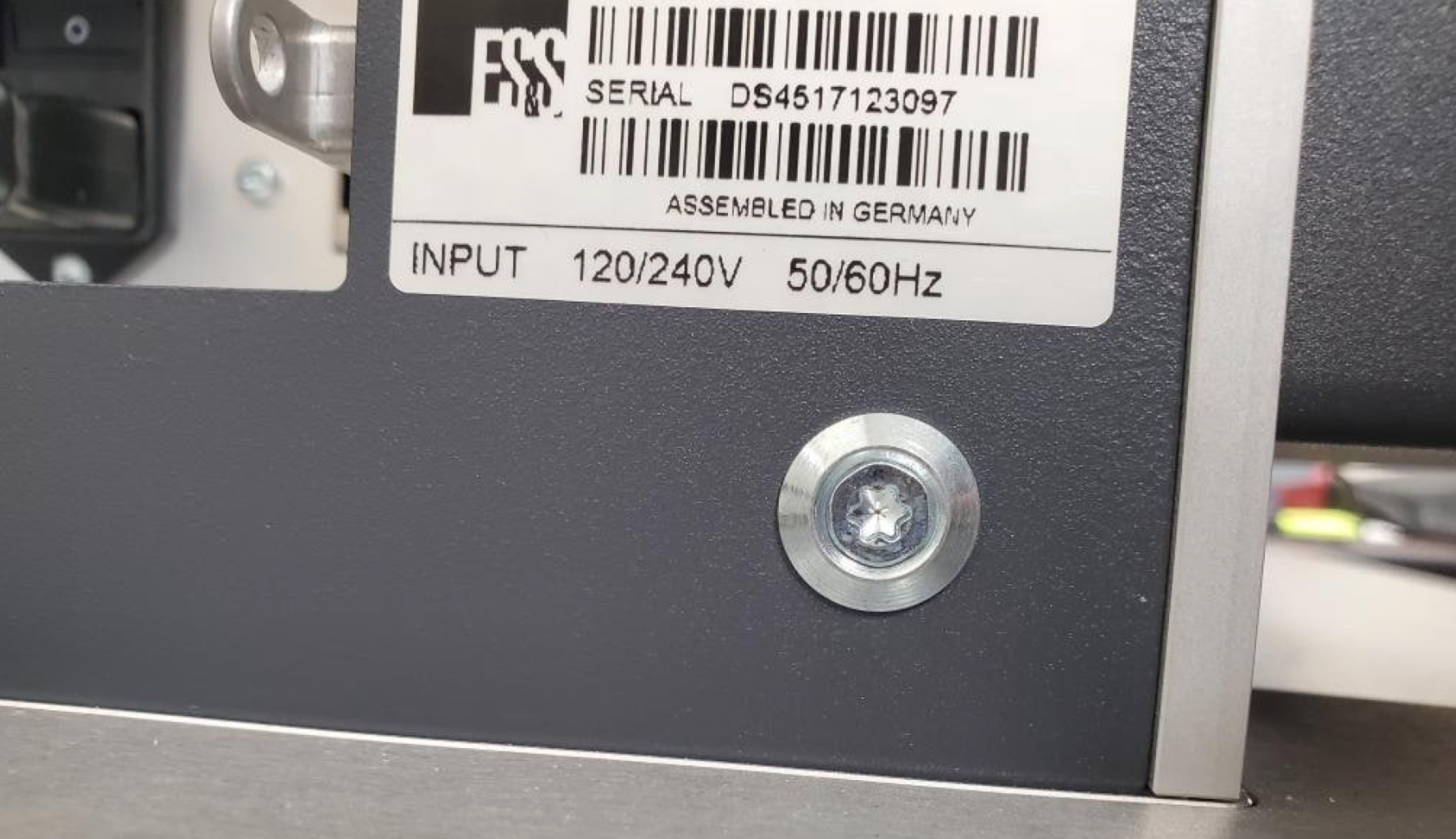
These newer models are quite expensive.
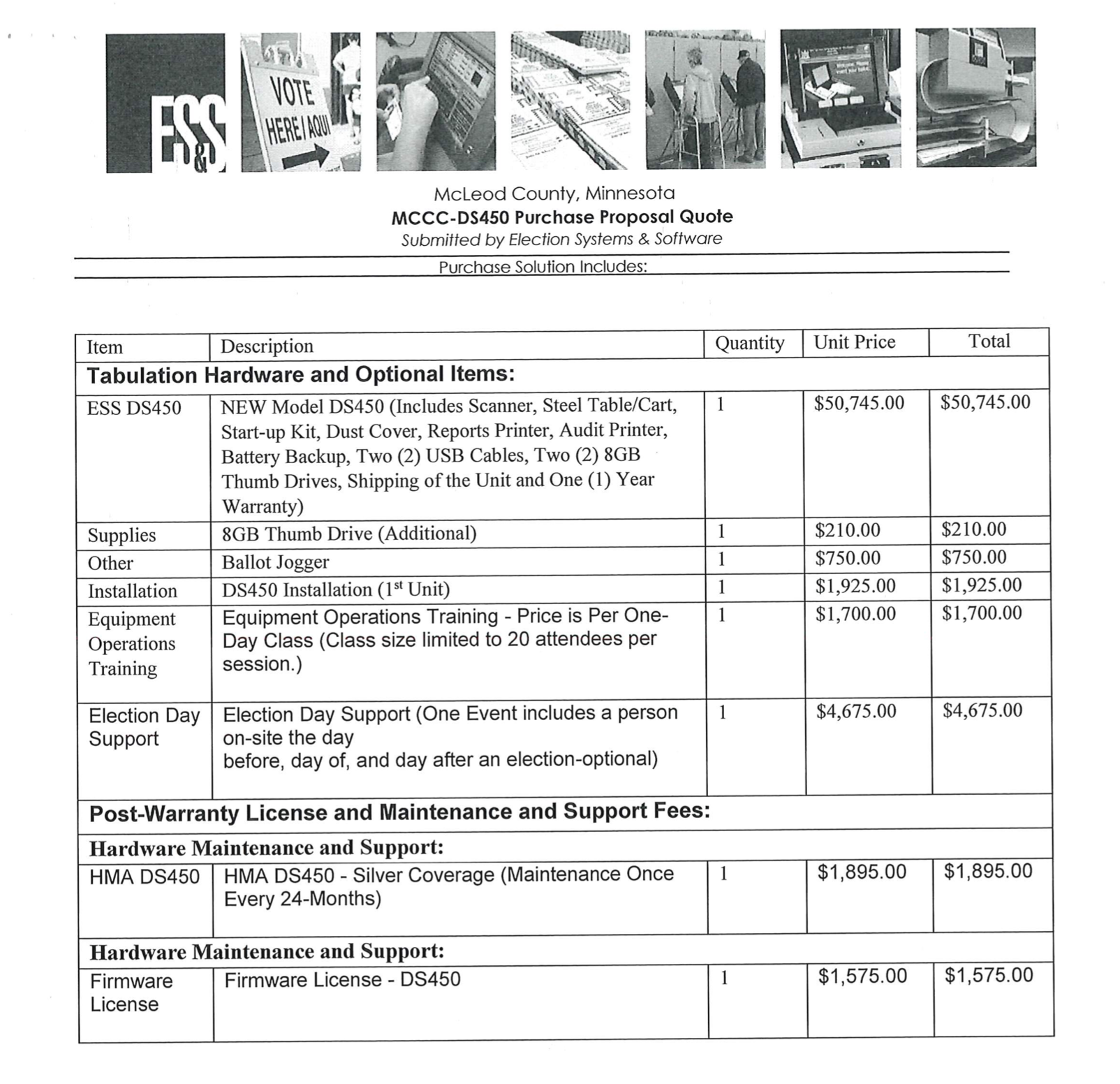
Even the Site Support at $4,250 alone could be repurposed toward 20 election judges at $20 an hour for 10 hours. Many more election judges could be hired with the $50,000 spent on the DS450 tabulator. Furthermore, if we legislatively removed or dramatically shortened the absentee and early voting periods, absentee ballot board work would be reduced and the election process further simplified.
Meanwhile, Saint Louis County recently purchased the DS950, one of the newest electronic voting machines on the market, likely costing about $250,000.
It’s one thing to spend a lot of tax-payer money on vulnerable machines, but another to actually use them correctly. For instance, the DS200 Operator Guide is 222 pages long.
The following two emails between staff at ES&S and the County Elections Administrator in McLeod County demonstrate that there is much vendor hand-holding to maintain and operate these machines.
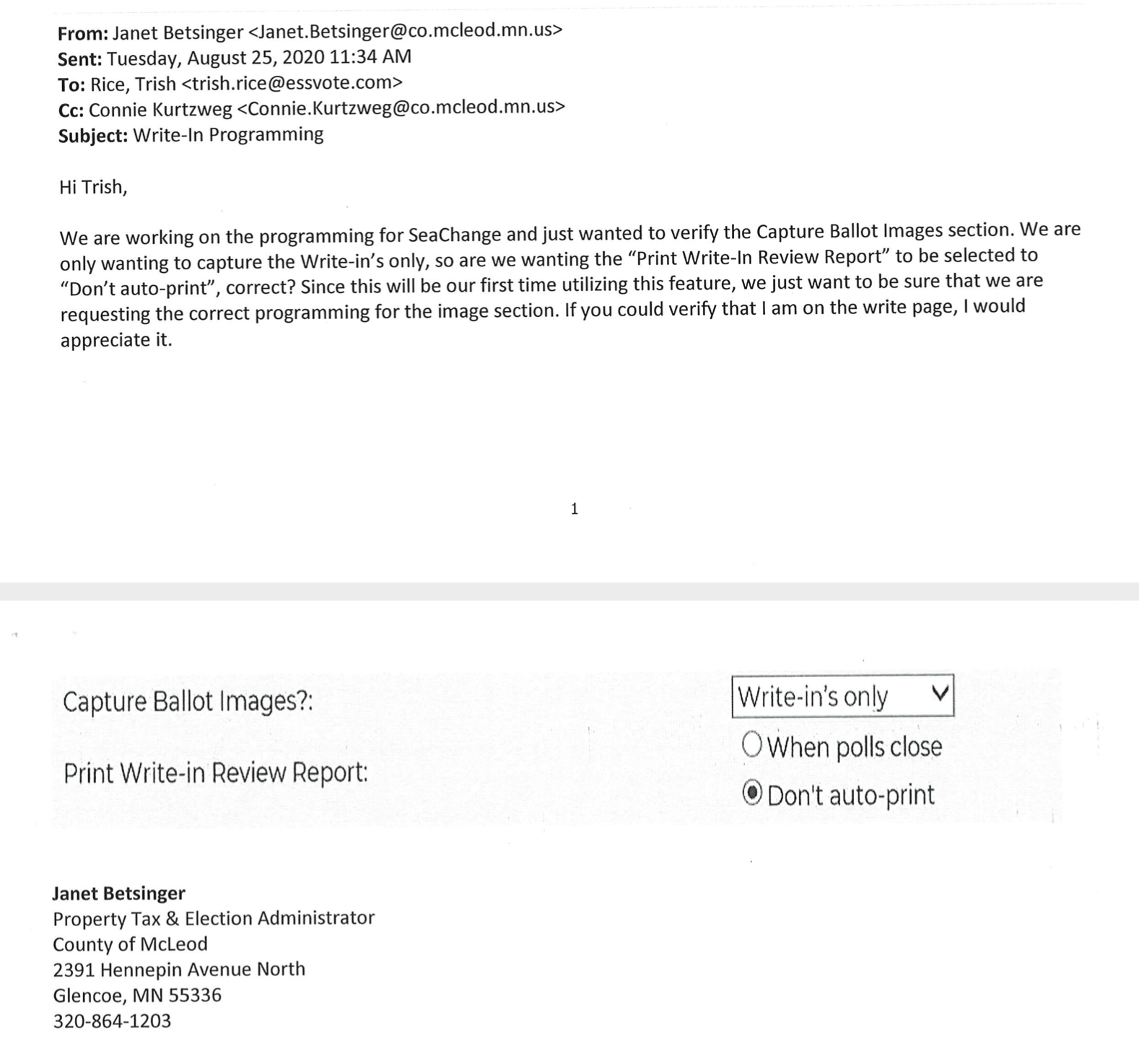
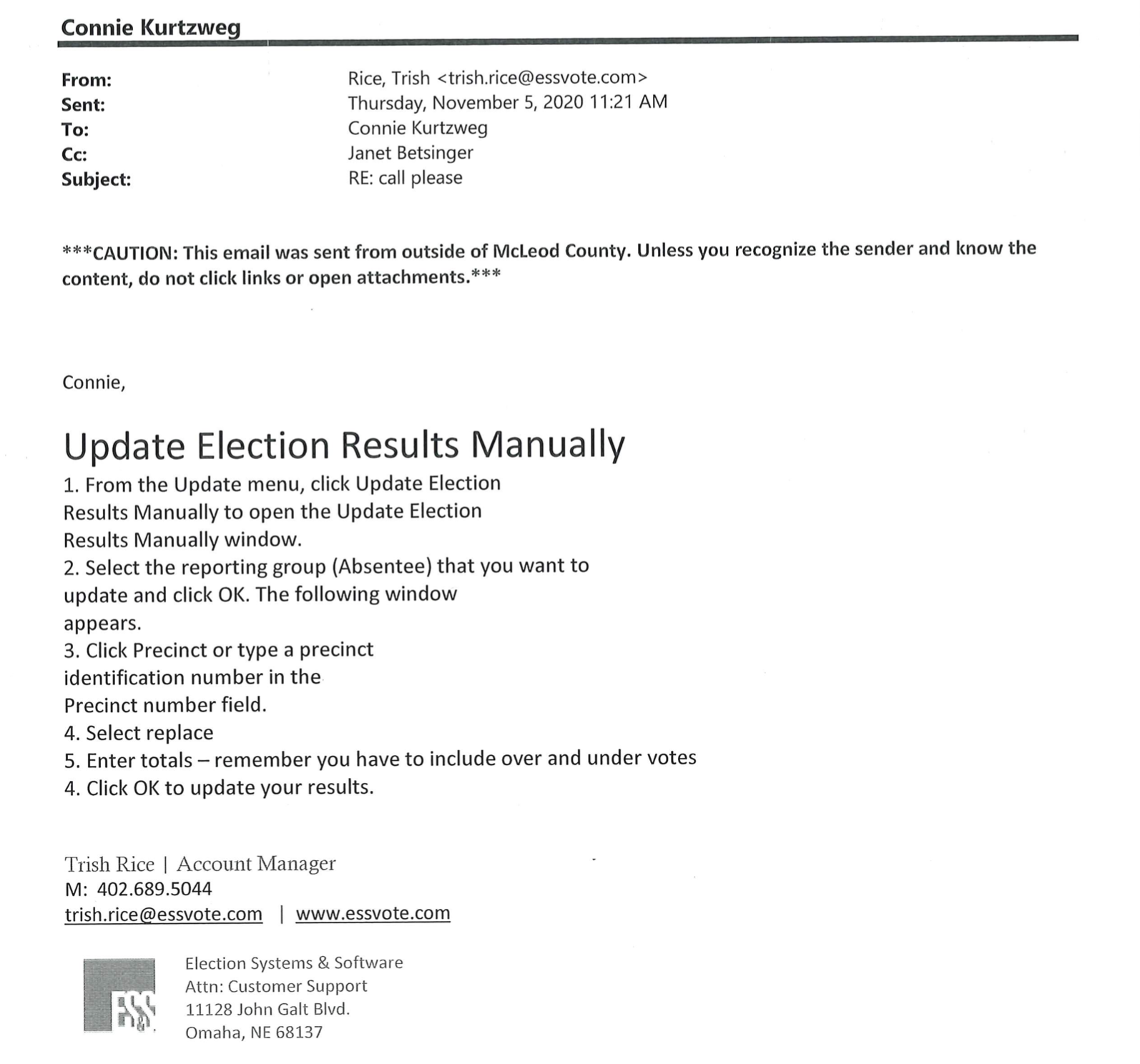
Are we asking too much of our election officials at the county level to not only maintain and operate but also mitigate cyber threats to these machines?
Or is it more likely that case that election officials are outsourcing our elections to the private NGOs, themselves not subject to FOIA requests?
The County Commission Strategy
How can these changes actually happen?
County commissioners have concurrent jurisdiction to govern the overall conduct of elections. Ultimately they must decide whether to use electronic voting equipment (such as tabulators and electronic poll pads) to begin with and, if they do, whether to certify local elections run on insecure hardware and software. For the time being, only hand counting paper ballots minimizes fraud to the fullest extent.
In this video, David Clements, speaking in Rochester on the first night of the 2022 MNGOP state convention (at a separate location), describes the county commissioner strategy. Here’s my take on the same.
Does it make sense to use the same machines in 2020 again in 2022, and again in 2024??
You too can stand in the gap.
Election Judges Don’t Have Much Control
Unfortunately, the responsibilities of election judges—who are not judges, but administrators, or workers—in Minnesota are setup so as not to oversee the key areas where cheating occurs, such as in processing (accepting or rejecting) absentee ballots as part of the ballot board (which lasts 46 days), and in verifying that voter rolls are accurate, and in validating the tallies for each candidate of the tabulators which scan every ballot. In fact, in 2024, even in rural counties like Benton, at least one judge was blocked from certain activities because she was known to pay careful attention.
Election judges are asked to sign oaths and then sign up on the summary tapes that are printed out of the tabulators, however there is no way to verify the accuracy of the vote totals for each candidate. This led some in 2022 to amend what they were signing, refuse to sign, or suggest hand counting to check that the tabulator tallies (not merely the total number of ballots) matched the total tallies for each candidate on the paper ballots. They were often met with stern resistance.
Some even asked in advance, such as three election judges in Anoka County. They were told that hand counting was illegal. When one pushed back, he was fired. The other two resigned in protest.
Meanwhile, I’ve heard a number of stories of people having to take extra steps to be included as either a head election judge or an election judge, even though supposedly there is a great need for them. In 2024, Hennepin County, and many other counties, did not use balanced absentee boards, a violation of the law, although only Hennepin was called to account, and received a slap on the wrist.
As described in the section about hand counting, I believe people will turn out in very large numbers as volunteers to assist in hand counting because they believe in the openness and accuracy of hand counting the votes themselves versus leaving it up to the black box electronics which they are denied access to.
Use Your Platform
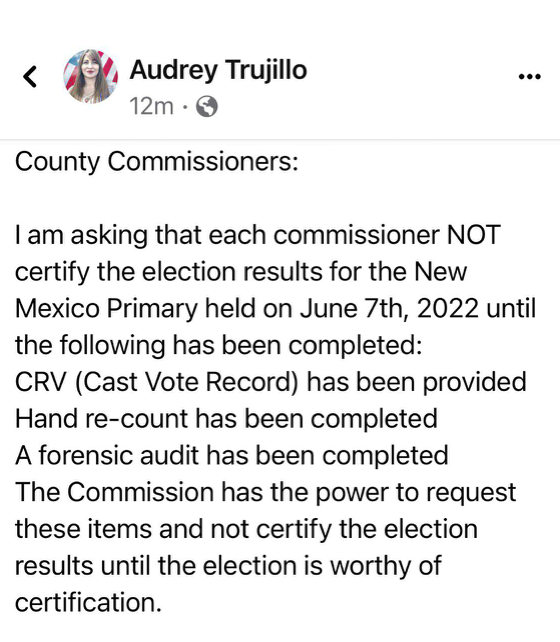
If you know a commissioner, please let them know about the option of refusing to certify the election, even though they will be threatened or told they actually don’t have a choice, that these certifications are in fact ministerial (Black’s Law definition: without discernment). If commissioners don’t certify their counties, then the state cannot certify until remediation is made, perhaps through a detailed micro-audit, to give the commissioners of that county confidence to then go ahead and certify.
If you are commissioner reading this, thank you. You are not alone in reading this as several commissioners already had copies in 2022.
We are already in territory (in other states, like New Mexico) where county commissioners are being put to the test. Are you going to certify your county’s primary election or general election if it is run on machines that have been shown to faciliate fraud?
I am also calling for all America First Candidates to make speaking about the election machines a priority. If you don’t think machines can alter elections, look at Kandiss Taylor’s gubernatorial result in the Georgia primaries. She had 60,000 volunteers but somehow only received 40,000 votes. That could be the power of an algorithm to swap votes.
When you’re evaluating candidates, consider: If candidates are not speaking about issues with our elections, and not answering what they have done or are doing about it, maybe ask yourself, Why aren’t they?
Do You Have A Few Minutes Per Day?
Connect with local groups or reach out to Cause of America Minnesota by inputting your contact info on Cause of America or simply subscribe for free to the newsletter at Project Minnesota - https://projectminnesota.com
Your skills will be put to use in areas such as:
- research
- data analysis
- communications
- media
- outreach (to new members)
- relationship building with towns, cities, counties
- attending local meetings with decision-makers
- meeting other focused on reforming our elections with integrity
When I was just getting into all this I had to learn the basics, such as how to put in a data request, part of our state-level FOIA.
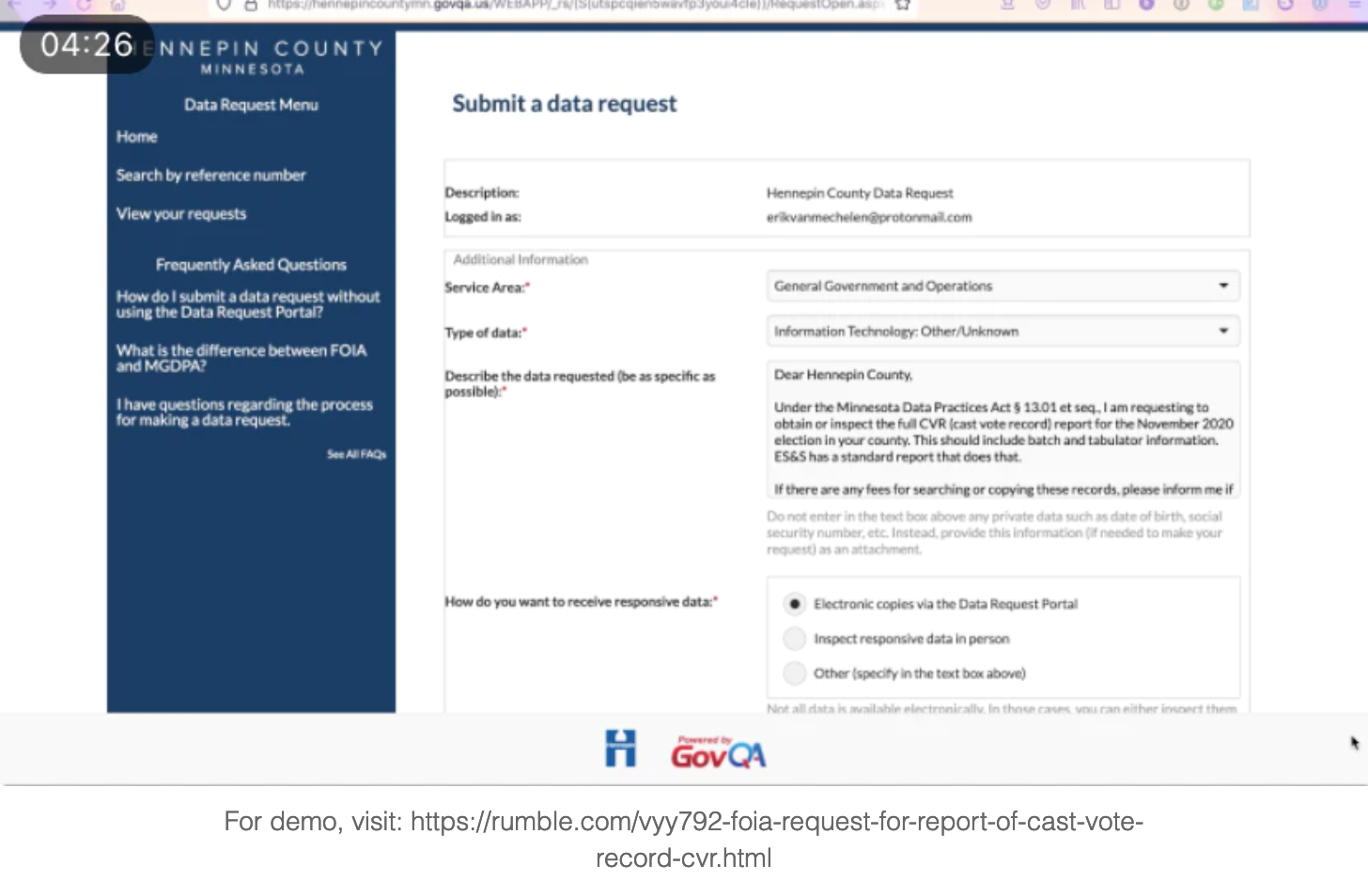
Now, I’m learning that I have specific skills, talents, and working style preferences that can be put to use.
To uncover what yours are, simply ask:
- What are my strengths?
- How do I perform best?
- What do I value?
- What do I believe I can contribute to this project or movement?
Vote in Person
It is important that anyone planning to vote for America First candidates votes in person on election day, as late in the day as possible.
Even if you join the queue five minutes before polls closed, you are legally allowed to vote, even if the line is very long. The polling place will post someone in the line marking the end of the line at the deadline. Everyone in front of that person already at the polling location in their precinct should be allowed to vote.
Why vote in person late in the day?
Because we now have reason to believe that there are centralized mechanisms that through a combination of the statewide voter registration system, the electronic poll pad centralized software, and the scanned barcode when absentee ballots are delivered which allow the powers that be to see the full landscape of who has voted and who has not.
If the vast majority of let’s say republican voters vote very late in the day, say at 5pm or later, then it becomes increasingly difficult to cheat using illegitimate absentee ballots. (I use the word illegitimate because by statute once a ballot enters the system it is by definition legal.)
Therefore, until significant changes occur legislately to limit or ban mail-in voting (absentee could still exist only perhaps for edge cases), I am urging voters not to take the convenient option and vote through absentee or early voting.
If you are in a mail-in ballot precinct, you have the option to deliver your mail-in ballot directly to the county clerk up until 3pm on election day (according to Minnesota Statute 203B.08).
Of course, voting in person doesn’t prevent tabulator vote-swapping or server-based tampering, but it does force those attempting to subvert our elections to resort to electronic methods at greater scale, which is risky.
Finally, considering sharing this book with your elected officials, candidates, county commissioners, city councilmembers, town supervisors, and election clerks to provide context on the depth of the problem we’re facing, and what they can do about it. They can read this book here for free.