What the Structure Does
“The product of work is people, as well as goods and services. A society is no better than the quality of the people it produces.”
— David (P.G.) Herbst1
Herbst’s claim is a design statement, not a sentimental one: if the product of work is also people, then how work is organised is not just an efficiency question. It is a question about what kind of people the organisation is producing. To answer that well, you need more than experience. You need a framework that reliably tells you why some arrangements produce flourishing and others produce harm, regardless of the people within them. In this book, that framework is Emery’s Open Systems Theory.
It clearly explains that the dysfunctions in the chapters that follow are not just random irritations, and they are not failures of individual character. They are outputs of structure. Different ways of organising work produce different families of dysfunction with a predictability that, once you see it, is hard to unsee.
This introduction sets the stage. It starts with where it comes from, because the research is older than most readers will expect, and that history matters. It then introduces the two structural patterns that organisations can be built on, and the third pattern that appears when those two are mixed or muddled. As Wengrow and Graeber show in The Dawn of Everything,2 humanity somehow decided that one of those patterns is the default when scaling to large social groups, a pattern solidified at work by the mechanisation of the industrial revolution. So much so that very few see the other alternatives, even when the people working there try to change it, which, unfortunately, makes things even worse, as we will see.
We will also describe the best tool to judge which structural pattern works or not: the six conditions that determine whether the people working inside such a structure are likely to flourish or wilt. Part Two will take the same framework outside the walls. For now, we stay inside.
What the coal miners discovered
In the late 1940s, researchers from the Tavistock Institute for Human Relations in London were invited into the British coal mines. The mining industry was modernising by introducing mechanical coal-cutting equipment that promised great efficiency improvements. With it came the supervisory and command-and-control management style, which had become standard in the industries of the day. Treating labour as an engineering problem, with division of labour and narrow tasks. The work was organised into distinct shifts that did highly specialised work in phases, where one would hand over their results to the next. The arrangement everyone now takes for granted as to how work should be organised. Taylorism by the book. People are reduced to an extension of the machine rather than the tool in their hands.
Surprisingly, it was producing terrible results. Productivity was poor, accidents were frequent, absenteeism was high, and morale was awful. Something was clearly wrong, but the assumption was that more of the same medicine would cure it: better training, stricter discipline, smarter supervisors, tighter control.
What the Tavistock researchers found was that some coalfaces had quietly gone back to an older way of working. Miners had reorganised themselves into self-managing groups that shared the whole task between them, rotated roles, coordinated their own work across the shift, and held themselves accountable for their results. The supervisors above them, literally on the surface in this case, had been left in place formally, but no longer ran the work in practice. These coalfaces were outperforming the others by considerable margins, with better safety records and higher worker satisfaction.
This is where sociotechnical systems design begins. The researchers, Eric Trist among them, recognised that something fundamental was being demonstrated. Organisations are simultaneously social and technical systems, and the two must be jointly optimised: fitting together the best version of the social structure with the best of the technology. The technology of the new coal-cutting machinery was almost identical in both arrangements. What differed was the social structure around it, and that difference was decisive.
The insight has been confirmed repeatedly over the decades, not particular to coal mining. In the 1960s, Einar Thorsrud, joined by Fred Emery from the Tavistock Institute, ran field experiments in the Norwegian Industrial Democracy Programme across four sites: wire drawing at Christiania Spigerverk, paper production at Hunsfos Fabrikker, panel heater manufacturing at NOBØ, and fertiliser production at Norsk Hydro.3 All four demonstrated the same effects. Norwegian working life owes a great deal to this work. It is a pillar of the Nordic work model, and the findings are encoded directly in the Work Environment Act: section 4-2 requires that employees are given opportunities for self-determination, influence, professional responsibility, variation, and the chance to see the connection between individual tasks and the whole. The research has since continued in healthcare, manufacturing, knowledge work, and increasingly in software. The conclusions have not changed.
The agile manifesto came along five decades after the coal mines and reached, in some respects, similar conclusions: small teams, self-organisation, and direct collaboration. The agile movement did not know it was reinventing sociotechnical systems design, and its lack of grounding in the design principles has cost it dearly, but the parallels are there for anyone who looks. Most of what is broken in modern software organisations was named, explained, and partly solved fifty to seventy years ago. We keep relearning the same lessons because we keep applying the same structural pattern. This book is an attempt to make that pattern visible.
The two design principles
In 1967, during the Norwegian programme, Fred Emery identified what he called the two genotypical organisational design principles. The word “genotypical” matters. He borrowed it from genetics to make a particular argument. The two patterns he was naming are not styles, preferences, or cultural variations. They are structural patterns at the deepest level, in the same way that genotypes underlie the surface variety of organisms. The superficial variations of most large organisations are phenotypes. The underlying genotypical design principle is the same. This is why most restructuring in large companies makes little lasting difference: the phenotype changes, the genotype does not.
Emery called them DP1 and DP2; Design Principle 1 and Design Principle 2. At their core, they represent a single structural choice: where do you place responsibility for coordination and control? Over the work, or with the people doing it? What follows is a precise definition lifted from the OST literature, where every word matters.
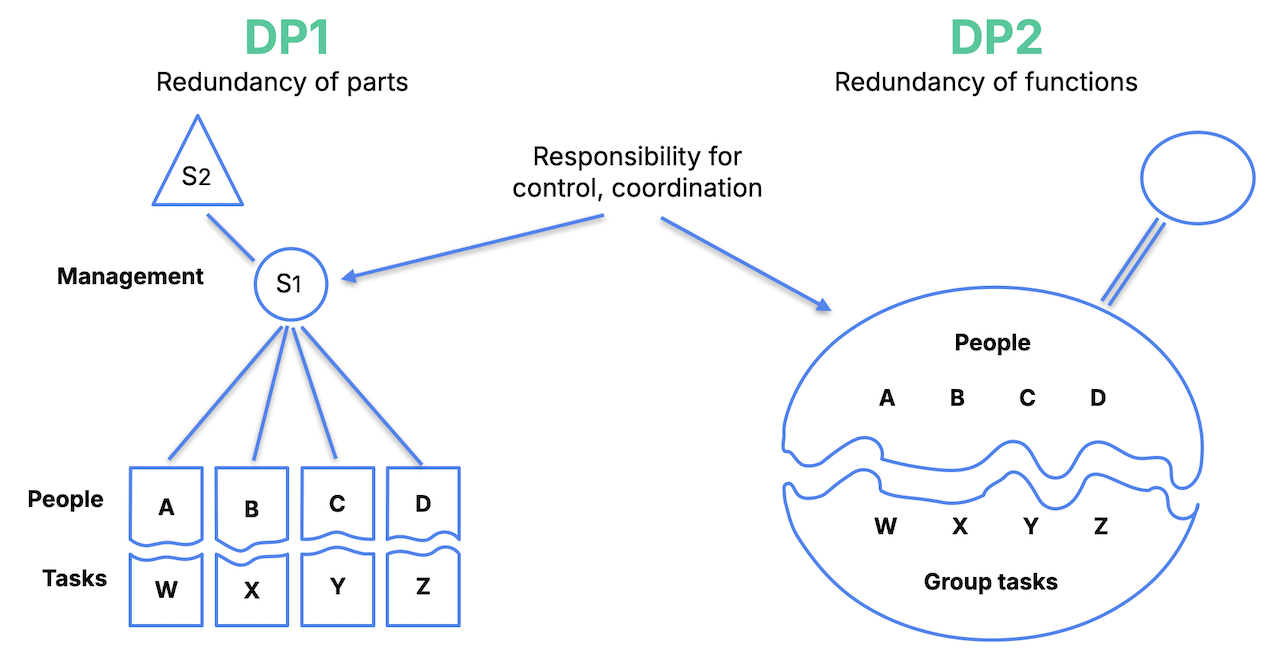
A few things worth pointing out before we move on. DP2 is not new and was not invented by Emery. It is how human beings have organised cooperative work for most of our history. The coal miners did not adopt DP2 in the 1940s; they returned to it. Hunter-gatherer bands, agricultural cooperatives, craft guilds, and the early modern shop floors before industrialisation. All of these were predominantly DP2 in structure. DP1 is not a recent invention either: the Roman Empire was governed by it, and royal courts have relied on dominant hierarchies for centuries. But it was only with the Industrial Revolution that ordinary people were forced into it through the factory system. Frederick Taylor then refined it into scientific management, and it now so dominates our experience of work that we mistake it for the natural order of things.
“It is only when the people involved work out their own designs that the necessary motivation, responsibility and commitment to effective implementation is present.”
— Merrelyn Emery4
DP2 also assumes multiskilling is possible. Where it is not, the group adapts: control remains with the individual while responsibility for coordination and goals is shared across the group. This is relevant wherever deep specialist knowledge cannot be distributed, whether in transdisciplinary research, cross-functional product teams, or at C-level where each executive owns a distinct domain. It is the coordination and the goals that are shared, not necessarily the skills.5
DP2 groups can also organise internally as they see fit, including having a leader. A self-managing group that chooses one person to lead a particular piece of work, or to coordinate the group over time, has made that choice itself. The source of authority is the group, not the hierarchy above it. Self-managing groups are, by default, leaderless. Leadership emerges when the situation calls for it (an emergency, a fire, an accident), where the group calls on whoever has the relevant experience. It is contextual and temporary, held at the group’s discretion, not installed from outside. What makes it DP2 is not the absence of leadership but where the authority to lead comes from. A DP1 organisation cannot do the reverse: it cannot include genuine DP2 because the source of control is fixed above the work. DP2 contains DP1 as a choice. DP1 cannot contain DP2.
Finally, the two principles cannot be mixed. This claim sounds strong, and many readers will resist it. Surely there are gradations and combinations? Surely there is a middle ground? There is not. Responsibility for coordination and control is either with the people doing the work or it is not. A third state exists, but it is not a hybrid. It was first identified by Lewin, Lippitt and White and called laissez-faire: the absence of a design principle altogether.6 More recently, Don de Guerre and Merrelyn Emery identified modern forms of laissez-faire emerging in organisations that have tried to move toward DP2 without completing the transition.7 Both perform worse than even DP1. Let us take a closer look at this next, as many of the dysfunctions in this book emerge from exactly this state.
Modern forms of laissez-faire: the third state
https://leanpub.com/organisationaldysfunctionsWhy structure beats culture
https://leanpub.com/organisationaldysfunctionsThe six psychological requirements
https://leanpub.com/organisationaldysfunctionsDavid (P.G.) Herbst, Socio-technical Design: Strategies in Multidisciplinary Research (London: Tavistock Publications, 1974).↩︎
David Graeber and David Wengrow, The Dawn of Everything: A New History of Humanity (London: Allen Lane, 2021).↩︎
Fred Emery and Einar Thorsrud, Democracy at Work (Leiden: Martinus Nijhoff, 1976).↩︎
Merrelyn Emery, Searching: For New Directions, in New Ways, for New Times (Canberra: Centre for Continuing Education, Australian National University, 1982). The relevant section is available at socialsciencethatactuallyworks.com.↩︎
Fred Emery and Merrelyn Emery, Participative Design: Work and Community Life (Canberra: Centre for Continuing Education, Australian National University, 1974), pp. 8–9. Available at socialsciencethatactuallyworks.com.↩︎
Lippitt, R., & White, R. K. (1943). The “social climate” of children’s groups. In R. G. Barker, J. S. Kounin, & H. F. Wright (Eds.), Child Behavior and Development (pp. 485–508). Norwood, NJ: Ablex.↩︎
de Guerre, D. W., & Emery, M. (2008). “Modern Forms of Laissez-Faire Organization.” Social Science That Actually Works. socialsciencethatactuallyworks.com.↩︎