Chapter 5: The First Core Drive - Epic Meaning & Calling
Now that we have established a foundational overview of the Octalysis Framework, it is time to dive deeper into each Core Drive and discover the power and enchantment within.
If there is only one thing you remember after reading this book, it should be to focus on motivation by thinking through the 8 Core Drives instead of focusing on features and functionalities. Of course to do that, you need to be familiar with the 8 Core Drives to wield them correctly, otherwise you may even end up hurting user motivation.
The Core Drive High Above
Epic Meaning & Calling is the First Core Drive of Octalysis Gamification. This is the drive where people are motivated because they believe they are engaged in something bigger than themselves.
Games often trigger the Epic Meaning & Calling Core Drive. In many games, an intro narrative communicates that the world is about to be destroyed, and somehow, you as the player are the only one qualified to save the world. That immediately creates excitement and motivation towards the adventure.
What about real life? Do we ever encounter scenarios where we are driven by Epic Meaning & Calling?
- Have you ever wondered why people contribute to the non-profit website Wikipedia? What would make someone spend hours updating a site that doesn’t pay her or even help her build her resume?
- Why are people so loyal to Apple products, to the extent that they know they want to buy the next product, even before they know what it is?
- Why are school rivalries so engaging, driving radical behaviors such as pranks, streaking, violence, while also leading to profit for the schools?
- Can higher purpose also be designed into parenting styles beyond the usual reward and punishment system?
Interestingly, these questions can all be answered by the powerful White Hat Core Drive of Epic Meaning & Calling. In this chapter, we’ll attempt to address many of these questions and provide more understanding of this selfless Core Drive.
The Encyclopedia that Pwned Me
“Pwn is a leetspeak slang term derived from the verb own, as meaning to appropriate or to conquer to gain ownership. The term implies domination or humiliation of a rival used primarily in the Internet-based video game culture to taunt an opponent who has just been soundly defeated (e.g., “You just got pwned!”).” - Wikipedia6.
When I founded my first startup company in 2004, I was really excited about finally being an entrepreneur and wanted to promote it everywhere. I learned that anyone can update Wikipedia because it is user-generated, and thought it would be a stellar idea to have my company included within the vast knowledge of Wikipedia. I excitedly spent an entire day crafting a great and informative section about my company - describing when it was founded, by which amazing prodigies, and the problems it set out to solve.
Once completed, I proudly clicked the “publish” button. And there it was: I saw my own company as a Wikipedia article. Woohoo! We were officially on Wikipedia now! What an Epic Win!
However, my bliss of “finally making it in life” was short-lived.
About three minutes after my posting, my post was flagged by a “member of the Wikipedia community,” stating that this entity was not significant enough and therefore does not deserve to be on Wikipedia. Five minutes later, a couple others agreed to that point of view, and my post was deleted.
Just like that, my full day’s worth of work disappeared within ten minutes.
The first question that came to my mind after the many “dot dot dot” moments and the three ||| lines across my forehead was, “Who are these people? Do they even have lives??”
It sure seems odd that a fairly large group of volunteers go on Wikipedia regularly, not to be enlightened with mind-blowing knowledge, but to police the platform for pests like me who are trying to sneak irrelevant or unimportant content into the Wikipedia.
If you have ever hired interns or entry-level employees and have paid attention to their motivations and feelings, you may know that asking people to do “auditing work” on mountains of pages and to flag outdated content can present an awkward situation. You know that no one enjoys this type of grunt work. These bright young interns and employees really want to learn great skills from you and your company so they can grow as professionals. But there is negligible learning associated with such mundane work. Someone in the company has to do the work, and the entry level interns naturally should be the ones that perform the tasks that no one else wants to do.
As a result, you try to tell them to do it as a matter-of-fact, so they may go with the flow without thinking about the demoralizing nature of it. Or you may choose to spend a lot of time explaining to them how this is important to the company and how their work creates great impact. You could also try to make the project sound fun and exciting. At the end of the day, you know in your heart that this is dreadful work, and the young colleague simply needs to “pay their dues” before they can get other interns to do the same.
But when it comes to Wikipedia, people are volunteering their precious time outside of their jobs to do the exact same thing without getting any “real” benefits! When you come home from work, there are lots of things you can do - practice your daily boss-complaining ritual, watch TV, Skype with your significant other, or even play games. People choose to police Wikipedia above all those other activities because they feel like they are protecting humanity’s knowledge - something greater than themselves.
When it comes to Epic Meaning & Calling, it’s not about what you want as an individual nor about what makes you feel good. Individuals participate in the system and take action not because it necessarily benefits them, but because they can then see themselves as heroes of a grander story. It’s about playing your part for the greater good.
And if playing my part does not require me to sacrifice my life as a martyr but simply requires me to spend a couple hours a day monitoring weird activities on Wikipedia, that’s a huge bargain and something worth doing.
According to an MIT study, obscenities that are randomly inserted on Wikipedia are removed in an average of 1.7 minutes7. These unpaid guardians are definitely keeping humanity’s knowledge in check diligently.
However, based on my later acquired understanding in human motivation, I also had the hunch that instead of getting paid for pouring hours of their precious labor into Wikipedia, they are also more likely to pay Wikipedia instead.
After some research, whoopee, I discovered that people who have spent time editing Wikipedia are almost nine times more likely to donate to Wikipedia compared to people who only benefit off it by consuming the valuable information (28% vs 3%)8. What’s more, donors who don’t edit the site have all donated far fewer than three times, while a whopping 80% of donors who have also put labor into Wikipedia have donated five times or more.
Time and time again, we see that, when your system or product demonstrates deep and sincere passion towards a higher vision, others will want to believe in it and get on the journey with you, even if it means foregoing financial compensation (which is Core Drive 4: Ownership & Possession).
Even to this day, when people ask me, “Why don’t you enter yourself and your Octalysis model onto Wikipedia? You’re fairly well-known in your industry right?” I usually try to sidetrack the conversation, as the mere thought of doing so brings back scarring memories of having such an authoritative community unanimously vote that I was not worthy of being mentioned.
“Nah, I’m not that well-known.”
Newton’s Legacy is Beyond a Fruit
Core Drive 1: Epic Meaning & Calling is generally best communicated during the Discovery and Onboarding Phase of a Player’s Journey. You want to communicate very early on exactly why the user should participate in your mission and become a player.
Apple is one of the rare companies that understand this Core Drive, and they managed to instill this into consumers without being user-generated, being an open platform, or pushing for “a charitable cause.” Every once in a while, I’ll have friends who excitedly tell me, “Hey Yu-kai, I am saving up to buy the next iPhone.” I would respond, “But you don’t even know what’s in the new iPhone! What if it sucks?” My friends would then respond with, “I don’t care. I’m going to buy the next iPhone.”
Isn’t that a strange phenomenon in a world where electronic consumers are spoiled by a plethora of options out there, with many alternatives touting the same or better capabilities than the iPhone but only a fraction of the cost?
Why are people so crazy about Apple products?
What we are seeing here is that these friends of mine (and I suspect yours too) have first self-identified as an “Apple Person.” Therefore, they need to do what “Apple People” do, which is to buy the newest iPhones and MacBooks, as well as act like “Apple Snobs” by walking around and making comments such as, “Oh, I never have that problem because I use a Mac.” I myself have also been guilty of this.
When confronted with the topic of many Android phones having better specs and lower prices than the iPhone, my response has usually been, “Well, I don’t know about the specs, but I do know that, when I’m using an Android phone, I feel frustrated; but when I’m using an iPhone, I feel happy. That’s probably worth something.” (By the way, in my opinion, it is often unfair to compare the market share of iPhones to Android Phones as a success measurement, since the iPhone is sold by one company, while Android Phones are sold by over a dozen companies throughout the world. When people freak out about “Oh look! There are more Android users than iPhone users now!”, that’s basically saying that all these non-Apple smartphone companies combined have surpassed Apple. Big deal.)
So the multi-billion dollar question is: How did Apple do this?
Besides offering stellar products with elegant design and meticulous engineering, Apple has been one of the few electronics companies that actually try to sell a higher meaning.
Let’s examine two of the most successful commercials in history - both from Apple.
The Crazy Ones in 1984
The first Apple commercial that reached massive fame and success, is the “1984” commercial, aired in 1984’s Super Bowl XVIII on CBS9.
This is a build-up of the popular novel “Nineteen Eighty-Four” by George Orwell, published in 1949 about a futuristic dystopian world where a unified society is controlled and brainwashed by a centralized government10.
The ad presents a drab, depressive setting - representing a diabolical, yet orderly society; seemingly under the repressive control of a totalitarian influence. In a large room filled with gray, cheerless individuals dressed in monotonous gray uniforms, an authoritative voice booms. The masses stare blankly at a huge screen displaying the colossal image of a “dictatorial figure”. “Big Brother” is addressing the minions, demanding their obedience, their loyalty, their minds.
Suddenly, a woman in full color runs in and throws a sledgehammer at the big screen, completely shattering it. Then, a deep male voice says, “On January 24th, Apple Computer will introduce Macintosh. And you’ll see why 1984 won’t be like ‘1984.’”11
Through this commercial, Apple reassures viewers that the world wouldn’t be controlled by “Big Brother” - IBM, but would be liberated by Apple’s computers.
Though Apple’s Board did not really approve of this commercial and it was almost thrown into the garbage bin, when finally aired, it became one of the most successful commercials in history. In his book, Electric Dreams: Computers in American Culture, Ted Friedman discusses how powerful the commercial was:
Super Bowl viewers were overwhelmed by the startling ad. The ad garnered millions of dollars worth of free publicity, as news programs rebroadcast it that night. It was quickly hailed by many in the advertising industry as a masterwork. Advertising Age named it the 1980s Commercial of the Decade, and it continues to rank high on lists of the most influential commercials of all time. 12
Afterwards, Apple’s internal team calculated the amount of free airtime that the commercial garnered. They estimated that the total value was about $150 million worth of derived airtime. Within three months of the commercial’s appearance, Apple would sell $155 million worth of Macintoshes, establishing itself as the revolutionary computer company on the block.
The second extraordinarily successful Apple marketing campaign to resonate with people was the “Think Different” campaign. This commercial ran in 1997, not long after Apple’s Founder, Steve Jobs returned to the board at the end of 1996. 13
At the time, Apple was a struggling company, and a dying brand. Jobs not only trimmed Apple’s product line from over 350 items down to 10, he knew he had to reinvent the Apple brand.
While there are many shorter versions of the ad, the original full text runs:
Here’s to the crazy ones. The misfits. The rebels. The troublemakers. The round pegs in the square holes. The ones who see things differently. They’re not fond of rules. And they have no respect for the status quo. You can quote them, disagree with them, glorify or vilify them.
But the only thing you can’t do is ignore them. Because they change things. They invent. They imagine. They heal. They explore. They create. They inspire. They push the human race forward. Maybe they have to be crazy.
How else can you stare at an empty canvas and see a work of art? Or sit in silence and hear a song that’s never been written? Or gaze at a red planet and see a laboratory on wheels? We make tools for these kinds of people.
While some see them as the crazy ones, we see genius. Because the people who are crazy enough to think they can change the world, are the ones who do.14
The series of commercials was a gigantic success. It won dozens of prestigious advertisement awards and made the Apple brand “cool” again. It tangibly spearheaded the transformation of Apple from a dying company into literally the most valuable company in the world within a decade.
Have you noticed something unique and interesting about these ads?
Neither of these campaigns actually talks about computers or electronics. They don’t talk about specs, RAM, color screens, or computers. You’re not even sure what they sell if you are unfamiliar with the company.
They sold a vision.
When people connect with a statement like, “Because of Apple Computers, 1984 will not be like Nineteen Eighty-Four,” many started to think, “Wow! That’s amazing! I don’t know what they do, but I want to be part of this!”
How do you “be part of it”? You buy the Macintosh computer.
Similarly, when people hear the deep wise voice concluding with, “Because the people who are crazy enough to think they can change the world, are the ones who do,” they become inspired and think, “Yes! I’ve always been hiding my true passions to conform with what people expected of me. I want to be one of the crazy ones that changes the world!” And of course, the way to think different and change the world is to buy an iPod and have a thousand songs in your pocket.
See the power of Epic Meaning & Calling? When every other company is selling how amazing their computers are, Apple sells a vision worth believing in. Interestingly, when Apple was developing the Think Different campaigns, the first rule was that there would be no products in the commercials. This is so counterintuitive, yet so Human-Focused.
As long as Apple can continue to make people think that it is a vision worth believing in, their customers will continue to be “Apple People” and buy Apple products. But if one day Apple does something stupid and breaks the trust of being a vision worth believing in, people will stop blindly purchasing their products and will begin to look at the specs again.
Mjolnir is Not Just a Tool
Some companies have approached me during my all-too-good-sounding soapbox, and asked me, “Yu-kai, this Epic Meaning & Calling thing is great and all, but our product is just a tool. It’s not meant to change the world and solve global warming. How can we add Epic Meaning & Calling to a simple tool?”
For this, one of my favorite examples is the mobile app Waze15. Waze is a GPS-based mobile navigation app that provides a wealth of user-generated information about travel conditions from the Waze community.
When you think of a GPS, it is purely functional as a tool. You turn left, turn right, and get to your destination - very functional as a tool, but not very epic. So how does an app like Waze create Epic Meaning & Calling? And how do you instill that meaning without giving users long videos to watch or huge amounts of text to read?
What Waze did was brilliant. In the early days of Waze, when you first download the app, it would show you one image. On the left side of that image, there is a huge snake monster, consisting of a street with many cars stuck on it. This snake monster’s name was Traffic. On the right side of the image, there were cute little Waze knight characters with swords, shields, and armor, working together to fight this big snake monster.
So now, when you are driving with Waze, you are not just getting to your destination, you are helping a community of brave Wazers fight this Traffic monster! This resonates on a subconscious level because, deep in our hearts, everyone hates traffic with a passion.
Of course, the actual way to beat this Traffic monster is to drive with Waze on. Since Waze is a user-generated system, as you drive with the app on, it will start to gather valuable information about the road conditions that will help the overall driving experience of the community.
The powerful thing about Epic Meaning & Calling is that it turns otherwise passive users into powerful evangelists of your mission. They are even highly forgiving of your flaws. Because Waze is user-generated, sometimes it is not as accurate. Consequently, in its early days, it took me to the wrong location about three times, and I became apologetically late for my meetings.
You would think that the only purpose of a GPS is to take you to the correct destination, and when it fails in that one purpose, most users would say, “This is a piece of crap. I’m going to delete it!” However, because of the Epic Meaning & Calling Waze has instilled in the hearts and minds of people, when it takes people to the wrong location: instead of deleting it in anger, many people start to panic. “Oh no! The map is broken! I need to go fix it!”
How powerful is that? When you fail in your core competency, instead of deleting the app in anger, users actually rush to solve the problem for you. Again, when it comes to Epic Meaning & Calling, what makes you happy is irrelevant. It’s about the bigger meaning and higher vision. And when you see a crack in that higher vision you believe in, you become fearful that others will see that crack and lose faith in the vision. As a result, you take it upon yourself to fix it.
This ties back to the core of Human-Focused Design. You play a game not because you have to, but because you enjoy doing so. You use Waze not because there aren’t any other good GPS apps out there that can report to you traffic conditions, hazards, and watchful policemen; you use it because it’s fun and you enjoy the experience the most. And just like Mjolnir, Thor’s mighty hammer known for leveling mountains16, this is no ordinary tool - it even slays traffic!
Despite the many errors and frustrations leading to inaccuracy, within a few years of its founding, the company was acquired by Google for over $1 billion. Not bad for selling a vision.
Your Parents are Bigger Than You!

Some people mistake Octalysis and Gamification as technology solutions that are expensive to implement. In reality, they are design systems focused on motivation. So if the activity relates to motivation, you can apply gamification to it. Just like games – you can play with a complex 3D Virtual World technology like World of Warcraft, or you can play Hide-And-Seek, something that requires no technology at all. Children these days have both World of Warcraft and Hide-And-Seek available, and the last time I checked they still enjoy Hide-And-Seek.
Because of that, we can even apply Octalysis Gamification to things a bit more abstract, such as parenting. Parents often use two main Core Drives to motivate their children to behave well - Core Drive 2: Development & Accomplishment (reward when the child behaves), as well as Core Drive 8: Loss & Avoidance (punish/ground when the child does not behave).
However, the Chinese culture has “figured out” how to implement Core Drive 1: Epic Meaning & Calling into parenting, through the meaning behind a term known as “孝”. Pronounced “Sheeow,” (or “Xiao” in correct Pinyin spelling, but most people don’t know what to do with the X). It has no direct English translation, but it is a concept that translates into a belief that since the first day of your birth, you are indebted to your parents who you owe your life and existence to. As a result, “孝” mandates that you need to do everything possible to honor them and lift them up.
There are even popular expressions and idioms in Chinese literature such as “不孝之子, 天地不容,” which means, “For a son without ‘孝,’ there is no space/tolerance for him in heaven or earth.” This means that if you do not have “孝 ,” you are such an epic scumbag you don’t even deserve to have ever existed; both the heaven and the earth are so disgusted by your existence they are literally spitting you out of their presence.
Some sources translate the character “孝” to mean “Filial Piety” – “a virtue of respect for one’s parents and ancestors.” Yet, having grown up with this term I feel it goes a long way beyond the word “respect.” When I was little and just started to comprehend the world, I remember reading or listening to the thrilling and sometimes gruesome stories of the well-known children of “孝” in Ancient China. These children would fight tigers to protect their parents, warm up their parents’ mattresses before bedtime, or cut off their own flesh in order to feed their hungry parents. In one story, a sixty-year-old man of “孝” pretends to play on the ground in a humorous way in order to entertain his eighty-year-old parents. (Note: regardless of the tactics to educate such Epic Meaning & Calling, “孝” is truly a great virtue that is slowly being lost in a globalized “flat world” of instant gratification and self-centeredness).
Other examples of “孝” in the 24 Paragons of Filial Piety17 include:
- a man sells himself into slavery to pay for his father’s funeral
- a man tastes his sick father’s stool to understand the health of his father
- a woman cooks part of her own liver to feed her mother
- an eight year old boy attracts mosquitoes to suck his blood so they won’t bother his parents
- a father decides to bury his three year old son so he can afford to care for his own mother. While digging the hole, he finds treasure and doesn’t have to kill his son.
While some of these actual stories are disturbing, they illustrate how important “孝” is as a value within the culture. Of course, parents aren’t just hypocritically manipulating their children. The children who see their parents treat their grandparents poorly, regardless of whether these stories are told to them, will most likely not buy into the Epic Meaning of 孝. This is an important factor in using the motivation elicited through Core Drive 1 - it must feel authentic.
In Traditional Ancient Chinese Culture, when one’s parents pass away, they need to dress in mourning attire, abstain from all entertainment and sometimes meat, as well as exclude social relationships for three entire years to express their grief. This act is called “守孝”, which literally means “guarding 孝” and was traditionally set to be three years because Confucius stated that it takes three years for us to leave our parents’ arms; hence, it is proper to spend three years mourning for them. Of course, in today’s modern society, much of the three-year mourning is lost and reduced to days or weeks as a symbolic gesture to honor one’s parents.
And because of this culture of “孝,” Asian children grow up feeling that they have to do a lot for their parents – they have to study hard, they have to get into a good school that their parents can be proud of, they have to support their parents throughout life, they should live with their parents to always be available and make sure everything is taken care of for their parents’ life-long wellbeing. As an example, I have a close relative in his fifties who has left his wife and son in the United States for close to a decade now - so he could live with and take care of his aged mother in Taiwan; only visiting his immediate family a few times each year.
In contrast, in many Western societies where the concept of “孝” is not as prevalent, people still respect their parents immensely; however, once they form their own families, they generally become more disconnected and simply bring their children to grandpa and grandma once or twice a year, instead of constantly making life decisions that are tailored to their parents.
Even today, if my parents told me I don’t have 孝 because of any behavior, it would crush me emotionally and motivate me towards almost anything to make amends for it. Just because I understand the nature of the motivation does not mean I am exempt from it. It is something deeply ingrained within me and my values. In similar fashion, my parents have never made that accusation to me (despite me regularly being very disappointing to them), because it would be one of the greatest insults a parent could give a child. It is that serious and tangible when it comes to this type of motivation.
Game Techniques within Epic Meaning & Calling
Now that you have the main concept of Core Drive 1: Epic Meaning & Calling, the question is how to implement it into your experiences. Below I introduce a few Game Techniques that, if designed correctly, can bring out the sense of Epic Meaning & Calling. Keep in mind, in my terminology, when I mention Game Techniques, I mean techniques that incorporate Game Elements (which includes Game Mechanics) to drive motivation.
You will also start to notice many “Game Technique numbers (#s)” that follow each Game Technique mentioned. These Game Technique #s are part of a scavenger hunt that originated from my website YukaiChou.com. My readers would try to collect all the numbers, which will one day result in some fascinating things that one can do with Octalysis down the road.
One key thing to remember is that the entire premise behind the Octalysis Design Framework is that one should not be too stuck on game mechanics, game techniques, or any outer appearances of a design. Rather, one should focus on the Core Drives and how they bring out motivation in an actionable manner. The Game Techniques, as well as the associated #s, are all just bells and whistles for great motivational design. If you do not focus on the Core Drives, it will simply have the Shell of an engaging game, not the Essence.
Narrative (Game Technique #10)
Most games start with a narrative that gives the player some context about why they should play the game. Many of them are related to saving the world, a princess, solving a case, or even just helping a dragon or crocodile take a bath. So why don’t we use narrative to give people context in other things?
One of the more effective ways to instill Epic Meaning & Calling into your user base is through an engaging Narrative. This allows you to introduce a story that gives people context for a higher meaning through interacting with your company, product, or website.
Zamzee, a “wearable technology” company for children, uses narratives to instill epic fantasies into children to motivate them to exercise more. Through its online software interface, Zamzee gives kids fantasy quests, such as becoming a sorcerer’s apprentice. In order to learn your first spell, you run up and down the stairs 15 times. Even though the action itself is disconnected from the narrative, just having them make-believe a magical meaning inspires the kids to exercise more because they are now motivated by their own imaginations. Zamzee shows that kids who participate in these imaginary missions move 59% more than kids who don’t18.
Humanity Hero (Game Technique #27)
If you can incorporate a world mission into your offerings, you can gain even more buy-in during the Onboarding process. One company that does an incredible job of instilling a sense of Humanity Hero is TOMS Shoes, which sends one pair of shoes to a child in a third-world country whenever you place an order with them19. The idea that you can help underprivileged kids every time you make a purchase is extremely motivating. Additionally, when customers wear the shoes, they let others know that they are helping the world, which is a form of Trophy Shelf (Game Technique #64) within Core Drive 5: Social Influence & Relatedness.
FreeRice is another example that utilizes the Humanity Hero technique. FreeRice.com is a website that donates 10 grains of rice for every correct answer to the educational questions posted on their site. The funding comes from the ads and the number of page views they generate from those answering the questions. To date, FreeRice has donated 6100 metric TONS of rice, consisting of 93 billion grains of rice and enough to feed 10 million people.20
Often, if you can tie your system to a cause that many people care about, you can build an entire business on the goodwill of others.
Elitism (Game Technique #26)
Allowing your users or customers to form a prideful group based on ethnicity, beliefs, or common interests also makes them feel like they are part of a larger cause. Elitism instills group pride, which means each member tries to secure the pride of the group by taking specific actions. The group also attempts to frustrate its rivals, which can lead to both groups upping their actions to beat the competition.
This is why University Rivalries are so engaging. When I was attending UCLA (University of California, Los Angeles), it was very difficult to not feel the strong rivalry against USC (University of Southern California). Starting from orientation as a Freshman (Onboarding), there is no lack of content and jokes that set the scene of the USC rivalry. During sports seasons, this rivalry reaches its pinnacle, with both sides aggressively, sometimes violently, insulting each other. There are even T-Shirts printed with the text, “My 2 favorite teams are UCLA, and whoever is playing USC.”
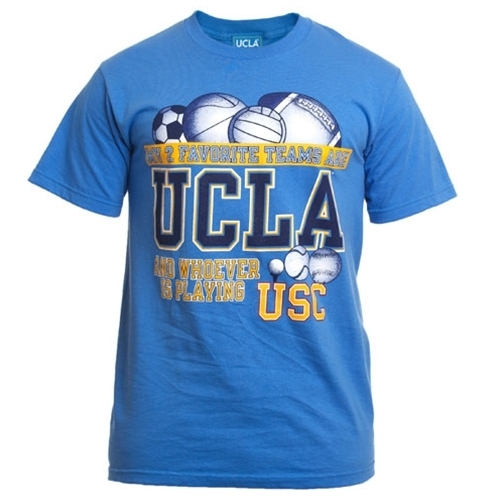
Both sides believe that this rivalry is bigger than themselves, and with this newly instilled sense of Elitism, they engage in many irrational activities because they “should” as a proud representative of that school.
Even though rivalries are engaging or even fun for students, who actually benefit the most from these rivalries? More often than not, it is the universities themselves. By creating an outside enemy that students “should hate with a passion,” it creates more “school spirit” where students bond together and commit Desired Actions in frenzies. Tickets to games against USC sell out quickly, with everyone gearing up with UCLA merchandise and war paint. More importantly, students feel a stronger tie towards their Alma Mater, which means that later on in their careers, they are more prone to donate to their schools since that’s what successful alumni “should” do.
Similar in effect to the concept of “孝,” I too implicitly feel that I “should” donate to my Alma Mater. Not because of any personal gains, but for a purpose beyond my own selfish and family matters. In one of my speeches, an attendee asked me, “I would like to figure out how to add more alumni participation for our university. Academically, we rank really well, but for some reason, our alumni don’t feel proud coming here and just see us as a stepping stone. They rarely participate or donate!” My response to him was, “Sounds like you need to add more school spirit to students while they are still attending. I’m guessing you don’t have competitive athletic teams or big school rivalries?” “No, we don’t! How did you know?”
Even a colleague of mine, Jerry Fuqua, chose to attend UCLA many years ago over having a full scholarship into Harvard and other Ivy League schools because he loved UCLA’s basketball team. Another friend of mine who aced all his Calculus exams as a Freshman in High School also chose to attend the University of Kansas over other more prestigious schools because he grew up being a fan of the KU Jayhawks. If you ever wondered if it was worth an educational institution’s budget to support an expensive athletic team, now you at least see the justification.
Another great example of Elitism is demonstrated by the microlending platform Kiva.org, which allows developed countries to pseudo-donate their money to help third world country villagers start their small businesses and help sustain their families. To create a sense of Elitism, Kiva.org created groups and published statistics that allowed Christians and Atheists to compare their giving against each other, to see who contributes more money in helping third world countries.21
The Christians believed that, since the Bible tells them to love God and love one another beyond all things, they should demonstrate generosity to the world and help those in need. As a result they increased their contributions. The Atheists, on the other hand, wanted to prove that one does not need to believe in a god to simply be kind to fellow human beings, so they also increased their contributions. Again, both sides contributed more than they would have otherwise, simply because they felt they were doing it for a greater purpose than themselves - protecting their group’s reputation. (Disclaimer: I am myself a person of Christian faith).
Beginner’s Luck (Game Technique #23)
Beginner’s Luck focuses on the Calling part in Epic Meaning & Calling. Calling makes people think they are uniquely destined to do something. With Beginner’s Luck, people feel like they are one of the few chosen to take action—which makes them much more likely to take it. If a gamer, upon the first day of playing a game, randomly earns one of the most powerful swords in the game, one that even veteran players couldn’t easily obtain, chances are he isn’t going to quit on day one. He’ll likely be using that powerful sword to kill monsters fanatically until the next hook in the game shows up.
The game designer would likely also add in Social Influence & Relatedness (Core Drive 5) by designing in Trophy Shelves (Game Technique #64), which are mechanisms that allow the user to implicitly show off what they are proud of. If the game designer also adds Scarcity & Impatience (Core Drive 6) through Moats (Game Technique #67) by telling the user he can only equip this sword once he defeats all the adversaries at a particularly difficult level, the user now becomes obsessed and tries to figure out all sorts of ways to conquer that level.
Free Lunch (Game Technique #24)
Along the lines of the “Calling” theme, giving freebies (that are normally not free) to selected people in such a way that it binds them to a larger theme can make customers feel special and encourage them to take further action.
For example, Spoleto, a Brazilian restaurant chain with over 200 restaurants throughout Brazil, Spain, and Mexico, gave a literal free lunch to any female who told them she was beautiful, in celebration of International Women’s Day.22 This helped promote a positive message and made women feel special for that day. This will likely bring them back in the future too, as this venue is now associated with a positive memory that makes them feel unique.
Believability is Key
Even though Epic Meaning & Calling is powerful “beyond measure,” it can also backfire and fail in epic proportions. As you use these concepts, keep in mind that you can really turn people off when you’re appearing disingenuous in your efforts to create Epic Meaning and Calling.
For example, if a major gasoline company that was known to “profit from evil” tried to convince people to use their brand by saying, “pumping with us protects the planet,” customers would not only be unimpressed, they would likely feel insulted. Or if a certain fast food conglomerate that is known for cheap unhealthy foods (that happen to never decompose) runs a marketing campaign that says, “Eating our food protects your health and your family,” people would likely see that as a manipulative slap in the face.
Even in fantasy make-believe settings like Zombies, Run!, where users are motivated to run more because they are trying to save their village from hypothetical zombies, you want to make sure the user is prepared to believe in the higher fantasy meaning in that context. Pretending that there are zombies in the room during large corporate board meetings in order to get everyone to stand up more often would likely not fare all that well. (So please don’t tell your Board of Directors that you did it because you read my book on Epic Meaning & Calling).
Once you have firmly established believability in your Epic Meaning & Calling, you will have a good chance of applying this Core Drive effectively to bring out the fun and selflessness in people.
Core Drive 1: The Bigger Picture
Core Drive 1: Epic Meaning & Calling is the prime White Hat Core Drive within the Octalysis Framework, and is often very powerful in the Discovery and Onboarding Phases of a player’s journey. It underlines the purpose behind the activity and strengthens all the other seven Core Drives when it is introduced correctly. In later chapters, we will also explore how some companies utilize Epic Meaning & Calling (among other White Hat Gamification Core Drives) to inspire their employees to work with more passion and stay in the organization, even when other companies offer them greater monetary incentives.
Core Drive 1: Epic Meaning & Calling’s weakness lies in the difficulty of implementing believability, as well as the lack of urgency within the motivation. While people constantly aspire to become part of something bigger and would feel great if they actually took the actions, they will often procrastinate and delay those very actions. Thus, to create desirable behavior, the gamification designer needs the help of the other Core Drives within Octalysis.
To get the most out of the book, Choose only ONE of the below options to do right now:
Easy: Think of an example where Core Drive 1: Epic Meaning & Calling motivated you or others to take certain actions. Does it make people act more selflessly?
Medium: Identify a project you are working on. Think about whether there are ways to install Core Drive 1: Epic Meaning & Calling into the experience. Can you tie the experience into a bigger theme?
Share what you come up with on Twitter or your preferred social network with the hashtag #OctalysisBook and see what ideas other people have.
New Section Unlocked! - Get Inspired
Now that you are becoming familiar with the Octalysis Framework, check out my TEDx talk on how eight different world-changing products utilize each of the 8 Core Drives to make the world a better place. The TEDx talk can be accessed at http://yukaichou.com/tedx, or you can simply go on Google and search “Gamification TEDx.”