Chapter 13: Left Brain vs Right Brain Core Drives
Using Octalysis in the Real World
Now that we have completed our journey through the 8 Core Drives, it is worth remembering that these Core Drives drive every action we take, whether it’s inside or outside a game. If none of the 8 Core Drives are present, there is no motivation, and therefore no action takes place (that is, with the exception of the hidden ninth Core Drive: Sensation).
You may have noticed that I always include a specific number with each Core Drive, and in some instances, I’ve only mentioned the Core Drive number without the full title. After reading this book and continuing on your journey to understand and implement Octalysis Gamification, you will find that knowing these Core Drive numbers will become extremely helpful.
When I work with my team of Octalysis designers on a client project, I often say things like, “Over here you can clearly see a Core Drive 6 design, which enforces Core Drive 3, which in turn promotes Core Drive 2, and ultimately leads to Core Drive 5.40”
If you are not familiar with the Core Drive numbers, you would naturally have difficulty keeping up with the conversation. The 8 Core Drives are designed to be “mutually exclusive and collectively exhaustive” (also known as MECE41). Unfortunately, the full name of each Core Drive is a mouthful. By using their numbers, you can save time and effort in a long conversation and instead focus on creating valuable solutions.
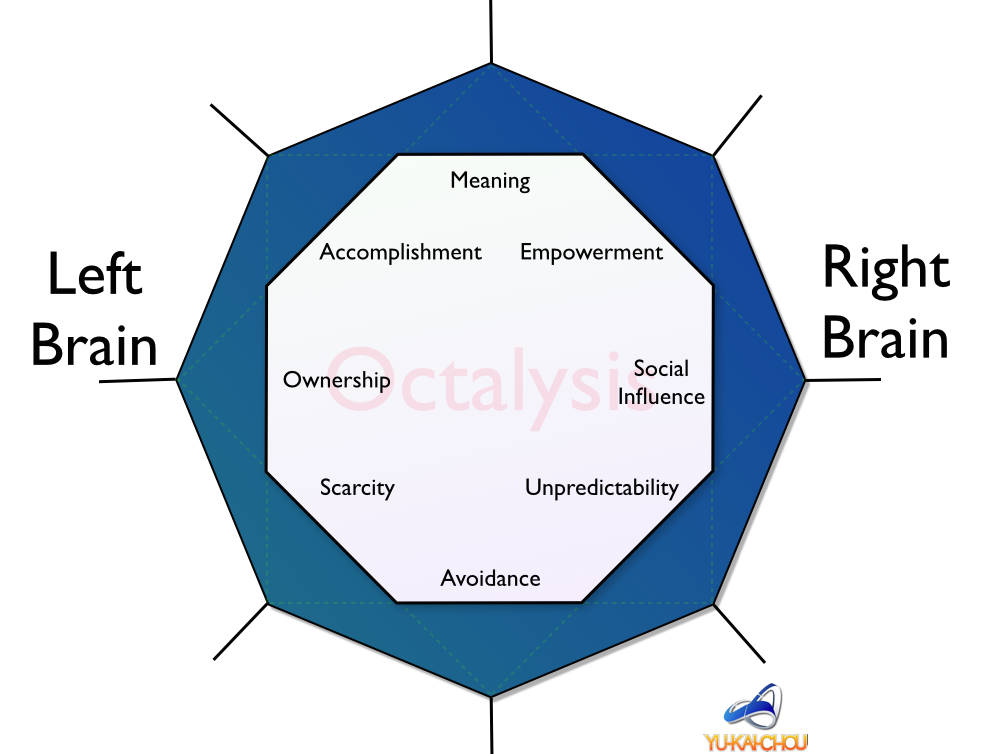
For me, the Octalysis Framework has been incredibly useful because it not only provides a visual understanding of the intricacies of motivation, but also its nature: the placement of each Core Drive on the octagon shape provides visual cues that help the designer determine if they have a long-term or short-term effect, or whether these experiences are intrinsically or extrinsically designed.
The Octalysis Framework also enables us to predict how motivation can evolve over subsequent phases and helps us identify the weaknesses of a design which can be addressed and improved upon.
Left Brain vs. Right Brain Core Drives
A key aspect of the Octalysis Framework is the difference between Left Brain and Right Brain Core Drives.
The Left Brain Core Drives involve tendencies related to logic, ownership, and analytical thought. They are expressed in the following three Core Drives:
- Core Drive 2: Development & Accomplishment
- Core Drive 4: Ownership & Possession
- Core Drive 6: Scarcity & Impatience
The Right Brain Core Drives are characterized by creativity, sociality, and curiosity and are illustrated by the following:
- Core Drive 3: Empowerment of Creativity & Feedback
- Core Drive 5: Social Influence & Relatedness
- Core Drive 7: Unpredictability & Curiosity
(Note: there will be several points later in this chapter where you may find the need to refer back to the reference above.)
Again, it is worth noting that the terminology of “Left Brain Core Drives” and “Right Brain Core Drives” does not necessarily mean that they are physically located on the left side or right side of our brains. These references are merely symbolic in that some of the Core Drives are influenced more by the “logical brain,” while other Core Drives are influenced more by the “emotional brain.”
There have been past instances where some individuals tried to attack my work, pinpointing how the “left brain vs. right brain” model has been debunked and therefore is no longer scientifically valid. From my perspective, this is simply an issue of semantics, for I could very well name the emotional Core Drives, “Rainbow Core Drives” and the logical Core Drives, “Stone Core Drives” - which would actually give a nice, game-like ring to them.
However, the current terminology is ideal for design purposes, as the “left/right brain” terminology is popularly understood in the social sciences. Therefore I designed the Left Brain Core Drives to be conveniently located on the left side of the octagon and the Right Brain Core Drives to be situated to the right. I’m a designer by trade, so even though I don’t see anything wrong with the Left/Right Brain terminology to begin with, I prefer tools that are useful over ones that are simply “semantically accurate.”
I believe that my intended goal to organize these Core Drives into intuitive patterns within a visually clear diagram was successful. This allows me and my students to follow complex motivational and behavioral design principles in an approachable manner. In turn, this enables us to design experiences that ensure long-term metrics are sustained.
Conveniently, the Left/Right Brain framework structure also allows us to differentiate and design for the differences between extrinsic and intrinsic motivation.
Extrinsic vs Intrinsic Motivation
The grouping of Left Brain and Right Brain Core Drives is correlated to what many motivational theorists understand as Extrinsic Motivation and Intrinsic Motivation.
Extrinsic Motivation is motivation that is derived from a goal, purpose, or reward. The task itself is not necessarily interesting or appealing, but because of the goal or reward, people become driven and motivated to complete the task. More often than not, people go to work every day not because they actually love doing the work, but because they want to make a living, advance their careers, and be recognized for higher achievements.
For example, let’s say you have a terrible job. Your job is to dig feces out of the ground for hours every day. It’s labor intensive, smells horrible, and you hate the job with a passion. But then someone shows up and says, “I’ll give you $10,000 for every single piece of dung you dig out.”
All of a sudden, you become excited and extremely motivated to dig, thinking, “Wow! This is easy money! Hahaha!” You’re now engaged, joyful, and motivated with the job. Morale is high, and you start working much faster than you did before.
However, it is important to remember that the task itself is still not fun. You are motivated because the extrinsic reward is extremely appealing, and it creates the illusion that you enjoy the activity. Once the extrinsic reward is gone, you will go back to hating the task - and possibly more so than before, as we will see soon.
Intrinsic Motivation, on the other hand, is simply the motivation you get by inherently enjoying the task itself. These are things you would even pay money to do because you enjoy doing them so much. For instance, you don’t need to reach any target to enjoy utilizing your creativity; you don’t need a physical reward to enjoy hanging out with your friends; and you don’t need any compensation to be absorbed by the suspense of unpredictability.
In fact, when you go to a casino, you have the opposite of a reward. Most people know that they are “statistically screwed” by the casino – that’s how the casinos make so much money. But they still come out saying, “I lost $200, but I had so much fun!” Why? Because, throughout those five hours, they were constantly thinking, “Maybe I’ll win this time!”
They are spending $200 to buy the intrinsic joy of “possibly” winning. If the unpredictability is removed and people know with absolute certainty that they will get $40 after pressing those buttons for five hours, they will no longer think it is fun. In fact, it would become very similar to the dreadful work of laboring in a factory.
Left Brain Core Drives are by nature goal-oriented, while Right Brain Core Drives are experience-oriented. Extrinsic Motivation focuses on results, while Intrinsic Motivation focuses on the process.
Slight Semantic Differences with the Self-Determination Theory
Intrinsic Motivation versus Extrinsic Motivation is a popular topic within the gamification space and was heavily popularized by Daniel Pink’s book Drive42. The book explores how instead of being motivated by money (Core Drive 4: Ownership & Possession) and punishment (Core Drive 8: Loss & Avoidance), people are motivated more by Purpose, Autonomy, and Mastery.
While I believe Drive, as well as the Self-Determination Theory it advocates, is fantastic, I should point out that my terminology differs slightly from Pink on what Intrinsic Motivation consists of.
When a basketball player practices by shooting hoops a thousand times a day, their motivation is to achieve Mastery, something that is characterized as Intrinsic Motivation within Pink’s theories43. However, within the Octalysis Framework, the activity itself is still monotonous and boring. It is only motivating because the athlete has a goal - an extrinsic motivation. That said, we will look at how Self-Determination Theory connects with White Hat Motivation within my framework in the next chapter.
Here is the test I usually apply to determine if something is extrinsically or intrinsically motivated: if the goal or objective were removed, would the person still be motivated to take the Desired Action or not?
In other words, at the end of the day, if the basketball player knows that whatever they do, they will lose all “progress” and everything obtained or accumulated, would they still choose to shoot hoops?
Social hangouts and creative activities, such as solving fun puzzles, will pass the test for intrinsic motivation. However, accumulating goods, earning points, or even progressing towards mastery would likely not. What would you spend time doing if you knew the world was surely going to end tomorrow? It would be unlikely that you will decide to practice shooting basketball hoops - though you may decide to play a game of basketball with those you love and care about.
Again, these are simply differences in terminology and grouping, not a fundamental difference in beliefs about what motivates people. Daniel Pink only differentiates between Intrinsic and Extrinsic motivation, while I classify using the extra dimension of White Hat versus Black Hat motivation (you will soon see that Mastery falls into the White Hat camp of motivation). Hence our categorization and language differ slightly, while our overall beliefs in the nature and effectiveness of these drives do not.
In a similar fashion, Michael Wu, Chief Scientist of the engagement platform Lithium, differentiates between Intrinsic/Extrinsic Motivation and Intrinsic/Extrinsic Rewards44.
Motivation is what drives us to do any action, and Rewards are what we obtain once we perform the Desired Action.
A person may receive Intrinsic Rewards after performing a certain task, such as gaining the appreciation of others or feeling a sense of accomplishment. However, since Intrinsic Motivation is derived from the activity itself without concern for the future outcome, if a person does something for any reward, including any Intrinsic Reward, it is not based on Intrinsic Motivation.
This is slightly tricky to comprehend, but along the lines of Michael Wu’s concepts, Core Drive 2: Development & Accomplishment may utilize Intrinsic Rewards, but ultimately does not focus on Intrinsic Motivation. The Left Brain Core Drives are result (goal) focused, while the Right Brain Core Drives are process (journey) focused. Core Drive 2 focuses on progress and achievements, and as a result is based on Extrinsic Motivation in my framework.
Motivation Traps in Gamification Campaigns
Most gamification campaigns typically employ loyalty programs, badges, progress bars, and prize rewards, which focus on Left Brain Core Drives. This is because it is much easier to add an extrinsic reward to a desired activity than to actually make the activity intrinsically fun or enjoyable.
However, there are many motivational traps which result from using too many Extrinsic Motivation techniques at the expense of Intrinsic Motivation45.
Let’s pretend for a moment that I love to draw and drew very often without any compensation. Research has shown that one of the best ways for you to make me stop drawing is to first pay me to do it and then stop paying me after a certain time period46.
In fact, from my own experience, I believe that a more effective way is for you to pay me successively less until you reach a very insulting amount - say $0.02 per drawing. At that point, I would feel insulted and no longer have any desire to continue drawing, even though I happily drew for free prior to meeting you. This is because the Intrinsic Motivation of drawing for joy through Core Drive 3: Empowerment of Creativity & Feedback, has now been shifted to an Extrinsic Motivation of drawing for money through Core Drive 4: Ownership & Possession.
As the pay decreased, drawing simply became less worthy of my time. Technically this is referred to as an “Overjustification Effect” - I become primarily engaged with the reward which subsequently eradicates and replaces the intrinsic motivation I originally had in the first place.
What’s worse, if you still paid an acceptable amount for my drawings, say $20, more often than not, I would become incentivized to render the quickest, unrefined drawings possible in order to maximize the amount of money I would make. In essence, as long as I still get paid, I would have less focus on the quality of the work compared to the completion of the work. In fact, many studies have shown that Extrinsic Motivation, such as paying people money to perform a task, actually lowers the creative capability to perform the task.
Dan Ariely, author of Predictably Irrational, demonstrated in his experiments that people who were paid the most (5 months’ pay) for performing some relatively quick tasks performed far worse than people who were paid much less (only one day or two weeks’ pay for doing the same tasks)47.
When people are thinking about the money, it distracts their focus from performance. Even the London School of Economics, after many experiments, concluded that, “We find that financial incentives may indeed reduce intrinsic motivation and diminish ethical or other reasons for complying with workplace social norms such as fairness. As a consequence, the provision of incentives can result in a negative impact on overall performance.”48
This is because when we are doing something for Extrinsic Motivators, our eyes are set on the goal, and we try to use the quickest and most effortless path possible to reach it. As a consequence, we often give up our abilities to be creative, think expansively, and refine our work.
Daniel Pink states that, “Rewards, by their very nature, narrow our focus. That’s helpful when there’s a clear path to a solution. They help us stare ahead and race faster. But ‘if-then’ motivators are terrible for challenges like the [creative] candle problem.”
Of course, in routine and mundane tasks that don’t require any creativity and hold little Intrinsic Motivation to begin with, Extrinsic Motivation does often increase performance and results because of the goal-driven focus it generates. Dan Ariely points out in his New York Times article, “What’s the Value of a Big Bonus”49, “As long as the task involved only mechanical skill, bonuses worked as would be expected: the higher the pay, the better the performance,” but if the task required any “rudimentary cognitive skill,” a larger reward “led to poorer performance” within his experiments.
The Problem with Educational Systems
The negative shift from Intrinsic Motivation to Extrinsic Motivation is a big issue within our educational systems.
I hold a firm belief that we as a species are endowed with an innate desire to learn, often driven by Core Drive 7: Unpredictability & Curiosity - a Right Brain Core Drive, and Core Drive 3: Empowerment of Creativity & Feedback - the Right Brain desire to use that knowledge in different ways. However, when it comes to school and training, that intrinsic motivation to learn quickly shifts into the extrinsic desire to obtain good grades, appease parents and teachers, gain respect from classmates, and secure prestigious, career-requisite diplomas. All of which are powered by Left Brain Core Drives such as Core Drive 2 and 4.
Because of this, students often stop caring about the learning itself and do the minimum amount of work to achieve those extrinsic results (which sometimes involves copying each other’s homework or cheating on tests). They may even forget why they are learning the material in the first place.
In early 2014, I had a research interview with a high school senior student on a variety of games. He was an overachieving student who was finishing high school two years earlier than his peers. He knew just about everything there was to know concerning the elite universities he was applying to. Over the course of our conversation, he stated (paraphrasing of course), “Well, Stanford is great at these things, but I’m not sure about this. Harvard is okay on this subject matter, but they have an amazing program that could help my future.”
Then, somewhere in the conversation, I mentioned that math is a very useful subject to prepare for one’s career. To my surprise, this teenager who was polite and enthusiastic the entire time suddenly responded in an almost disdainful way:
“Come on Yu-kai. When do people ever use advanced math after graduating from school?”
I felt I had to justify myself: “I’m serious. Math is really useful. If you want to be a scientist, you need to use a lot of advanced math.”
His eyes widened. “Really?”
“Yeah, of course. You need math to calculate sound waves, gravity, satellite positioning information and such. Also, you need math if you want to become an engineer, economist, or even an accountant. How else would you tell the President that the economy would dry up if he doesn’t bail out certain banks for nine billion dollars, or calculate how many days it takes for an asteroid the size of Texas to hit earth?” I said.
He exclaimed, “Wow, I never thought about that, but it makes a lot of sense!”
So here is a teenager who is doing everything he is supposed to do – get good grades, get good SAT scores, participate in extracurricular activities, write strong essays on his college applications, and research the schools he wants to attend. And yet, he does not know why he is studying math beyond the goals of getting into a good college and perhaps securing a good job.
It was eye-opening for me to see how bad the impact of goal-oriented education was on our learning. I can say this from my own experience: many students who neglect school and get in trouble all the time aren’t like that because they are stupid or dislike learning. They just don’t see the purpose of learning the subjects that are taught in class.
All too often, this tendency is even present at the college level. I do a fair amount of work with universities to improve their educational methodologies. I often ask professors about the students that attend their office hours. If humans were so passionate about learning, you would expect that these students should be thrilled that there’s a professor who is brilliant, has spent decades researching a subject, and is dedicating their time just to transfer that knowledge to them!
With this in mind, every student should be excited about the opportunity to visit every single office hour and pick the professors’ brains. (For some reason, I’ve always felt this phrase to be rather gory in a Hannibal Lecter kind of way.)
As it turns out, the majority of their students that actually show up are only there when they have problems with their grades. Either they are approaching the professor because they are about to fail the course, or because they feel the professor incorrectly graded their tests and want to get their points back.
As a result of this extrinsic focus, students often forget what they learned immediately after their exams.
When I was a student, I once told a few friends, “Did you know that, since most people forget 80% of what they have learned after the test, if you simply remember 80% instead of forgetting 80%, you are immediately four times better than everyone else? That’s not just a 20% or 30% improvement. It’s a 400% improvement! What else can you do to quickly become four times better than others in the same major?”
To my surprise, my friends responded, “Wow, that’s true Yu-kai! But… what’s the point? We’ve already finished the test.” At the time, I wasn’t sure how to respond to a statement like that, but I’m guessing the most appropriate response would have been, “You’re wrong. You still have to remember it for the Final Exam!”
You can see that Extrinsic Motivation design and goals have clearly taken their toll on our desire to learn and curiously explore subject matters that benefit our society.
Pay to Not Play
Remember when I mentioned that Core Drive 3: Empowerment of Creativity & Feedback is the golden Core Drive, where people use their creativity and “play”? Often, if you can establish a strong Core Drive 3 element in your experience, it becomes an evergreen mechanic that continuously engages the mind of users without needing to add more content.
Unfortunately, there are many examples where Core Drive 4: Ownership & Possession (in the form of financial rewards) overtakes Core Drive 3: Empowerment of Creativity & Feedback.
There are studies that illustrate how our creative problem solving skills diminish when we are offered financial rewards. One of the more famous and effective demonstrations is the “Candle Problem” quoted earlier.
Many of my readers may have seen the Candle Problem in other literature, but if you have not (and thank you for choosing my book over the other literature first!), first take a look at the image below:

Karl Duncker was the notable psychologist who created the Candle Problem in the 1930s. The goal of the problem was to figure out how to attach a lit candle to a wall using only the tools given, so that the melting wax would not drip on the table.
Later in the 1960s, a psychologist named Sam Glucksberg divided participants into two groups to solve this problem. One group was promised $5 to $20 if they could solve the problem quickly - not bad for a few minutes of work. The other group was simply told that he was having them establish the norms for how long it typically took people to solve the problem.
I’ll demonstrate the solution to the problem soon, but the original findings were quite astonishing. It turns out that the people who were offered money to solve the problem took, on average, three and a half minutes longer than those who weren’t offered money.51
Getting paid resulted in the Left Brain Core Drive 4: Ownership & Possession overtaking the Right Brain Core Drive 3: Empowerment of Creativity & Feedback, in producing inferior results.
Before I present the solution, here’s another image of the same problem, just in another setting.

Remember that we talked about how Extrinsic Rewards enhance focus and increase performance towards straightforward tasks that require less creativity? If the problem is described using the Illustration above, the solution becomes more obvious. With this version, the people who were offered rewards did solve the problem slightly faster than those who weren’t.
If you haven’t solved the problem yet, don’t worry - since you are in a “book reading” mode and less likely to be intensively focused on problem-solving. The solution is below:

As you can see, the way to solve the problem is to think “outside the box” and actually use the unassuming box itself.
When a person is trying to solve the problem for free, the activity resembles play. The mind searches for new, creative ways to do things. This makes the right solution easier to find because the mind is flexible and dynamic.
In contrast, when a person is offered a reward, the situation immediately becomes one devoid of play. Unless clear, simple directions are laid out for the person, performance will actually decrease because the mind is fixated on completing the assignment.
How Market Settings Reverse Social Settings
Giving people financial rewards through Core Drive 4: Ownership & Possession doesn’t simply reduce our intellectual curiosity (Core Drive 7) and our creative problem-solving skills (Core Drive 3), it also shifts the focus away from our social brain (Core Drive 5) to our economic brain. Depending on the actual goals of the gamification designer, this could become detrimental to the intended outcome.
In Predictably Irrational, Dan Ariely makes it clear that these aren’t just two different ways of thinking; they are completely different behavioral modes that make us act differently in everything we do. Ariely defines these differences as Social Norms versus Market Norms to show the significant contrast between these paradigms54.
For example, Ariely demonstrated that people were often very willing to perform mundane tasks, leave candy for others, perform free legal work, teach martial arts, solve difficult puzzles, move large pieces of furniture, and work on open source projects, all without any material reward55. This was because their brains were following a social norm mode, “I will do them a favor as we appreciate each other. We take care of each other when we can.”
But once we offer money for the service, the brain immediately shifts into a market norm mode. If we offer as little as 1¢ for the service, people will feel insulted by the amount of money and not only refuse to perform the activity, but question the social relationship itself. The social ties weaken and break, with everything boiling down to: “Are you paying me my worth to do this for you?”
Suppose you were willing to do me a favor for free because you genuinely take pleasure in helping me improve my situation. But then I asked you, “Can you do this for me? I can pay you $5.” You are not likely to think that you are getting the pleasure of helping me out as initially intended, and making an extra $5 bonus on top of it. Our brains are either using the Social Norms, or the Market Norms. Once I offer to pay you, you begin to think, “My time is worth much more than $5. This is insulting.”
Ariely adds another hypothetical scenario to drive this point home56: what would happen if you offer to pay your mother-in-law a few hundred dollars for hosting a great Thanksgiving meal and a wonderful evening? Immediately, you transition the situation from Social Norms to Market Norms, and it is not difficult to predict that she would respond quite poorly to this generous offer.
After conducting a few experiments, Ariely found that when the price of delicious Lindt chocolate truffles shifts from 10¢ to 5¢ to 1¢, demand from university students increased by 240 percent and then by 400 percent, which fits well into traditional economic models.
However, when the price went from 1¢ to free, instead of a massive increase in demand, as basic economic theory would predict, the number of truffles taken (without cost) by each student was immediately reduced to one. In the end this led to an overall decrease in demand by 50 percent.
When the price was shifted from 1¢ to free, our brains shifted from the Market Norm of “This is a great deal! I must get more!” to the Social Norm of, “I don’t want to be a jerk and take too many. What if it runs out and other people don’t get to have any?”
In the Octalysis Framework, this is a perfect example of Left Brain Core Drive 4: Ownership & Possession shifting to Right Brain Core Drive 5: Social Influence & Relatedness. When you incentivize people with money, they lose some of their social altruism and generosity, which means that they are not selflessly collaborating and sharing useful information with one another as much as they would otherwise. They become more like rational economic calculators and tend to work more only when the pay justifies it. (Assuming, of course, that there aren’t much stronger Right Brain Core Drive forces within the environment.)
An interesting caveat is that when you offer gifts instead of cash, experiments reveal that the rules of Social Norms still apply. Your mother-in-law would be unlikely to become offended if you brought a nice wine as a gift for the Thanksgiving Dinner. This is because “Gifting” (or Social Treasures) is still mostly in the realm of Core Drive 5: Social Influence & Relatedness, so the interaction is still intrinsic in nature.
However, the moment you mention the dollar amount of the gift, the Social Norm shifts to a Market Norm once again. In another experiment by Dan Ariely, simply mentioning something along the lines of, “Can you help with something? I’ll give you this 50¢ chocolate bar,” caused applicants to immediately switch to their Market Norm mode and interpret the statement as an insult.57
But when the experimenter simply said, “Can you help with something? I’ll give you this chocolate bar,” many people were eager to help because they were still operating within the Social Norm.
Exploring this further, let’s look at a dating scenario. When you buy gifts for your date, once you make statements such as, “I would be happy to buy you this $80 steak!” or even “I’ve spent quite a bit of money on our dates now. Perhaps we should take this to the next level?” the situation shifts dramatically. The person might become offended, because you have transitioned the Social Norm to a Market Norm. You likely won’t accomplish the goals you intend, since the potential partner will likely prefer to treat your relationship as a “social” one instead of a “market exchange” one. Here again, when applying a Left Brain Core Drive technique, the Right Brain Core Drive becomes diminished.
Of course, our brains are quite easy to fool. A clever device that bypasses this gifting inconvenience is known as the gift card. Though in reality it functions like cash, since the value is stored on a card and can only be used at a certain place, people treat it as a gift. Sometimes they even include the receipt so that the recipients can even return the gift card for cash! However, since it is still a gift, not a real payment, people accept it without shifting to Market Norms - unless you say, “Here is a gift card that is worth $50. I would like you to have it.”
The Chinese and some Asian cultures also disguise their cash gifts with “red envelopes.” Though it is still just pure cash, the envelope represents good luck, and therefore it is received as a Social Treasure. But once the person takes the cash out from the envelope and gives it to another, the exchange becomes a Market Norm, and is therefore insulting again. After all, people don’t like to be treated as beggars. Better put a red envelope around it or invest in a gift card.
The Advantages of Extrinsic Motivation Design
Obviously designing for Extrinsic Motivation is not all negative. Besides enhancing a person’s focus on completing monotonous routine tasks, it also generates initial interest and desire for the activity.
Often, without there being extrinsic motivation during the Discovery Phase (before people first try out the experience), people do not find a compelling reason to engage with the experience in the first place. Promoting, “You will get a $100 gift card if you sign up,” usually sounds more appealing than “You will utilize your creativity and be in a fun state of unpredictability with your friends!” (Though both actually utilize Core Drive 6: Scarcity & Impatience.)
When people consider themselves “too busy,” they won’t justify spending time to try out your experience. But when you offer them an extrinsic reward to try out the experience, they will at least test it out, assuming of course that the reward is not an insult to the value of the user’s time investment.
Rewarding users $2 for trying a new search engine for an entire month is pretty weak, while paying people $3 to spend weeks going to stores, taking pictures, and sharing them with their friends is also a path to failure. It is better to not give them a reward at all!
And of course, as we have seen earlier, if people continuously justify doing something for high extrinsic rewards, their intrinsic motivation dwindles as the Overjustification Effect settles in.
Therefore, as Michael Wu of Lithium points out, it is better to attract people into an experience using Extrinsic Rewards (gift cards, money, merchandise, discounts), then transition their interest through Intrinsic Rewards (recognition, status, access), and finally use Intrinsic Motivation to ensure their long term engagement. Through this process, users will start to enjoy the activity so much that they will focus on relishing the experience itself without thinking about what can be gained from the experience.
How to Make an Experience More Intrinsic
Since this book is entitled Actionable Gamification, we want to make sure you have a set of steps and tools to help you develop your own projects. The ultimate question that this chapter seeks to answer is: “How do I make my users more motivated intrinsically?”
Well, we’ve noted earlier that Intrinsic Motivation is often derived from Right Brain Core Drives, which relate to Core Drive 3, 5, and 7. Therefore, the actionable way to add Intrinsic Motivation into an experience is to think about how to implement those Core Drives into the experience.
1. Making the experience more Social
One of the common Right Brain Core Drives that the business world has been using in recent years is Core Drive 5: Social Influence & Relatedness. Many companies are seeking ways to make things more social by incorporating social media, and constantly spamming their users to spam their friends.
Of course, there are better and worse ways to make your experience more social. The first principle to note is that users are intrinsically interested in inviting their friends to an experience only if they are first sold on its value. Often this happens during the First Major Win-State, which is a term referring to the moment when the user first says, “Wow! This is awesome!”
Many companies make the gigantic mistake of asking users to invite all their Facebook friends at the beginning of the Onboarding Phase, which happens right after the user signs up the user signs up. The users don’t even know whether they will like the experience themselves, let alone risk their friendships by spamming others. In fact, this prompting interface actually delays the First Major Win-State, which could be detrimental to the entire experience.
The experience designer needs to identify exactly where that First Major Win-State is, and count exactly how many minutes it takes for the users to get there - because every second before that you will be seeing dropout. Once the user hits the first major Win-State, that’s the best time to ask them to invite their friends or rate the product. (We will reiterate these important points on First Major Win-States in our chapter discussing the Experience Phases of a Player’s Journey.)
Besides finding the right time to prompt friend-invites, it is important to determine the right type of message. I’ve seen many companies require their users to share a default text such as, “I just used Company A, the leader in B space, to solve all my problems! Sign up right now for a 30% discount!” This is a message that is obviously not genuine, and will lead to users feeling like they are being baited to share crappy promotional messages.
Rather, it is better to have something less informative, but more believable, such as, “I’ve been reading Yu-kai’s book on gamification. It’s worth checking out! #OctalysisBook.” A default tweet like this (which still allows the user to modify it any way they wish), produces a social message that their friends will more likely recognize as a true endorsement.
With that all said, none of the above is actually making the experience itself more social. It is much better to foster collaborative play within the Desired Action, where users can help each other out, socialize, and grow together.
When you design for Intrinsic Motivation, you want to create environments that foster socializing, even with areas that are non-critical to the Desired Actions (such as the Water Cooler game technique). Also, consider adding in more Group Quests where users can work together, utilize their unique strengths, and accomplish tasks together. This often makes an experience more intrinsically motivating and enjoyable.
2. Add more Unpredictability into the Experience
Another way to add Intrinsic Motivation into the experience is to utilize Core Drive 7: Unpredictability & Curiosity. If every result is expected and the experience predictable, much of the fun and excitement will fade. Adding some unpredictability, though Black Hat in nature, increases the thrill to the experience and prevents the user from losing interest and dropping out.
When you design your experience, ask yourself if there is a way to build controlled randomness into the experience? If the user performs the Desired Action again and again, does the result have to be exactly the same each time? Or can some things be altered from time to time, even if they are just trivial things like alternating feedback dialogue or randomly generated tips.
Unpredictability matched with Core Drive 8: Loss & Avoidance will often make an undesirable event even more stressful, and sometimes more motivating in a Black Hat way; but unpredictability accompanying Core Drive 2: Development & Accomplishment or Core Drive 4: Ownership & Possession increases the excitement of the experience.
If you implement a variable reward, either in the form of a Mystery Box (users expect a reward but don’t know what it will be) or an Easter Egg (users don’t expect a reward at all), you will likely build positive anticipation and unpredictability. In the book Hooked, Nir Eyal confirms that, “Variable rewards are one of the most powerful tools companies implement to hook users.”58
Obtaining a reward is in and of itself extrinsic. However, when you make the reward variable, you add a layer of intrinsic excitement, much like how the animal in the Skinner Box continues to press the lever to get more food, even though it is no longer hungry.
Do be cautious though, since Core Drive 7: Unpredictability & Curiosity is by nature a Right Brain and Black Hat Core Drive, it may unsettle some users who feel uncomfortable because they are not in control of their own destinies. If I told an employee, “Work hard for a year, and you may or may not get a surprising reward!” I may have made the year more intrinsically “interesting” because of the suspense and guesswork. However, it may also cause the employee to leave my company because of how uncomfortable it feels when a person is exposed to long-term Black Hat motivators.
Before you snicker for too long, it is worth noting that this is also what most companies implicitly communicate to their employees regarding their raises and promotions: work hard for a few years, and perhaps you will receive some type of promotion! Is it a wonder then that companies complain about their employees lacking loyalty and joining a competitor as soon as they are offered an immediate and higher compensation package? Once you are exposed to Black Hat Motivation and have received your Extrinsic Reward, there is often a very high chance you will leave the game for more “empowering” environments.
Like anything, there’s a right way to design something, and a wrong way to design something. Ideally, if you use variable rewards, you should make sure the action to obtain them is relatively short and easy, such as pulling the lever on a slot machine or refreshing your Facebook home feed.
If I told you, “Can you please bring me my crystal ball that’s lying on the couch? There’s a chance I might give you a surprising reward when you do.” Since the Desired Action is fast, my variable reward offer sounds intriguing, especially compared to just stating what the reward will be. If I asked you to get my crystal ball from the other side of town, the intrigue factor would be diminished and you would be less inclined to take this protracted action for me. Of course, if you consider me of high status and want to gain my liking, Core Drive 5: Social Influence & Relatedness might still be a motivating factor for you to take the Desired Action.
If you must drag out the Desired Action, it would be advisable to make sure all of the variable rewards are appealing to the users, and that the user knows that up front. If I promised my employees a free vacation either to Italy, France, or Denmark if they worked hard for a year, that likely would be much more appealing than being completely vague with what the reward might be. In this case, there is sufficient information for the employees to get excited about the reward. Perhaps they would even stay in the company for longer in anticipation of finding out which of the vacation options are finally offered.
3. Add more Meaningful Choices and Feedback
Since I mentioned that adding unpredictability into your experience utilizes Black Hat Core Drives, you may wonder about how to make an experience more intrinsic through White Hat methods. I’ve mentioned a few times that Core Drive 3: Empowerment of Creativity & Feedback sits at the top right of the Octalysis Framework, representing the “golden corner” of being both White Hat and intrinsic in nature. It is the Core Drive where the process becomes “play” and generates evergreen mechanics that keep a user engaged. Unfortunately, it is also the most difficult Core Drive to implement well.
In your own experience design, you want to make sure that users are able to make as many Meaningful Choices as possible to reflect their style, preference, and strategy (recall that this is done with the “Plant Picker” Game Technique).
If a hundred users go through your experience and all hundred take the exact same actions to achieve the Win-State, there are no meaningful choices present for the user to express their creativity. If thirty of those hundred take one path, another thirty take a second path, and the last forty take a third path to reach the Win-State, a greater feeling of having meaningful choices will be present.
If all hundred users played the game differently and still ended up reaching the Win-State, your experience will have been successful in generating an optimal meaningful choice design.
If you asked a hundred children to build something great with a box of Legos, it is almost statistically impossible that any two will build the same thing (outside of kids copying each other) in the exact same order. There is a high sense of Core Drive 3: Empowerment of Creativity & Feedback with this type of experience.
You should ask yourself, “Is there a way to allow my users to take multiple routes but still reach the same goal? Are there places that I could allow them to make meaningful choices to craft their own experiences?” These are often difficult questions to answer. But if you can address them with insightful design mechanics, you will see a great deal of value in the form of enthusiastic, loyal, and engaged users that are glued to the experience - from Onboarding all the way into the Endgame Phase. And remember, in order to be successful, this must go beyond providing a shallow perception of choice.
Also keep in mind, our brains hate it when we have no choices, but we also dislike having too many choices. The latter leads to decision paralysis and ultimately makes us feel stupid. This is an Anti Core Drive within Core Drive 2: Development & Accomplishment, which I also call the “Google+ Problem.” In Google+, there is an impressive amount of technology and engineering hours behind each feature, but users feel lost, powerless, and end up leaving quickly. You should avoid this by letting users choose between two to three meaningful options at any given point so they feel empowered without being overwhelmed.
Don’t forget the Boosters!
Finally, designing multiple Boosters as your rewards increases strategy and creative play within an experience. If users can choose different paths to obtain different power-ups that work together towards different goals, they can optimize on what combinations to use and paths to take.
The biggest innovation introduced by the iconic game Megaman (known as Rockman in non-American countries) in 1987 was that it allowed players to pick which stage and boss they want to challenge. This was contrary to the traditional linear design where players challenge through Stage 1, Stage 2, Stage 3 sequentially59.
Besides allowing each player to play the game differently each time they come back (this was before games could “save” their progress), it allowed players to strategize their own optimal path to play the game based on booster abilities along the way. When Megaman defeats a boss, he absorbs the boss’ ability and is allowed to use that ability on other stages and bosses. Some abilities are perfect solutions to other bosses and scenarios, which incentivize the players to carefully pick which bosses they want to fight early on and which bosses to fight later.
In the real world, when you see people figuring out how to take multiple layovers to maximize their Airline Miles points, signing up for various credit cards to optimize spending and rewards, or collecting a variety of coupons to reduce a $20 item to $1, you are seeing strong implementations of Core Drive 3: Empowerment of Creativity & Feedback in making Extrinsic Rewards more intrinsically motivating. The end reward is often nice (Core Drive 2 and 4), but it is often the process of strategizing and optimizing that is truly engaging the individuals.
Left Brain vs Right Brain Core Drives: the Bigger Picture
When you want to hook users into trying your experience, extrinsic rewards via Left Brain Core Drives work fairly well. However, most gamification campaigns see immediate results from these efforts and end up sticking with the same techniques continuously, which ultimately leads to a stale and stagnant experience. This results in overjustification, dwindled motivation, and even burnout. It is very important to quickly transition into Right Brain Core Drives and start implementing elements such as Meaningful Choices, Social Bonding, Refreshing Content (Game Technique #73), and Variable Rewards into the experience. Failure to do so will threaten the long-term success of a campaign.
Beyond that, it is also critical to consider the full implications of implementing various White Hat and Black Hat Core Drives, which we will cover in more depth in the next chapter.
To get the most out of the book, Choose only ONE of the below options to do right now:
Easy: Try reciting the Left Brain Core Drives and Right Brain Core Drives without looking at any cheat sheets.
Medium: Think about how a company has engaged you through Left Brain Core Drives in the past by offering you a reward, and contemplate whether it affected your overall enthusiasm about the company itself after the reward campaign was finished.
Medium: Think about how you can add at least one of the Right Brain Core Drives into a project you have done in the past or are currently doing. Would that have improved motivation and engagement for the tasks themselves?
Hard: Try to design a full engagement campaign that lures users in with the Left Brain Core Drive of giving them a reward (Core Drive 4), and then start making users feel accomplished (Core Drive 2) while dangling new unlockables within the experience (Core Drive 6). Then transition into the Right Brain Core Drives by giving users Group Quests (Core Drive 5) that utilize plenty of creativity, meaningful choices, and boosters (Core Drive 3). Upon each Desired Action, serve them unpredictable rewards or content (Core Drive 7). After going through this design practice, do you feel a better grasp of all the things you can do when mastering the 8 Core Drives?
Share what you come up with on Twitter or your preferred social network with the hashtag #OctalysisBook and check out what ideas other people have.
Practice with a Buddy
Now that you have acquired a great deal of Octalysis knowledge (and I assume you still feel very positive about it since you have read all the way up to this chapter), it’s time to practice explaining it to others. Part of using any knowledge is how well you can persuade and explain it to others. I’ve learned early on in my consulting career that it doesn’t matter if you become the best at what you do and if you can help people increase client metrics - if you can’t emotionally persuade your value, all that knowledge becomes worthless. If you want your manager, your university Dean, your engineers, or your significant other to understand and cooperate with your new design skills (whether you call it Gamification or not), you better know how to communicate it well and convincingly.
Find someone who you trust (and won’t look down on you if you mess up and sound unorganized) and practice telling them about the concept of Human-Focused Design (as opposed to Function-Focused Design), the 8 Core Drives, and differences in the nature of various Core Drives. Think about which Core Drives you should use to communicate these concepts (maybe some Unpredictability? Scarcity? Social Influence? Epic Meaning?). Observe if the person becomes truly emotionally excited about it, interested but mostly because you are a friend, or bored but still being polite about it.
Another great place to find an Octalysis Buddy is the Octalysis Explorers Facebook Group. If you haven’t joined the group yet, consider doing so and find one other person to learn/practice together. As we have learned in Core Drive 5, collaborative play makes everything even more intrinsically meaningful.