Chapter 14: The Mysteries of White Hat and Black Hat Gamification
In the last chapter, we looked at how Left Brain Core Drives and Right Brain Core Drives differ in the nature of their motivation as well as their design methodologies, resulting in various short-term and long-term effects.
In this chapter, we will examine the fascinating intricacies of White Hat and Black Hat Core Drives, and how to balance them within a design.
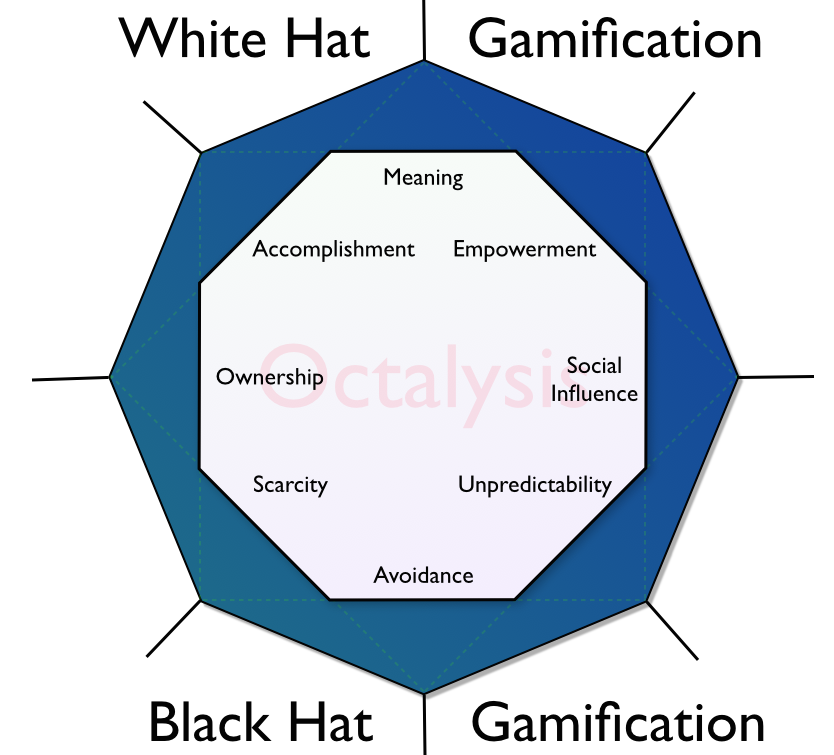
The White Hat Core Drives are represented by the Core Drives at the Top of the Octalysis diagram:
- Core Drive 1: Epic Meaning & Calling
- Core Drive 2: Development & Accomplishment
- Core Drive 3: Empowerment of Creativity & Feedback
The Black Hat Core Drives are represented by the Core Drives at the Bottom of the Octalysis diagram:
- Core Drive 6: Scarcity & Impatience
- Core Drive 7: Unpredictability & Curiosity
- Core Drive 8: Loss & Avoidance
Origins of the Theory
Up to this point in the book, you should have a fairly good understanding of how White Hat and Black Hat Core Drives function. In this chapter we will discuss when and how to use them for optimal motivational systems.
Though every single Core Drive in the Octalysis Framework has been researched and written about individually (including the differences between intrinsic and extrinsic motivation), I believe my work on White Hat versus Black Hat Gamification theory is fairly original and provides a unique design perspective.
I began developing the White/Black Hat concepts while I was studying the Endgame Phase of different games. I became curious as to why the majority of successful games were obsessively addictive for many months, and then experienced a huge user dropout with large numbers of players moving on with their lives.
On the other hand, I looked at how a few games such as Poker, Chess, Mahjong, and even Crossword Puzzles stood the test of time and never got old for their players. Video games like Starcraft, World of Warcraft, Defense of the Ancients (abbreviated as DotA60, eventually spinning off the even bigger hit, League of Legends61), and re-skins of similar shooting games like Counter Strike62 or Call of Duty63, continue to be popular and engaging no matter how many years a player plays them.
Upon further research and observation, I realized that there was a big difference in how these games were designed and what Core Drives motivated their users in the late Scaffolding and Endgame Phases. It seemed like the games that go viral but then have shorter shelf-lives utilize Core Drives that create obsession, urgency, and addictiveness. Players would become glued to the game but then towards the Endgame Phase, the joy and fun no longer persist as strongly, yet the player mechanically continues to grind through many hours “laboring” through them. Due to the Sunk Cost Prison covered in Core Drive 8, players feel demoralized, but are unable to quit.
Eventually, some people do find the strength to finally quit and move on with their lives. This is perhaps due to important responsibilities, or a shift to newer games that hit them hard with epic Discovery Phase marketing. Once that happens, Social Influence & Relatedness dictates a big exodus of people finally leaving the game, in hopes of finding that joy and passion again.
But for the games that are quite timeless (until their own sequels come out), when players are in the Endgame phase, there seems to be a continuous sense of wellbeing and satisfaction, just like the joy one has when playing an instrument or being called to a purpose. Based on this research, I started labeling a few Core Drives “White Hat” and a few others “Black Hat,” which borrows from my background knowledge in SEO (Search Engine Optimization64).
In Search Engine Optimization, “White Hat SEO” refers to designing and promoting your site the way search engines like Google intend you to do. As a result, they rank your site highly when users search for related terms. “Black Hat SEO” on the other hand refers to methodologies that dishonestly exploit the rules, rigidness, and weaknesses of the search engines to get your site highly ranked.
Needless to say, search engines hate Black Hat SEO, and have massive teams of engineers that continuously make the engines smarter and harder to exploit, while severely penalizing any website that is caught utilizing Black Hat SEO techniques. Sometimes the search engine companies even ban websites completely off their search results, defeating the purpose of the Black Hat SEO in the first place. In the realm of SEO, just don’t do Black Hat – it’s not worth it.
Unfortunately, our brains cannot continuously update themselves to become harder to exploit like Google can. Nor can we as efficiently blacklist people who constantly apply black hat motivation techniques on us (nor do we want to, since some of them have good intentions that ultimately benefit us). The end result is that we become subconsciously motivated by things that make us stressed, worried, and obsessed, while feeling that we are not in control of ourselves.
The Nature of White Hat vs Black Hat Core Drives
White Hat Core Drives are motivation elements that make us feel powerful, fulfilled, and satisfied. They make us feel in control of our own lives and actions.
In contrast, Black Hat Core Drives make us feel obsessed, anxious, and addicted. While they are very strong in motivating our behaviors, in the long run they often leave a bad taste in our mouths because we feel we’ve lost control of our own behaviors.
The advantages of White Hat Gamification are obvious and most companies who learn my framework immediately think, “Okay, we need to do White Hat!” They would mostly be right, except there is a critical weakness of White Hat Motivation: it does not create a sense of urgency.
For example: if I approached you with great enthusiasm and exclaimed, “Go out and change the world today!” you may become very excited by this Core Drive 1 trigger and may echo, “Yes! I’m going to go out and change the world! But I’m going to first have a nice breakfast, brush my teeth, and get prepared for the day!” As you can see, there is no urgency with this level of White Hat excitement.
However, if I took out a gun and pointed it at your head, while quietly whispering, “Go out and change the world, or I’m going to kill you” - you are still likely to “change the world,” but you are probably not going to enjoy your nice breakfast or brush your teeth while being pushed by my threatening Core Drive 8: Loss & Avoidance motivation.
Of course, at that point you also no longer feel good about changing the world. Once you can leave my grasp, you will likely stop caring and drop the noble cause altogether. That is, unless the Epic Meaning & Calling regenerates from within.
Black Hat Gamification creates the urgency that system designers often need to accomplish their goals and change behavior. Often this cannot be accomplished through White Hat Gamification alone.
If a company simply implements White Hat Gamification while the user is constantly exposed to Black Hat stimuli from other sources such as email, appointments, or distractions from Facebook, they will most likely not have the opportunity to test out the experience. Of course, this user will feel terrible also, because they will continue to procrastinate instead of doing the things that are more meaningful and make them feel good. Unfortunately, because of the nature of Black Hat motivation, they will continue behaving that way nevertheless.
Zynga and Black Hat Gamification
My theories on Black Hat vs White Hat Gamification can often be utilized to explain or predict why certain companies are successful or fail at different stages.
One such example is the social gaming company Zynga65, which is known for games such as Farmville, Words with Friends, and Zynga Poker.
Zynga has mastered how to implement all sorts of Black Hat Game Techniques – of course, they don’t have a framework to think about the techniques as “Black Hat.” Instead, they consider it “Data-Driven Design66,” which at the outset seems to be extremely clever and legitimate. Because of the Black Hat designs, all their immediate metrics looked good: Monetization, Viral Coefficients, Daily Active Users, User Addiction, etc. However, because people don’t feel good playing Zynga games after a while, when they can drop out of the system, they will.
This is especially true for the late Scaffolding stage as well as the Endgame phase, since all the novelty, creativity, and true sense of development run out during these phases. This makes it even harder for all their new re-skinned games - basically Farmville in a city, in a castle, in a kitchen, and so on, to become long-term successes. When that happens, it is almost like the users are still playing the same Endgame – right in the Onboarding phase!
Because of these Black Hat mechanics, users quickly get tired if they have already been burnt out by the last Zynga game. Farmville 2 was doomed from the start unless they could implement much better White Hat designs into it to ensure long-term success.
Early in 2014, Zynga proved my Octalysis theories accurate when they decided to “double-down” on Casino Slot Machine games like Riches of Olympus67. Of course, since they were committed to stick with Black Hat game design (which shows quick data-driven results), the only long-lasting engagement element they could use was the Right Brain Core Drive 7: Unpredictability & Curiosity. Nonetheless, even if a person were addicted to gambling, they don’t feel awesome about themselves and their activities. This could still lead to later burnout.
In a VentureBeat article that accompanied the Riches of Olympus launch, the journalist Jeffrey Grubb asked then Head of Zynga’s Casino franchise, Barry Cottle, what he meant when he said Zynga was focusing on “quality in experiences and excellence in execution.” Cottle explained that Zynga wanted to make things that look and feel good. Cottle specifically brought up the game Candy Crush Saga, which “has a simple puzzle mechanic that players respond well to due to the extra animations and special effects.”68
If Zynga thinks extra animations and special effects are what made Candy Crush successful, it’s no wonder they have their own graves dug out as a “game design company.” If extra animations and special effects are so important, why would a game like Minecraft become so successful? The graphics for Candy Crush aren’t even that stunning, compared to other games that look similar but don’t have even a tenth of Candy Crush’s success.
If you have been an active student of the Octalysis Framework, you will know that the reason why these games became so popular was due to their ability to retain Core Drive 3: Empowerment of Creativity & Feedback for the longest time. Most Zynga games do not have long lasting Core Drive 3, and therefore engagement will wane.
Of course, the two games that are consistently top-ranking within Zynga are Zynga Poker and Words with Friends69. If you notice, since they build on already timeless game designs like Poker and Scrabble70, Zynga accidentally copied sound Core Drive 3 design without necessarily recognizing it. Both games elicit a higher level of strategy and problem-solving that other Zynga games lack. As a result, they demonstrate long-term success well into the Endgame.
With a good understanding of White Hat and Black Hat game design, you can begin to analyze and predict the strengths and longevity of any motivational system. If there aren’t any Black Hat techniques, it is likely there won’t be any breakout success; if there aren’t any White Hat techniques, users will quickly burn out and leave for something better.
According to the Octalysis Framework, Zynga will never achieve long-term success unless they start building in more White Hat game techniques and continue to empower their users. Instead of putting so much emphasis on Black Hat manipulative techniques, they should design for more long term engagement.
Black Hat with a Clear Conscience
I want to clarify here, that just because something is called “Black Hat Gamification” doesn’t mean it’s necessarily bad or unethical. Some people voluntarily use Black Hat gamification to force themselves to live healthier and achieve their short term and long term goals. I would personally love to be addicted to eating more vegetables or confronting the tasks that I tend to procrastinate on. The point of it being called Black Hat is that, once designed well, we are more compelled to take certain actions quickly without feeling completely in control.
However, whether it is “good” or “bad” depends on the intentions and final outcome of those actions. We could use Black Hat designs to motivate people towards good behaviors or we could use Black Hat designs to motivate people towards evil. Similarly, some of the most infamous people in history motivate others with Core Drive 1: Epic Meaning & Calling (among other Core Drives) towards evil and genocide, even though the nature of the motivation itself is White Hat.
An example of Black Hat Motivation towards good behaviors is the SnuzNLuz71 alarm clock app. SnuzNLuz automatically donates the user’s money to a non-profit they hate if they hit the snooze button (the “wake me up 10 minutes later” button - for my foreign readers).
A more visually compelling (but illegal) concept is the Shredder Clock72, which physically destroys your money when you press the snooze button.

In these products, people are waking up because of Core Drive 8: Loss & Avoidance – they don’t want to lose their money, especially to a non-profit they hate! (The SnuzNLuz also has a weird Core Drive 1 angle, as it does donate to a non-profit for a cause.)
But people are okay with this Black Hat design, because it’s for a goal they want. They are fine with designs that compel them to do things that they intend to do already but lack the willpower to do so.
What people hate is when companies, governments, instructors, or marketers utilize these Black Hat techniques to get them to buy things they don’t need, succumb to tyranny, work overtime, and get grades they don’t care about. Keep in mind that these people will often still perform the Desired Actions because, again, these tendencies are obsessive and/or addictive. They just won’t feel good about the actions and will burn out or revolt as time goes on.
Gamification, Manipulation, and Ethics
During my conference talks, I regularly get questions from people who ask me whether gamification is a form of manipulation and therefore unethical to use. While there is no “correct” answer on this topic, and while the focus of this book is on effectively designing for behavioral change rather than ethics, I will attempt to share my own thoughts on the issue.
My quick answer: yes, gamification is a form of manipulation. However, even though “manipulation” is a strong word with immense negative connotations, we regularly accept it in our daily lives and even expect it.
If you think about it, saying “please” is a form of manipulation. You weren’t going to do something for your friend, but your friend said “please” in a sincere manner (Core Drive 5), and even though nothing tangible has changed about the transaction, you now willingly and happily agree to do it for them.
That’s manipulation.
And when your friend says, “Thank You,” that’s an emotional reward that makes you feel like the action was worth it. If your friend offered you payment (somehow paying someone to do the activity is one of the only ways that people don’t complain as “manipulation” these days), you may even become offended.
And in our society, we don’t seem to have a problem with people saying “please” and “thank you.” In fact, we expect that, teach that, and get mad when people don’t do it. It makes our brains happy and improves our quality of life. We enjoy that sort of manipulation.
When you want your employees to work harder and you transform the work to become a lot more interesting and engaging (as opposed to paying them more) – is that exploiting them? What about providing them a stronger sense of purpose, accomplishment or autonomy?
I have a litmus test to determine whether gamification or human-focused design is ethical or not:
a) Is there full transparency on its intended purpose?
b) Does the user implicitly or explicitly opt-in to the system?
If you have an extremely charismatic friend who is trying to persuade you to go to a party that you are not interested in, you may reject him with a smile. He will then pour in a lot more energy, saying something like, “Come on! Everyone’s doing it! You got to show up!”
Even if you still didn’t want to do it, you are starting to be persuaded. But in no way do you think your friend is being unethical in doing so. There is full transparency in what he is trying to get you to do. You also “opt-in” by allowing your friend to persuade you, especially when you turn him down with a smile. You may or may not change your mind, but because there is transparency in his intention and you’ve opted-in to his continued persuasion, you don’t feel negatively manipulated.
However, I believe that gamification is completely unethical when there is a hidden agenda that users are not aware of. For example, when users think they are signing up for something, but in reality they are signing up for something else. False statements, lies, and a lack of authentic transparency create unethical interactions.
As a stunning example of whether transparent manipulation is bad, consider the field of hypnotism. Hypnosis can be considered the ultimate form of manipulation because, supposedly, once hypnotized, a person is fully compliant with whatever the hypnotizer wants them to do.
However, it is not generally considered unethical because a) there is transparency in what the hypnotizer is trying to accomplish, and b) the person fully opts-in to being hypnotized.
At the end of the day, gamification is not mind control. When we see amazing case studies where gamification increased conversions by 100%, it’s often only where these metrics increased from 8% to 16%. A crushing 84% of the users can and still choose to not engage with the Desired Actions. If an action does not create emotional or physical value for someone, they still won’t do it. But good gamification design motivates those who are on the fence - those who are interested in the end-results but need a bit more motivation to push through.
The people who don’t want a service to begin with won’t sign up (unless the marketing is being dishonest). Just as you don’t have to agree with people who say “please” to you, nor do you have to finally consent to your charismatic friend who is persuading you to do things you hate. If you truly don’t want to go to your friend’s party, you still won’t do it.
When to Use White Hat Gamification Design
Because of their natures, there are dominant strategies to determine when and how to use either White Hat or Black Hat gamification. Since employee motivation and workplace gamification are about long-term engagement, companies should use White Hat designs to make sure employees feel good, grow with the enterprise, and are there for the long haul.
Workplace gamification is often about the top three Core Drives in Octalysis: creating meaning, providing a path to mastery, and ensuring meaningful autonomy. You may identify these as components of Self-Determination Theory74 and the concepts within Drive75, which we will cover in more detail in the next chapter.
Most large corporations make the mistake of believing that, because they pay their employees, their employees have to do their work regardless of exploitive policies, unappreciative bosses, and bad workplace culture. As a result, employees only work hard enough to get a paycheck (Core Drive 4: Ownership & Possession) and not lose their jobs (Core Drive 8: Loss & Avoidance).
One company that challenged this trend is Google76. Very early on, Google started with the assumption that every one of their employees was either an entrepreneur, or wanted to be an entrepreneur. As a result, if these employees did not feel “happy” being at Google, they would simply leave and start their own businesses instead, maybe even becoming a Google competitor.
Remember I talked about how Gamification is Human-Focused Design and that games were the first to master it because no one has to play a game? When you design an experience with the underlying belief that, the moment your experience is no longer engaging, people will leave your system - you will likely create much better Human-Focused Designs.
In the case of Google, they implemented many White Hat designs into their company culture.
The first thing Google did was implement Core Drive 1: Epic Meaning & Calling. Google is widely known for having the mission statement, “Organizing the world’s information and making it universally accessible and useful” as well as the catchy slogan, “Don’t be evil.” Because of that, many talented engineers felt that, “I could earn a paycheck anywhere, but at Google, I’m creating an impact in the world. Not only that, I’m part of the good guys, and that’s really valuable for me!”
In regards to Core Drive 2: Development & Accomplishment, besides the usual raises and promotions, Google realizes that not every engineer can become a manager, but every engineer needs to feel a sense of progress and development. As a result, they introduced eight levels of engineers so that engineers who either shouldn’t or don’t want to become managers can continue to “level up.” In 2013, Google even introduced a ninth level titled “Senior Google Fellow,” allegedly because they needed a way to give legendary engineer Jeff Dean a promotion77.
In terms of Core Drive 3: Empowerment of Creativity & Feedback, we discussed in Chapter 7 how Google introduced 20% time, which allowed employees to spend 20% of their time to work on anything they wanted, as long as the intellectual property belonged to Google.
They also use some Core Drive 4: Ownership & Possession by allowing employees to take full ownership of their projects (and of course taking home nice paychecks too). They utilize Core Drive 5: Social Influence & Relatedness by creating a university-like campus and a workplace culture that makes laziness and stagnation highly undesirable and disparaged within their healthy social dynamics.
All these examples are White Hat influences that help their employees to be engaged in the long run. Unfortunately, there seems to be a weakening of Google’s playful culture as Google becomes much larger and restructures their policies to be more like those of other large corporations that are more efficiently focused on profits.78
When to use Black Hat Gamification Design
On the other hand, when people are doing sales or running eCommerce sites, they often don’t care about long-term engagement and motivation (though they probably should). All they want is for the customer to come in, buy something as quickly as possible, and then leave.
As a result, they often involve Black Hat Gamification techniques: “What’s going to be the surprise launch tomorrow? The chance to get this deal will expire in four hours. If you don’t buy, you will end up being worse off than others!”
In an earlier chapter we looked at how Woot.com became an extremely successful eCommerce site based on two Core Drives: Scarcity & Impatience, as well as Unpredictability & Curiosity. Because Black Hat gamification creates urgency, when you need someone to take immediate action or a transaction, Black Hat techniques often become the most effective solutions.
This dynamic also holds true for sales and fundraising. One of my clients, Morf Media, provides a gamified training platform designed to make SEC compliance training more engaging and fun for employees of financial institutions79.
By nature, financial institutions are risk-averse (Core Drive 8), and they are not inclined to work with new technology companies. You can give them a great deal of White Hat motivation, and they will be interested, intrigued, even excited, but they will likely take forever to make a move because there is no sense of urgency to take on any perceived risk.
The key here is to convince the company that, none of their employees like doing SEC compliance training (hardly a difficult sell), and every single day their employees aren’t compliant increases their risk. Lawsuits are literally laid out ahead like land mines. In that sense, it is riskier to not work with Morf Media than it is to work with them. We’ve turned that Black Hat Core Drive 8: Loss & Avoidance around. (Note: we will likely explore the strategy and process of turning Anti Core Drives around in a future book).
Black Hat Motivation within Fundraising
In the realm of fundraising, I regularly get approached by startup entrepreneurs who are looking for some support to help them navigate fundraising from angel investors as well as venture capitalists (I also get approached by many investors, but on an entirely different set of motivational challenges - mostly White Hat).
The thing about investors is that they are generally motivated by the forces of greed and fear. The force of greed - the intense desire to make a billion dollars (Core Drives 2 and 4); the force of fear - the apprehension of losing all their money (Core Drive 8).
At the beginning, the entrepreneur may promote many great attributes about the company, appealing to the investor’s sense of Core Drive 1, 2, 4 and even 5 if there is a good social proof. (Here you see the value of remembering the numbers for each Core Drive. Don’t worry if you don’t remember these numbers now, but just take note that they are mostly on the White Hat side of things.) The investor starts to show a lot of excitement, and the entrepreneur feels like the deal is sealed.
However, as the investor gets closer and closer to writing a check, the fear of losing all their money begins to preoccupy them, which is driven by Core Drive 8: Loss & Avoidance. They start to ask for more metrics, traction, and further social proof. Often, six months go by, and still no funding is committed.
From my personal experience, investors generally only close deals quickly when they are convinced that they will lose the deal if they don’t commit. If an entrepreneur convincingly tells the investor that a lot of people are already in on the deal, and if the investor does not act this week the round will be full, only then will they finally react. Black Hat creates urgency and closes deals.
When I was trying to raise $600,000 for my gamification startup straight out of college80, I found the experience to be extremely difficult and sobering. We were a very young team, and this “gamification” thing seemed like a half-baked crazy idea.
After struggling for a while to raise a modest amount of money to keep our small team afloat, we were finally able to secure $650,000 from three investors. At that point, I wrote an email to all our potential investors, who for over a year continually “wanted to see more” and “weren’t sure about this gamification thing.” I simply told them, “We are going to close the round, but thank you for your continuous (and non-existent) support!”
At this point, many of these investors who didn’t want to commit for an entire year suddenly responded with passion, enthusiasm, and even anger. “Yu-kai. I thought we agreed that I could invest this much money in your company. Why are you telling me that you are closing the round without me?” I was thinking, “Well, you kind of had an entire year to do that…” but they oddly made it seem like I was burning bridges if I didn’t take their money.
As a result, we tried to cap the round at $800,000 instead of $600,000, and we couldn’t do it. We tried to cap it at $900,000 and couldn’t. We tried to cap it at $1,000,000 and we still couldn’t. Finally, I capped the round at $1,050,000, while rejecting some investor money, just to show that we were serious about the cap. (I’ve also heard this same experience retold many times by other entrepreneurs.)
This illustrates the irrational power of Core Drive 6: Scarcity & Impatience as well as Core Drive 8: Loss & Avoidance (while also serving as a fine example of the limits of White Hat motivation). All these “potential investors” clearly liked what I was doing. They were encouraged whenever I gave them good news. They saw that it could potentially make the world a better place. But they didn’t act until they saw that the deal was being taken away from them. With White Hat motivation alone, people will always be intending, but never actually doing.
For the curious, eventually my startup launched RewardMe, a product that gamified the offline commerce experience. RewardMe was performing eleven times better than the numbers our closest competitors published. (Sorry - since these companies are still in existence, I won’t cite sources here in respect to their current success.) Towards the end of my time there, we even closed a $1.5 million sales deal with a national chain.
Startups are risky, and the unfortunate thing is, just having a stunning product doesn’t mean a company will be successful. A few years after RewardMe’s launch, we hit a combination of personnel, funding, and legal issues. I stepped down as the CEO, and eventually the company folded. If only I had my Octalysis knowledge back then, many things would likely be different, which is why I am hoping my readers learn these elements of motivation before they run into issues in their own companies.
Fortunately, by stepping down as the CEO of RewardMe, it freed up a lot of my time to further study gamification, human-focused design, and develop the Octalysis Framework.
Today, even though my Octalysis Group organization is becoming busier and busier, I’m a lot happier than when I was running a technology startup. That’s because I am now mostly motivated by White Hat Core Drives, as opposed to the Black Hat Core Drives of constantly counting our runway before dying81.
Bad Shifts from White Hat Design to Black Hat Design
When you switch from White Hat motivation to Black Hat Motivation, you need to make sure you understand the potential negative consequences. As an example, there was a day care center in Israel that had a problem with parents being late to pick up their kids. Researchers Uri Gneezy and Aldo Rustichini decided to conduct an experiment and implemented a test policy where parents would be charged $3 every time they were late82.
Now a typical economist will tell you that this penalty would result in more parents picking up their kids on time because they don’t want to lose money. However, the plan ended up backfiring - even more parents were now arriving late. Worse yet, when the daycare center realized this wasn’t working and decided to remove the penalty fees, more parents continued to be late.
The plan backfired because they transitioned the parents’ motivation from Core Drive 1: Epic Meaning & Calling (as well as Core Drive 5) to a weak form of Core Drive 8: Loss & Avoidance. Originally the parents tried to pick up their kids in a timely manner because they inherently wanted to be good and responsible parents. They also didn’t want to burden the daycare center and its staff, so they tried earnestly to show up on time.
But when the daycare center put a monetary value on tardiness, it basically told parents that it was alright to be tardy as long as they paid the modest fee. Parents who were in business meetings or were preoccupied were therefore able to justify being late because a business meeting is worth more to them than the $3. Loss & Avoidance against leaving that meeting early was more powerful than Loss & Avoidance for losing $3.
Returning to the concept of proportional loss, we see that despite Loss and Avoidance typically being a powerful motivator, the $3 fee was just too low to properly motivate the parents in this situation. Remember I discussed how when you use Loss & Avoidance, the loss needs to be threatening? If the daycare center charged a lot more than $3, the Loss & Avoidance motivation would become more threatening and more parents would likely comply (begrudgingly of course, which would lead to switching day-care centers soon).
Currently, there are some daycare centers that charge a $1 late fee for every minute the parent is late. This design actively gets parents to be on time more often. This is not only because the loss is more threatening, but also due to the parents feeling a combination of Core Drive 6: Scarcity & Impatience, as well as a bit of Core Drive 3: Empowerment of Creativity & Feedback since they feel a stronger sense of agency over end results.
Careful Transitioning between White Hat and Black Hat
So now that we’ve covered the nature and differences between White Hat and Black Hat gamification, how do we blend that knowledge together into our designed experiences?
In general (with some exceptions), it is better to first set up a White Hat environment to make users feel powerful and comfortable, then implement Black Hat designs at the moment when you need users to take that one Desired Action for conversion. At that point, users will likely take the Desired Action, but won’t feel very comfortable. This is when you transition quickly back to White Hat motivation to make them feel good about their experience.
An example of this is seen in the previously mentioned game Battle Camp. In Battle Camp, there are often scenarios where you are in a “Troop” with twenty-four other players and the whole group needs to battle a big boss. Typically, you would have eight hours to fight this boss, where everyone needs to come back every fifty minutes when their energy is recharged (remember this technique is called a Torture Break), and then use that energy to attack the boss.
At times, after seven and a half hours, the boss will still have 20% of his health, and you begin to realize that your troop will not be able to defeat him. At this point, you basically have two options. Option one: you lose to the boss, and twenty-five players all waste eight hours of their time, not to mention falling behind other troops that will be ranked much higher after they defeat their boss. Option two: spend $10 and purchase more energy in order to beat the boss.
Because it is such a devastating event when everyone loses eight hours of their precious time, there is a fairly high chance that you will feel compelled to take option two - buy the energy needed to defeat the boss, especially if you were also the leader of the troop.
Now, we see that you were motivated by Core Drive 8: Loss & Avoidance when making this purchase – again, very compelling, but you feel fairly terrible afterwards. After you defeat the boss, if that was all and nothing special happened afterwards, you would feel pretty demoralized and perhaps subconsciously wish you weren’t playing the game anymore.
However, this is when the game starts to shower you with White Hat Motivation by showing you how great of an achievement you accomplished (Core Drive 2: Development & Accomplishment), and the rewards or trophies you have obtained (Core Drive 4: Ownership & Possession) because you have beaten the boss. On top of that, your teammate will often start cheering for you (Core Drive 5: Social Influence & Relatedness), “Wow! You spent real money just to save our troop. You are our hero!” Being sprinkled by all this emotional confetti, people often start to think, “Hmm, maybe that was $10 well spent after all!” And this eventually trains their brains to be more open to spending the next $10 to buy energy and defeat the boss when necessary.
No Buyer’s Remorse from TOMS
Similar to the Battle Camp example, businesses should consider creating an environment of White Hat motivations, use Black Hat techniques to convert users, and then revert back to a White Hat strategy to make users feel more comfortable again.
The initial White Hat environment is for people to take interest and have a good opinion of your system in the first place. A venture capitalist wouldn’t want to invest in a startup if he didn’t first consider it world-changing and a smart investment (Core Drives 1 and 2), even if there was convincing apprehension that he may lose the deal. (Oddly enough, some investors still plunge under the pressure of Scarcity and Loss, even though they have previously determined it to be a worthless idea with no future).
Once people feel comfortable in your system but aren’t necessarily taking the strong Desired Action, such as making a purchase, you can then use the Black Hat techniques within Core Drives 6 and 8 (and sometimes Core Drive 5), to close the deal. If the user ends up buying the product, you want to reassure them that, if true, this is indeed the smartest purchase possible (Core Drive 2), that legions of others also made the same decision (Core Drive 5), and that it positively improves the world (Core Drive 1). This will likely ensure that customers don’t feel buyer’s remorse.
When you buy a pair of TOMS Shoes and begin to feel a little regret for making an expensive purchase, they hit you with reaffirming information on how your purchase has made a tremendous difference to a poor child in Africa - one who couldn’t afford a pair of shoes and had to walk barefoot to fetch water for her family. When you see that, you instantly feel good again about your purchase. Subsequently, whenever you see your shoes, it will remind you that you are a decent human being that benefits the world.
It is the same thing with donations to children in developing countries. When you make a commitment, the non-profit will continuously send you pictures, thank-you letters, sometimes even something written by the “adopted” child to make you feel that you have truly made an impact in their lives. Of course, there is nothing wrong with sending donors these pictures and letters for such a noble cause (unless they are falsely manufactured) as these donors are truly making a big difference in the lives of the less fortunate. In fact, it would be a mistake for any charitable organization to not show visual and social information on the impact they are making in the world. We would all like to see some Feedback Mechanics after taking Desired Actions.
As you design your experiences, never forget that if you want good Endgame design, you must immerse your users in White Hat Gamification techniques.
What about Core Drives 4 and 5?
You may have noticed that I mentioned Core Drive 4: Ownership & Possession and Core Drive 5: Social Influence & Relatedness a few times in this chapter (in a White Hat context), and may wonder where they fit into all of this. They are in the middle of the Octalysis model, so are they Black Hat or White Hat?
Generally speaking, Core Drive 4 and Core Drive 5 have the duality of being able to be either White Hat or Black Hat. Often with Core Drive 4: Ownership & Possession, owning things makes us feel like we are in control, that things are organized, and our general well-being is improving. We feel powerful and enriched.
However, sometimes the stuff we own starts to own us instead. You can imagine a person who buys an extremely rare vintage car, and then becomes afraid of taking it anywhere because he is afraid to damage it or rack up miles. At the same time, he also doesn’t want to leave it at home because he’s afraid it might get stolen.
There are also people who are so obsessed about building more wealth that they neglect everything else that matters, such as family, health, and friendships. Then there are people who compulsively need to organize things to the point where they can’t really focus on more important things that would bring them happiness. At that point, Black Hat starts to take over and the individual no longer feels good about their behavior, but simply does it because they feel compelled to do it.
On the other hand, for Core Drive 5: Social Influence & Relatedness, we obviously enjoy and have fun when hanging out with our friends, building strong friendships, and expressing appreciation for each other. Even if we are making friends to network and build our careers (which adds certain Left Brain Core Drives such as Core Drive 2: Development & Accomplishment as well as Core Drive 4: Ownership & Possession), we feel pretty positive about the experience.
However, sometimes peer pressure can cause some of the worst moments in our lives. When we feel pressured by our environment to behave in certain ways or get into fights with our loved ones, it starts to drive us crazy in a way that few other things can.
In fact, from time to time, social pressure is so strong that people end up committing suicide simply because they cannot endure the judgment of others. For these people, choosing to end their own lives is easier than confronting the situation, even when it is something as trivial as being afraid to go home and tell parents about a failed test. You can clearly see the Black Hat influences that can arise from Core Drive 5.
At the end of the day, each of the Core Drives wields a tremendous amount of power, and a designer must think carefully about designing for ethical purposes - to make sure there is full transparency towards the Desired Behavior, matched with the users’ freedom to opt in and out. If this is not carefully done, gamification design will fail the promise of making life more enjoyable and productive, and it would simply become a source of misery and bitterness - and then likely be dropped altogether. No one wants that.
The cliché phrase is that, “with great power comes great responsibility.” When you understand how to motivate and change behavior, you can improve the world by helping others achieve their life, career, fitness, and relationship goals. Conversely, you can wield this knowledge to get people more addicted to harmful substances, create bad habits, and perpetuate broken relationships83. Ultimately, when your experience design becomes extremely successful, you must look in the mirror and ask yourself, “Is this the impact I want to have in the world?”
To get the most out of the book, Choose only ONE of the below options to do right now:
Easy: Try to recite the three White Hat Core Drives and the three Black Hat Core Drives without looking at them. Are you able to explain their differences?
Medium: Think back on your own life and all the major decisions that you made: applying for schools, changing jobs, finding a significant other, moving to new locations. What Core Drives motivated you to make those decisions? Are they mostly for White Hat reasons, or Black Hat? Are you happier with the decisions that you made from White Hat Core Drives? Do you feel less comfortable with decisions that were driven by Black Hat Core Drives, but feel like you had little choice when the decision was made?
Hard: Think of a campaign that you can design for your own project. Try to come up with ways to use White Hat Gamification to create motivation and desire, then switch to Black Hat Gamification to trigger important Desired Actions. Finally, understand how to transition user motivation back to White Hat Core Drives so they enjoy the experience fully and feel emotionally rewarded after committing the Desired Actions.
Share what you come up with on Twitter or your preferred social network with the hashtag #OctalysisBook and check out what ideas other people have.
Share your Life reflections.
If you picked the Medium Challenge above, share your life paths and choices as part of a self-introduction to the Octalysis Explorers Facebook Group. Identify the Core Drives that motivated you along the way, and reflect on how you felt during those life choices. That way the community will get to know you better as well as learn a bit more about the 8 Core Drives through your experiences.
As you know, a community makes an experience engaging and fun, and it will make all the time you have invested into this book more fulfilling. Chances are, there will be others in the group that will also have similar life experiences and choices as you and can help you understand your life motivations more through the 8 Core Drives.